Wrestling's AI Revolution: Why 2026 Demands a Smart Coach
Folkstyle and freestyle in 2026 reward precision. Here is what a wrestling AI coach actually does, where the limits are, and how to make it useful in your room.
Titans Grip
Wrestling Coach, folkstyle and freestyle technical development
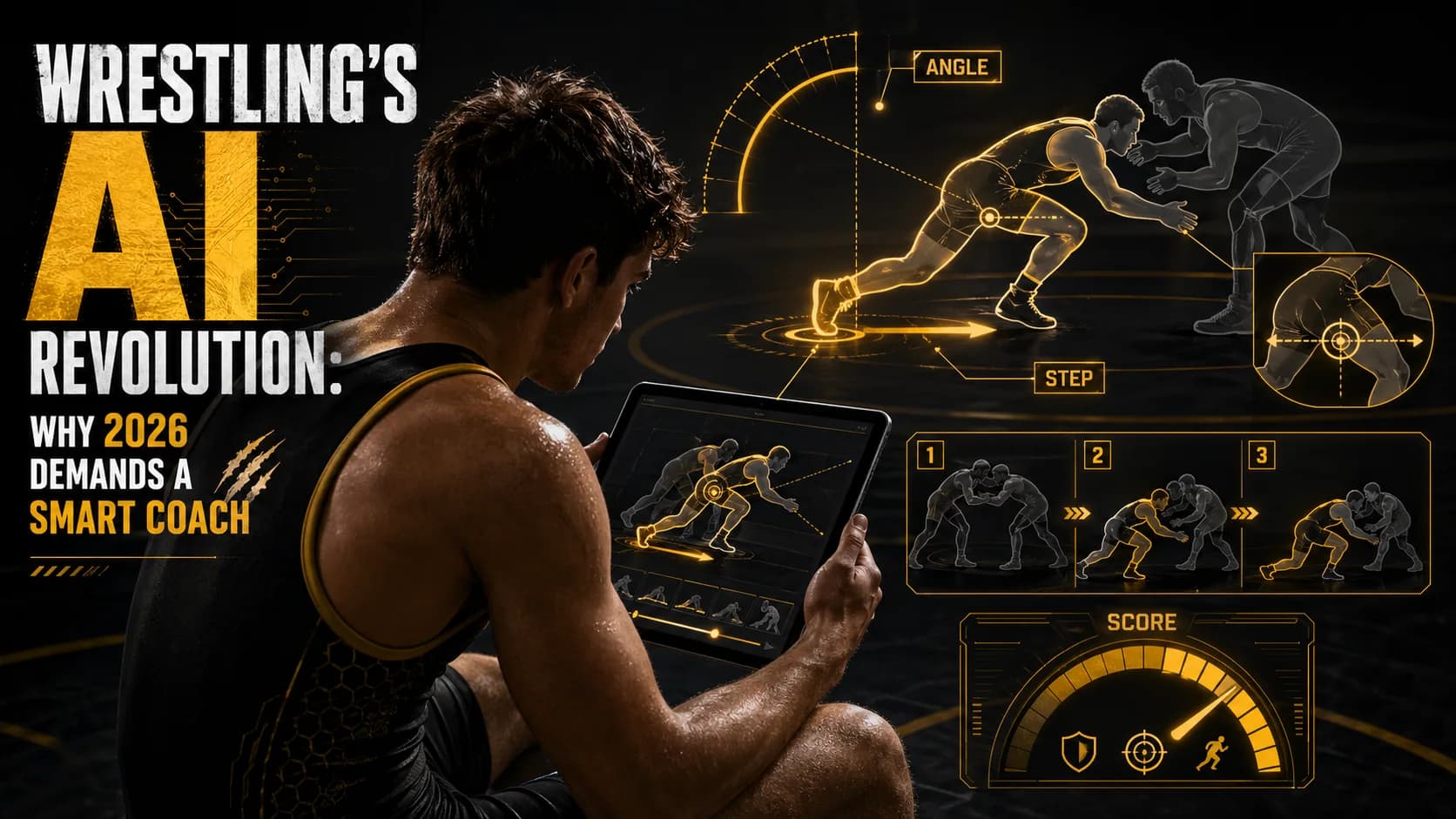
The whistle goes, you shoot, the scramble is over in three seconds. Did your head come up at the wrong frame? Was the penetration step deep enough? For decades the answer lived in your coach's memory and on a tape no one would rewind. That is not where the answer lives anymore.
The 2026 wrestling season rewards precision. Cael Sanderson's Penn State just won its fifth straight NCAA Division I championship with a school-record point total. Tom Brands at Iowa is in his nineteenth season. Oklahoma State is now coached by David Taylor — John Smith retired in April 2024 — and the program is rebuilding around modern video review. The folkstyle gap between podium and out-of-bracket is small enough now that the room with the better feedback loop usually wins it. That is what a real wrestling AI coach is for.
This is not science fiction. It is operational standard for the programs that intend to keep finishing on the top step.
Key Takeaways
- A wrestling AI coach uses computer vision to score your technique on a defined scale and return feedback you can act on. Adoption at the elite end is real — platforms like MatBoss and Hudl Assist are used by every NCAA Division I championship contender.
- Generic fitness trackers fail wrestlers because they were not built for angles, timing, or sport-specific position. The data is the wrong data.
- The "one fix" weekly focus method aligns with how motor learning actually works. One correction at a time, repeated, converges faster than five corrections at once.
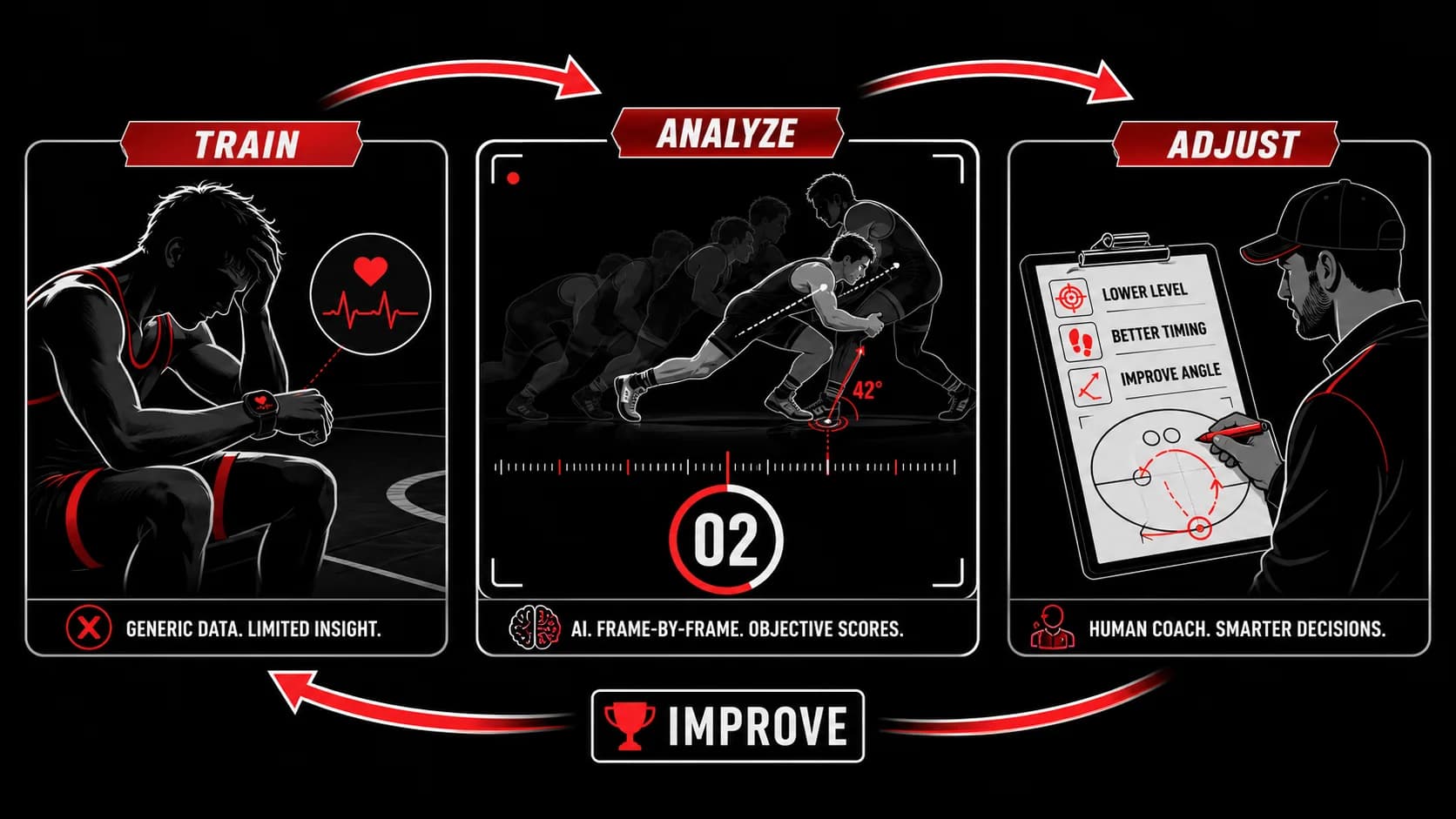
- The optimal model is a triad: athlete trains, AI scores, human coach decides what to do with the score.
- Build a gold-standard library of your best reps. Re-watch before practice and competition.
- Your video data is sensitive — treat training footage like your game plan and read the privacy policy before signing up.
What a wrestling AI coach actually is
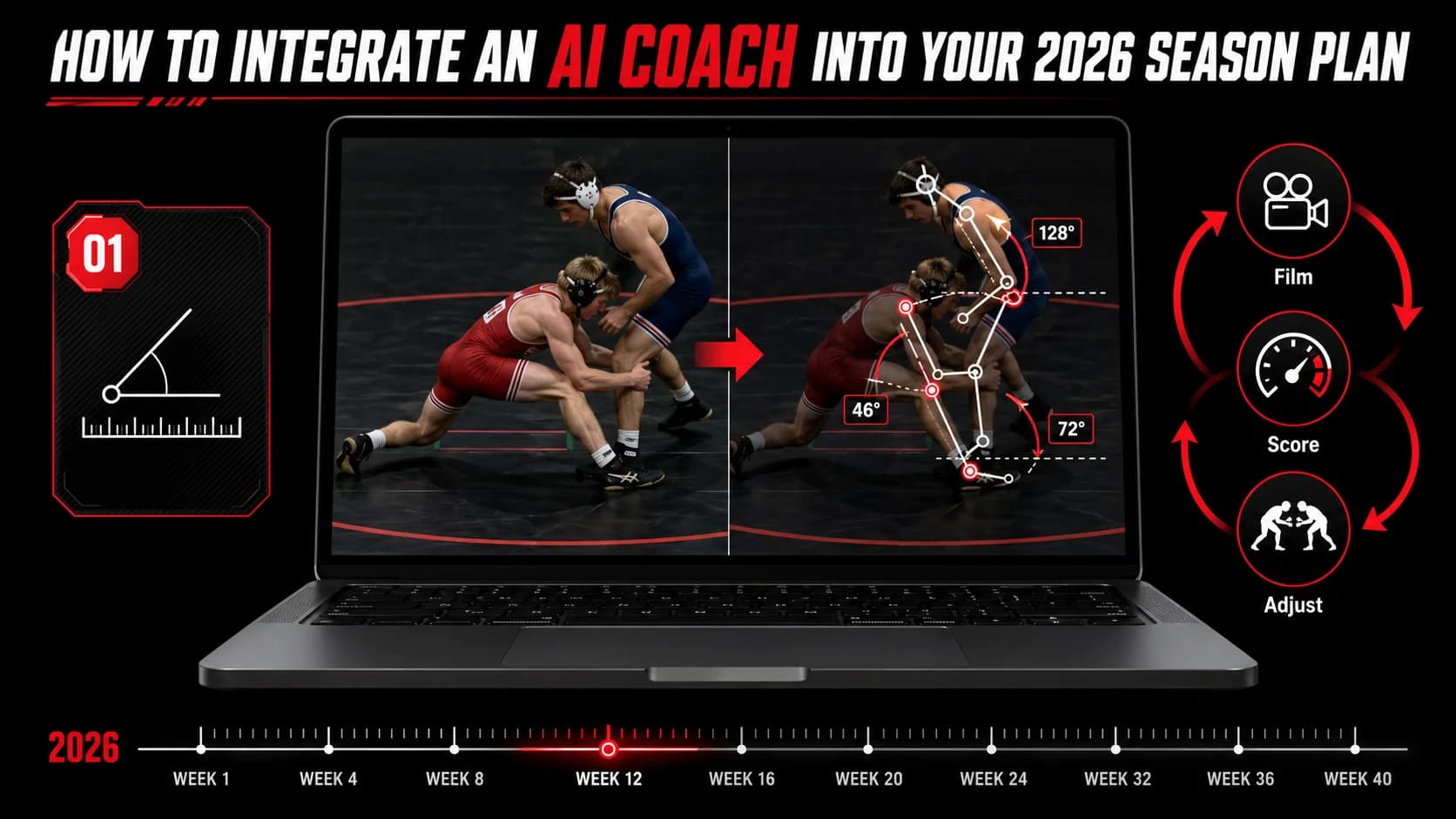
A wrestling AI coach is a software platform that uses computer vision and machine learning to analyse video of your technique, score it on a defined scale, and return feedback you can act on. It maps your skeleton across frames. It tracks joint angles, attack timing, and position relative to your opponent. It compares your rep against a library of reference reps and tells you where the gap is.
Adoption is real. MatBoss, the most-used video and stat platform in NCAA wrestling since 2013, is integrated with TrackWrestling and is publicly used by every NCAA Division I championship contender of the past several seasons; the company expanded its tagging into freestyle scoring in mid-2025. Hudl Assist for wrestling is the same story at the high-school level. App-store native tools like Wrestle AI and Cradle have entered the market in the last eighteen months. Whether or not your program uses one of these specific platforms, your opponents almost certainly do.
The core value is consistency. Two coaches will disagree on the height of your lead leg in a high-crotch finish. A wrestling AI coach measures it. The measurement might be wrong on the edges, but it is wrong the same way every time, and that is what makes it useful.
How AI video analysis works for wrestling
A pose-estimation model takes the video and identifies key body landmarks frame by frame — wrists, elbows, hips, knees, ankles, head — at thirty or sixty frames per second. The model tracks how those points move and compares the trajectory against a reference. From there the system flags timing problems (level change too slow), positional problems (head up on a finish), and sequence problems (no follow-through on a turn).
The 2025 narrative review of artificial intelligence in sport in the Journal of Sports Sciences gives a measured account of what these tools do well and what they still struggle with. Joint angles on clean reps are solid. Edge cases — chaotic scrambles, partial occlusions, two athletes at the same depth in frame — are still developing. Treat the output as a useful second opinion, not as gospel.
The difference between a fitness tracker and a wrestling AI coach
A fitness tracker gives you heart rate and steps. A wrestling AI coach gives you joint angles, attack timing, and positional scoring. The difference is the difference between knowing you trained hard and knowing why a specific scramble cost you the match.
| Feature | Generic fitness tracker | Wrestling AI coach |
|---|---|---|
| Primary data | Heart rate, steps, calories | Joint angles, technique timing, positional scoring |
| Feedback | "You had a hard workout." | "Your head came up at 0:03, attack power dropped." |
| Sport specificity | None | Built for folkstyle, freestyle, and Greco rule sets |
| Use case | General wellness | Technical mastery and match preparation |
The broader pattern across combat sports is laid out in our overview of the AI sports coaching revolution.
Can an AI coach really replace a human coach?
No. That is not the use case. A wrestling AI coach is a force multiplier. It does the repetitive analysis your coach does not have time for. In a two-hour practice, your coach gives you maybe ten minutes of direct attention. The AI can analyse every live go before you finish lacing your shoes back up.
The model that works is a triad: the athlete trains, the AI scores, the human coach decides what the score means and what to do about it. The AI handles the volume. The human handles the judgment.
Why your current training tools are failing you
You are logging miles. You are hitting lifts. You are drilling. If your only feedback is a weekly "good job" and a vague "keep your hips lower," the loop is broken. The problem is not effort. It is precision.
The tools most wrestlers use in 2025 were built for general fitness, not for the chaotic micro-second world of an exchange. That is why athletes searching for a freestyle wrestling app 2026 or a folkstyle training app keep being disappointed. The category they want did not exist in mainstream stores until very recently.
How much time is lost to vague drill feedback
Drill a high-crotch fifty times with a small, repeated error and you have just made the error harder to fix. Drilling reinforces whatever movement you do, including bad movement. The motor-learning literature is consistent on this point. The 2022 systematic review by Petancevski and colleagues in Psychology of Sport and Exercise found that augmented feedback — external information you would not see by yourself — improves both performance and learning of sport-specific skills compared to no augmented feedback. It is not magic. It is the difference between practising a thing and learning a thing.
A folkstyle training app should interrupt the reinforcement before bad reps cement.
What generic apps miss about wrestling technique
Most of what makes wrestling work. They cannot tell a deep penetration step from a short lunging one. They cannot score the alignment of hips, knees, and head during a throw-by. Wrestling is a sport of angles and connections. A 45-60 degree angle of attack is the difference between a clean head-and-arm and a stalled tie-up. Generic apps see "movement." They do not see angles.
The same logic is why related sports need their own engines. We covered the parallel for Sambo and the broader combat sports category elsewhere on the site.
Why post-practice memory is unreliable
Specific motor sequences fade fast after the work ends. You will remember that you got countered on a single leg. You will not remember the 200-millisecond window where your elbow flared and broke the connection. The textbook references on this are Schmidt and Wrisberg's Motor Learning and Performance and Magill and Anderson's Motor Learning and Control, both standard in coach-education programs. The short version: humans encode rough patterns and discard most fine detail within minutes. A wrestling AI coach saves the fine detail for you.
Your coach's eyes are valuable. They cannot rewind reality.
How to integrate a wrestling AI coach into your 2026 season plan
This is a process, not a product. Five steps.
Train Freestyle Wrestling with AI
Coach Jake analyzes your technique, scores your form 0-100, and builds your training plan.
Download Freestyle WrestlingStep 1: Establish a technical baseline (weeks 1-2)
Film and score your core techniques. Not live goes — clean, isolated drills. Double-leg, high-crotch, stand-up, top turks. Upload them. Whatever scoring scheme your tool uses, log the starting numbers. The number itself is less important than the fact that you have one. Without a baseline you cannot measure progress and you will spend the season arguing with yourself about whether you are getting better.
Common mistake: Filming only your best reps. That gives you a false baseline. Film five reps in a row — good, bad, and average — and score them all. The average of those five is your real starting point.
Decision rule: If your tool gives a score of 70 or above on a clean rep, that technique is probably in decent shape. Focus your baseline on techniques scoring below 60.
Step 2: Run a "one fix" weekly focus
Pick the single biggest deduction your AI flagged. If it says your double-leg is twenty points light because of head-up on the finish, that is the only thing you fix this week. Drill it. Film the drill. Score the drill. Then move to the next.
This is the boring version of motor learning. It works because it converges on one error at a time, and motor systems learn one thing at a time. Spreading attention across five flaws gets you a slower version of the same flaws.
Common mistake: Trying to fix everything at once. You will see five red flags on your first analysis and want to address them all. Resist. Pick one. The others will still be there next week.
Decision rule: If a technique has multiple deductions, fix the one that costs the most points first. The AI's scoring breakdown should tell you which component is dragging the total down most.
Step 3: Pre-competition scouting and simulation
Use your tool to break down opponent film. Most platforms let you tag tendencies. "Wrestler A shoots eighty percent of his singles to his left, with a low head position." Drill against that pattern. Film your defensive responses. Are you creating distance? Is your sprawl angle in the working range? Folkstyle scouting on this level used to be a full-time assistant coach's job. It is now a single afternoon with the right tagging tool.
Common mistake: Scouting only one opponent. If you have a tournament with multiple potential opponents, scout the first-round match first, then the likely quarterfinal. Do not try to scout the whole bracket at once — the information will blur together.
Decision rule: Spend no more than 30 minutes scouting a single opponent. Beyond that, the marginal value drops. Focus on their top three attacks and their most common defensive breakdown.
Step 4: Post-match analysis with a day's distance
Wait until the next morning. Then watch the match with the AI overlay on. The day-after gap removes the emotional filter. You may have won and find that your shot conversion rate dropped to ten percent in the third period because your posture broke down. That is the conditioning prescription writing itself.
Common mistake: Analysing immediately after the match. Your emotional state will colour what you see. A loss looks worse than it was; a win hides the flaws. Give it 12-24 hours.
Decision rule: If you lost, watch the match three times: once for emotional processing (no analysis), once with the AI overlay for technical breakdown, once with your coach for tactical discussion. If you won, skip the first pass.
Step 5: Collaborate with your human coach
Bring the report. Stop saying "I think I am doing this wrong." Start saying "the AI flagged my hip height at twenty-two inches on the finish; the reference is eighteen — what am I missing?" The conversation gets sharper. Your coach can apply real expertise to a clearly defined problem. That is when the relationship gets ten times more productive.
Common mistake: Presenting the AI report as definitive truth. Your coach may see something the AI missed — a subtle weight shift, a grip fight that changed the angle. The AI is a tool, not an authority.
Decision rule: If your coach disagrees with the AI's assessment, film five more reps and compare. If the pattern holds, the AI is probably right on the measurement but wrong on the interpretation. If the pattern breaks, your coach's eye wins.
Strategies to use AI for actual competition advantage
Past the basics, the leverage moves up.
Identify and break your own technical patterns
Aggregate data across hundreds of attacks. You may believe you attack equally to both sides. The data may show you finish 85 percent of shots to the left. Opponents will scout the bias. Drill the weak side deliberately. Set a measurable target for the next two weeks (e.g., increase weak-side attempts by thirty percent in live goes). The AI will tell you whether you actually did it.
Use technical degradation as a fatigue marker
Heart-rate drift tells you that you are tired. Technical degradation tells you what gets tired first. If your shot depth drops from ninety to seventy percent of optimal in the third period, that is the conditioning prescription: explosive hip movement repeated under duress, not more aerobic miles. Sport-specific conditioning recommendations along these lines are detailed in Kirk and colleagues' MDPI review of high-intensity conditioning for combat athletes.
Build a "gold standard" reference library
When the AI scores a rep at the top of your range, save it. Tag it. Watch your gold standards before practice and before competition. This is not magic. It is what motor-learning textbooks call observational priming, and it is well-documented in coach-education literature. Over a season the folder grows. So does the evidence that you are improving.
A wrestling AI coach does not just make you better. It makes you smarter about how you got better. That is the part you can carry to the next sport, the next program, the next career.
Common mistakes wrestlers make with AI coaching
Even with the right tool, athletes make predictable errors. Here are the ones I see most often.
Mistake 1: Treating the AI score as absolute truth
The AI measures joint angles and timing. It does not measure intent, strategy, or the context of a live match. A low score on a technique does not mean the technique is wrong — it might mean you were executing a different setup than the AI expected. Always cross-reference with your coach.
Mistake 2: Analysing every rep
You do not need to score every drill. That creates data noise and analysis paralysis. Pick three to five key techniques per week and score only those. Everything else is just practice.
Mistake 3: Ignoring the baseline
Athletes love to skip the baseline and jump straight to fixing things. Without a baseline, you cannot measure progress. You will spend the season guessing whether you are actually improving or just feeling different.
Mistake 4: Using the tool alone
The AI is most effective when paired with a human coach. If you are a self-coached athlete, find a training partner or mentor to review the AI reports with you. The second pair of eyes catches what the algorithm misses.
Mistake 5: Not protecting your video data
Training footage is sensitive. It reveals your tendencies, your weaknesses, and your game plan. Treat it like you would treat a scouting report. Read the privacy policy before signing up for any platform.
Decision rules for choosing a wrestling AI coach
Not all tools are the same. Here is how to evaluate them.
| Criterion | What to look for | What to avoid |
|---|---|---|
| Sport specificity | Separate scoring models for folkstyle, freestyle, Greco | One-size-fits-all "sports" mode |
| Pose estimation accuracy | Published validation data or third-party reviews | Vague claims about "AI-powered" with no evidence |
| Feedback granularity | Joint angles, timing, positional scoring per rep | "Good job" or a single number with no breakdown |
| Data privacy | Enterprise-grade encryption, clear privacy policy | Vague terms of service, no mention of data handling |
| Integration | Works with your existing video capture setup | Requires proprietary hardware or specific camera angles |
| Cost | Transparent pricing, no hidden fees | Free tools that monetise your data |
FAQ
What is a wrestling AI coach and do I need one for 2026?
It is software that analyses your video and scores your technique. For 2026, if you are competing at varsity high-school level or above, the answer is yes — your opponents are using it. The margin between podium and out-of-bracket is small enough now that an asymmetric feedback loop becomes a real advantage.
How much does a wrestling AI coaching app cost?
Roughly USD 20-60 per month for a sport-specific platform. Team and club discounts exist. Free tools are usually fitness trackers with a wrestling skin. Set the cost against the practical alternative: an extra fifty hours of misguided drilling over a season is more expensive than the subscription.
Can an AI coach handle both folkstyle and freestyle?
The serious tools support both rule sets, with separate scoring models for the differences (back-exposure points and gut wrenches in freestyle, riding time and turks in folkstyle). When you evaluate a platform, check that the technique library and scoring explicitly cover both. The biomechanics overlap heavily; the tactical applications do not.
How accurate is the AI's technique scoring?
Joint-angle measurement is reliable on clean reps. Edge cases (occluded bodies, fast scrambles, two athletes at similar depth) are weaker. The 2025 narrative review of AI in sport in the Journal of Sports Sciences covers the picture honestly. Treat the score as a measured second opinion, not a referee's call.
Is my video data safe with an AI coaching platform?
Reputable platforms use enterprise-grade encryption and have privacy policies stating that your video is used solely for your analysis. Read the policy before signing up. Treat training footage as sensitive — your scouting tape is the same as your game plan, and you would not hand a stranger your game plan.
How long until I see results?
You can get useful insight from your first analysis. Measurable score improvement on a focused technique usually appears within two to four weeks if you actually apply the feedback. The variable is volume of focused drill, not the magic of the tool.
Do I need special equipment to use a wrestling AI coach?
Most platforms work with standard smartphone video. You do not need a high-speed camera or a tripod, though stable footage from a consistent angle gives better results. Some tools recommend filming from a side angle at hip height for optimal pose estimation.
Can I use an AI coach for my whole team?
Yes. Most platforms offer team or club accounts with shared libraries and coach dashboards. This is common at the NCAA and high-school levels. Individual accounts are better for self-coached athletes.
What if my coach does not want to use AI?
Start using it yourself. Bring the reports to your coach. Most coaches will engage once they see the quality of the data. If they still resist, use the AI for your own self-analysis and keep the conversation focused on what the tool found, not on the tool itself.
Will AI coaching make wrestling less human?
No. It makes the technical feedback more precise, which frees up coaches to focus on strategy, motivation, and the human elements that AI cannot touch. The best rooms in the country use AI as a supplement, not a replacement.
The 2026 season will be won by athletes who close the feedback loop tighter than their opponents. Your will is non-negotiable. Your technique can now be audited. Stop guessing. Find your edge with Titans Grip and step into a season where every rep gets the eyes it deserves.
Other Doved Studio projects
Related tools from the same studio you might find useful:
- Glean: Turn scrolling time into a daily action plan. Capture, process, execute.
- Popout: Create your portfolio in minutes with a single shareable page.
- Doved Studio: Studio indie derrière cette app et une dizaine d'autres outils.
Coach Jake
Freestyle Wrestling specialist. Expert in takedowns, scrambles, rides.
Coach Jake is the AI coaching persona behind Freestyle Wrestling, built to provide personalized freestyle wrestling guidance through video analysis, training plans, and technique breakdowns.
Train Freestyle Wrestling with AI
Freestyle Wrestling gives you an AI coach that analyzes your technique, plans your training, and tracks your nutrition. Try it for free.