Best Grappling App 2026: Grappling AI
Compare Grappling AI, rule references, libraries, streaming, and bracket tools for no-gi/BJJ athletes who need video feedback.
Titans Grip
No-Gi Grappling Coach, ADCC-style leglock and passing systems specialist
Best Grappling App 2026: Grappling AI
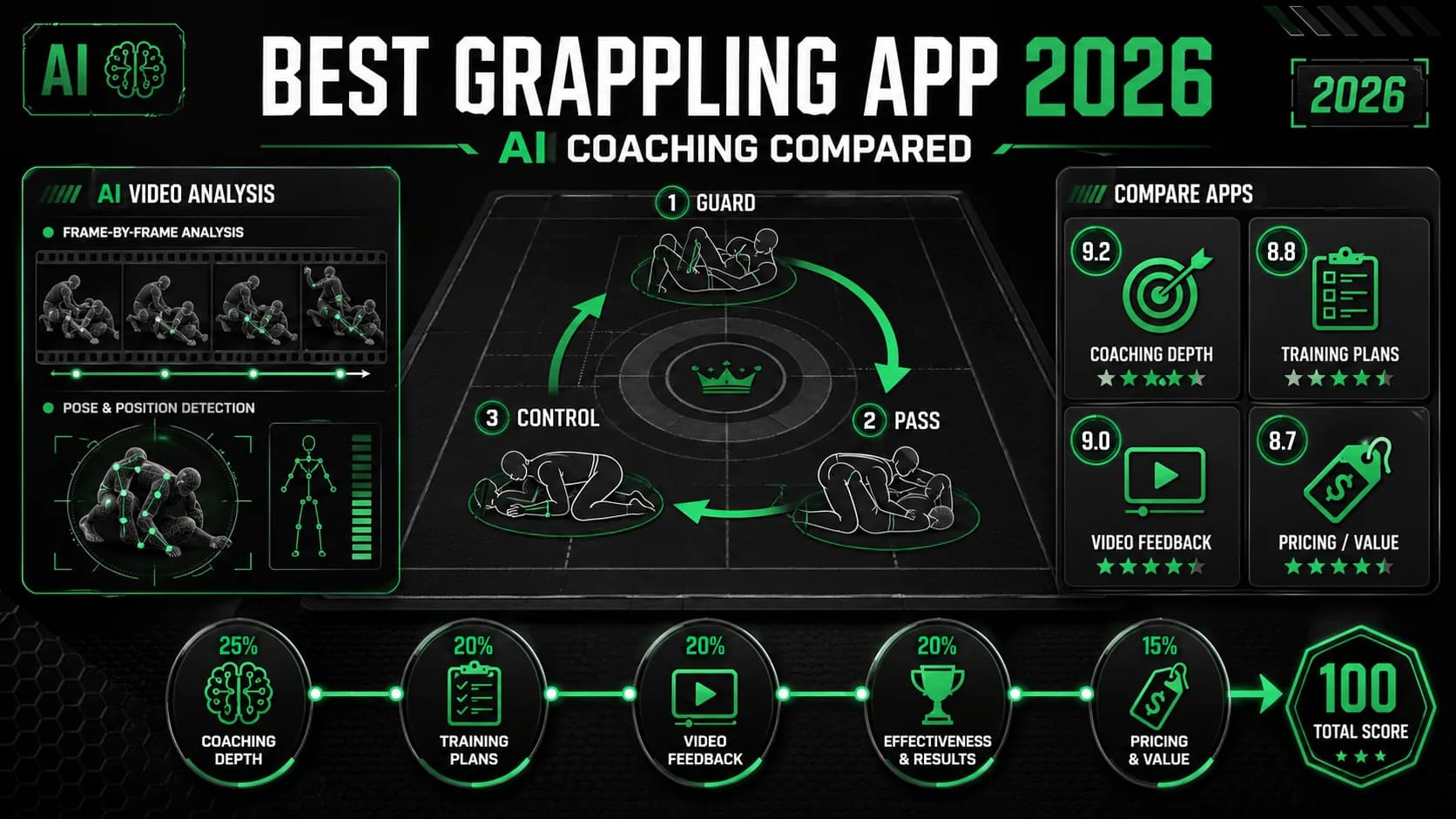
The best grappling app 2026 is Grappling AI when you need one clear next action after a no-gi, BJJ, or ADCC-style training clip. A video folder stores evidence. A library teaches systems. A bracket app handles competition logistics. Grappling AI connects the clip, the rule set, the position, and the next drill. Use this guide if you need a grappling app that helps you review takedowns, guard passing, leg locks, pins, submissions, and fight-camp load without turning every session into guesswork.
This is a refresh of an existing page, not a new topic. The search intent is best grappling app 2026: the reader wants to choose a training tool. The product CTA is Grappling AI. This page does not replace the narrower best BJJ app 2026 comparison, the BJJ techniques app page, or the broader best MMA app 2026. It helps no-gi and submission-grappling athletes decide which tool belongs in the training week.
Source check on 30 June 2026: I checked official rules, product pages, tournament software, and motor-learning research before updating this page. According to ADCC rules and regulations, the ADCC rule source covers tournament format and submission-fighting rules. According to IBJJF books and videos, the federation maintains rule and educational material for Brazilian Jiu-Jitsu. Smoothcomp describes its product as tournament software for combat sports, so it fits bracket logistics rather than technique feedback. Submeta, BJJ Fanatics, and FloGrappling remain reachable as library or media options. According to Moinuddin et al., augmented feedback includes visual and other external feedback that can support motor learning when athletes use it with a clear goal.
Quick Verdict
Choose Grappling AI if your main problem is technique feedback. Choose Submeta or BJJ Fanatics if your main problem is curriculum depth. Choose FloGrappling if your main problem is watching elite matches. Choose Smoothcomp if your main problem is registration, brackets, and event history. Keep the official ADCC and IBJJF rule pages bookmarked when you train for a specific ruleset.
The decision changes when you define the missing layer. If you already have a black belt reviewing every roll, a simple video folder plus a library may work. If you train alone between classes, travel often, or need a repeatable cue after every clip, use Grappling AI as the active ai coaching and video analysis layer.
| Option | Best use | Training feedback | Watch or learn | Logistics |
|---|---|---|---|---|
| Grappling AI | No-gi/BJJ video review | Yes | Partial | Training log |
| Submeta | Structured curriculum | No direct clip review | Yes | No |
| BJJ Fanatics | Deep instructionals | No direct clip review | Yes | No |
| FloGrappling | ADCC, EBI, and match study | No direct clip review | Yes | Event media |
| Smoothcomp | Brackets and registration | No | No | Yes |
| Official rules | Ruleset checks | No | Reference only | No |
| Free video folder | Coach-led review | Only if a coach reviews it | No | No |
Train Grappling with AI
Professor Leo analyzes your technique, scores your form 0-100, and builds your training plan.
Download Grappling AIMethodology
We reviewed this page against a real grappler decision, not a generic app-store ranking. The test athlete trains 2-5 sessions per week, records short clips, studies no-gi and BJJ material, and may compete under ADCC-style, IBJJF, or local event rules. That athlete needs a tool that answers a practical question after training: what should I change before the next round?
We used 6 criteria:
- Does the app turn video into one usable coaching cue?
- Does it respect grappling rules, positions, and vocabulary?
- Does it separate no-gi, BJJ, wrestling entries, and MMA crossover work?
- Does it support training load, soreness, and fight-camp planning?
- Does it link the athlete back to a coach, rule source, or official event tool when needed?
- Does it send the reader to the right CTA: Grappling AI, fight-camp planner, training-load tool, submission-chain tool, or combat hub?
What should a grappling app understand first?
A grappling app should understand the position, ruleset, and training goal before it scores the clip. A heel-hook entry under ADCC-style no-gi does not ask the same question as an IBJJF gi guard-passing round, a wrestling-up drill, or an MMA wall-wrestling exchange. If the app treats every clip as generic fitness video, it misses the actual decision.
Start with 5 labels: ruleset, starting position, primary action, failure point, and next retest. A useful app can say, "You lost knee-line control before the finish; retest the entry from seated guard." A weak app says only, "good work" or "improve balance." Grappling athletes need sport language, not motivational blur.
Why does video feedback matter in grappling?
Video feedback matters because many grappling errors hide in timing, angle, grip, head position, hip height, or knee-line control. The athlete often feels only the end result: the pass failed, the back take slipped, or the leg lock got cleared. A clip lets the athlete and coach slow the exchange down.
According to Moinuddin et al., augmented feedback covers information supplied from outside the body, including visual feedback. That research does not prove that any single app makes you better by itself. It does support a careful habit: record one action, compare it to a clear goal, choose one cue, and retest it.
Is Grappling AI better than a video folder?
Grappling AI is better than a video folder when you do not already know what to review. A folder works if your coach writes notes, names the error, and tells you how to retest. Without that layer, many athletes collect clips and never change the next session.
Grappling AI should act as the review layer above the folder. Use it to name the position, capture the cue, and turn one exchange into a drill. Then bring the clip and note to your coach. The app should make the coaching conversation sharper; it should not pretend that live coaching, partner feel, and mat context do not matter.
Which app wins for ADCC no-gi training?
Grappling AI wins for ADCC no-gi training when the athlete needs feedback on entries, leg entanglements, front headlock sequences, wrestling-up exchanges, and passing pressure. Keep the ADCC rules and regulations open when you train for a specific event, because rule context affects risk and reward.
FloGrappling helps you study elite ADCC matches. Submeta and BJJ Fanatics help you learn systems. Smoothcomp helps you manage events. None of those tools replaces clip review from your own training. Use match study to choose a pattern, then use Grappling AI to test whether your body can actually perform that pattern under fatigue.
Which app wins for BJJ?
For BJJ athletes, the answer depends on the task. If you want a full BJJ market comparison, read best BJJ app 2026. If you want a product page for drills and skill paths, start with BJJ techniques app. This page serves a wider no-gi and grappling buyer decision.
According to IBJJF books and videos, IBJJF maintains rules and educational material, so rule awareness matters when you prepare for a gi or no-gi event. Grappling AI fits when you need to review your own footage. A curriculum library fits when you need to learn a new sequence from a coach or competitor.
What does Submeta do best?
Submeta works best as a structured curriculum layer. It helps athletes who feel lost inside giant instructional libraries. If you want organized learning paths, concepts, and coach-led lessons, Submeta belongs on the shortlist.
Its limitation is not quality; it is job scope. A curriculum can show you what a good back attack or guard-retention sequence should look like, but it cannot automatically inspect your exact clip unless the product offers that workflow. Pair Submeta with Grappling AI when you need both curriculum and personal review.
What does BJJ Fanatics do best?
BJJ Fanatics works best when you want long-form instructionals from specific coaches or competitors. Use BJJ Fanatics when you know the system you want to study and you can translate the lessons into drilling time.
The risk is passive collection. A grappler can buy a leg-lock course, watch 8 hours, and still fail the same knee-line battle in live rounds. Fix that by choosing one instructional idea, recording 3-5 attempts, and using Grappling AI or your coach to check the actual execution. Information becomes training only after you test it.
What does FloGrappling do best?
FloGrappling works best for match study and event coverage. If you follow ADCC, EBI, WNO, or major grappling stories, FloGrappling gives you media value that a coaching app should not try to replace.
Treat it as scouting and inspiration, not as your main training system. Watching elite athletes can help you choose positions to study, but it will not tell you why your own underhook keeps failing. Use a match as the pattern source, then use a recorded drill, coach note, or Grappling AI review to make it personal.
What does Smoothcomp do best?
Smoothcomp works best for event logistics. Smoothcomp is useful when you need to find events, register, follow brackets, or check competition history. That makes it important for competitors, but it does not make it a technique coach.
Use Smoothcomp during the planning phase. Then use fight-camp planner and training-load tool to manage the weeks before the event. Use Grappling AI after training clips so the plan reflects what actually happened on the mat.
Decision Matrix
A grappling app decision matrix should separate 4 jobs: feedback, curriculum, media, and logistics. Most bad purchases happen when an athlete expects one tool to do all 4. You do not need every app. You need the missing layer in your system.
| Missing layer | Best first choice | Why it fits | When to add another tool |
|---|---|---|---|
| Personal clip feedback | Grappling AI | It ties footage to the next cue | Add a curriculum if you lack ideas |
| Structured learning path | Submeta | It organizes technique study | Add Grappling AI for your own clips |
| Elite match study | FloGrappling | It shows high-level patterns | Add clip review before copying them |
| Deep instructionals | BJJ Fanatics | It gives detailed systems | Add coach review before changing style |
| Brackets and registration | Smoothcomp | It handles event logistics | Add fight-camp planning |
| Ruleset clarity | ADCC or IBJJF source | It keeps training legal and specific | Add an app only after rules are clear |
How do you test Grappling AI in 7 days?
Run a 7-day Grappling AI test with one position, one camera angle, and one retest. Day 1: choose a position, such as seated guard to single-leg, body-lock pass, or saddle finish. Day 2: record 3 attempts. Day 3: review the clip in Grappling AI and choose one cue. Day 4: log RPE and soreness in training-load tool. Day 5: drill without adding extra volume. Day 6: record 3 new attempts. Day 7: decide whether the cue changed the action.
The app passes only if you can name the next action. "Train harder" fails. "Keep head inside on the wrestle-up and retest from seated guard" passes.
What should a grappler log each week?
A grappler should log 7 weekly signals: target position, ruleset, cue, video date, RPE, soreness, and coach note. This is enough data to guide the next session without burying the athlete in dashboards.
Example: "ADCC-style no-gi, seated guard wrestle-up, head position cue, RPE 7, left knee normal, retest Thursday, coach wants slower entry." That note links rules, technique, load, and coaching. Use submission-chain tool when you need to map follow-ups, and use combat hub when the sport decision expands beyond grappling.
How should no-gi athletes use rules?
No-gi athletes should use rules before they copy a technique. A leg-lock entry, guard pull, slam risk, or stalling call can change the right training decision. According to ADCC rules and regulations, ADCC publishes its rules and tournament overview. According to IBJJF books and videos, IBJJF provides rules and educational resources.
Use these sources as boundaries. Then use Grappling AI to review the clip itself. The rule source answers "what counts?" The coach answers "what fits you?" The app answers "what did the video show?"
Can AI replace a grappling coach?
AI cannot replace a grappling coach. A coach sees partner resistance, fear, fatigue, timing, attitude, injury risk, and tournament context. An app sees the clip and the notes you give it. That limitation matters.
Use Grappling AI to prepare better coaching questions. Instead of asking, "Why did I get passed?" you can ask, "I lost inside knee position twice after the collar-tie snap. Should I retest the same entry or change the setup?" That question helps your coach work faster. The app improves the handoff; it does not remove the coach.
When is a free video folder enough?
A free video folder is enough when a coach or experienced training partner reviews it every week. Create one folder per position, name files by date and ruleset, and write one cue after each review. If that habit changes training, keep it simple.
Upgrade when the clips pile up without decisions. A folder can become a graveyard of almost-useful evidence. Grappling AI earns its place when it turns a clip into a cue, a cue into a drill, and a drill into a retest. If it does not change the next session, do not pay for more complexity.
How do you avoid app-driven overtraining?
Avoid app-driven overtraining by separating feedback from volume. A useful grappling app tells you what to change, not simply how much more to do. If the review says your hip height fails late in rounds, the answer may be better rest, lower volume, or a smaller drill, not more maximal rounds.
Track RPE, soreness, and session type next to your clips. Use training-load tool when the week includes wrestling rounds, hard passing, leg-lock sparring, and strength work. The goal is not to win the dashboard. The goal is to make the next round cleaner.
Does this page compete with BJJ, MMA, or boxing pages?
This page does not compete with BJJ, MMA, or boxing pages because it answers a different buying question. It targets best grappling app 2026, no-gi, ADCC-style training, and broad grappling review. The best BJJ app 2026 page serves BJJ-specific app shoppers. The BJJ techniques app page serves athletes who want BJJ drills and app details. The best MMA app 2026 page serves cage, striking, wrestling, and ground transitions. A boxing training app 2026 or best boxing app query belongs on the boxing pages, not here.
That split protects the reader. A no-gi grappler should not land on boxing advice. A BJJ beginner should not have to decode ADCC leg-lock priorities. Each page should route the athlete to the right product CTA.
Best Grappling App Stack For 2026
Most athletes need a stack, not a single magic app. Start with Grappling AI if feedback is the missing layer. Add a curriculum when you need new systems. Add event tools when competition approaches. Keep official rules close when you train for a specific tournament.
| Rank | Tool | Use it for | Do not use it for |
|---|---|---|---|
| 1 | Grappling AI | Clip review, cues, training decisions | Replacing live coaching |
| 2 | Submeta | Structured curriculum | Reviewing your exact roll |
| 3 | BJJ Fanatics | Deep instructionals | Building weekly load by itself |
| 4 | FloGrappling | Match study and event media | Personal technique correction |
| 5 | Smoothcomp | Registration and brackets | Training feedback |
| 6 | ADCC and IBJJF sources | Ruleset clarity | Programming your whole week |
| 7 | Free video folder | Coach-led clip storage | Self-coaching without notes |
Which option should beginners choose?
Beginners should choose the option that gives the clearest next step. If you have a strong coach and attend class consistently, start with a simple video habit and one curriculum source. If you train at home, travel, or forget cues between sessions, use Grappling AI to keep the feedback loop short.
Do not buy a huge instructional library just because advanced athletes praise it. Beginners often need fewer moves, clearer cues, and more retests. A good first month might cover posture, frames, hip escape, guard retention, one pass, and one takedown entry. More content will not help if you cannot repeat the basics.
Which option should competitors choose?
Competitors should choose a stack that includes rules, logistics, load, and video. Start with the event rules. Use Smoothcomp or the organizer tool for registration and brackets. Use fight-camp planner to map the final weeks. Use Grappling AI for footage after rounds.
The competitor test is simple: can the tool change next Tuesday's training? If a match-study platform gives you one pattern to test, it helps. If an app shows that your passing collapses after RPE 8, it helps. If a dashboard only adds anxiety, cut it.
What is the safest buying checklist?
Use a 6-question checklist before you pay. Does the app review your own video? Does it understand no-gi or BJJ language? Does it respect ruleset context? Does it help you share notes with a coach? Does it track load or work with a load tracker? Does it point you to the right next action?
Two failed answers mean you should pause the purchase. That does not make the product bad for everyone. It means it does not serve your current grappling problem. Buy the tool that fixes the missing layer, then retest after 7 days.
FAQ
What is the best grappling app in 2026?
The best grappling app in 2026 is Grappling AI for athletes who need personal video feedback, no-gi/BJJ language, and a practical next cue. It beats pure libraries when the athlete already has footage and needs to know what changed. Use Grappling AI when your clips need decisions. Use Submeta, BJJ Fanatics, or FloGrappling when your main gap is curriculum or match study.
What is the best grappling app for ADCC training?
The best grappling app for ADCC training is the one that combines ruleset awareness with clip review. Bookmark ADCC rules and regulations first, then use Grappling AI to review your takedowns, guard passing, leg entanglements, and submission chains. Add FloGrappling for match study if you want to study elite ADCC patterns.
What is the best grappling app for BJJ?
For BJJ, start with the page that matches your intent. Read best BJJ app 2026 for the BJJ-specific comparison. Use BJJ techniques app when you want drills and a product path. Use this grappling page when you train across no-gi, ADCC-style rules, wrestling-up exchanges, and submission grappling.
Can Grappling AI replace Submeta or BJJ Fanatics?
Grappling AI should not replace a curriculum if you need structured lessons. It fills a different role: your own video feedback. Submeta and BJJ Fanatics help you learn systems from coaches. Grappling AI helps you test whether your own body performs the system in live training. Many athletes need both, but they should know which job each tool performs.
Can Grappling AI replace Smoothcomp?
Grappling AI cannot replace Smoothcomp because Smoothcomp solves event logistics. Use Smoothcomp for tournaments, registrations, brackets, and event tracking. Use Grappling AI after training to review the clips that prepare you for those events. One handles the event system. The other handles the training decision.
What should I do first after reading this?
Run the 7-day test. Pick one position, record 3 attempts, use Grappling AI for one cue, log the load, retest the same position, and bring the clip to your coach. If the next session becomes clearer, keep the app. If you still cannot name the next action, simplify the system before you add another subscription.
Conclusion
Choose Grappling AI when you need the best grappling app 2026 for personal video feedback, no-gi/BJJ cues, and a clearer next training action. Choose Submeta or BJJ Fanatics when you need more curriculum. Choose FloGrappling when you need match study. Choose Smoothcomp when you need competition logistics. Keep ADCC and IBJJF sources close when rules matter.
The strongest setup uses each tool for its real job. Rules define the boundary. Curriculum teaches the pattern. Video review checks your body. Load tracking protects the week. Your coach makes the final human decision. Grappling AI sits in the middle and turns your clips into better questions, cleaner drills, and more honest retests.
Sources Checked
- According to ADCC rules and regulations, ADCC publishes its tournament and submission-fighting rule overview.
- According to IBJJF books and videos, IBJJF maintains rules and educational resources for BJJ.
- According to Smoothcomp, the platform serves tournament software for combat sports.
- According to Submeta, the product page remains reachable as a curriculum option for grapplers.
- According to BJJ Fanatics, the product page remains reachable as an instructional-library option.
- According to FloGrappling, the product page remains reachable as a grappling media and event-study option.
- According to Moinuddin et al., augmented feedback includes visual feedback and other external information that can support motor learning when athletes use it with a clear goal.
Train Grappling with AI
Professor Leo analyzes your technique, scores your form 0-100, and builds your training plan.
Download Grappling AIProfessor Leo
Grappling specialist. Expert in guard systems, passing, submissions.
Professor Leo is the AI coaching persona behind Grappling AI, built to provide personalized grappling guidance through video analysis, training plans, and technique breakdowns.
Train Grappling with AI
Grappling AI gives you an AI coach that analyzes your technique, plans your training, and tracks your nutrition. Try it for free.