AI boxing coach app: how phone-camera analysis actually scores your technique (2026)
What an AI boxing coach app measures that a mirror cannot — pose estimation, hip-shoulder timing, retraction, guard recovery, and the hard limits of computer vision in 2026.
Titans Grip
Boxing Coach, 15+ years coaching footwork, head movement, and ring IQ
Key Takeaways
- AI boxing coach apps use pose estimation — a computer-vision model tracking 17–33 body keypoints across frames — to measure technique in degrees and milliseconds, not just subjective feel.
- The camera catches what mirrors miss: hip-shoulder timing, retraction speed, guard recovery gaps, and fatigue-driven stance narrowing. These are the metrics that separate elite from amateur.
- Accuracy is real but bounded. A 2024 IMU-and-vision study hit 91–94% classification accuracy on lead and rear punches. But the camera cannot measure power, read timing in real time, or account for stylistic intent without calibration.
- The most actionable metric for most fighters is retraction speed. Slow hand return is the single largest tell of an amateur jab, and it is invisible without frame-by-frame measurement.
- Use the data as a measurement layer, not a coach replacement. Pick one number per session, train normally, review after. The richest insights come when the data and your coach disagree.
The thing your coach can feel but cannot count
Stand a good coach next to your shadow round and they will catch the obvious: chin up, elbow flaring, rear hand drifting. Watch the same round again and a great coach catches the medium things — the lead foot stalling a fraction before the cross, the hip starting to rotate after the shoulder.
What no coach catches in real time is degrees and milliseconds. The difference between a clean jab and a parried one is often eight to fifteen degrees of shoulder rotation. The difference between a cross that scores and a cross that hurts is often twenty to thirty milliseconds of hip-to-fist timing. Those are measurements humans can feel but cannot quantify, and without quantification you cannot watch them improve.
Mirrors do not solve this. Mirrors create three problems: you train your eyes to watch yourself instead of an opponent, you only see one angle, and your brain tells you your guard is up because you can feel your hands near your face — even when, on camera, there is a six-inch gap.
This is the gap an AI boxing coach app fills. Not as a coach replacement. As a measurement layer.
How pose estimation works for boxing
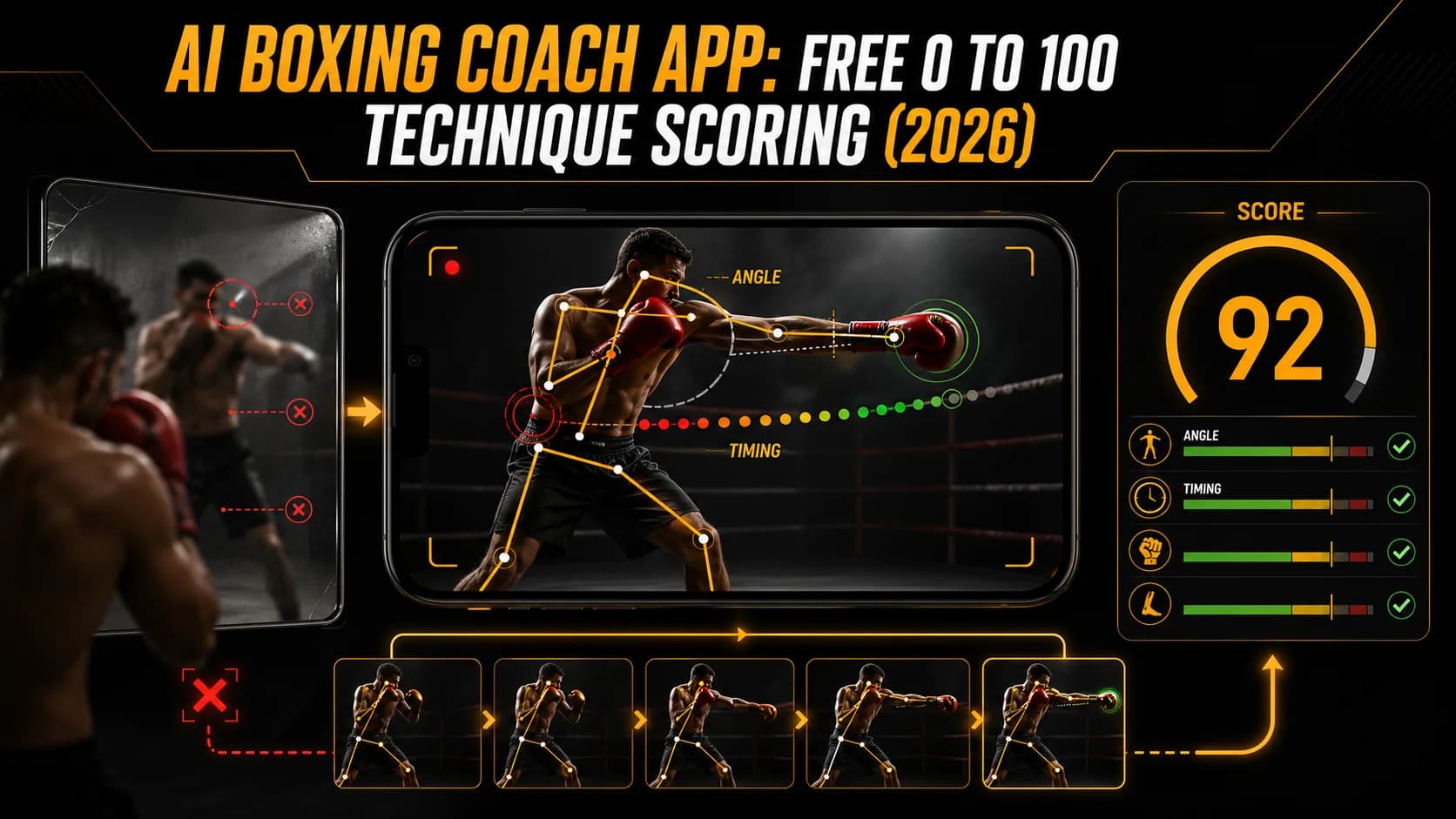
Modern phone-based AI uses pose estimation: a computer-vision model that identifies and tracks anywhere from 17 to 33 keypoints on the body across frames. Shoulders, elbows, wrists, hips, knees, ankles, head, spine. For boxing, the useful information is in the relationships between those points, not the points themselves.
The relevant relationships, and what each one tells you:
- Shoulder rotation. The angle between the shoulder line and the camera or the imaginary opponent. Low rotation means an arm punch. High rotation means committed weight transfer.
- Hip torque. The hip-line angle relative to the spine. In a clean cross the hip rotates 45–60° before the shoulders follow. When hip and shoulder fire together, power drops sharply.
- Guard position. Both wrists relative to the chin keypoint. A clean guard keeps both hands within ~6 inches of the chin. The interesting measurement is not the start or end frame — it is the middle of a combination, where guards drop and you don't notice.
- Stance width. Ankle distance normalized to shoulder width. Most fighters narrow their stance over the course of a round under fatigue. The narrowing is invisible by feel and obvious in the data.
- Weight distribution. The hip center against the midpoint of the feet. A neutral stance loads ~60% on the front foot for offense and shifts back for defense. The shift is what the camera sees.
- Center-of-gravity trajectory. Average of hip and shoulder centroids over time. Whether you drift backward when pressured, lean too far forward when attacking, or stay stable through combinations.
Modern phones run this at 30–60 frames per second. A textbook jab takes about 300 ms, so the camera sees a jab as 9 to 18 ordered snapshots, each tagged with full body position. That is the raw material.
The accuracy of this kind of system is no longer hypothetical. A 2024 IMU-and-vision punch-recognition study using active learning hit 91–94% classification accuracy on rear and lead punches with only a fraction of the labeled data prior systems needed (PMC, 2024). Earlier work in Computer Vision and Image Understanding showed depth imagery improves recognition further by helping with occlusion (Sciencedirect, 2017). The technology is not magic. It is mature enough to be useful, and the limits are knowable.
What the camera measures, punch by punch
The jab
The jab gets thrown more than any other punch and reveals more about a fighter than any other punch. The measurements that matter:
- Extension angle. Elbow angle at full extension. A textbook jab lands around 170–175°. A lockout (180°) hyperextends the elbow and slows retraction. Most amateurs sit at 150–160° — under-reaching — or full lockout, leaving the arm out there too long.
- Shoulder line at impact. The lead shoulder should be 15–25° ahead of the rear at the moment of contact. Less than that, no weight behind the punch. More than that, you are over-committing and exposing the right side.
- Retraction speed. Time from full extension back inside the guard radius. Elite-level retraction is roughly 150–200 ms; most amateurs sit at 300–500. The number is brutal once you see it. Slow retraction is the single largest tell of an amateur jab.
- Chin tuck. Vertical distance from chin to lead shoulder at extension. The lead shoulder protects the chin. The camera measures the gap.
- Rear-hand position. Where the right hand lives during and after the jab. Tracks whether it dropped, drifted forward, or held the cheek. The most common jab flaw, full stop.
The cross
The cross is where the kinetic chain gets visible.
- Hip-to-shoulder timing. When the rear hip starts rotating versus when the rear shoulder starts. Clean crosses have the hip leading by 50–100 ms. When they fire together — common beginner pattern — power output collapses.
- Rear-foot pivot. Pivot angle on the ball of the rear foot. Cleanly thrown, 45–90°. Anything below 30° is the most common power leak.
- Weight transfer. Center-of-gravity shift from rear to lead foot through the punch. ~70% of body weight should ride into the lead foot at extension.
- Guard integrity. Lead-hand position throughout the cross. The classic miss: the lead hand drops or pulls back while the right extends, opening the chin to a counter.
- Recovery path. Whether the hand returns on the same line it left on. A looping return is slower and telegraphs the right is still busy.
The hook
The hardest punch to measure, because the rotation is in a different plane.
- Elbow angle. 85–100° at the impact frame. Below 80° is an arm-hook. Above 110° is a wide loop with telegraph.
- Hip-shoulder synchronization. Unlike the cross, the hook fires hip and shoulder together. The camera measures whether they rotate in lock or stagger.
- Elbow height. The lead elbow should rise to shoulder level. Below that, it is a slap. Above that, you have signaled the punch.
- Rear-hand drop. Most fighters drop the rear hand 4–8 inches during the lead hook without realizing it. The camera tracks this through every frame.
The uppercut
- Drive source. Hip vertical velocity vs wrist vertical velocity. Hips should rise before the fist does. Otherwise it is an arm scoop.
- Starting elbow angle. ~90°, fist near the body. Wind-ups that drop the fist below the waist (120°+ angle) telegraph and slow the punch.
- Chin exposure. Throwing an uppercut typically lowers the lead hand. The camera measures how much, and for how long.
- Vertical path. Whether the fist travels in a clean vertical line or a curved one. Curved paths waste motion and read easily.
Defense is where AI earns its keep
Offense gets the marketing. Defense is where the cameras really pay off, because the margin between safe and getting hit is measured in inches and tens of milliseconds.
Head-movement heatmap
The model logs head position relative to the shoulder midpoint over the round. The output is a heatmap. Static fighters cluster tight. Good movers show pendulum or figure-eight patterns. Predictable slippers show a single side. The heatmap is one of the few outputs that is genuinely actionable on first look — you immediately see whether you are slipping the same way every time.
Slip depth and timing
A clean slip moves the head 4–6 inches off the centerline. Most amateurs over-slip by 8–12 inches, which puts them off balance and out of counter range. The camera measures the displacement and the latency between your last punch and your first defensive motion. Long latency after combinations is where counters land.
Guard recovery time
Time between the end of a punch and both hands returning inside the protective radius. Most fighters believe their guard is instant. The data typically shows 200–400 ms gaps. Multiply by punches per round and you understand why technically sound fighters get caught.
Style adherence and drift under fatigue
The camera can be calibrated to a peek-a-boo, philly shell, or traditional guard, then watch how that shape holds up across rounds. The most common pattern: clean stance round one, drifting low-hands and lifted chin by round three. The camera quantifies that drift. You then know whether your shape problem is technical or conditioning.
Footwork mapping
Stance width over time
A graph of foot distance through the round, normalized to your shoulder width. Where it narrows, you lose lateral balance. Where it widens, you lose mobility. Every fighter has a fatigue signature. Find yours, then train against it.
Pivot angles
When you pivot off, the camera measures the actual rotation. Most fighters who feel like they are pivoting 90° produce 45–60°. That is the reason their angle change does not create the new line they expected. Knowing the gap is the first step in closing it.
Cut-off patterns
For working the ring, the model tracks your trajectory against the center of your training space. Are you walking opponents down in straight lines (they circle out) or stepping at angles to cut off the ring? Trajectory data makes this obvious in a way that is almost impossible to self-assess in real time.
Round-by-round fatigue
This is the measurement no human coach can give you. Continuous, objective fatigue.
- Punch velocity decay. Wrist velocity per round. A fresh jab might run 8 m/s. By round three, drop to 5.5. A 30% velocity loss is a real strategic problem.
- Guard height decay. Average wrist height relative to chin per round. Half an inch drop is the gap between a block and a clean shot.
- Stance narrowing. As above. Crossing from "narrowed but functional" to "narrow enough to get pushed off balance" is the threshold to flag.
- Combination completeness. Whether your scripted four-punch combinations actually finish four punches under fatigue. Often the fourth punch quietly disappears.
- Recovery time between bursts. Pause between the last punch of one combination and the first of the next. If it grows from 1.5 s to 3 s across a round, you have a hard read on your work capacity.
These are exactly the metrics that elite vs amateur boxer kinematics studies consistently flag — peak punch velocities of ~7.16 m/s in elite male amateurs vs ~6.32 m/s in juniors, with significantly higher front-foot loading on the cross in the elite group (PMC, 2022; PMC, 2020).
Sparring analysis
Tracking two athletes is harder than one and also more useful. The model identifies your most common offensive sequences (jab-cross-hook 40%, jab-body-jab 25%) so you can diversify on purpose. It measures your distance-management — the percentage of time you spend in your preferred range — and shows where your offense leaves the largest defensive windows. Those windows are where opponents counter you.
The frequency drop from bag to sparring is one of the most quietly useful metrics. Most fighters throw 30–50% fewer punches in sparring than on the bag. Knowing which punches go missing — usually body shots — is the start of training pressure into your live work.
Step-by-step: How to run an AI analysis session
Step 1: Set up the camera
Phone on a tripod, slightly elevated (chest height), full body in frame. The camera should be 8–12 feet away. Landscape orientation. Good lighting — overhead or front-facing, not backlit. Do not use a handheld phone. The data quality difference between a fixed tripod and a handheld recording is massive.
Step 2: Calibrate the app
Most AI boxing apps, including Titans Grip Boxing AI, ask you to stand in a neutral stance for a few seconds before starting. This establishes your baseline guard height, stance width, and shoulder line. Do not skip this step. The calibration frame is what the model uses to judge everything else.
Step 3: Pick one focus metric
Before you throw a punch, decide what you are measuring today. Retraction speed on the jab. Hip rotation on the cross. Guard recovery after combos. One number. Tell your coach the focus, ask them to watch for it.
Step 4: Train normally
Do not check the screen during the session. Real-time correction is your coach's job. The camera's job is to record. If you start chasing numbers mid-round, you will change your technique and the data becomes useless.
Step 5: Review after
Run the footage. Compare against your baseline and your trend. Show your coach the numbers. The richest conversations happen when the data and the coach disagree — your coach thought your footwork looked clean, the camera shows your stance narrowed 15% by round three. That gap is the next thing to fix.
Step 6: Track the longer arc
Over weeks, the trend lines tell you whether you are actually improving. Plateaus are usually felt before they are real, and improvements are usually missed. The data corrects both errors.
Common mistakes when using AI boxing analysis
Mistake 1: Chasing the score instead of the skill
The app gives you a 0–100 technique score. It is tempting to treat it like a video game high score. Do not. The score is a composite of many measurements, and optimizing for the composite often means neglecting the one thing you actually need to fix. Pick one metric per session.
Mistake 2: Bad camera setup
Angle changes, low light, distance from camera — all degrade the data. Casual handheld filming is much noisier than a fixed tripod. If the camera moves during the round, the pose estimation has to re-calibrate. You lose frames.
Mistake 3: Ignoring the calibration frame
Skipping the neutral-stance calibration means the model guesses your baseline. Guessed baselines produce unreliable comparisons across sessions.
Mistake 4: Reviewing mid-session
Checking the screen between rounds changes how you train. You start adjusting to the numbers instead of the opponent. Review after the session.
Mistake 5: Expecting the camera to measure power
Pose estimation models the mechanics that produce power; it does not measure force at the fist. That requires force sensors or accelerometers. Do not confuse velocity with impact.
Mistake 6: Using the same calibration for different styles
A philly shell looks "wrong" to a model calibrated for a traditional guard. A coach knows it is a choice. The camera needs to be told. Most apps let you set your guard style in the settings.
Decision rules: When to trust the data and when to trust your coach
| Situation | Trust the data | Trust the coach |
|---|---|---|
| Measuring retraction speed in milliseconds | Yes | No — humans cannot time this |
| Hip-shoulder timing on the cross | Yes | No — too fast to see |
| Fatigue drift across rounds | Yes | Partially — coach sees effort, camera sees mechanics |
| Stance width narrowing | Yes | Partially — coach feels it, camera measures it |
| Whether a punch is landing with power | No | Yes — camera cannot measure force |
| Whether a defensive choice is strategic or a flaw | No | Yes — camera lacks context |
| Whether your guard is dropping in combinations | Yes | Partially — coach sees the drop, camera measures the gap |
| Whether you are over-slipping | Yes | Partially — coach sees the miss, camera measures the inches |
What the camera cannot do
Honesty matters. AI video analysis in 2026 is not a coach. It cannot:
- Read timing in real time. Sparring analysis is post-hoc. The camera will not call out an opening as it happens.
- Teach strategy. When to throw, what combinations to set up against a particular opponent's style, where to lay traps. Coach territory.
- Measure power. Pose estimation models the mechanics that produce power; it does not measure force at the fist. That requires force sensors or accelerometers.
- Account for stylistic intent. A philly shell looks "wrong" to a model calibrated for a traditional guard. A coach knows it is a choice. The camera needs to be told.
- Survive a bad camera setup. Angle changes, low light, distance from camera — all degrade the data. Casual handheld filming is much noisier than a fixed tripod.
Where this is going
Within two to three years, expect three things: real-time on-screen feedback during bag work (the processing power exists on flagship phones already), multi-camera 3D pose estimation from commodity hardware, and integration with wearable sensors so you finally get force and kinematics together. Research benchmarks like the FACTS framework (arXiv, 2024) are pushing fine-grained boxing action classification well past current consumer apps, and that work will trickle into the products fighters actually use.
For now, the state of AI boxing analysis is good enough to be useful. Not perfect. Not a coach. A measurement layer that catches what your eye misses, holds you accountable to numbers, and tracks improvements your training journal cannot.
If you want a working version of this in your pocket, that is what the Titans Grip Boxing AI is built for: pose estimation across the punch arc, fatigue tracking across rounds, and a 0–100 technique score on every clip.
FAQ
How accurate are AI boxing coach apps in 2026?
A 2024 IMU-and-vision study using active learning hit 91–94% classification accuracy on rear and lead punches (PMC, 2024). That is for punch recognition. For specific measurements like joint angles and timing, accuracy depends on camera quality, lighting, and setup. A fixed tripod with good lighting produces reliable data. Handheld or low-light footage degrades accuracy significantly.
Can AI measure punch power?
No. Pose estimation models the mechanics that produce power — hip rotation, weight transfer, wrist velocity — but it does not measure force at the fist. That requires force sensors or accelerometers. Velocity correlates with power but is not the same thing.
Is AI analysis useful for beginners or only advanced fighters?
Both, but differently. Beginners benefit most from guard position, extension angle, and retraction speed — the fundamentals that are hard to self-assess. Advanced fighters benefit from hip-shoulder timing, fatigue drift, and combination pattern analysis. The tool scales with the user.
How much does a good AI boxing app cost?
Pricing varies. Titans Grip Boxing AI is available on the App Store. Most apps offer a free tier with limited analysis and a subscription for full features. Expect $10–$30 per month for the premium tier.
Can I use AI analysis for sparring?
Yes, but it is harder. Tracking two athletes requires the model to distinguish between them, handle occlusion (one fighter blocking the other), and maintain keypoint tracking through movement. The data is noisier than bag work but still useful for combination frequency and distance management.
Does the app work with a heavy bag?
Yes. Bag work is actually the cleanest data source because there is no opponent occlusion and the motion is repeatable. Most AI boxing apps are optimized for bag work first, sparring second.
What phone do I need?
Any phone from the last 3–4 years with a decent camera and sufficient processing power. The pose estimation runs on-device for most modern flagships. Older budget phones may struggle with frame rate or accuracy.
Can AI replace a human coach?
No. The camera is a measurement layer, not a coach replacement. It cannot teach strategy, read timing in real time, or account for stylistic intent. The best results come from using the data alongside a coach who can interpret it and apply it to your specific game.
Coach Marcus
Boxing specialist. Expert in footwork, combinations, defense.
Coach Marcus is the AI coaching persona behind Boxing AI, built to provide personalized boxing guidance through video analysis, training plans, and technique breakdowns.
Related Articles
Best Boxing App 2026: We Tested 8 Boxing Training Apps — AI Video Analysis, Fight Camp Plans & Honest Rankings
Jun 21, 2026 · 21 min read
BoxingRoland Garros Is Spiking Again: A 7-Day Footwork Microcycle for Fighters
Jun 2, 2026 · 22 min read
BoxingFootball Search Spikes: The Fighter Footwork Plan Behind Today's Attention
Jun 1, 2026 · 22 min read
Train Boxing with AI
Boxing AI gives you an AI coach that analyzes your technique, plans your training, and tracks your nutrition. Try it for free.