How AI Is Changing Sports Training in 2026
A practical, evidence-aware guide to AI sports coaching: video analysis, adaptive programming, limits, privacy, and why sport-specific tools beat generic fitness apps.
Titans Grip
Sambo Coach, combat and sport sambo throws and leglocks
Key takeaways
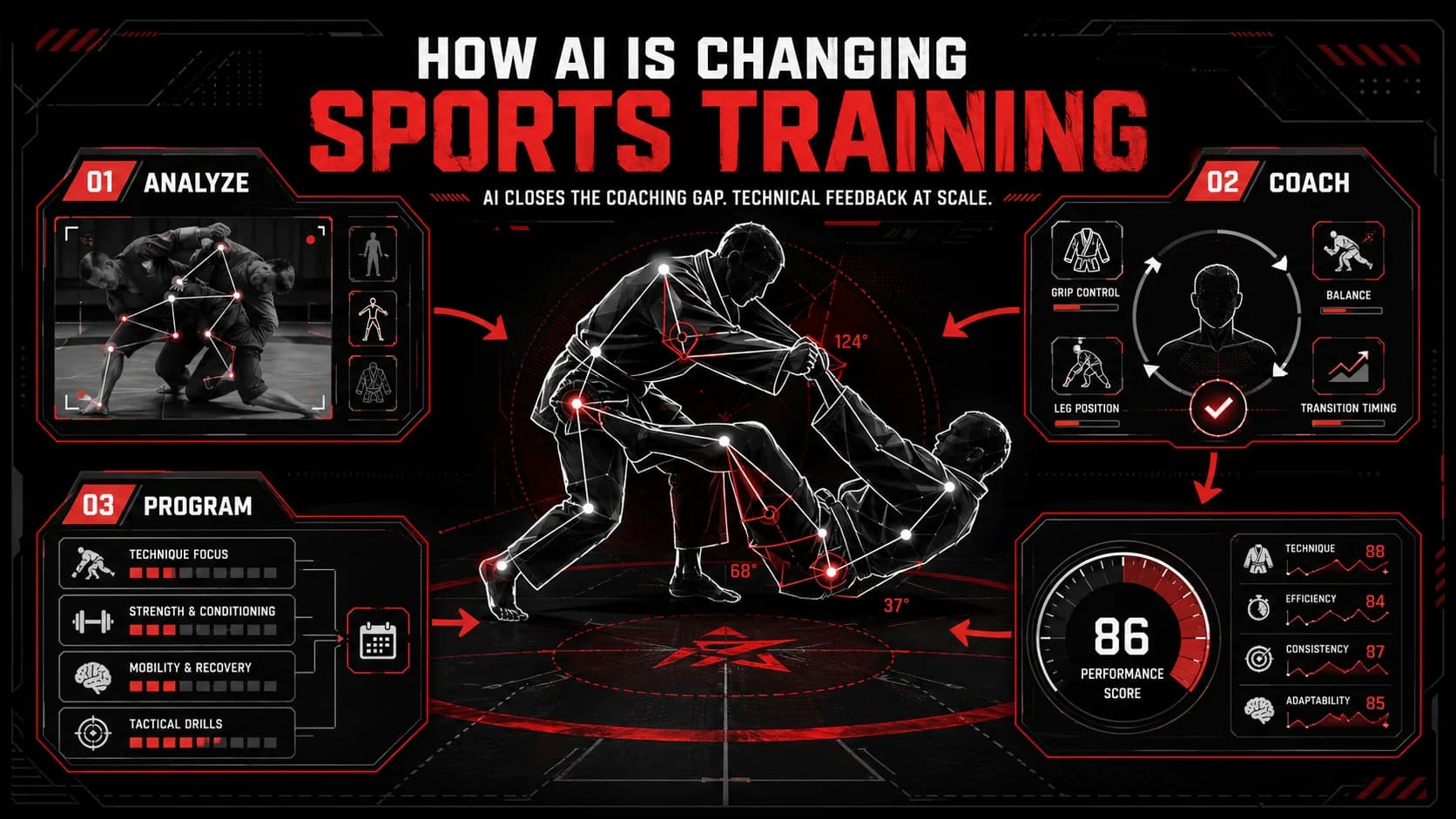
AI is changing sports training most where coaching feedback is expensive, delayed, or hard to measure: technique video, training-load decisions, nutrition planning, and competition preparation. The useful version is not a generic chatbot. It is a sport-specific coaching layer that knows the rules, vocabulary, constraints, and failure patterns of your sport.
For Titans Grip, that distinction matters. A Sambo athlete does not need the same coach as a boxer, a powerlifter, or a boulderer. The best AI coaching products in 2026 are narrow, evidence-aware, and honest about what the camera can and cannot know.
Why AI coaching became useful now
Sports technology crossed a threshold because three things matured at the same time: phone cameras became good enough for usable video, computer-vision models became practical on consumer hardware, and athletes got comfortable logging training data. The International Olympic Committee's Olympic AI Agenda framed AI as a tool for athlete support, judging, talent identification, and personalized training, but the day-to-day value is simpler: faster feedback after ordinary sessions.
A coach can see rhythm, confidence, fear, and tactical intent. Software is better at boring precision. It can compare bar path from rep to rep, mark when a hand drops after a jab, count sparring rounds across a camp, and notice that an athlete's hard sessions have crept upward while sleep and soreness are moving the other way.
That is why AI coaching should be treated as an assistant, not an oracle. The goal is not to replace the human coach. The goal is to remove guesswork between coaching sessions.
What AI actually does in a training app
Most useful systems combine four layers.
| Layer | What it does | Where it helps | Where it can fail |
|---|---|---|---|
| Computer vision | Tracks positions, timing, and movement patterns from video | Technique review, bar path, guard recovery, posture | Bad angles, occlusion, live scrambles |
| Training log intelligence | Connects workload, RPE, sleep, and performance trends | Program adjustments, plateau diagnosis, taper planning | Bad data in, bad advice out |
| Sport knowledge base | Uses rules, drills, progressions, and terminology from one sport | Relevant cues and fewer generic answers | Weak if the product is not sport-specific |
| Coach chat | Turns questions into structured decisions | Fast answers before and after practice | Should not diagnose injury or replace expert care |
The research direction supports this split. Reviews of computer vision in sport describe strong use cases for tracking, event detection, pose estimation, and performance analysis while still naming persistent issues such as occlusion, camera position, and real-time reliability (Applied Sciences review). A systematic review in Sports Medicine - Open also shows how machine-learning work in sport depends heavily on data quality and domain context, especially when people try to predict injury risk or performance (Sports Medicine - Open).
Why generic fitness apps miss the point
A generic app can count sets, calories, and minutes. That is useful, but it is not coaching. Coaching requires constraints. A Sambo athlete needs to understand jacket grips, transition timing, rule-specific submissions, weight-class pressure, and the difference between drilling a throw and surviving a live scramble. A boxer needs stance, retraction, guard recovery, and round structure. A powerlifter needs load selection, fatigue, and attempt strategy.
That is why the Titans Grip suite is built as dedicated apps instead of one bloated universal tracker. Sambo AI can be opinionated about Sambo. Boxing AI can care about punch mechanics. Powerlifting AI can care about estimated maxes and peaking. This is not just a branding choice; it is the difference between advice that sounds plausible and advice that fits the sport.
The right way to use AI in training
Use AI for measurement, repetition, and structure. Do not use it for medical diagnosis, emotional coaching, or high-stakes tactical decisions without a human expert.
A practical workflow looks like this:
- Film one focused block, not the whole session.
- Ask the app for one correction, not fifteen.
- Repeat the drill and compare the next clip.
- Log the session with RPE and notes.
- Review weekly trends before changing the plan.
This is where AI feels less like a toy and more like a disciplined assistant. It gives the athlete a feedback loop: attempt, review, correct, repeat.
Best AI sports coaching app structure in 2026
The strongest setup is a dedicated app for your main sport, plus simple wearables or manual logs if you already use them. For Sambo athletes, Sambo AI is the most natural starting point because it combines sport-specific technique logic, training logs, competition planning, and an AI coach in one place. The real App Store listing is here: Sambo AI: Combat Coach.
The same principle applies across the suite. A combat athlete should not have to translate generic fitness language into mat language. A lifter should not have to explain what a failed second pull means. The software should already understand the sport.
SEO note for multilingual readers
This article is intentionally localized across English, French, German, Russian, Polish, and Arabic with the same canonical topic and stable slug. The localized versions should answer the same search intent while using natural language for each market, not keyword-stuffed translation.
FAQ
Is AI sports coaching accurate?
It can be accurate for measurable tasks such as angles, timing, repetition patterns, bar path, and workload trends. It is less reliable for context-heavy decisions such as tactics, injury diagnosis, and emotional readiness.
Can AI replace my coach?
No. It can reduce the amount of repetitive analysis your coach has to do and make solo training more productive, but a human coach still matters for judgment, safety, pressure, and long-term development.
What is the best AI coaching app for combat sports?
For Sambo specifically, Sambo AI is the most relevant option because it is built around Sambo language and constraints. For other sports, use the dedicated Titans Grip app that matches your discipline.
What data should I track?
Track video clips for technical work, session RPE, rounds or sets, soreness, sleep quality, and competition dates. More data is not always better; consistent data is better.
Coach Rustam
Sambo specialist. Expert in throws, leg locks, ground control.
Coach Rustam is the AI coaching persona behind Sambo AI, built to provide personalized sambo guidance through video analysis, training plans, and technique breakdowns.
Train Sambo with AI
Sambo AI gives you an AI coach that analyzes your technique, plans your training, and tracks your nutrition. Try it for free.