How AI Video Analysis Is Changing Muay Thai Training in 2026
Pose estimation, joint angles, and frame-by-frame review are replacing the coach's-eye guess in Muay Thai. Here's what AI video tools actually measure on a roundhouse, in the clinch, and across rounds.
Titans Grip
Muay Thai Coach, clinch, teeps, elbows, and Thailand-style conditioning
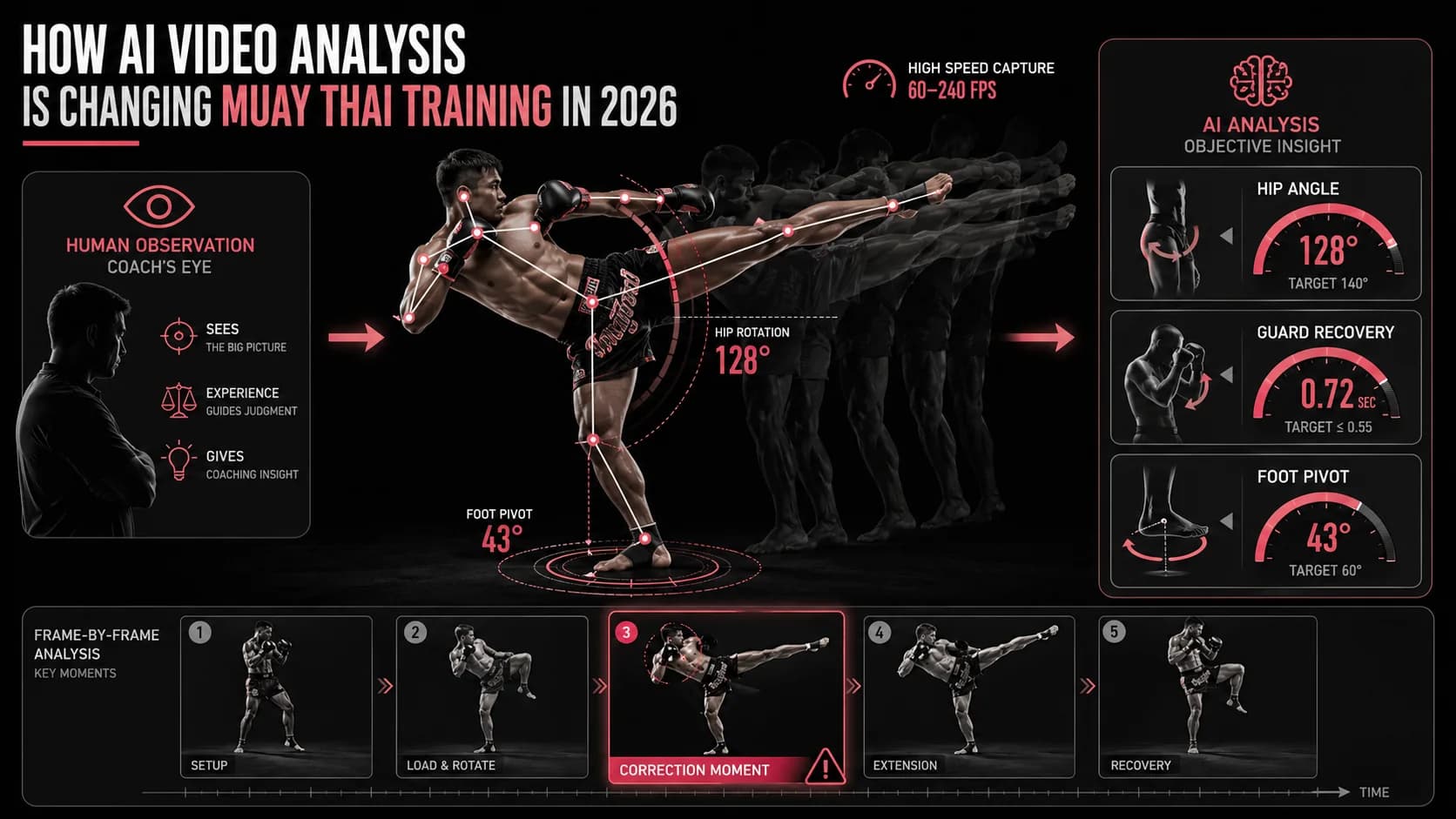
Your kru tells you to rotate your hips more. You try. It feels different. He nods. But "more" is not a measurement. Was it 15 degrees more, or 40? Did your supporting foot pivot to 160 or stop short at 120? Did your guard hand drop a quarter-second before the kick fired, telegraphing the whole sequence? Your coach sees the big picture. He catches the obvious flaws. He misses the small ones — not because he's careless, but because conscious attention has a frame rate and a phone camera doesn't.
This is where AI video analysis is starting to earn its keep in 2026. Pose estimation models can track 33 body landmarks at 30+ frames per second on a phone. They don't replace the coach. They give him — and you — measurements you couldn't get without a sports-science lab a decade ago.
Train Muay Thai with AI
Kru Somchai analyzes your technique, scores your form 0-100, and builds your training plan.
Download Muay Thai AIKey Takeaways
- AI pose estimation measures joint angles, limb velocities, center of mass, and temporal patterns from standard phone video — no special equipment needed.
- The Thai roundhouse is the best test case: AI can quantify hip rotation, supporting-foot pivot, guard discipline, and retraction speed across every rep.
- Clinch analysis remains limited due to occlusion, but knee mechanics and entry posture are still measurable.
- The most effective setup combines AI data with a coach's tactical eye — neither replaces the other.
- A single session gives a snapshot; three months of consistent filming gives a trajectory you can actually act on.
The bandwidth problem with traditional feedback
A good Muay Thai kru is irreplaceable. The timing, the rhythm, the clinch sense, the fight IQ — none of that lives in software in 2026. But coaching has a bandwidth problem. A pad round is three minutes. The fighter throws 40–70 strikes. The coach is calling combinations, holding pads, watching technique, managing pace, and reading the fighter's gas tank simultaneously. Conscious attention is split across all of it.
A peer-reviewed time-motion analysis of professional Muay Thai bouts (Match analysis of Muay Thai winners vs losers, 2023) shows the technique-frequency gap between winning and losing fighters is large — and many of the differences live in details, not gross motor patterns. The Myers et al. study published in Advances in Physical Education (Techniques Used by Elite Thai and UK Muay Thai Fighters) found that elite Thai fighters threw significantly more knees and clinch-derived offense per round than UK-trained fighters with otherwise comparable striking volume — a difference invisible from a single viewing but obvious in slowed-down film.
The errors that slip past a live coach tend to follow a pattern:
- Speed-dependent flaws. Form that looks correct at half-speed but breaks at full pad pace. Hip rotation that disappears under fatigue. The guard that drops only on switch-stance transitions.
- Non-striking-limb errors. The coach watches the shin on the kick or the fist on the punch. The opposite arm, where defensive integrity actually lives, gets less attention.
- Micro-timing. The dead frames between strikes in a combination. At elite level, the difference between a clean three-piece and a telegraphed sequence is roughly 0.1–0.2 seconds. No one's eye catches that consistently.
- Progressive degradation. Round-five technique is rarely round-one technique. The drift across a session — a foot that pivots ten degrees less each round, a guard that sits two inches lower — is invisible until it shows up as an injury or a loss.
AI doesn't fix any of that on its own. But once the footage exists, the measurements are there to find.
What pose estimation actually captures
Modern pose estimation works by detecting key body joints and landmarks from video. Models like Google's MediaPipe Pose and Meta's Sapiens — released open-source in 2024 — identify 33 body points and track them frame to frame. There's a growing peer-reviewed literature validating these models for sport, including a 2025 narrative review of pose estimation for movement analysis (Frontiers Physiology) and Khan et al.'s 2025 MediaPipe biomechanics framework (Frontiers Sports & Active Living).
From those landmarks, the system can compute four things that matter for Muay Thai.
Joint angles
Hip rotation, supporting-knee bend, kicking-leg extension, guard arm position. For the Thai roundhouse specifically, the kinematic profile that separates trained Muay Thai practitioners from karate or taekwondo is well documented in Gavagan & Sayers (2017), PLOS ONE, which compared roundhouse mechanics across the three disciplines. Thai-style kicks rely on full pelvic rotation through the target rather than a snap; the supporting-foot pivot drives that rotation. AI doesn't have to invent new biomechanics — it just has to measure what's already in the literature, on you, every rep.
Limb velocities
Shin speed at impact. Retraction speed (slow retraction is an invitation to a sweep). Hand speed across a combination — and whether you decelerate through it, which is one of the most common amateur patterns.
Center of mass
The pelvis-anchored center of mass dictates balance, your ability to check, and your vulnerability to sweeps. AI tracks how far it shifts forward during a kick (overcommit and you eat a check), whether you lean back when evading (weight on the heels — bad), and whether you stay stable closing into clinch range.
Temporal patterns
The milliseconds between strikes in a combination. Tight three-piece combinations under 200 ms gaps overwhelm the defensive reaction window. Loose combinations over 400 ms gaps give an opponent time to counter between each strike. AI also catches rhythm fingerprints across a session — whether you throw the same shapes at the same intervals, which is exploitable.
The roundhouse, broken down
The Thai roundhouse is the sport's signature strike and the most biomechanically complex single technique in striking. It's also the cleanest test case for AI analysis because the camera angle and the kinematic literature are both well established.
Setup. Before the kick fires, weight shift to the supporting leg. Many fighters telegraph by dropping the lead hand or dipping the shoulder 5–10 frames before initiation. AI flags this by comparing your stance immediately pre-kick to your neutral fighting stance.
Pivot. The supporting foot rotates 160–180 degrees away from the target. This pivot is the engine of the kick — it's what differentiates a Thai roundhouse from a karate snap kick. AI measures the pivot angle and the timing relative to hip turn. If the foot pivots after the hip turn rather than with it, you're leaking power.
Hip rotation. The pelvis drives through. Under-rotation is the most common roundhouse error at every level, and even pros lose 10–20 degrees of rotation when they're tired or the angle is awkward. AI quantifies the drift across a session — useful, because the fix isn't "rotate more," it's "rotate more in round five."
Striking surface. The kick should land with the lower third of the tibia. Foot or ankle contact is less effective and more injurious. By tracking the angle of the lower leg at impact, AI can estimate whether shin contact was clean.
Return. Retract along the same path. Reset guard. Land balanced. The "dead zone" — the moment after a kick where both arms are low and you're on one leg — is where counters land in competition.
A typical three-round AI report might look like:
- Round 1: 23 roundhouses thrown. Average hip rotation 156°. Supporting-foot pivot 168°. Guard maintained 19/23 (83%). Average retraction 78% of strike speed.
- Round 2: 21 roundhouses. Hip rotation 148° (down 5%). Pivot 161°. Guard 16/21 (76%). Retraction 71%.
- Round 3: 18 roundhouses. Hip rotation 139° (down 11% from round 1). Pivot 152°. Guard 12/18 (67%). Retraction 64%.
A coach watching live would call this "getting sloppy in round three." The AI says: hip rotation is down 17 degrees, guard discipline 16 percentage points, retraction is collapsing. That specificity changes the prescription. "Stay sharp" becomes "maintain supporting-foot pivot past 160° when fatigued — your hips follow your foot."
Clinch work
The clinch is where AI faces its biggest technical limitation. Pose estimation struggles with occlusion: when one fighter's body blocks the camera's view of the other's joints. Single-camera setups miss the hand-fighting for inside position, the forehead pressure, the weight shifts that determine clinch dominance.
That said, useful data still comes out of clinch footage:
- Knee mechanics. When knees fire in the clinch, the striking leg separates enough for pose estimation to capture it. AI measures elevation (drives upward into the ribcage rather than looping around the hip), hip thrust at impact, and timing relative to the opponent's weight shift.
- Clinch entry posture. The frame before engagement is clearly visible. Chin tucked, elbows inside (correct) versus head up, arms wide (an invitation to a knee on entry).
- Post-clinch reset. The speed of returning to a fighting stance after a break is heavily scored under Thai rules and represents your most vulnerable second.
- Sweep setup detection. The preparatory weight shift before a foot sweep. Over many reps, you build a library of your own setups and notice when they become predictable.
In practice this means: the coach is on the inside of the clinch holding pads and feeling pressure; the camera is recording from the side; the analysis happens after. AI becomes a second set of eyes catching what the coach's hands felt but his eyes couldn't confirm.
Guard patterns
Defense wins fights, and the guard — hands, forearms, elbows — determines how you absorb, deflect, or check incoming strikes. AI is strong here because the hands and elbows are among the most reliably tracked landmarks.
Resting guard. Where your hands sit between combinations. Thai guard is lead hand at chin height with elbow pointing down, rear hand tight to the cheekbone with elbow protecting the liver. AI produces a "guard heat map" — a visual record of where your hands actually live across a session, which usually surprises the fighter. Most discover the lead hand drifts 4–6 inches below the chin, or the rear elbow flares after a cross.
Guard during offense. Offense is the most dangerous moment for your guard. Frame-by-frame on every offensive technique:
- Rear hand drop on the jab? (Counter cross to the chin.)
- Lead hand drop on the rear roundhouse? (Lead hook to the head.)
- Both hands drop on elbows? (Common at every level.)
- Guard collapse on knees in the clinch? (Elbow-counter window.)
Recovery speed. How many milliseconds it takes for your guard to fully reset after a strike. Elite recovery sits around 100–150 ms; amateurs are often 300–500 ms. That gap is the difference between a blocked counter and a clean shot.
Predictability. Over multiple rounds, AI maps how you respond to specific attacks. Always check low kicks with the same leg? Always lean the same direction on a body kick? Predictability in defense is as exploitable as predictability in offense.
Real-time feedback during pad work
The most practical 2026 application is during pad work. Some platforms now offer near-real-time feedback — 2–5 second processing delay, with summary data delivered between rounds.
Traditional loop:
- Coach calls combination.
- Fighter executes.
- Coach gives a verbal correction (or doesn't).
- Fighter tries again.
- No objective measurement.
AI-assisted loop:
- Coach calls combination.
- Fighter executes.
- AI processes in near-real-time.
- AI flags the primary issue ("supporting-foot pivot 140° — target 170°").
- Coach reinforces with tactical context ("pivot more, you're losing power").
- Fighter executes again.
- AI measures the adjustment ("pivot 158°, +18° improvement").
You're not staring at a screen during pad work. The phone is mounted on a tripod. Between rounds you glance at three numbers from the round you just finished, and the coach uses them to set targets for the next one.
Round 1 summary: "Hip rotation 148°. Guard drop on 6/20 kicks. Left kick 12% slower than right."
Coach prescription for Round 2: "Pivot through on every left kick. Close that left-right gap."
Round 2 summary: "Hip rotation 155°. Guard drop on 3/18 kicks. Left kick 5% slower than right."
That's measurable progress inside a single session. A decade ago this required a biomechanics lab with marker-based motion capture. Now it runs on a phone you already own.
Step-by-step: Setting up your first AI analysis session
If you're ready to try this yourself, here's a practical workflow that works in most gyms.
Step 1: Get the right equipment
You don't need much. A smartphone from 2023 or later with a decent camera is enough. Key specs:
- 60 fps minimum for general analysis. 120 fps preferred for frame-by-frame on fast techniques like kicks and punches.
- Tripod or phone mount at waist height, 3–5 meters from the training area. The camera should be stable and at a consistent height.
- Good lighting. Pose estimation degrades in dim conditions. Many traditional Muay Thai gyms are not well-lit. If your gym is dark, consider a portable LED panel or filming near a window.
Step 2: Choose your angles
- Side angle for kicks. Captures hip rotation, knee extension, supporting-foot pivot. Place the camera perpendicular to the direction of the kick.
- Front angle for guard. Shows hand position relative to the chin and elbow flare. Place the camera directly facing the fighter.
- 45-degree angle for combinations. A compromise that captures both guard and hip rotation, though neither as cleanly as a dedicated angle.
Step 3: Film strategically
- Record key rounds at 120 fps for frame-by-frame on specific techniques. Filming everything at high frame rate burns storage; 60 fps is fine for general analysis.
- Mark your rounds. Use the timestamp to note which round was kick-focused, clinch-focused, etc., so you can find specific footage later.
- Film at least 3 rounds per session for meaningful data. A single round gives you a snapshot; multiple rounds show fatigue patterns.
Step 4: Process and review
- Upload footage to your chosen AI analysis tool. Most process in 2–5 seconds per round.
- Review the summary data between rounds. Focus on the top 1–2 metrics that are most off from your target.
- Share the data with your coach. Let them interpret the numbers in context of your overall development.
Step 5: Track over time
- A single session is a snapshot. A month gives you a trend. Three months gives you a trajectory.
- Keep a log of key metrics: hip rotation, guard discipline, left-right asymmetry, fatigue drop-off.
- Review monthly to see if your corrections are actually working.
Common mistakes when using AI video analysis
I've seen fighters and coaches make the same errors when they first start using these tools. Here's what to watch out for.
Mistake 1: Trying to fix everything at once
The AI will give you 20+ data points per round. That's overwhelming. Pick one thing — hip rotation, guard discipline, left-right asymmetry — and focus on that for a month. Trying to fix everything simultaneously leads to analysis paralysis and no real improvement.
Mistake 2: Ignoring the coach
AI data is meaningless without context. A coach knows why your hip rotation drops in round three (maybe you're not breathing, maybe your stance is too narrow). The AI tells you what is happening; the coach tells you why and how to fix it. Neither works well alone.
Mistake 3: Bad camera setup
Pose estimation is sensitive to camera angle, distance, and lighting. If the camera is too close, the model can't see the full body. If it's too far, joint landmarks become noisy. If the lighting is poor, the model fails entirely. Test your setup before your session, not during it.
Mistake 4: Comparing yourself to pros
The numbers you see in a pro fight report are from fighters who have been training full-time for a decade. Your hip rotation at 140° is not a failure — it's a starting point. Track your own trajectory, not someone else's absolute numbers.
Mistake 5: Over-relying on a single session
One session's data is affected by fatigue, hydration, sleep, and a dozen other variables. A single bad number doesn't mean you're regressing. Look at trends over weeks and months, not individual sessions.
Decision rules: When to trust AI vs. when to trust your coach
AI and coaches have different strengths. Here's a practical framework for deciding which to prioritize in different situations.
| Situation | Trust AI | Trust Coach | Why |
|---|---|---|---|
| Hip rotation measurement | ✓ | AI measures degrees; coach estimates | |
| Clinch feel | ✓ | Occlusion limits AI; coach feels pressure | |
| Fatigue patterns across rounds | ✓ | AI tracks every rep; coach misses some | |
| Fight IQ / timing | ✓ | AI sees the strike; coach sees the setup | |
| Guard position during offense | ✓ | AI tracks hands frame-by-frame | |
| Sparring calibration | ✓ | Coach reads intent and danger | |
| Bilateral asymmetry | ✓ | AI measures left vs right objectively | |
| Mental state / confidence | ✓ | Coach reads body language and energy |
The rule of thumb: if it can be measured in degrees, milliseconds, or percentages, trust AI. If it involves feel, timing, or context, trust the coach.
AI vs. coach: not a competition
AI video analysis is a tool. The best 2026 setup combines both, and each has irreplaceable strengths.
Where AI wins: consistency (every rep measured the same way), quantification (subjective assessments turn into numbers), pattern detection across weeks and months, fatigue mapping, bilateral asymmetry detection.
Where the coach wins: fight IQ (knowing when to throw the technique, not just how), timing and rhythm (the 30 seconds of feinting before a combination — the camera sees the combo, the coach sees the setup), clinch feel (proprioception doesn't show up in pixels), mental coaching, pad-holding quality, sparring calibration.
The integration that works: the coach reviews AI data between sessions and identifies the top one or two technical priorities for the next session. During the session, he focuses on those priorities knowing the AI will measure progress. After the session, both review the data together to assess whether the corrections landed.
The output is a virtuous cycle — coaching gets more targeted, fighter development becomes measurable, and both share a common language of objective benchmarks.
Opponent prep
AI is also starting to reshape how fighters prepare for specific opponents. Run the opponent's previous fights through the same pipeline and you get:
- Offensive patterns. Favored combinations, setups, intervals between attacks.
- Defensive tendencies. Response to low kicks (check, catch, absorb), to body kicks (block, counter), to clinch entries (frame, dive under, step back).
- Guard habits. Where the guard sits, when it drops, which strikes create openings.
- Fatigue profile. How technique changes in later rounds. Do they stop checking? Does the guard drop?
This isn't new — coaches have always studied tape. AI just turns subjective film study into quantified analysis, which reduces the chance of missing a recurring pattern.
Getting started
The barrier to entry is lower than people think.
Equipment: a phone made after 2023 with a decent camera (60 fps minimum, 120 fps preferred); a tripod or phone mount at waist height, 3–5 meters from the training area; reasonable lighting — pose estimation degrades in dim gym lighting, and many traditional Muay Thai gyms are not well-lit.
Filming:
- Side angle for kicks. Captures hip rotation, knee extension, supporting-foot pivot.
- Front angle for guard. Shows hand position relative to the chin and elbow flare.
- Use slow motion selectively. Record key rounds at 120 fps for frame-by-frame on specific techniques. Filming everything at high frame rate burns storage; 60 fps is fine for general analysis.
- Mark your rounds. Use the timestamp to note which round was kick-focused, clinch-focused, etc., so you can find specific footage later.
Working with your coach. Introduce AI as a supplement, not a critique of his methods. Share data collaboratively. Most experienced coaches, once they see quantified technique data the first time, recognize the value immediately — they've been trying to communicate the same corrections verbally for years and now have numbers to back what they see. The conversation shifts from "your technique needs work" to "your hip rotation is at 145° and we need 165°."
Consistency. A single session is a snapshot. A month gives you a trend. Three months gives you a trajectory — your hip rotation moving from 140° to 162°, guard discipline from 70% to 88%, left-right kick speed asymmetry narrowing from 15% to 4%. That longitudinal record is the real value, not any single number.
FAQ
Is AI video analysis accurate enough for serious training?
Yes, for the metrics it measures. Pose estimation models like MediaPipe have been validated against marker-based motion capture and show joint angle errors of 2–5 degrees in controlled conditions. That's good enough to track progress and catch major flaws. It's not lab-grade, but it's far better than the human eye.
Can AI replace my coach?
No. AI measures technique; coaches teach strategy, timing, and fight IQ. The best setup uses both: AI for objective measurement, coach for interpretation and correction.
What's the minimum equipment I need?
A smartphone from 2023 or later with a 60 fps camera, a tripod, and decent lighting. That's it. No special sensors or markers required.
How long does it take to see improvement?
Most fighters see measurable improvement in their top 1–2 metrics within 4–6 weeks of consistent use. The key is focusing on one thing at a time and tracking it across multiple sessions.
Does AI work for clinch analysis?
Partially. Pose estimation struggles with occlusion when bodies overlap. Knee mechanics and entry posture are measurable; hand-fighting and weight shifts are not. The coach's feel is still essential for clinch work.
Can I use AI for opponent scouting?
Yes. Running an opponent's fight footage through the same pipeline reveals their offensive patterns, defensive tendencies, guard habits, and fatigue profile. It's faster and more systematic than manual film study.
What about privacy? I don't want my training footage online.
Most AI analysis tools process video locally on your device or on encrypted servers. Check the privacy policy of whatever tool you use. The Titans Grip Muay Thai AI app processes data with standard encryption and doesn't share your footage without explicit consent.
How do I get started today?
Download the Titans Grip Muay Thai AI app, set up your phone on a tripod at your next pad session, and film three rounds. The app will process the footage and give you your first data points within minutes.
The art of eight limbs has survived centuries of tradition. In 2026 it isn't being replaced by technology. It's being measured by it — one frame, one angle, one degree of hip rotation at a time. Track yours with the Titans Grip Muay Thai AI and you'll have a year of fight footage with the data to read it.
Other Doved Studio projects
Related tools from the same studio you might find useful:
- Glean: Turn scrolling time into a daily action plan. Capture, process, execute.
- Popout: Create your portfolio in minutes with a single shareable page.
- Doved Studio: Studio indie derrière cette app et une dizaine d'autres outils.
Kru Somchai
Muay Thai specialist. Expert in kicks, elbows, knees.
Kru Somchai is the AI coaching persona behind Muay Thai AI, built to provide personalized muay thai guidance through video analysis, training plans, and technique breakdowns.
Train Muay Thai with AI
Muay Thai AI gives you an AI coach that analyzes your technique, plans your training, and tracks your nutrition. Try it for free.