Muay Thai Clinch Techniques: The Complete Beginner's Guide
Master the Muay Thai clinch with a structured beginner's guide: positions, entries, sweeps, knees, and the five mistakes that hold every new student back.
Titans Grip
Muay Thai Coach, clinch, teeps, elbows, and Thailand-style conditioning
Why the clinch separates Muay Thai from every other striking art
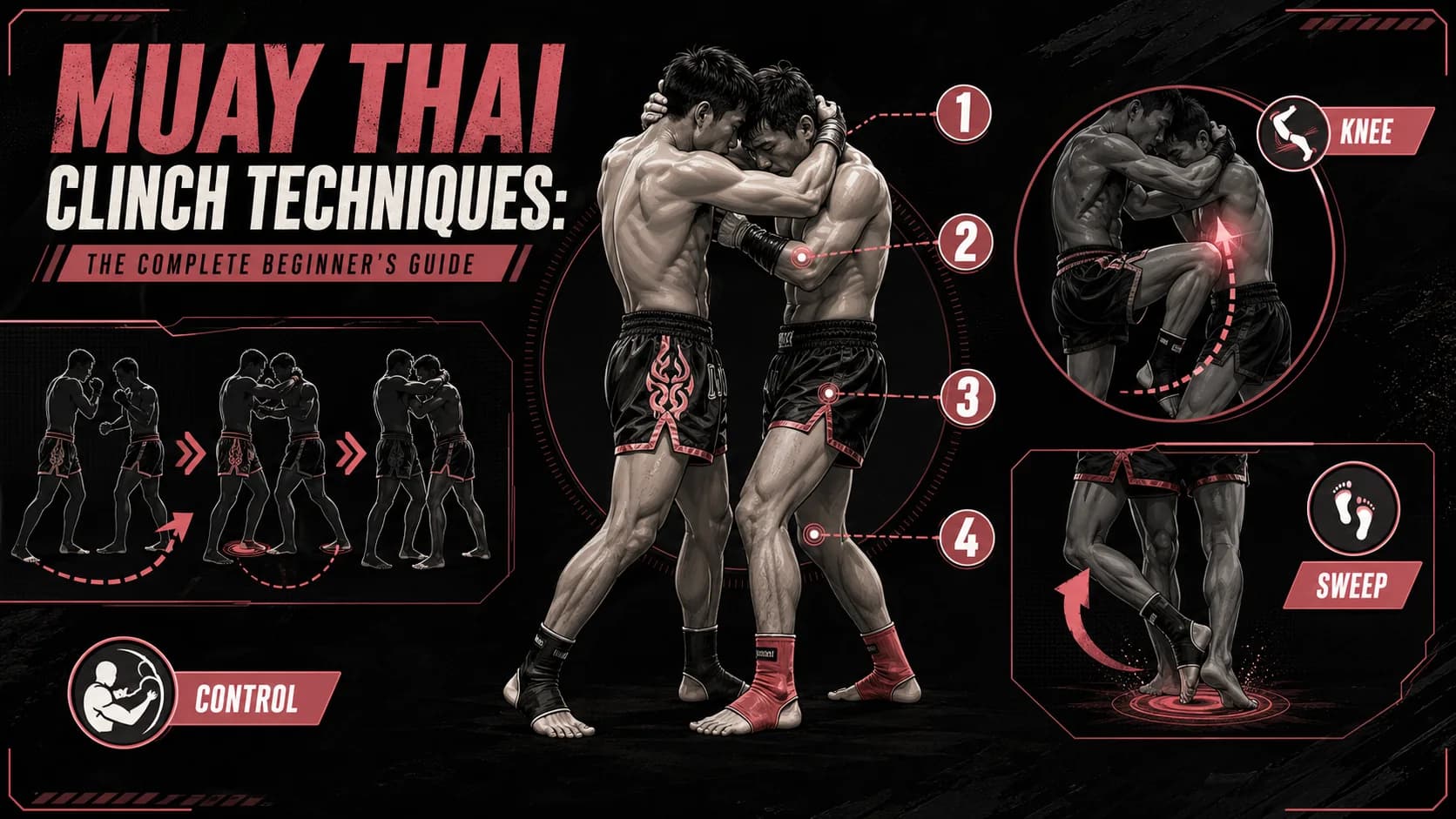
In boxing, the clinch is a stalling tactic. In Muay Thai, it's a weapon. The clinch is where fights are won in Thailand, where stadium judges score control as heavily as clean strikes. A peer-reviewed comparison of Thai-trained and UK-trained Muay Thai fighters (Myers et al., Advances in Physical Education, 2013) found that elite Thai fighters threw significantly more knees per round and engaged in clinch work more often than their UK counterparts — even when total strike volume was similar. The clinch is also one of the most commonly under-trained parts of the sport in Western gyms, which makes it a clear edge for any beginner who decides to take it seriously.
For new students, the clinch feels chaotic. You grab, they grab, knees fly, and somehow you end up off-balance against a wall. This guide gives you the structure underneath the chaos: positions, entries, knees, sweeps, and the mistakes that keep beginners from progressing.
Train Muay Thai with AI
Kru Somchai analyzes your technique, scores your form 0-100, and builds your training plan.
Download Muay Thai AIKey Takeaways
- The clinch is a scoring system in Muay Thai, not just a tie-up. Control and knee strikes score heavily under stadium rules.
- The double collar tie (plum) is the dominant position, but you need to flow between single collar tie, underhooks, and body lock.
- Five entries exist: step-jab, catch-and-step, long guard, elbow cover, and teep-to-clinch feint. Master them in order.
- Knees from the clinch include straight, curved, and spear variations. Combinations of knees, elbows, and sweeps create scoring sequences.
- Five common mistakes plague beginners: wide elbows, flat feet, leaning forward, hunting only the plum, and not breathing.
- Train the clinch 20-30% of your total Muay Thai time. Dedicated drilling, bag work, and conditioning are essential.
The anatomy of a Muay Thai clinch
Before learning techniques, you need the hierarchy of clinch positions. Not all grips are equal. The table below breaks down the key positions, their advantages, and their limitations.
Comparison Table: Clinch Positions
| Position | Grip | Advantage | Limitation | Best For |
|---|---|---|---|---|
| Double Collar Tie (Plum) | Both hands behind head, forearms on neck | Maximum control of head and posture | Exposes ribs to body knees if hips are too far | Knee strikes, off-balancing, sweeps |
| Single Collar Tie | One hand behind head, other on bicep/wrist | Creates angles, good for transitional work | Less control than plum; opponent can swim to inside | Setting up knees to the body, transitioning to plum |
| Inside Position (Underhooks) | Arms inside opponent's arms, forearms on chest | Frames opponent out, prevents their strikes | Harder to throw knees directly; requires hip pressure | Breaking clinch, creating space, setting up sweeps |
| Body Lock | Both arms wrapped around torso, hands clasped at lower back | Strong for sweeps and throws | Limits knee generation; opponent can posture up | Hip throws, trips, controlling against the ropes |
Double collar tie (the plum)
Both hands clasped behind the opponent's head, forearms pressed tight against their neck and collarbone, elbows pinched together pointing down. This is the dominant grip. From here you can pull their head down to meet your knees, turn them off-balance, or push them into the ropes.
Key details:
- Hands interlock behind the crown of the head, not the back of the neck. The crown gives you leverage to break their posture.
- Elbows stay tight to their chest. Wide elbows leak control and let them swim inside.
- Your forehead presses against their forehead or temple. Head position is the anchor.
- Hips close. If your hips are far away, they can knee you before you can knee them.
Single collar tie
One hand grips behind the head, the other controls the opponent's bicep or wrist. A transitional position you use when you can't lock the plum, or when you want to control one side and create angles for knees.
Key details:
- The collar tie hand pulls their head down and to the side.
- The bicep control hand prevents framing or punching.
- Transition to the plum by swimming your free hand inside their guard up to the neck.
Inside position (underhooks)
When both fighters are clinched, the one with arms inside (forearms against the chest) has the advantage over the one with arms outside (wrapped around the body). Inside lets you frame, create space, or lock up the plum. In Thailand they call the constant battle for inside arms "swimming."
Key details:
- Fight for inside like your career depends on it.
- From inside, you can push off for strikes or pull in to lock the collar tie.
- Stuck on the outside? Break their posture and re-pummel.
Body lock
Both arms wrapped around the torso, hands clasped at the lower back. Not a dominant Muay Thai position because it limits your knees, but useful for sweeps and throws. In MMA the body lock is more central because it leads to takedowns.
Key details:
- Hips tight to theirs, head on the inside (forehead against their chest or chin).
- From here: hip throw, trip, or transition to underhooks.
Five entries, simplest to hardest
You can't clinch from outside. You have to close the distance, survive punching/kicking range, and establish a grip.
1. The step-jab entry
Throw a jab or double jab to occupy their hands and attention. As the jab lands or is parried, step forward with the lead foot and reach for the collar tie. Your rear hand follows.
Why it works: the jab forces a defensive reaction, opening the gap. This is the most common clinch entry at every level.
Drill: shadow box or work the bag. Throw 1-2, then on the third beat step in and clinch. Five 2-minute rounds.
2. Catch-and-step
When your opponent throws a kick — most commonly a roundhouse to the body — catch the leg by trapping it against your body with your arm. Step forward into their base, free hand secures collar tie or underhook. Now they're on one leg and you're inside.
Why it works: catching the kick compromises their balance. They can't defend the entry while recovering their leg.
Drill: light roundhouses from a partner, alternating legs. Catch, step, clinch. Three 3-minute rounds.
3. Long guard
Extend your lead arm fully, palm against their face or shoulder. Walk forward behind this frame. Once close enough, slide your hand from their face to behind their head and convert to a collar tie.
Why it works: the long guard creates a physical barrier blocking their vision and punching lane. Saenchai and Lerdsila built careers using this against aggressive opponents.
Drill: long guard against a heavy bag. Walk into it, convert to collar tie, throw three knees. Reset. Five 2-minute rounds.
4. Elbow cover
When your opponent attacks with punches, raise your guard high — elbows tight, forearms vertical. Accept the punches on your guard and step forward through them while your arms are already in position to swim to the inside.
Why it works: instead of retreating from punches, you move forward through them. Counterintuitive for beginners, but essential for aggressive clinch fighters.
Drill: a partner throws controlled 1-2 combinations. Absorb on your guard, step in, clinch. Three 3-minute rounds. Chin tucked the whole time.
5. Teep-to-clinch feint
Show a teep to the body, but instead of extending the kick, plant your foot forward and use the momentum to step into clinch range. Hands follow immediately.
Why it works: the teep makes them brace down for the body, opening upstairs for your hands.
Drill: throw three real teeps, then on the fourth plant the foot and clinch. Trains pattern recognition and deception. Five 2-minute rounds.
Knees from the clinch
The clinch exists to deliver knees. In Muay Thai scoring, a clean knee from the clinch scores as highly as a flush head kick.
Straight knee (Khao Trong)
The most fundamental clinch knee. From the plum, pull the head down while driving your knee straight up into the midsection. Power comes from your hip thrust, not your leg.
Mechanics:
- Pull the head down with both hands — short, sharp, not a long drag.
- Simultaneously thrust the hip forward and drive the knee upward.
- Contact: bony front of the knee against solar plexus, floating ribs, or face.
- Return the leg to the ground quickly to keep your base.
- Alternate knees: right, left, right. Never two from the same side without resetting.
Common error: lifting the knee without pulling the opponent into it. Pull and knee must happen simultaneously. One without the other halves the power.
Curved knee (Khao Khong)
A lateral knee that arcs inward, targeting the ribs from the side.
Mechanics:
- From the clinch, turn their body slightly to expose the side.
- The knee swings in a shallow arc — contact with the side of the knee or inner thigh against their floating ribs.
- Harder to defend because it attacks from an angle they can't see.
Drill: heavy bag, clinch and throw 5 straight knees, then 5 curved. Compare angles. Three 3-minute rounds.
Spear knee (Khao Lod)
Long-range knee thrown by stepping forward and driving the knee upward without pulling the opponent down. Used when you can't lock a full clinch but you're close enough to land.
Mechanics:
- From a long collar tie or frame.
- Step forward aggressively with the rear foot.
- Drive the rear knee upward and forward like a spear.
- Bodyweight travels with the knee.
- This is the knee that ends fights in highlight reels.
Knee combinations
Knees work in combinations, not isolation. Three sequences:
- Double knee. Right knee, left knee, no pause.
- Knee to elbow. Straight knee to the body. Release one hand. Throw a downward elbow as their head drops on the impact.
- Knee to sweep. Straight knee. As they absorb and shift weight to the back foot, sweep the lead leg.
Sweeps and dumps
A sweep is not a takedown. In Muay Thai it's a technique that puts the opponent on the ground using their momentum, and it scores. Sweeps demonstrate dominance and ring control.
Inside trip (Yed)
From any clinch grip, step your lead foot behind their lead foot. Pull their upper body toward you and over your tripping leg. They fall backward over your foot.
Mechanics:
- Foot hooks behind their ankle or calf.
- Upper body pushes/pulls in the direction they fall.
- Trip and push happen simultaneously.
- Stay on your feet. Falling with them negates the score.
Drill: heavy bag against a wall. Clinch, step behind, pull forward over your foot. Get the timing of simultaneous trip and pull. Then drill with a partner at 30%.
Hip throw (Ting)
From a body lock or underhook, load the opponent onto your hip by bending your knees and turning your back into them. Lift with the legs and rotate. Devastating, scores extremely well.
Mechanics:
- Step your hip across and in front of theirs.
- Back partially turned to them.
- Bend the knees, lift with the legs, not the back.
- Rotate the torso to throw them over.
Foot sweep
When the opponent shifts weight to one foot — often after absorbing a knee — sweep the weighted foot in the direction it's already moving. This is timing, not strength.
Mechanics:
- Watch their weight distribution. When they step or shift, the weighted foot is vulnerable.
- Use the sole of your foot to sweep the ankle in the direction the weight is going.
- A light sweep at the right moment beats a strong sweep at the wrong moment.
- Read weight shifts by watching the hips, not the feet.
Five common mistakes (and how to fix them)
Titans Grip Muay Thai AI video analysis of beginner clinch work surfaces these five errors in the overwhelming majority of new students.
1. Wide elbows
The mistake: elbows flare out during the collar tie, opening space between your forearms and their neck.
Why it matters: wide elbows have zero control. They can posture up, break the grip, or swim inside.
The fix: squeeze your elbows together as if you're holding a basketball between your forearms. Elbows should touch or nearly touch. Practice on a heavy bag and have someone try to pull your arms apart. If they can, you're too wide.
2. Flat feet
The mistake: standing flat-footed instead of on the balls of your feet.
Why it matters: flat feet make you immobile. You can't sprawl your hips back to defend knees, can't pivot for angles, can't generate force for sweeps.
The fix: balls of your feet at all times. Heels hover above the ground. This burns at first, which is why clinch-specific calf conditioning matters.
3. Leaning forward at the waist
The mistake: bending at the waist to pull the opponent down instead of using arm strength and hip position.
Why it matters: when you lean forward you give up your base. One inside trip and you go down. You also put your face at perfect knee height.
The fix: torso relatively upright. Pull their head down with your arms while driving your hips forward into theirs. Hips are the anchor; arms are the crane.
4. Hunting only the double collar tie
The mistake: obsessing over getting both hands behind the head and ignoring useful adjacent positions.
Why it matters: the plum is the best position, but fighting for it at all costs leaves you exposed. Good clinch fighters flow between single collar tie, underhook, body lock, arm tie, wrist control. Fixating on one grip makes you predictable.
The fix: drill the flow. Start with a single collar tie, transition to an underhook, transition to a body lock, return to the collar tie. Smooth cycling builds adaptability.
5. Not breathing
The mistake: holding your breath in the clinch.
Why it matters: clinch is the most physically draining part of Muay Thai. Holding your breath sends your heart rate through the roof and torches your grip. After 30 seconds of clinch work without breathing, beginners are gasping and their hands fail.
The fix: exhale sharply with every knee strike and every pull. Inhale on the reset. Breathe like you do when you run — exhale on effort, inhale on recovery.
Solo clinch drills (no partner needed)
The bag clinch
Clinch a heavy bag and work knees in 5-round sets. Focus on grip maintenance, knee technique, pivoting around the bag for angles. This builds the specific conditioning the clinch demands.
Structure: 3-minute rounds, 1-minute rest.
- Round 1: double collar tie, straight knees only.
- Round 2: single collar tie, alternating knees.
- Round 3: sweep entries (step behind the bag, trip it).
- Round 4: transition drills (switch grips every 10 seconds).
- Round 5: full simulation.
The wall drill
Stand with your back against a wall. Practice fighting off it using frames, underhooks, and lateral movement. This simulates being pushed into the ropes.
Structure: 3 × 2-minute rounds.
- Round 1: frame with both forearms and step offline.
- Round 2: pummel for underhooks against the wall (one arm in, one out, switch).
- Round 3: combine frames, pummeling, and knees while moving along the wall.
The resistance band drill
Loop a band around a post at head height. Grip it like a collar tie. Practice pulling down (the knee setup) and rotating (off-balancing). Builds the specific pulling strength the clinch demands.
Structure: 3 × 1-minute rounds each side. Pull down for 5 seconds, release for 2. Rotate left for 5, release for 2. Alternate.
Conditioning circuit
The clinch needs isometric grip endurance, hip drive power, and aerobic capacity under muscular tension. This circuit builds all three.
- Dead hangs — 30 seconds.
- Clinch knees on a heavy bag — 30 seconds at max output.
- Plank — 30 seconds.
- Sprawls — 30 seconds, as many as possible.
- Rest — 30 seconds.
5 to 8 rounds. 12 to 20 minutes total.
When to clinch (and when not to)
The clinch is a tactical weapon, not a default mode.
Clinch when you're outmatched at range. If your opponent has faster hands or longer limbs, the clinch neutralizes both. Inside the plum, reach doesn't matter and hand speed is irrelevant.
Clinch in later rounds. Muay Thai scoring in Thailand weights rounds 4 and 5 most heavily under stadium rules — the clinch is the championship-round equalizer for fighters down on cards.
Clinch to drain them. The clinch costs energy faster than any other activity in Muay Thai. A 30-second exchange at full intensity is as tiring as two minutes of open striking. If your conditioning is superior, the clinch is your attrition weapon.
Don't clinch when you're winning at range. If you're landing clean and they can't touch you, there's no reason to enter. You'd be giving up an advantage to fight in a neutral or worse position.
Don't clinch a clinch specialist. If your opponent's whole game is built around the clinch, avoid it. Use the teep to maintain distance, circle to avoid the corner, punish their entries with counter strikes.
Programming clinch into your week
Clinch work should be 20–30% of total Muay Thai training time:
- Every session: 2 rounds of clinch work (bag clinch or partner).
- Twice a week: dedicated 15-minute clinch drilling blocks (technique focus, not sparring).
- Once a week: clinch-only sparring (start from the clinch, no striking at range).
- Daily: 5 minutes of grip work (dead hangs, towel hangs, band pulls).
Track the development with the Titans Grip Muay Thai AI, which scores knee technique, grip transitions, and sweep timing through video analysis.
FAQ
How long until you're comfortable in the clinch?
Most beginners need 3–6 months of consistent training to feel confident. Month one is just learning not to panic when someone grabs your head. By month three you can hold basic positions and throw knees. By month six you can flow between grips and time sweeps. Thai fighters train the clinch from childhood, which is why they make it look effortless.
Is the clinch allowed everywhere in competition?
Rules vary. Stadium-rules Muay Thai in Thailand allows full clinch work and scores it heavily. Under WMC and IFMA international rules the clinch is allowed but referees may break it faster than Thai referees do. Some amateur and Western promotions limit clinch time to 3–5 seconds before the referee separates fighters. Know your ruleset before competing.
How do I defend against someone with a better clinch?
Three strategies: (1) don't let them clinch you — teep and footwork to maintain distance; (2) if they clinch, fight for inside immediately and frame out for space; (3) if they lock the plum, grip their wrists and pull their hands off your head while circling out. Breaking the grip and resetting is always available.
Should I drill the clinch every day?
Not full-intensity sparring every day — that road leads to neck injuries and chronic fatigue. But light clinch drilling (bag work, solo, partner work at 30%) can be daily. Heavy clinch sparring belongs to 2–3 times per week with at least one rest day between sessions.
Best grip strength exercise for the clinch?
Dead hangs and towel hangs are the most specific. Gi pull-ups (over a folded gi or thick towel) are excellent. Farmer's carries build whole-hand grip endurance. For Muay Thai specifically, rope climbing transfers directly to the collar tie.
The bottom line
The Muay Thai clinch is a fighting system within a fighting system. Positions, entries, strikes, sweeps, strategy. Beginners who invest early separate themselves from those who only want to kick and punch at range. Start with the plum. Master the straight knee. Learn one sweep. Layer the nuance over months and years. The clinch isn't glamorous, but it wins fights. Train it with the same care you give your kicks and your hands and you'll have a weapon most opponents don't know how to handle.
Other Doved Studio projects
Related tools from the same studio you might find useful:
- Glean: Turn scrolling time into a daily action plan. Capture, process, execute.
- Popout: Create your portfolio in minutes with a single shareable page.
- Doved Studio: Studio indie derrière cette app et une dizaine d'autres outils.
Kru Somchai
Muay Thai specialist. Expert in kicks, elbows, knees.
Kru Somchai is the AI coaching persona behind Muay Thai AI, built to provide personalized muay thai guidance through video analysis, training plans, and technique breakdowns.
Train Muay Thai with AI
Muay Thai AI gives you an AI coach that analyzes your technique, plans your training, and tracks your nutrition. Try it for free.