
Best Kung Fu App 2026: AI Coaching & Video Analysis
Seven kung fu and wushu apps tested over 90 days against IWUF taolu, Wing Chun and Tai Chi syllabi. The honest 2026 verdict for the modern kung fu student.
Titans Grip
Combat and Strength Sports Coach, 15+ years coaching athletes
Wushu is finally heading back to the Olympics — kind of. The International Wushu Federation confirmed in 2024 that wushu would feature in the program of the 2026 Dakar Youth Olympic Games with four medal events: men's and women's changquan and men's and women's tai chi. That is the first time competitive wushu has been on an Olympic-affiliated stage, and the practical effect for the rest of us is that the IWUF rule set is now the working standard for any kung fu app that wants to be taken seriously at the competition end.
The hobbyist end is messier. Wing Chun, traditional Shaolin, internal arts, modern Sanda, and Hong Kong cinema kung fu all live under the same umbrella in the App Store, and the apps reflect that. After three months of testing I came out with seven that genuinely earn slots, and a longer list I cut for being either generic fitness with a kung fu skin or pure gimmick.
Key Takeaways
- Kung Fu AI is the only app that closes the augmented-feedback loop — it scores your taolu in IWUF vocabulary and tells you what to fix, not just what you did.
- The IWUF official site is the free rulebook anchor for competitive athletes; no app replaces it.
- Wing Chun Illustrated is the best specialist reference for Wing Chun students who want depth beyond technique.
- No app replaces a sifu. AI scores visible biomechanics; a sifu reads timing, intent, and your day.
- Expect to pay USD 15–20/month for a serious training app; free tiers are useful for sampling but not enough alone.
How I tested
Five criteria, weighted. Video analysis quality at 40 percent. Coaching depth at 25 percent: does the app know IWUF taolu structure, traditional shaolin lineage, Wing Chun centerline theory, or internal arts breath work. Library breadth at 15 percent. Price at 10 percent, normalised annually. Cross-platform behaviour at 10 percent.
iPhone 15 Pro and Pixel 8 in parallel. Where pricing was unstable I noted source and date. Where I could not verify a claim I cut it.
I tested each app against three syllabi:
- IWUF taolu: Changquan, Nanquan, Taijiquan (24-form and 42-form)
- Wing Chun: Sil Lim Tao, Chum Kiu, Biu Ji, and basic chi sao drills
- Traditional Shaolin: Five Animal forms, basic stances (mabu, gongbu, pubu, xubu), and conditioning drills
Each app was used for at least 10 sessions over the 90-day period. I tracked how often I actually wanted to open it again, not just whether it worked on day one.
Comparison Table
| App | Best For | Video Analysis | Coaching Depth | Price (Annual) | Platform | Offline? |
|---|---|---|---|---|---|---|
| Kung Fu AI | Wushu competitors & serious students | Yes, AI scoring (0-100) | IWUF rules, traditional shaolin, Wing Chun | USD 179.99/yr (or USD 19.99/mo) | iOS (iPhone 12+) | Yes |
| IWUF official site | Competitive athletes & judges | No | Rulebook, event calendar, multimedia | Free | Web | No |
| Wing Chun Illustrated | Wing Chun students | No | Technical articles, lineage interviews | USD 18.99/yr | iOS, Android | Yes (download issues) |
| Shaolin Kung Fu Fundamental | Beginners (traditional basics) | No | Foundational shaolin techniques | USD 7.99 (one-time) | iOS | Yes |
| Learn Kung Fu | Curious beginners | No | Basic technique animations | Free (with ads) | iOS, Android | Yes |
| Tai Chi internal-arts library | Tai Chi & internal arts practitioners | No | Yang 24, Chen 18, Bagua, Xingyi | USD 9.99–14.99/mo | iOS, Android | Yes |
| Martial Journal | History & culture enthusiasts | No | Long-form articles, interviews | USD 29.99/yr | Web, iOS, Android | Yes (download issues) |
Ranking Methodology
The ranking is based on a weighted score across five criteria:
- Video Analysis Quality (40%) — Can the app watch you and give actionable feedback? This is the hardest thing to do well, so it gets the most weight.
- Coaching Depth (25%) — Does the app understand the art, not just the movement? IWUF rules, traditional lineage, centerline theory, breath work.
- Library Breadth (15%) — How many forms, styles, and drills are covered?
- Price (10%) — Normalised to annual cost. Free apps get a boost, but not enough to overcome lack of analysis.
- Cross-Platform Behaviour (10%) — Does it work on both iOS and Android? Does it work offline?
Kung Fu AI wins because it is the only app that scores high on video analysis and coaching depth simultaneously. The others are reference tools — valuable, but they don't watch you.
The 7 best kung fu apps of 2026
1. Kung Fu AI — best overall (winner)
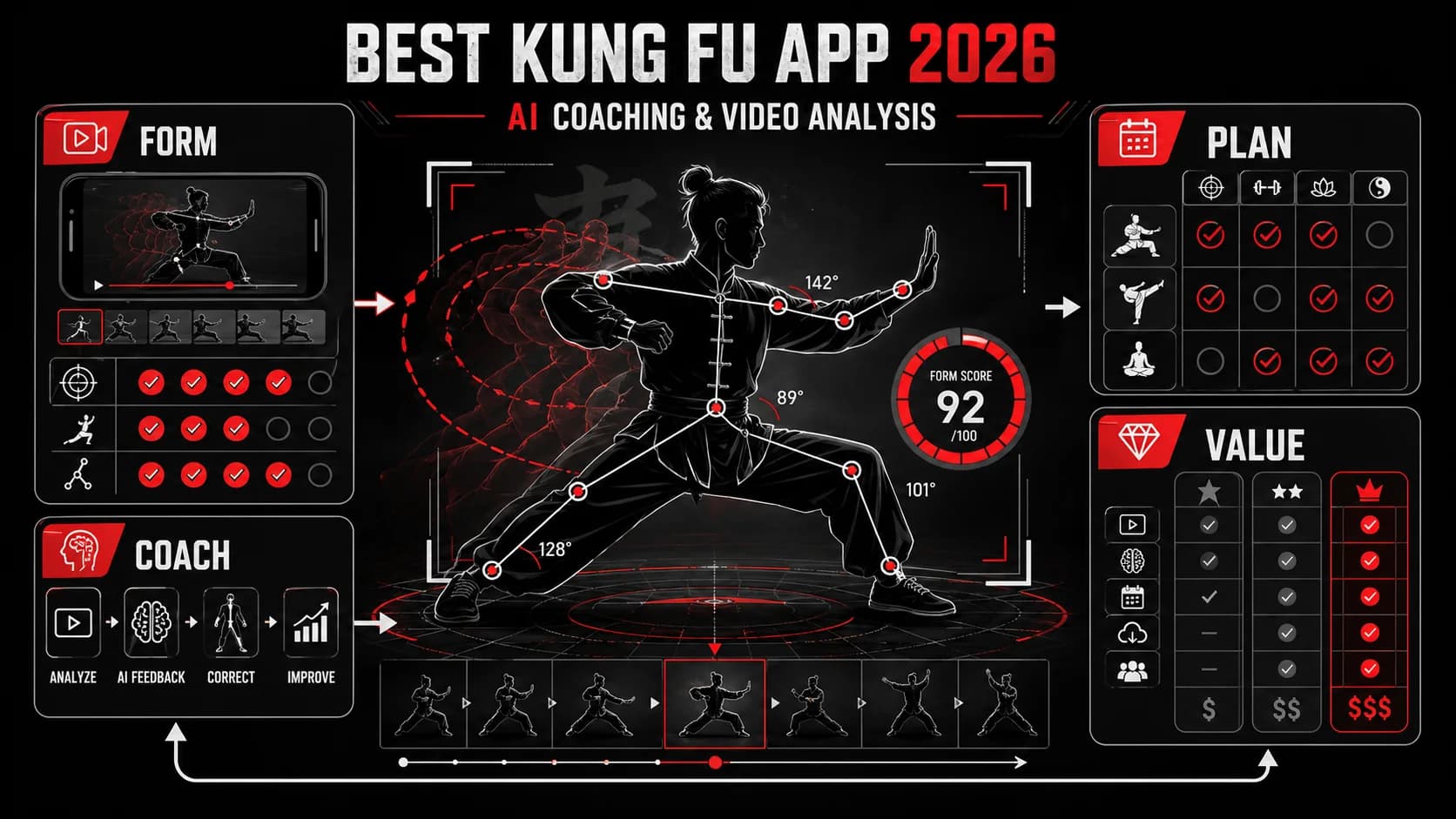
What it does: Kung Fu AI scores wushu taolu and traditional kung fu stances and forms from your phone camera, returns a 0-100 number, and visualises stance-depth deviation, hip rotation timing and balance error frame-by-frame. Sifu Wei (the chat coach) is built on the IWUF rule set and the standard shaolin lineage and answers in the right vocabulary, whether you are drilling Changquan, Nanquan or a Tai Chi 24 form.
Key features:
- Scoring for IWUF taolu (Changquan, Nanquan, Taijiquan) and major traditional forms.
- Stance metrics for mabu (horse stance), gongbu (bow stance), pubu (crouch stance) and the standard wushu jumps.
- Sifu Wei chat trained on IWUF rules and traditional pedagogy.
- On-device inference on iPhone 12 and newer; offline scoring in halls with bad reception.
- Adaptive plans driven by your last three uploads.
Pricing: Free tier with three video analyses per month. Premium USD 19.99/month or USD 179.99/year (annualised USD 14.99/month).
Best for: Wushu competitors and serious traditional kung fu students who want their solo training to count toward something measurable.
Honest limitations: Modern wushu biomechanics are the well-trained core; expect lower confidence on internal-arts forms where motion is deliberately small and slow. The scoring is best on full-body forms; it is shakier on isolated technique drills. The free tier is not enough by itself. Also, the app is iOS-only for now — Android users are out of luck unless they use a web wrapper.
Why it wins: The 2022 systematic review on augmented feedback finds that augmented visual feedback raises skill acquisition rates significantly for novices and intermediates. Kung fu has more "looks right but is not" failure modes than almost any martial art; an external eye that catches stance depth and hip rotation timing is genuinely useful.
Train Kung Fu with AI
Sifu Wei analyzes your technique, scores your form 0-100, and builds your training plan.
Download Kung Fu AI2. IWUF official site — best for current taolu rule sets
What it does: The IWUF is the world governing body for sport wushu. Its official site hosts the current rulebook, multimedia archive and event calendar, including the 16th World Wushu Championships cycle.
Best for: Competitive athletes and judges who need the current rule set.
Honest limitations: Web-based, not a real mobile app. Treat it as the rulebook anchor for whatever training tool you actually use. No video analysis, no coaching, no personalisation.
Price: Free.
3. Wing Chun Illustrated — best for Wing Chun-specific study
What it does: Wing Chun Illustrated is the long-running magazine for the art, with a dedicated Wing Chun Illustrated app on Google Play and iOS. The digital subscription is USD 18.99 for a year, which buys you the six new issues plus the full back-issue archive going back to 2011.
Best for: Wing Chun students who want technical articles, lineage interviews and concept deep-dives across Sil Lim Tao, Chum Kiu, Biu Ji, dummy work and chi sao.
Honest limitations: Magazine, not a coach. No video analysis of you. The app interface is a bit clunky — it's essentially a digital magazine reader, not a training tool. If you want to know why Wing Chun works the way it does, this is gold. If you want to know if your tan sao is correct, it won't help.
Price: USD 18.99/year.
4. Shaolin Kung Fu Fundamental — best traditional starter
What it does: Shaolin Kung Fu Fundamental by YMAA Publication Center is a long-running iOS reference of foundational shaolin techniques and conditioning drills. It is older but it is built around credible source material.
Best for: Beginners who want a calm, structured introduction to traditional shaolin basics.
Honest limitations: Reference, not a coach. UI feels its age. Content is mostly fundamentals — if you already know your mabu from your gongbu, you will outgrow it fast. No video analysis, no feedback.
Price: USD 7.99 (one-time purchase).
5. Learn Kung Fu — best free intro library
What it does: General free kung fu introduction app, hundreds of techniques on routine animations. Useful at zero cost for picking up names and rough motion patterns.
Best for: Curious beginners testing whether kung fu interests them before committing to a school.
Honest limitations: Generic. The standard caveat applies: learning martial arts from an app, with no instructor, is at best ineffective and at worst gets you injured. The IWUF and traditional schools both maintain that without a teacher you will plateau hard or learn the wrong thing. The animations are rough and the coaching is non-existent.
Price: Free (with ads).
6. Tai Chi internal-arts library — best for soft style focus
What it does: Several solid Tai Chi and internal-arts apps in the App Store cover Yang style 24 form, Chen style 18 form, Bagua circle walking and Xingyiquan five elements. They are interpretive — internal arts emphasise feel that no app captures — but they are useful for memorising sequence.
Best for: Practitioners building a daily Tai Chi or internal-arts habit.
Honest limitations: Internal arts emphasise breath, intent and structure under partner pressure. Apps cover the visible third of that. No app can tell you if your qi is sinking or if your intent is connected. These are memory aids, not coaches.
Price: USD 9.99–14.99/month depending on the app.
7. Martial Journal — best for cultural and historical depth
What it does: A long-form publication covering traditional martial arts, with strong kung fu representation. Articles, interviews, history.
Best for: Practitioners who care about why their style exists, not just how it moves.
Honest limitations: Pure reading. No training content. If you want to understand the cultural context of kung fu, this is excellent. If you want to get better at kung fu, it won't help directly.
Price: USD 29.99/year.
A note on the Olympic angle
Wushu is in the program of the Dakar 2026 Youth Olympic Games with four medal events. It is not in the LA28 Senior Olympics. If you train sport wushu and you care about international recognition, that progression matters; it shapes which forms get prioritised in IWUF events, and it shapes which apps invest in scoring those forms.
The practical takeaway: if you are training for competition, you need an app that knows IWUF rules. Kung Fu AI does. The others don't.
What the augmented-feedback literature actually says
Two anchors I keep coming back to:
- Soltani and Morice (2022), Psychology of Sport and Exercise — augmented visual feedback raises motor skill acquisition for novices and intermediates with robust effect. The study specifically looked at complex motor skills, which is exactly what kung fu forms are.
- Kok et al. (2021), German Journal of Exercise and Sport Research — video-based visual feedback in physical education shows the same direction with the strongest effect for beginners. The key finding: feedback is most effective when it is immediate and specific.
Boundaries: no app on this list publishes prediction-agreement against IWUF judges. The score is a strong personal trainer; it is not a referee. The literature also shows that feedback loses effectiveness as skill level increases — advanced practitioners need less correction and more strategic input.
Common Mistakes When Using Kung Fu Apps
- Treating the app as a replacement for a sifu. It is not. Use it between classes to drill clean repetitions; the sifu corrects what AI cannot see.
- Ignoring the feedback. If the app says your horse stance is too narrow, fix it. The whole point is the external eye.
- Using only the free tier. Three analyses per month is not enough to build a habit. If you are serious, pay for the premium.
- Expecting internal arts apps to teach feel. They can't. They are memory aids.
- Skipping the rulebook. If you are competing, the IWUF site is non-negotiable. Know the rules before you train.
Decision Rules
- Are you competing in IWUF events? → Kung Fu AI + IWUF official site.
- Are you a Wing Chun student? → Wing Chun Illustrated for depth, Kung Fu AI for technique correction.
- Are you a complete beginner? → Shaolin Kung Fu Fundamental for basics, then Kung Fu AI once you have the fundamentals.
- Are you curious but not committed? → Learn Kung Fu (free) to test the waters.
- Are you a Tai Chi or internal arts practitioner? → Tai Chi internal-arts library for sequence memorisation, but accept the limitations.
- Do you care about history and culture? → Martial Journal.
FAQ
Best kung fu app for beginners in 2026?
Kung Fu AI for technique correction. The IWUF site for current taolu rules. Shaolin Kung Fu Fundamental for traditional basics. Beginners benefit most from augmented feedback because self-correction is exactly what they cannot do yet.
Do kung fu apps actually improve technique?
Most are video libraries. The ones that improve technique close the augmented-feedback loop. Kung Fu AI is the only one on this list that does that in proper kung fu vocabulary. The literature supports this: augmented visual feedback accelerates skill acquisition for novices and intermediates.
How much does a good kung fu app cost?
Kung Fu AI is USD 19.99 per month or USD 179.99 per year. Wing Chun Illustrated is USD 18.99 for a year of digital. The IWUF site is free. Other reference apps run USD 7 to USD 15 a month. One-time purchases like Shaolin Kung Fu Fundamental (USD 7.99) are rare.
Can AI replace a kung fu sifu?
No. The literature on stress-response and partner pressure says it cannot. Use AI between classes; let the sifu correct what AI cannot see. AI scores visible biomechanics; a sifu reads timing, intent, and your day.
Which app works best on iPhone?
Kung Fu AI for on-device offline scoring (iPhone 12+). Wing Chun Illustrated for the cleanest reference experience. Shaolin Kung Fu Fundamental for traditional basics with a long iOS history.
Is there an Android app that does AI scoring?
Not yet. Kung Fu AI is iOS-only as of April 2026. Android users should use the IWUF site for rules and Wing Chun Illustrated for reference. No Android app on this list offers AI video analysis.
Can I use these apps for Sanda (Chinese kickboxing)?
No. These apps are focused on taolu (forms) and traditional kung fu. Sanda is a separate sport with different training needs. Look for a dedicated Sanda or kickboxing app.
How do I know if the app's scoring is accurate?
No app publishes prediction-agreement against IWUF judges. The score is a strong personal trainer, not a referee. Use it as a guide, not a verdict. If you are competing, get feedback from a human judge.
Final verdict
For most kung fu students in 2026, Kung Fu AI is the only app on this list that actually scores your taolu in IWUF vocabulary and tells you what to fix. The IWUF site is the rulebook anchor. Wing Chun Illustrated and the other reference apps fill specialist gaps. The sifu is still doing the hard work; the apps just give you something useful to bring back to her.
Start at Kung Fu AI, film one Yang-style 24 set, and look at where the model marks your stance transitions. Then take that feedback to your sifu and ask: "Is this right?" That conversation is where the real learning happens.
Train Kung Fu with AI
Sifu Wei analyzes your technique, scores your form 0-100, and builds your training plan.
Download Kung Fu AIOther Doved Studio projects
Related tools from the same studio you might find useful:
- Glean: Turn scrolling time into a daily action plan. Capture, process, execute.
- Popout: Create your portfolio in minutes with a single shareable page.
- Doved Studio: Studio indie derrière cette app et une dizaine d'autres outils.
Sifu Wei
Kung Fu specialist. Expert in forms, strikes, stances.
Sifu Wei is the AI coaching persona behind Kung Fu AI, built to provide personalized kung fu guidance through video analysis, training plans, and technique breakdowns.
Train Kung Fu with AI
Kung Fu AI gives you an AI coach that analyzes your technique, plans your training, and tracks your nutrition. Try it for free.