
AI Boxing Sparring Analysis: Fight IQ from Video
Use AI boxing sparring analysis to turn phone footage into fight-IQ metrics: punch patterns, guard recovery, range control, and round-by-round fatigue.
Titans Grip
Boxing Coach, 15+ years coaching footwork, head movement, and ring IQ
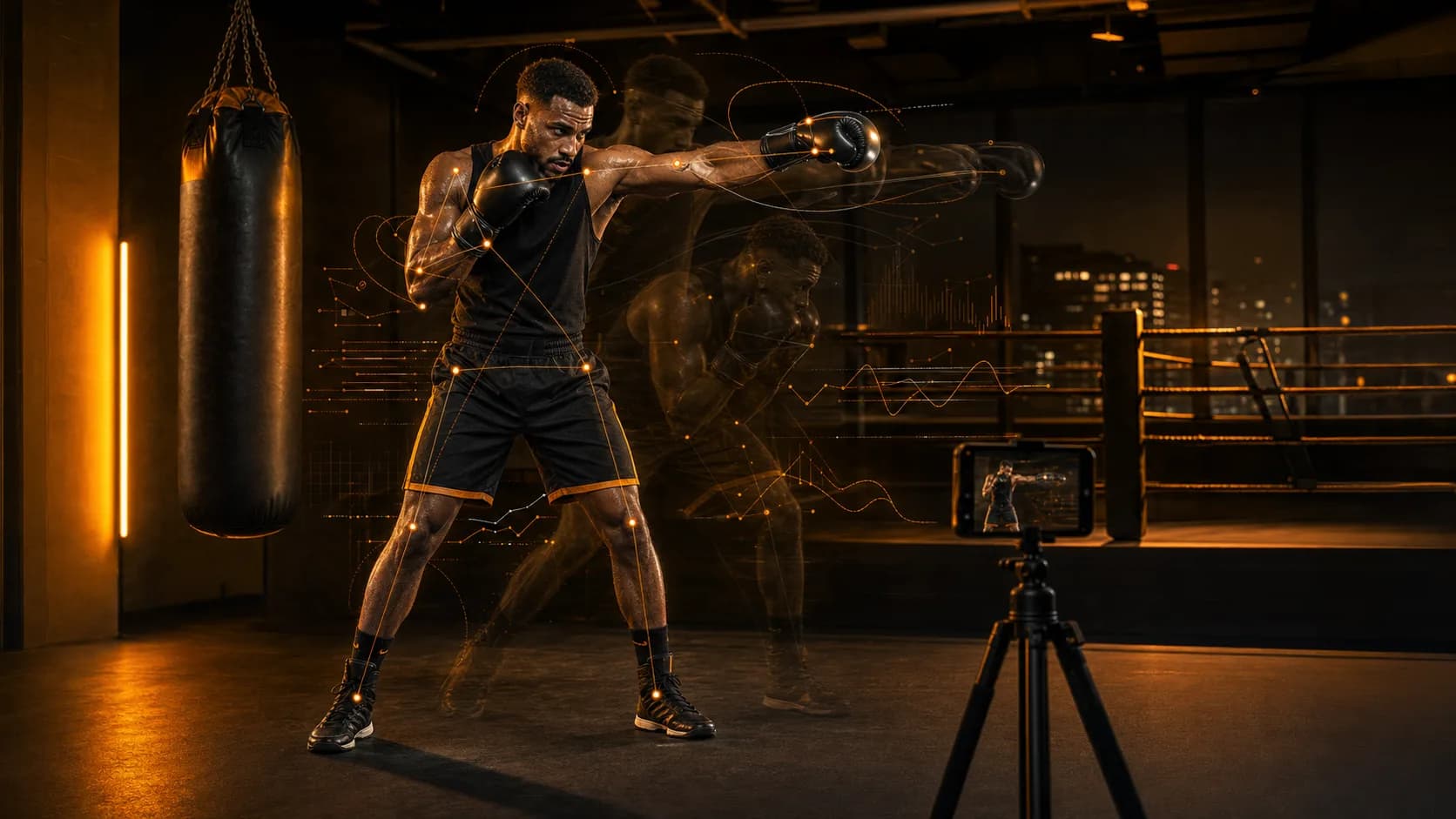
The best AI boxing sparring analysis in 2026 turns one phone clip into five useful fight-IQ checks: punch choice, guard recovery, exit direction, range control, and fatigue drop-off. Use it after sparring, not during sparring. Pick one question, review one metric, turn the answer into one drill, and retest the same behavior next week. That loop gives your coach cleaner evidence and gives you a way to improve between gym sessions.
You do not need a broadcast setup. A chest-height tripod, a clear side angle, and one honest round can show whether you jab before exiting, drop the rear hand after a cross, stand too square under pressure, or stop throwing to the body when you tire. Boxing AI works best when you treat the app as a review layer: it counts the repeatable patterns, then you and your coach decide which pattern deserves the next training block.
June 30, 2026 source check: I reviewed the competition, computer-vision, and motor-learning evidence before updating this page. The sources support a practical claim: AI can help you review sparring, but it works best when you pair the numbers with coaching judgment.
According to World Boxing, the 2026 competition structure includes 13 events across cups, confederation championships, U19 events, the Commonwealth Games, and the Youth Olympic Games.
According to Stefanski, Kozak, and Jach, single-camera punch detection can identify boxing actions, but it still carries limits around context and frame classification.
According to the BoxingVI benchmark, boxing action recognition still needs diverse clips because punch speed, camera angle, and athlete style change the problem.
According to Moinuddin et al., visual feedback plays a central role in learning complex motor skills.
Key takeaways
- AI sparring analysis is most valuable when it measures repeatable behaviors: punch selection, exit habits, guard recovery, stance width, and distance control.
- Single-camera boxing research is now good enough to detect punch events, but the hard part is still context: whether the punch mattered, landed clean, or was a tactical setup.
- The highest-ROI review is one metric per week. Do not chase a 0-100 score when the real problem is that your rear hand drops for 300 ms after every jab-cross.
- Use AI after sparring, not during it. Live sparring needs attention, not score-watching.
- Combine the numbers with coach review. When the data and the coach disagree, you found the next question.
- Pair sparring review with the boxing combo generator, fight-camp planner, round timer, punch speed tool, and Boxing AI technique library when you want the data to turn into training.
- Use the combat sports hub when you want to compare boxing review with MMA, kickboxing, Muay Thai, and grappling analysis.
Quick answer: what should AI review in sparring?
AI should review the behaviors that repeat across rounds. It should not try to judge your courage, decide who won the round, or claim exact punch power from ordinary video. A useful review answers plain questions:
| Sparring question | Metric to check | Training decision |
|---|---|---|
| Do I exit after I punch? | First step after every combination | Add a planned pivot or side step after the main combo. |
| Does my guard recover? | Time from final punch extension to both hands returning | Drill punch-catch-reset instead of throwing longer combinations. |
| Am I predictable? | First two punches after each reset | Add one second opener and one body-shot entry. |
| Am I losing range? | Time spent outside, jab range, pocket, or clinch | Change the entry plan or footwork constraint. |
| What disappears when I tire? | Round-by-round jab, body shot, pivot, or head-movement drop | Fix conditioning only after you know which skill decays. |
That table is the whole philosophy. AI boxing sparring analysis should make one behavior easier to see. Your coach, your opponent, and your training goal decide what the behavior means.
Why sparring footage is different from bag footage
Bag rounds are clean. You control distance, rhythm, and punch choice. Sparring is messy: feints interrupt combinations, your opponent crowds the line, the camera loses wrists behind shoulders, and your habits show up under stress. That mess is the point.
AI should not treat sparring like a perfect technique demo. A good review asks four questions:
- What did you try to do?
- What did you actually do under pressure?
- What kept repeating?
- Which repeat is worth training next week?
For most boxers, the answers are humbling. The jab disappears when they get backed up. The lead hook shows up only after the same right hand. The exit is always straight back. The guard is disciplined on the bag and late in sparring. Those are not character flaws. They are patterns, and patterns can be trained.
Bag footage still has value. Use the bag when you want clean mechanics, volume, and punch-speed work. Use sparring when you want truth under pressure. If your bag cross looks sharp but your sparring cross leaves your chin exposed, the sparring clip deserves priority. That gap tells you the skill has not survived contact, distance changes, and decision speed yet.
This is also why you should keep your review narrow. A full sparring round contains too much information. If you ask AI to summarize everything, you get a flattering report and no training decision. If you ask, "Did I exit after jab-cross under pressure?", you get a clean answer.
What modern computer vision can see
Recent boxing computer-vision work shows why phone-based analysis is becoming useful. The 2024 single-static-camera punch detection paper framed Olympic boxing analysis as a non-invasive video problem. It reported strong frame-level separation between punch and non-punch moments, while also showing that detection does not automatically equal tactical understanding. The BoxingVI benchmark then pushed the field toward action recognition and localization with 6,915 labeled punch clips across six punch types.
That means the technology is moving from "can a model see a punch?" toward "can a model understand a sequence?" For athletes, the second question is where the value lives.
The useful parts today:
- Pose estimation can flag stance width, shoulder rotation, hip timing, and hand return path when the camera sees the full body.
- Punch detection can count common events, separate busy rounds from quiet rounds, and find the moments worth reviewing.
- Sequence maps can show whether you repeat the same opener or always leave on the same side.
- Round splits can show whether fatigue changes your decision making.
The weak parts today:
- Ordinary video cannot measure true impact force.
- A single camera can miss wrists behind shoulders, clashes at close range, and punches hidden by an opponent.
- AI can count a backward exit, but it cannot always know whether that exit was a mistake or a smart reset.
- It cannot replace the coach who knows your injury history, your opponent, and your fight plan.
That is why I like a simple rule: let AI describe the repeat; let the coach choose the correction.
Train Boxing with AI
Coach Marcus analyzes your technique, scores your form 0-100, and builds your training plan.
Download Boxing AIThe fight-IQ metrics worth tracking
How predictable are your first two punches?
If 70% of your offense starts jab-cross, opponents learn the rhythm. The goal is not random punching. The goal is enough variation that the opponent cannot sit on your first or second beat.
Track your first two punches after every reset. If the same opener dominates, build one alternative for the next week: jab to body jab, double jab to exit, feint jab to rear uppercut, or jab step-off.
Our review note: when I test this in Boxing AI, I do not count every combination as a separate problem. We found that tagging the first two punches after each reset, then comparing round one against round three, makes the metric specific enough to train. A boxer who opens jab-cross 70% of the time does not need ten new combos. They need one second opener that survives pressure.
How fast does your guard recover?
Guard recovery is the time between the final extension frame of a punch and both hands returning near the defensive shell. It is one of the cleanest metrics because it survives style differences. A low-hand style still has a chosen defensive home; the question is whether the hand returns there after offense.
Slow recovery after a jab is usually a retraction issue. Slow recovery after a cross is often a shoulder-hip sequencing issue. Slow recovery after hooks is usually balance.
Review it in three bands:
- Under 250 ms: your hand returns before most counters arrive, assuming your feet stay under you.
- 250-500 ms: you need context. This may be fine after a committed power shot, but it is risky after a range-finding jab.
- Over 500 ms: build a dedicated drill. Throw, catch, reset, and make the reset as important as the punch.
Where do you exit after combinations?
Most boxers think they use angles. Film often shows they exit backward. AI can count the first step after a combination: left, right, forward, back, pivot, or hold ground.
If your exit map is mostly straight back, the fix is not "move more." It is pairing combinations with one planned exit. For example: jab-cross, lead-foot outside, right-hand guard glued, pivot out.
Use the boxing combo generator to build one exit into the combination itself. "Jab-cross-pivot" beats "jab-cross, then remember to move" because the exit becomes part of the pattern.
For example, a 3-round review might show 18 backward exits, 6 holds, 3 right exits, and 1 left pivot. That does not prove the boxer fought badly, but it does prove the exit menu is narrow. The next drill should not be a random footwork ladder. It should be one combination with one rehearsed angle, then one sparring constraint that rewards the angle.
Are you spending time at the right range?
Sparring analysis should show how much time you spend outside range, at jab range, in pocket range, or clinch range. If you are a tall boxer losing time in the pocket, the issue may be lazy exits. If you are a pressure boxer spending too long outside, the issue may be entry timing.
Range control also changes how you read punch volume. A low-volume round from outside range may show patience. A low-volume round from pocket range may show hesitation. The same number means different things once distance changes.
In practice, I separate range into four plain buckets: outside, jab range, pocket, and clinch. A tall boxer wants more controlled time at jab range. A pressure boxer wants cleaner entries from outside into pocket range. When the bucket does not match the style, the clip tells you where the plan broke.
What disappears when you tire?
The most honest metric is what disappears when you are tired. Does the jab volume fall? Do body shots vanish? Does your stance narrow? Does your head stop moving after combinations?
Round-three decay tells you whether the fix belongs in technique practice, conditioning, or tactical constraints.
If only conditioning drops, the answer may be roadwork, intervals, or better pacing. If the jab drops but your movement stays, you need a skill constraint. If your stance narrows and your head stops moving, you need fatigue-resistant footwork. Use the fight-camp planner to place that work into a real block instead of trying to fix it in one hard session.
When do counters become available?
AI review can also mark the frames after your attack where the opponent could counter. You do not need a perfect model to learn from this. If the same counter window appears after every lead hook, you can adjust the hook, add a roll, or exit on a different angle. The best sparring review does not shame the mistake. It names the timing.
Treat a counter window as a training question, not a verdict. If your lead hook leaves a 400 ms window before the rear hand returns, you can test three fixes: shorten the hook, roll under after the hook, or exit to the lead side. The next sparring round then asks one question: which fix closes the window without killing your offense?
Does your stance drift under pressure?
Stance drift means your feet change shape under pressure. You start balanced, then the rear foot drags narrow, the lead foot crosses the center line, or your hips square up when you throw. Stance drift matters because every other metric gets worse after it: guard recovery slows, exits shrink, and counters land cleaner.
Use the stance analyzer after a technical session, then compare that clean stance to sparring. The difference tells you whether the issue is knowledge, fatigue, or pressure.
A clean stance in shadowboxing proves you know the shape. A messy stance in sparring proves the shape breaks under pressure. That distinction matters because the fix changes. If you do not know the shape, drill technique. If you know it but lose it, spar with a constraint: every exchange must end with the rear foot outside the center line and both hands back home.
A 30-minute weekly review workflow
How should you film one sparring round?
Use landscape mode, tripod height around chest level, and enough distance to keep both athletes in frame. Do not zoom. Do not let a teammate handhold the phone unless you want shaky data.
Which question should you choose before upload?
Good questions:
- Am I exiting after my jab-cross?
- Does my rear hand drop after I throw the jab?
- Am I relying on one opener?
- What punch disappears under fatigue?
- Does my stance narrow after the second exchange?
Bad questions:
- Was I good?
- What is my score?
- Did I win the round?
- Am I ready to fight?
How should you review the metric?
Numbers need context. A low punch count may be smart if you were drawing counters. A repeated jab-cross may be fine if it kept landing. A backward exit may be tactical if you were resetting a taller opponent. The metric starts the conversation; it does not finish it.
How do you turn the finding into one drill?
If the finding is rear-hand drop, the drill is not "keep your hand up." It is jab-cross, catch, pivot, repeat. If the finding is no body work, the drill is double jab upstairs, cross to body, exit left. If the finding is stance narrowing, use rope-line footwork rounds with a width constraint.
When should you retest?
Do not change five things at once. Fix one metric and re-test. The compounding effect is the point.
What sentence should you log?
Write one sentence after every review:
This week I will fix my exit after jab-cross by drilling jab-cross-pivot for three rounds after technical sparring.
That sentence beats a dashboard full of numbers. It names the behavior, the fix, and the place where you will retest it.
Sparring review examples
Example 1: the tall boxer who keeps getting crowded
The clip shows a tall orthodox boxer winning the first exchange with a jab, then losing range after every second punch. The AI exit map shows 62% backward exits and only 9% pivots. The coach sees the same thing: the boxer punches, admires the work, then backs out in a straight line.
The fix:
- Limit the review to first step after jab-cross.
- Drill jab-cross, lead-foot outside, rear hand glued, pivot.
- Run two controlled sparring rounds where the boxer only scores the exchange if the exit happens.
- Retest one week later.
Do not add five new combinations. The athlete already has offense. The missing skill is leaving on an angle.
Example 2: the pressure boxer whose body work vanishes
The boxer wants to fight inside, but the round-three map shows body shots dropping from 18 attempts in round one to 3 attempts in round three. Punch-speed data stays stable. Footwork volume stays stable. The issue is not general fatigue; the athlete stops choosing body shots under pressure.
The fix:
- Add one body-shot entry to the weekly plan: double jab upstairs, cross to body, left hook exit.
- Use the round timer for three 2-minute constraint rounds.
- Review only body-shot attempts and exits.
- Retest in live sparring.
Example 3: the beginner who wants a score
Beginners often want a 0-100 answer. That can help motivation, but it does not teach enough by itself. If the app gives a 74, ask what behavior caused the missing 26 points. Maybe the jab returns late. Maybe the feet cross. Maybe the boxer throws every cross with the chin high.
The fix is one named behavior, not a better score. A good beginner review says, "Your jab is useful, but your rear hand drops after it. This week, every jab ends with catch-reset."
How to film sparring so AI can help
Use a boring setup:
- Place the phone on a tripod, not in a teammate's hand.
- Film landscape.
- Keep both boxers in frame, including the feet.
- Use a side or 45-degree angle instead of filming from behind a corner post.
- Avoid mirrors and bright windows behind the athletes.
- Film one round you can review calmly, not the wildest round of the night.
If the camera misses the feet, you lose stance and exit data. If the camera misses the hands, you lose guard recovery. If the clip is too shaky, the app may still give a score, but you should not trust the fine detail.
For home work, pair this with the boxing workout at home guide and the punch speed tool. For app selection, compare the full best boxing app 2026 ranking and the boxing app reality check.
What AI should not claim
AI should not tell you it knows punch power from ordinary video. It can estimate speed and mechanics, but impact force needs more context. AI should not pretend every guard is the same. Philly shell, high guard, long guard, and peek-a-boo all need different baselines. AI should not score sparring like judging. Clean scoring depends on contact quality, target area, balance, and referee interpretation.
The honest promise is better: AI gives you objective pattern memory. It remembers every frame without ego, fatigue, or favorite athletes.
How Boxing AI fits into fight camp
Use Boxing AI for the boring measurements that humans are bad at repeating: punch counts by round, guard recovery, stance drift, exit direction, and common sequence maps. Use your coach for the strategic interpretation: why the pattern happened and which fix matters most for your next opponent.
That partnership is the sweet spot. The app makes the invisible pattern visible. The coach turns the pattern into boxing.
When you use it in a fight camp, split the work by week:
| Camp phase | What to review | What to ignore |
|---|---|---|
| Weeks 8-6 | Baseline habits: stance, exits, guard recovery | Tiny scoring changes after one round |
| Weeks 5-3 | Opponent-specific entries and counters | New techniques that do not fit the plan |
| Weeks 2-1 | Fatigue decay, pacing, and safe exits | Heavy technical rebuilds |
| Fight week | Confidence clips and simple reminders | Any metric that makes you second-guess the plan |
AI belongs in the review room. Your body belongs in the ring. Keep those jobs separate and the tool helps instead of distracting you.
FAQ
Is AI boxing sparring analysis accurate enough for real training?
It is accurate enough to track visible patterns when the video shows the full body and both athletes. It is not accurate enough to replace a coach, judge a round, or measure true impact force. Use it for repeatable behaviors: exit direction, guard recovery, stance drift, and punch selection.
Should I review every sparring round?
No. Review one or two useful rounds each week. If you review every clip, you will collect more numbers than decisions. Pick the round that matches your current training question.
Can AI tell whether a punch landed?
Sometimes, but contact quality remains hard from ordinary video. A model may detect that a punch reached the target zone, but it may miss whether the glove landed clean, glanced off, or hit the guard. Use landing data as a prompt for review, not as a final verdict.
What is the best metric for beginners?
Guard recovery is the best first metric. It stays simple, it protects the athlete, and it connects directly to drills. If your hands return late, your coach can fix that before you chase more advanced tactics.
What is the best metric for competitive amateurs?
Exit direction usually gives the best return. Good amateurs can punch. Many still leave exchanges in straight lines. A clean exit map turns film study into a tactical edge fast.
Conclusion: use AI to choose the next drill
AI boxing sparring analysis should not make sparring feel like a video game. It should help you choose the next drill with less guesswork. Film one honest round, ask one question, review one behavior, and build one correction into the next week.
Start with Boxing AI if you want the app to review your footage, then use the fight-camp planner and boxing combo generator to turn the finding into training. The score matters less than the sentence you can act on: "I will fix this one habit before the next round."
Sources
Coach Marcus
Boxing specialist. Expert in footwork, combinations, defense.
Coach Marcus is the AI coaching persona behind Boxing AI, built to provide personalized boxing guidance through video analysis, training plans, and technique breakdowns.
Related Articles
Train Boxing with AI
Boxing AI gives you an AI coach that analyzes your technique, plans your training, and tracks your nutrition. Try it for free.