
Boxing Training Plan for Beginners: 12 Weeks to Your First Spar
A real 12-week plan for new boxers. Stance, jab, footwork through controlled sparring, with weekly drills, conditioning benchmarks, and the gear that matters.
Titans Grip
Boxing Coach, 15+ years coaching footwork, head movement, and ring IQ
Boxing has had a quiet boom for the last five years. The International Boxing Association and USA Boxing have both reported steady amateur participation growth since the gym shutdowns of 2020 sent a generation home to a heavy bag and a YouTube playlist. Search interest tells a similar story: queries like "how to start boxing" climb every January and stay elevated through spring.
The problem is the gap between wanting to box and knowing how to train. New boxers tend to fall into one of two ditches. The first is YouTube university – 30-second clips of slick combinations that skip the stance, guard, and weight transfer that make those combinations land. The second is the cold-plunge introduction at a gym – showing up day one and getting thrown into an intermediate class where you either get discouraged or pick up bad habits that take months to unlearn.
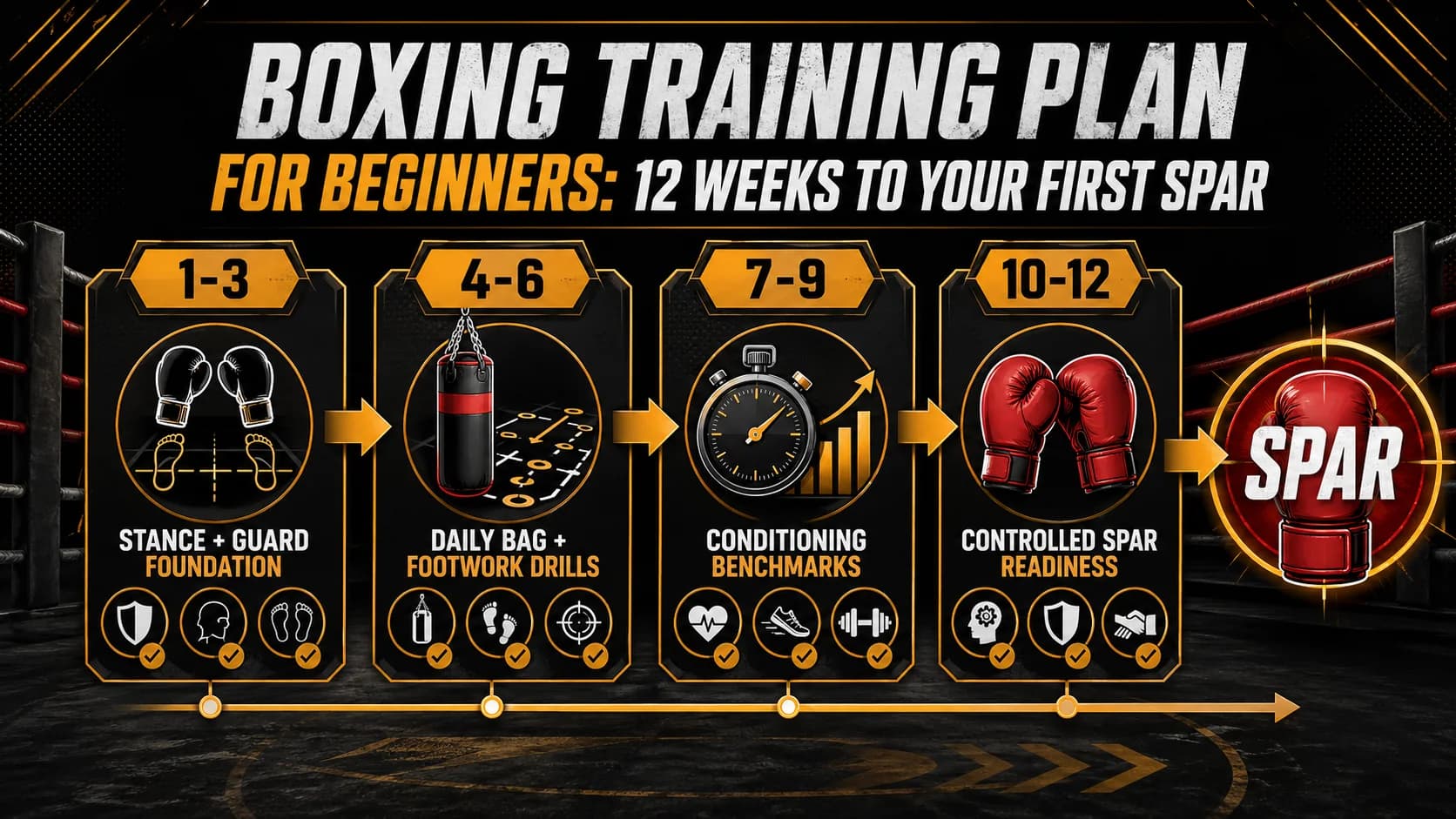
This program bridges that gap. It assumes zero boxing experience and progresses through three phases of four weeks: foundation (stance, basic punches, footwork), building (full punch arsenal, defense, combinations), and application (partner drills, controlled sparring, ring craft). By week 12 you have the technical base, the conditioning, and the tactical awareness to step into a ring for controlled sparring rounds without embarrassing yourself or getting hurt.
The plan runs four sessions a week: two technique-focused, one conditioning, one bag or pad work. The four-day frequency matches what most amateur programs run for the same reason: enough exposure for skill acquisition, enough recovery to keep showing up.
I have coached boxing and combat sport athletes for 15 years, from total beginners to national-level amateurs. This is the same progression I use in person, adapted for self-directed training.
Key Takeaways
- Three-phase progression: Foundation (weeks 1-4), Building (weeks 5-8), Application (weeks 9-12). Each phase has clear benchmarks you must meet before moving on.
- Four sessions per week: Two technique, one conditioning, one bag/pad work. This frequency balances skill acquisition with recovery.
- Equipment is non-negotiable: Hand wraps, 16oz gloves, mouthguard, jump rope, and flat-soled shoes. Cheap gear creates bad habits and injuries.
- Controlled sparring only after week 8: Sparring before you have a solid technical base teaches bad habits under pressure. The program builds to it deliberately.
- Conditioning is sport-specific: Jump rope, bodyweight circuits, and steady-state running build the anaerobic power and muscular endurance boxing demands.
- Benchmarks prove readiness: Each phase ends with specific, measurable benchmarks. If you can't hit them, repeat the phase before progressing.
Equipment checklist before you start
You don't need much. What you do need matters. Cheap gear creates bad habits and injuries.
Hand wraps, 180-inch Mexican-style: $10-15. Non-negotiable. Wraps protect the small bones in your hands and the wrist tendons during impact. Mexican-style (semi-elastic) wraps conform better than traditional cotton. Buy two pairs so you always have a dry set. Wrap both hands every session, including shadow work.
Boxing gloves, 14-16oz for training: $40-80. Beginners use 16oz. More padding protects you and your training partners; the extra weight builds shoulder endurance. Decent entry-level brands: Venum Challenger, RDX F6, Everlast Elite. Avoid anything under $30; the padding compresses inside a month. You'll need separate sparring gloves later, but one training pair handles the first 12 weeks.
Mouthguard: $10-30. A boil-and-bite from Shock Doctor or Venum is fine for training. You'll need it starting week 9. Custom-fitted dental guards are better but not necessary at this stage.
Jump rope: $10-20. Basic PVC speed rope is the right choice. Skip weighted ropes – they slow your rhythm, and the point is foot speed and coordination. The rope should reach your armpits when you stand on the center.
Shoes: flat-soled. Boxing shoes ($60-120) are optional. Any flat shoe – Converse Chuck Taylors, wrestling shoes, indoor court shoes – works fine. Avoid running shoes; the raised heel shifts your weight backward and kills your ability to pivot.
Optional but useful: a heavy bag ($80-200 freestanding), a mirror for shadow feedback, and a round timer (free apps work, or use the built-in Titans Grip round timer with customizable intervals).
The plan at a glance
| Phase | Weeks | Focus | Sessions/Week | Key skills |
|---|---|---|---|---|
| Foundation | 1-4 | Stance, guard, jab, cross, basic footwork | 4 | Orthodox/southpaw stance, jab, cross, forward/back/lateral movement |
| Building | 5-8 | Hooks, uppercuts, defense, combinations | 4 | Lead hook, rear hook, uppercuts, slips, rolls, parries, 4-6 punch combos |
| Application | 9-12 | Partner drills, controlled sparring, ring craft | 4 | Touch sparring, controlled rounds, cutting the ring, counter-punching |
Weekly structure
- Monday — Technique. Shadow boxing, new skills, drill work (60-75 min).
- Tuesday — Conditioning. Jump rope, bodyweight circuits, running (45-60 min).
- Wednesday — Rest or active recovery (walking, mobility).
- Thursday — Technique. Shadow, combination work, defense drills (60-75 min).
- Friday — Bag or pad work. Heavy bag rounds, mitts if you have a partner (45-60 min).
- Saturday — Long run. 25-40 min steady-state, conversational pace.
- Sunday — Full rest.
Train Boxing with AI
Coach Marcus analyzes your technique, scores your form 0-100, and builds your training plan.
Download Boxing AIWeeks 1-4: Foundation
This phase exists to build the platform everything else sits on. Stance and footwork are not exciting. They are also why a fighter with a clean jab and clean feet will outperform a fighter with fancy combinations and a bad base. The published boxing biomechanics literature on punch power confirms the obvious: the kinetic chain runs from the floor up. The stance is the floor.
Week 1: stance, guard, jab
Technique sessions. Establish your stance. Orthodox (left foot forward, for right-handers) or southpaw (right foot forward, for lefties). Feet shoulder-width apart, rear foot angled 45°, knees slightly bent, weight 50/50. Lead hand at eyebrow height, rear hand against your cheekbone. Chin down, elbows tucked.
Learn the jab only. The jab sets up everything: it measures distance, disrupts timing, scores points. Extend your lead hand straight from your guard, rotate so the palm faces down at full extension, snap it back to your guard immediately. Don't reach. Don't drop the rear hand. Don't lean forward.
- 3 rounds shadow boxing (2 minutes each, 30 seconds rest), jab only, focus on returning to guard.
- Footwork drills: forward step, backward step, lateral slide left and right.
- 50 jabs in front of a mirror, checking form every 10.
Week 2: cross
Technique sessions. The cross (straight right for orthodox) is your power punch. Force generates from the rear-foot rotation through hip, torso, and shoulder. Cue: push off the ball of your rear foot, rotate the hip 90°, let the hand follow. Rear heel lifts off the ground. Fist travels straight from cheekbone to target and straight back.
- 4 rounds shadow boxing: jab, cross, jab-cross.
- Footwork: pivots off the front foot to create angles after the jab-cross.
- Drill: throw jab-cross, immediately step at a 45° angle to the right. 10 reps each side.
Week 3: jab-cross-jab and head movement
Technique sessions. Three-punch combination, jab-cross-jab. The rhythm is quick-power-quick. The second jab is faster and shorter than the first because your body is already rotated.
Introduce slips. Slip left: bend knees, shift weight to lead leg, head moves outside the lead knee. Slip right: shift weight to rear leg, head moves outside the rear knee. Slips are small and controlled. They are not ducks.
- 5 rounds shadow boxing: jab-cross-jab, slips between combinations.
- Mirror drill: imagined partner throws jab → you slip right; cross → you slip left. 3 rounds.
Week 4: double jab, body jab, first bag work
Technique sessions. Double jab-cross. The double jab is not two separate jabs; the first is a range-finder, the second carries the weight. Body jab uses the same mechanics with bent knees to lower your level, targeting solar plexus or liver. Bend the knees, not the waist.
First heavy bag work. Start light. The bag is for timing and accuracy, not testing how hard you can hit. Three rounds maximum this week. Hit the bag with the first two knuckles, wrist straight on impact.
- 4 rounds shadow boxing: all combinations to date.
- 3 rounds heavy bag: jab, cross, jab-cross, double jab-cross at 50-60% power.
- Conditioning: 3 rounds jump rope (2 min on, 30 sec rest), 3 sets of 15 push-ups, 3 sets of 20 sit-ups.
Foundation phase benchmark
Before you move on, you should be able to: throw a clean jab-cross while keeping the non-punching hand at guard, move forward-back-lateral without crossing your feet, complete 3 rounds of shadow boxing without dropping your hands from fatigue, and hit a heavy bag with proper fist alignment (no wrist pain). Cannot check all four? Repeat week 4 before progressing.
Weeks 5-8: Building
Phase 2 expands your punch arsenal to hooks and uppercuts, adds defensive techniques beyond basic slips, and builds your ability to throw flowing multi-punch combinations. By the end you have all eight fundamental punches (jab, cross, lead hook, rear hook, lead uppercut, rear uppercut, body jab, body cross) and three primary defensive movements (slip, roll, parry).
Week 5: lead hook
Technique sessions. The lead hook puts more people on the canvas in pro boxing than any other single punch. It travels on a horizontal arc, generates power from hip rotation, and the most common beginner mistake is swinging the arm wide like a haymaker. Correct form: elbow bent at 90°, fist at chin height, rotate the lead hip and shoulder simultaneously, fist travels in a tight arc to the jaw or temple. Elbow stays at the same height as the fist throughout.
Roll defense (sometimes called "rolling under" or bob and weave): U-shaped movement, knees bend, weight shifts from one leg to the other, you come back up on the opposite side. Primary defense against hooks.
- 5 rounds shadow boxing: jab-cross-lead hook, lead hook-cross, jab-lead hook.
- Defense drill: partner throws slow hook, you roll under and counter with a cross. 3 rounds.
- Heavy bag: 4 rounds. Lead hook focus on rotation, not arm strength.
Week 6: rear hook and parry defense
Technique sessions. The rear hook uses lead-hook mechanics from the rear hand. It's thrown less often, defended less often, and that's why it works as a surprise weapon. Power comes from the rear hip rotating forward, with the arm holding 90°.
Parry: small, sharp redirecting motion. Lead hand parries an incoming jab across the body; rear hand parries an incoming cross. A parry is not a slap and is not a grab.
- 5 rounds shadow boxing: 3-4 punch combinations including both hooks.
- Parry drill: jab parried with rear hand → counter jab. Cross parried with lead hand → counter cross. 3 rounds.
- Heavy bag: 4 rounds. Flow between straights and hooks.
Week 7: uppercuts
Technique sessions. Lead and rear uppercuts are close-range weapons that travel vertically from below. Power comes from driving up through legs and hips. Common beginner error: dropping the hand before throwing, which telegraphs the punch. The uppercut should launch from your guard, fist dipping slightly, palm rotating to face you, driving upward to the chin or body.
- 6 rounds shadow boxing: combinations with uppercuts (jab-cross-lead uppercut, cross-lead hook-rear uppercut, jab-rear uppercut-lead hook).
- Heavy bag: 4 rounds. Uppercuts to the body of the bag (closer range).
- Conditioning: 5 rounds jump rope, 4 sets of 20 push-ups, 3 sets of 30 sit-ups, 100 crunches.
Week 8: flowing combinations and counter-punching
Technique sessions. This week integrates everything. You have all eight punches and three defenses. The focus is flowing between them without resetting to a static guard between every combination.
Counter-punching: any punch thrown immediately after a defensive movement. Slip right → counter cross. Roll under a hook → come up with an uppercut. Parry a jab → counter jab-cross.
- 6 rounds shadow boxing: 5-6 punch combinations with defense between combos.
- Counter-punching drill: shadow-spar (imagine an opponent attacking, defend, counter), 3 rounds.
- Heavy bag: 5 rounds. Full combinations, all punches at 60-70% power.
Building phase benchmark
Before phase 3: clean 4-punch combination ending with a hook while maintaining balance, slip a jab and counter with a cross without pausing, 5 rounds of heavy bag at moderate intensity without dropping your hands, jump rope 5 consecutive rounds. Any of those fail? Repeat week 8.
Weeks 9-12: Application
This is where boxing becomes a two-person sport. Everything you've practiced gets tested against an unpredictable, moving, reacting human. The rule for this entire phase: ego stays outside the ring. Controlled sparring is for learning, not winning. Every round where you learn something is a successful round, regardless of whether you "won" it.
You need a training partner. A real boxing gym is the right answer; explain you're a beginner looking for controlled sparring and most gyms have experienced members who will work with you at light contact. No gym access? Partner drills with a friend on the same plan work, with honesty about level and intensity.
Week 9: touch sparring (30% power)
You're tagging your partner, not hitting them. The goal is timing, distance, reaction. Hitting a moving person who hits back is nothing like hitting a bag. Everything you practiced will feel harder. That's normal.
- 3 rounds touch sparring (2 min each, 1 min rest).
- After each round: identify one thing you did well and one to improve.
- Partner drill: one attacks with jab-cross only, the other defends with slips and parries only. Switch roles. 3 rounds each.
- Focus targets: maintaining distance, keeping hands up under pressure, breathing.
Week 10: controlled sparring (50% power)
Punches land with a solid pop but not enough force to hurt or mark. This is where you start feeling the reality of boxing – the anxiety of getting hit, the tunnel vision, the heavy breathing. All normal. Combat-sport-specific stress responses tend to normalize after several controlled sparring sessions; the boxing-injury epidemiology literature suggests training-injury rates are far lower than competition-injury rates, on the order of 1.7 vs 1,200 per 1,000 hours, so the controlled-training context is genuinely safe relative to competition.
- 4 rounds controlled sparring (2 min each, 1 min rest).
- Pair with a more experienced partner if possible – they will control the pace and give you openings.
- Focus targets: throwing combinations (not single punches), using footwork to create and close distance, breathing between exchanges.
Week 11: ring craft
The tactical layer. Cutting off the ring: stepping laterally to reduce your opponent's escape angles, herding them toward a corner or rope. Pivoting off the ropes when you end up there instead of trying to push through. Stepping offline after combinations so you're not standing directly in front of your opponent for the counter.
- 4 rounds sparring (2 min each) with specific tactical assignments:
- Round 1: cutting off the ring (one moves, one cuts).
- Round 2: pivoting off the ropes.
- Round 3: creating angles after combinations.
- Round 4: free round, apply all tactics.
- Heavy bag: 3 rounds focusing on combination-then-angle (combo, step to 2 o'clock or 10 o'clock).
Week 12: full controlled sparring
Three full rounds of controlled sparring at 60-70% power. Final exam. Apply everything: stance, footwork, all eight punches, defense, combinations, counters, ring craft. Record your sparring rounds and review them – you will see things you cannot feel in real time. The Titans Grip Boxing AI app can score your recorded sparring footage across multiple parameters.
- 3 rounds sparring (2 min each, 1 min rest).
- Video review after each session.
- Post-sparring debrief: 3 strengths, 3 areas for improvement.
- Cool-down: 5 rounds shadow boxing at low intensity, smooth technique focus.
Conditioning program
Boxing conditioning is not bodybuilding. The goal is sustained output across 2-3 minute rounds with brief recovery, plus the explosive power to throw hard punches when openings appear. Sport-specific conditioning research (see NSCA combat-sport guidance) consistently identifies anaerobic power, upper-body muscular endurance, and core rotational strength as the limiting qualities.
Weekly schedule
| Day | Session | Duration | Details |
|---|---|---|---|
| Tuesday | Conditioning | 45-60 min | Jump rope, bodyweight circuits, core |
| Saturday | Long run | 25-40 min | Steady-state, 2-4 miles, conversational pace |
Tuesday progression
Weeks 1-4:
- Jump rope: 3 rounds × 2 min (30 sec rest)
- Push-ups: 3 × 15
- Sit-ups: 3 × 20
- Bodyweight squats: 3 × 20
- Plank: 3 × 30 sec
Weeks 5-8:
- Jump rope: 5 rounds × 2 min (30 sec rest)
- Push-ups: 4 × 20
- Sit-ups: 4 × 30
- Burpees: 3 × 10
- Mountain climbers: 3 × 30 sec
- Plank: 3 × 45 sec
- Russian twists: 3 × 20 (rotation for punching power)
Weeks 9-12:
- Jump rope: 8 rounds × 2 min (30 sec rest), vary regular, single-leg, double-unders
- Push-ups: 5 × 20 (variations: diamond, wide, clapping)
- Sit-ups: 4 × 40
- Burpees: 4 × 12
- Shadow boxing intervals: 6 × 30 sec all-out / 30 sec rest (round-surge simulation)
- Plank: 3 × 60 sec
- Medicine ball rotational throws: 3 × 10 each side (if available)
Week 12 benchmark targets
By the end of the program, you should hit:
- 12 consecutive rounds of jump rope (2 min on, 30 sec rest).
- 5 rounds of heavy bag at moderate-high intensity without dropping hands.
- 50 consecutive push-ups (any pace).
- 3-mile run under 24 minutes.
- 3 rounds of sparring without gassing in the third round.
Common beginner mistakes
I've seen thousands of beginners make these. Each one is fixable; you have to know to look for it.
Dropping the rear hand on the jab. The most universal beginner mistake. Your rear hand drops from cheekbone to chest while you extend the jab. That leaves your chin completely exposed to the counter cross, the most dangerous punch in the sport. Fix: consciously press your rear glove to your cheekbone every time you jab. Exaggerate it for the first four weeks until it becomes automatic.
Standing flat-footed. Flat feet kill movement, pivots, and power. Weight on the balls of the feet, heels slightly elevated. "Ready to move in any direction at any instant." If someone gently pushed you, you should be able to step and recover.
Holding your breath while punching. Beginners hold their breath through combinations. The result is rapid fatigue and sometimes dizziness. Exhale sharply with every punch – a short "shh" or "tss" sound. It prevents breath-holding, tightens the core at impact, and creates rhythm.
Swinging instead of snapping. Power comes from hip rotation and the kinetic chain, not from winding up the arm. Beginners pull the fist back before throwing it. That telegraphs the punch and reduces speed. Every punch travels the shortest possible path from guard to target and back. Snap, don't swing.
Going too hard early in sparring. Ego is the biggest injury risk for beginners. Get hit → instinct says hit back harder. Land a clean shot → instinct says chase the knockout. Both wrong. Controlled sparring at 30-50% power teaches you more in one round than 100% sparring teaches in ten, because you can think, observe, and adjust instead of operating in panic mode.
FAQ
How long does it take to learn boxing?
This 12-week program gives you a solid technical foundation. Boxing mastery is a lifelong sport. Most coaches consider 6 months to 1 year the timeline for a beginner to be "competent" – able to spar safely, basic strategy, reliable combinations. Sanctioned amateur bouts typically take 1-2 years of consistent training before they're appropriate. Consistency is the variable: four sessions a week, every week, beats six sessions a week for two months and then nothing.
Do I need a gym, or can I learn at home?
Phases 1 and 2 (weeks 1-8) work entirely at home with a mirror, hand wraps, gloves, and ideally a heavy bag. Phase 3 (weeks 9-12) requires a partner and ideally a gym with coaching supervision. A coach catches errors you can't see or feel. If a gym is accessible, use it from week 1.
Is boxing dangerous for beginners?
Controlled training with proper equipment carries low injury risk. The boxing injury epidemiology research finds amateur training injury rates roughly comparable to recreational soccer. Most training injuries are hand and wrist (improper wrapping or glove fit) and shoulder strains (poor mechanics). Sparring should only begin after 8 weeks of technical preparation, at controlled intensity, with proper headgear and mouthguard.
How often should a beginner box per week?
Four sessions per week is the realistic optimum. Two technique, one conditioning, one bag. The frequency gives you enough exposure for skill acquisition without overwhelming recovery.
When am I ready to spar?
After completing weeks 1-8 and meeting both phase benchmarks. Specifically: clean 4-punch combinations with maintained guard, slip and parry basic attacks, 5 rounds of bag at moderate intensity, conditioning to sustain 2-minute rounds. Sparring before this foundation is built teaches bad habits under pressure – the kind that take months to unlearn.
Can an app help me learn boxing?
Apps are useful for structured programming, round timing, technique reference, and form analysis. The Titans Grip Boxing AI app does AI-powered video analysis that scores your punching technique, identifies form errors frame by frame, and generates personalized training plans. It includes a technique library, customizable round timer, combination generator, and training log. An app supplements coaching and structured programs like this one – it does not replace the need for a training partner and eventually a coach's eye. More boxing content lives at the combat sports hub.
This program is designed for healthy adults with no pre-existing injuries. Consult a physician before beginning any new exercise program. If you experience persistent joint pain, dizziness, or unusual symptoms, stop training and seek medical advice.
Other Doved Studio projects
Related tools from the same studio you might find useful:
- Glean: Turn scrolling time into a daily action plan. Capture, process, execute.
- Popout: Create your portfolio in minutes with a single shareable page.
- Doved Studio: Indie studio behind this app and a dozen others.
Coach Marcus
Boxing specialist. Expert in footwork, combinations, defense.
Coach Marcus is the AI coaching persona behind Boxing AI, built to provide personalized boxing guidance through video analysis, training plans, and technique breakdowns.
Related Articles
Roland Garros Is Spiking Again: A 7-Day Footwork Microcycle for Fighters
Jun 2, 2026 · 22 min read
BoxingFootball Search Spikes: The Fighter Footwork Plan Behind Today's Attention
Jun 1, 2026 · 22 min read
BoxingRoland-Garros Footwork for Boxing and MMA: The 6-Week Split-Step Conditioning Plan
May 31, 2026 · 17 min read
Train Boxing with AI
Boxing AI gives you an AI coach that analyzes your technique, plans your training, and tracks your nutrition. Try it for free.