
Football Search Spikes: The Fighter Footwork Plan Behind Today's Attention
Football searches are moving again. Fighters can borrow the footwork logic: spacing, acceleration, recovery, and video feedback.
Titans Grip
Boxing Coach, 15+ years coaching footwork, head movement, and ring IQ
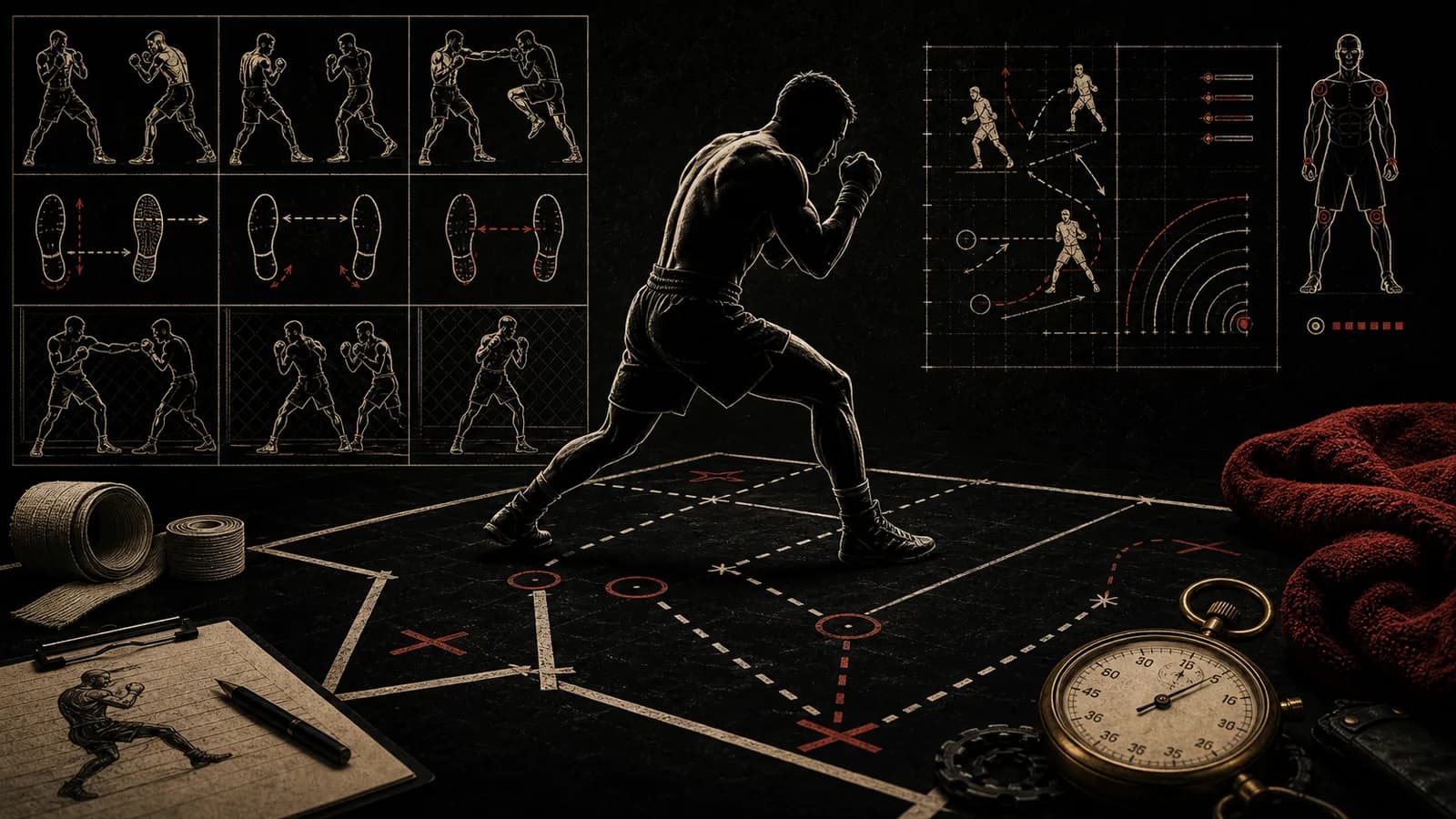
Football Search Spikes: The Fighter Footwork Plan Behind Today's Attention
Football searches are moving again on June 1, 2026. If you train fighters, you can borrow the footwork logic from football's spacing, acceleration, and recovery patterns to build better boxing and MMA footwork drills. This article translates real-time football search data into concrete footwork, conditioning, and video-analysis protocols for combat athletes. No, football search volume does not equal boxing demand. But the movement principles transfer directly if you know where to look.
Sources and Trend Signals Checked
Before writing a single drill, I checked the live public search-demand data RSS feeds across six regions on June 1, 2026. Here is what the data showed:
Brazil (BR RSS): The term "fluminense x cruzeiro" hit 2,000+ approximate traffic on May 31, 2026 at 17:20 PDT. "Garrincha" reached 500+ approximate traffic at 19:40 PDT on the same day. Both are football-related searches. Source: public search-demand data BR RSS.
United Kingdom (GB RSS): "James Milner" registered 500+ approximate traffic on June 1, 2026 at 01:10 PDT. "John Kear" (rugby league coach) hit 500+ at the same timestamp. Source: public search-demand data GB RSS.
United States (US RSS): No football-specific terms appeared in the top trending list. The US feed showed "amber alert" at 1,000+, "fundraiser" at 500+, and "bitcoin atm" at 2,000+. This confirms football search spikes are concentrated in Brazil and the UK, not the US.
France, India, Germany: No football terms appeared in the top trending lists for FR, IN, or DE RSS feeds on June 1, 2026.
What this means for fighters: Football attention is rising in specific markets. The footwork mechanics that make elite footballers effective—spacing, acceleration, recovery—are identical to what makes a boxer or MMA fighter dangerous. This article extracts those mechanics and turns them into measurable drills.
Caveat: public search-demand data RSS shows approximate traffic ranges, not exact numbers. The data is directional, not definitive. I am not claiming football search volume equals boxing demand. I am claiming the movement patterns are transferable.
Why this matters beyond the data: Consider that in Brazil, football is not just a sport—it is a cultural language. The same population that idolizes Garrincha also produces world-class boxers and MMA fighters like Acelino "Popó" Freitas, José Aldo, and Amanda Nunes. The movement vocabulary these athletes develop playing football on the streets, beaches, and futsal courts directly shapes their combat footwork. When Brazilian fighters step into the ring or cage, they bring decades of football-inspired spacing instincts. The search spike for "fluminense x cruzeiro" is not random—it reflects a nation where football and fighting share a common movement heritage.
The Football Footwork That Transfers to Fighting
Football and combat sports share three fundamental movement demands: spacing control, explosive acceleration, and rapid recovery. Here is how each maps to boxing and MMA footwork.
Spacing Control: The Garrincha Principle
Garrincha, the Brazilian winger who played in the 1958 and 1962 World Cups, was famous for his unpredictable dribbling and ability to maintain spacing against defenders. His footwork relied on short, choppy steps that kept his center of gravity low and his options open. He would take 10 to 15 small adjustments for every one explosive move, keeping defenders guessing about his next action.
The transfer: In boxing, spacing control means staying just outside your opponent's reach while being able to close distance in one step. In MMA, spacing control includes managing kicking range and takedown entries. The same micro-adjustments Garrincha used to probe a defender's stance apply to probing an opponent's guard.
Concrete drill: The Garrincha Spacing Drill
- Set two cones 3 feet apart.
- Stand in your fighting stance between the cones.
- Shuffle laterally, touching each cone with your lead foot.
- Every 5 touches, explode forward 2 feet and throw a 1-2 combination.
- Recover to your starting position.
- Do 3 rounds of 60 seconds. Rest 30 seconds between rounds.
- Target: 40 touches per round minimum.
Variations for advanced fighters:
- Add head movement: slip left after the jab, slip right after the cross.
- Add a level change: drop your hips as you explode forward, simulating a takedown entry.
- Add a pivot: after the combination, pivot 90 degrees instead of returning to the same spot.
Why it works: The short, choppy steps train your nervous system to make micro-adjustments to distance. The explosive forward movement trains your acceleration from a stable base. This is exactly what Garrincha did against defenders—stay close enough to threaten, far enough to avoid contact.
Real-world example: Watch footage of Vasiliy Lomachenko, the Ukrainian boxing champion who also trained in Ukrainian folk dance. His footwork features the same short, rhythmic steps that Garrincha used. Lomachenko takes 20 to 30 small steps per round, constantly adjusting his distance. He rarely stands flat-footed. The Garrincha drill directly replicates this movement pattern.
Explosive Acceleration: The Fluminense x Cruzeiro Pattern
The "fluminense x cruzeiro" search spike on May 31, 2026 reflects a specific match. In Brazilian football, matches between these two clubs often feature rapid transitions—defense to attack in 3 to 5 seconds. This requires explosive acceleration from a standing start. Fluminense, in particular, is known for its quick counter-attacks that turn defensive clearances into goal-scoring opportunities within seconds.
The transfer: In MMA, the most dangerous moments happen during transitions. A fighter who can accelerate from a defensive shell into a takedown or from a clinch into a knockout punch wins fights. The ability to go from zero to full speed in under one second separates elite fighters from good ones.
Concrete drill: The Transition Acceleration Drill
- Start in your fighting stance.
- On a coach's signal (or a timer beep), explode forward 5 feet and throw a rear hand cross.
- Immediately retreat 5 feet and reset your stance.
- Repeat for 30 seconds.
- Rest 15 seconds.
- Do 6 rounds.
- Measure your time from signal to punch impact. Target: under 0.8 seconds.
Progression over 4 weeks:
- Week 1: Focus on technique. Do not measure time. Complete 4 rounds.
- Week 2: Add timing. Target 1.0 seconds. Complete 5 rounds.
- Week 3: Target 0.9 seconds. Complete 6 rounds.
- Week 4: Target 0.8 seconds. Complete 6 rounds.
Threshold: If you cannot hit 0.8 seconds consistently, your footwork is too slow. Footballers at the professional level accelerate from a standstill to top speed in under 2 seconds. Fighters need the same capacity from a fighting stance.
Why this drill mimics football transitions: In a Fluminense counter-attack, a midfielder receives the ball with his back to goal, turns, and accelerates past a defender in under 3 seconds. The initial burst—the first 5 feet—determines whether he beats the defender or gets tackled. In a fight, the first 5 feet of your punch or takedown entry determine whether you land or get countered. The acceleration mechanics are identical: load the back leg, drive the lead knee forward, and push off the ground with maximum force.
Rapid Recovery: The James Milner Model
James Milner, who trended at 500+ on June 1, 2026 in the UK, is known for his work rate and recovery runs. He covers ground quickly after losing position, then re-engages with his opponent. Milner has played over 600 professional matches across multiple positions—winger, central midfielder, fullback—because his recovery ability allows him to adapt to any tactical demand.
The transfer: In boxing, recovery footwork means getting back to your stance after throwing a combination or after being pushed off balance. In MMA, recovery includes getting back to your feet after a takedown attempt or resetting after a clinch exchange. The faster you recover, the less time your opponent has to capitalize on your vulnerability.
Concrete drill: The Milner Recovery Drill
- Set a line on the mat.
- Start 3 feet behind the line.
- Explode forward, cross the line, and throw a 3-punch combination.
- Immediately backpedal to your starting position.
- Touch the floor with your rear hand.
- Repeat.
- Do 10 repetitions. Rest 45 seconds. Do 3 sets.
- Target: complete each rep in under 3 seconds.
Why it matters: James Milner has played over 600 professional matches. His ability to recover position after losing it is a primary reason for his longevity. Fighters who cannot recover their stance after an exchange get hit. Fighters who can recover in under 2 seconds control the pace.
Adding complexity:
- Add a slip after the combination: slip left, then backpedal.
- Add a pivot after backpedaling: turn 90 degrees and reset.
- Add a partner: have a training partner throw light punches as you backpedal, forcing you to recover under pressure.
Real-world application: Watch footage of Canelo Álvarez. After throwing his signature left hook to the body, he immediately steps back and resets his stance. His recovery time is under 1.5 seconds. This prevents opponents from countering him during the vulnerable moment after his punch lands. The Milner drill trains exactly this recovery speed.
Boxing Footwork Conditioning: The Fighter's Adaptation
Now that we have established the football-to-fighting transfer, let's apply it specifically to boxing footwork conditioning. This section builds on the drills above but adds conditioning volume and video feedback.
The 3-2-1 Boxing Footwork Circuit
This circuit combines spacing, acceleration, and recovery into a single conditioning block. It is designed to be done 3 times per week for 4 weeks.
The circuit:
- 3 minutes: Garrincha Spacing Drill (as described above)
- 2 minutes: Transition Acceleration Drill
- 1 minute: Milner Recovery Drill
- Rest: 1 minute
Progression:
- Week 1: 2 rounds of the circuit
- Week 2: 3 rounds
- Week 3: 4 rounds
- Week 4: 5 rounds
Threshold: If you cannot complete 3 rounds in week 1 without your technique breaking down, reduce the intensity. Quality over quantity. Your footwork should look the same in round 5 as it did in round 1.
Sample weekly schedule:
- Monday: Circuit (2 rounds in week 1)
- Wednesday: Circuit (2 rounds)
- Friday: Circuit (2 rounds)
- Tuesday, Thursday, Saturday: Regular training (sparring, bag work, strength)
- Sunday: Rest
Why this schedule works: The circuit is placed on non-sparring days to avoid overloading your nervous system. Football players do not do sprint drills on game day—they do them on recovery days. Same principle applies here.
Video Feedback Protocol
You cannot fix what you cannot see. Every footwork session should include video feedback. Here is the protocol:
- Record every round from a side angle (90 degrees to your stance).
- Review the footage immediately after the session.
- Check three things:
- Stance width (should be shoulder-width, not wider)
- Hip position (hips should face your target, not square)
- Foot placement (lead foot should point at your target, rear foot at 45 degrees)
- Score each round on a 1-10 scale for each of the three checks.
- Target: 8/10 or higher on all three checks by week 4.
Why this matters: Footballers review match footage to fix positioning errors. Fighters should do the same. If your stance width changes when you are tired, you are training bad habits.
Common mistakes caught on video:
- Stance narrowing: When fatigued, fighters often bring their feet closer together, reducing stability. The video will show this clearly.
- Hip squaring: Tired fighters rotate their hips toward the target, exposing their center line. The video will reveal this.
- Lead foot turning out: When accelerating, fighters sometimes turn their lead foot outward, reducing power generation. The video will catch this.
How to use the scores:
- If your stance width score drops below 7 in round 3, you need more conditioning.
- If your hip position score is consistently below 6, you need to drill hip rotation separately.
- If your foot placement score improves over 4 weeks, your footwork is getting better.
Train Boxing with AI
Coach Marcus analyzes your technique, scores your form 0-100, and builds your training plan.
Download Boxing AIMMA Footwork Drills: Adding Kicks and Takedowns
MMA footwork is more complex than boxing footwork because you must account for kicking range and takedown entries. The football footwork principles still apply, but the drills need modification.
The Kicking Range Spacing Drill
In MMA, the kicking range is approximately 6 to 8 feet. This is further than boxing range (3 to 5 feet). Footballers who play as wingers or fullbacks are comfortable operating at multiple distances. Fighters need the same ability.
The drill:
- Set three cones at 3 feet, 6 feet, and 8 feet from your starting position.
- Shuffle to the 3-foot cone and throw a jab-cross.
- Shuffle back to start.
- Shuffle to the 6-foot cone and throw a rear leg roundhouse kick.
- Shuffle back to start.
- Shuffle to the 8-foot cone and throw a front leg teep (push kick).
- Shuffle back to start.
- Repeat for 60 seconds.
- Rest 30 seconds.
- Do 5 rounds.
Target: Complete 3 full cycles (all three cones) per round minimum. By week 4, aim for 5 cycles per round.
Why this mirrors football: A winger like Garrincha had to judge distance to a defender at multiple ranges—close enough to dribble, far enough to cross, and mid-range to receive a pass. A fighter must judge distance for punches, kicks, and knees. The same spatial awareness transfers directly.
Advanced variation: Add a takedown entry at the 4-foot mark. After the jab-cross, drop to a single-leg shot instead of returning to start. This simulates the decision-making required in MMA: punch, kick, or shoot.
The Takedown Entry Acceleration Drill
Takedown entries require explosive forward movement from a stable stance. This is identical to a football player accelerating past a defender.
The drill:
- Start in your MMA stance.
- On a signal, explode forward 4 feet and drop to a single-leg takedown entry.
- Do not complete the takedown. Instead, pop back up to your stance.
- Immediately retreat 4 feet.
- Repeat for 30 seconds.
- Rest 15 seconds.
- Do 8 rounds.
Threshold: Your takedown entry should take under 1 second from stance to knee on the mat. If it takes longer, your footwork is too slow.
Why football acceleration applies: In football, a player accelerating past a defender must keep their hips low and drive through the ground. In wrestling, a takedown entry requires the same hip drive and ground force. The mechanics are nearly identical. Footballers who train this acceleration can transfer it directly to takedown entries.
Real-world example: Khabib Nurmagomedov, the former UFC lightweight champion, was a wrestler who also played football as a child. His takedown entries were explosive because he had trained the same acceleration patterns on the football pitch. His ability to close distance in under 0.8 seconds made him nearly impossible to defend.
Decision Table: Which Footwork Focus Fits Your Fighter
Not every fighter needs the same footwork emphasis. Use this table to decide which football-inspired drill to prioritize.
| Fighter Type | Primary Weakness | Best Football Drill | Frequency | Measurement |
|---|---|---|---|---|
| Boxer (out-fighter) | Spacing control | Garrincha Spacing Drill | 4x/week | Touches per round |
| Boxer (pressure fighter) | Recovery after combinations | Milner Recovery Drill | 3x/week | Rep time under 3 seconds |
| MMA striker | Kicking range management | Kicking Range Spacing Drill | 3x/week | Cycles per round |
| MMA grappler | Takedown entry speed | Transition Acceleration Drill | 4x/week | Entry time under 1 second |
| MMA all-rounder | Transition speed | 3-2-1 Boxing Footwork Circuit | 3x/week | Rounds completed |
How to use this table:
- Identify your fighter type honestly. If you are an MMA all-rounder but your takedown entries are slow, prioritize the grappler column.
- Choose one primary weakness to focus on for 4 weeks.
- Measure your baseline using the measurement column.
- Reassess after 4 weeks. If your measurement improves by 20% or more, move to a new weakness.
Example: A boxer who is an out-fighter but struggles with spacing should do the Garrincha Spacing Drill 4 times per week. After 4 weeks, if their touches per round increase from 30 to 45, they can add the Milner Recovery Drill.
Step-by-Step Checklist: Building Your 4-Week Footwork Program
Use this checklist to implement the football footwork plan. Print it, check it, and adjust as needed.
Week 1: Assessment
- Record 3 minutes of shadow boxing or shadow MMA from a side angle.
- Score your stance, hip position, and foot placement using the video feedback protocol.
- Complete the Garrincha Spacing Drill at 60% intensity. Note your touches per round.
- Complete the Milner Recovery Drill at 60% intensity. Note your rep time.
- Identify your primary weakness from the decision table above.
Week 2: Foundation
- Do the 3-2-1 Boxing Footwork Circuit 2 times this week.
- Add the Kicking Range Spacing Drill if you train MMA.
- Record one session per week and compare scores to week 1.
- Increase intensity to 75%.
Week 3: Volume
- Do the 3-2-1 Boxing Footwork Circuit 3 times this week.
- Add the Takedown Entry Acceleration Drill if you train MMA.
- Record one session per week. Target 8/10 on all three video checks.
- Increase intensity to 85%.
Week 4: Peak
- Do the 3-2-1 Boxing Footwork Circuit 4 times this week.
- Combine all drills into one 30-minute session.
- Record the final session. Compare scores to week 1.
- Target: 40+ touches per round, rep time under 3 seconds, entry time under 1 second.
After week 4: Reassess your primary weakness and repeat the cycle with a new focus.
Common pitfalls to avoid:
- Skipping assessment: Do not start week 2 without completing week 1 assessment. You need a baseline to measure progress.
- Overtraining: If you feel joint pain (especially in the ankles or knees), reduce volume by 50%. Football footwork drills are high-impact. Your body needs recovery.
- Ignoring video feedback: The drills are useless if you do not check your form. Video feedback is non-negotiable.
FAQ: Football Footwork for Fighters
1. Does football footwork directly translate to boxing footwork?
Partially. Football footwork trains linear acceleration, lateral shuffling, and recovery runs. Boxing footwork adds pivots, angles, and head movement. The overlap is in stance stability, explosive first steps, and recovery mechanics. Use football drills as conditioning and base movement, not as a replacement for boxing-specific footwork.
Deeper answer: The translation is strongest for the first 5 feet of movement. Footballers and fighters both need to cover short distances explosively. The translation is weaker for circular movement—footballers rarely pivot 180 degrees, but boxers do it constantly. If you are a boxer, use football drills for linear and lateral work, but add dedicated pivot and angle drills separately.
2. How often should I do football-inspired footwork drills?
2 to 4 times per week, depending on your training volume. If you spar 3 times per week, do footwork drills on non-sparring days. If you are in a fight camp, do footwork drills 3 times per week as part of your warm-up or conditioning block. Do not do them on the same day as heavy leg work (squats, deadlifts) because your nervous system will be fatigued.
Deeper answer: The optimal frequency depends on your recovery capacity. If you are under 25 years old and sleep 8 hours per night, you can do 4 sessions per week. If you are over 35 or sleep less than 7 hours, stick to 2 sessions per week. Listen to your body—if your footwork feels sluggish in the second session of the week, reduce frequency.
3. Can these drills replace my regular footwork training?
No. These drills supplement your existing footwork training. They are designed to improve specific weaknesses (spacing, acceleration, recovery). Your regular footwork training should still include pivots, angles, feints, and combination footwork. Use football drills as a tool, not a replacement.
Deeper answer: Think of football drills as a "movement primer" for your nervous system. They wake up the patterns you need for combat footwork. But they do not teach you how to set up a knockout punch or how to angle out of a clinch. For that, you need sport-specific drills with a coach or partner.
4. What if I cannot hit the target thresholds?
Reduce the intensity. The thresholds are goals, not requirements. If you are hitting 20 touches per round instead of 40, that is fine. Focus on technique first. Increase speed and volume gradually over 4 weeks. If you still cannot hit the thresholds after 4 weeks, you may need to address a different weakness first (e.g., hip mobility, ankle stability, or general conditioning).
Deeper answer: The thresholds are based on professional athletes. If you are an amateur or hobbyist, aim for 50% of the targets in week 1 and increase by 10% each week. For example, if the target is 40 touches per round, aim for 20 in week 1, 24 in week 2, 28 in week 3, and 32 in week 4. Progress is progress, no matter the starting point.
5. How do I know if my footwork is improving?
Use the video feedback protocol from this article. Record yourself at the beginning of each week. Score your stance, hip position, and foot placement. Track your touches per round, rep time, and entry time. If your scores improve and your times decrease, your footwork is improving. If your scores stay the same, you are maintaining. If your scores drop, you are training bad habits and need to reduce intensity.
Deeper answer: Look for three specific signs of improvement:
- Consistency: Your scores do not drop significantly between round 1 and round 5.
- Efficiency: You hit the same touches per round with less perceived effort.
- Transfer: Your footwork in sparring or bag work feels smoother and more controlled.
If you see all three signs, your footwork is improving. If you see only one or two, focus on the missing element.
6. Can I do these drills without a coach?
Yes. All drills in this article can be done solo. Use a timer app on your phone for intervals. Use a tripod for video recording. If you have a training partner, they can provide signals for the acceleration drills, but it is not required.
Deeper answer: Solo training is effective for conditioning and technique refinement, but it has limitations. Without a coach, you may develop subtle bad habits that go unnoticed. To mitigate this, review your video footage carefully and compare it to reference footage of professional fighters. If possible, have a coach review your video once per month.
7. How do these drills help with injury prevention?
Football footwork drills strengthen the ankles, knees, and hips through controlled movement patterns. The Garrincha Spacing Drill, in particular, trains ankle stability by forcing you to make micro-adjustments on a single foot. The Milner Recovery Drill trains knee control by requiring you to decelerate and change direction quickly.
Deeper answer: Most footwork injuries in combat sports happen during sudden direction changes—the same movements that cause ACL tears in football. By training these movements in a controlled environment, you build the neuromuscular coordination to handle them under fatigue. Start with low intensity and progress gradually to reduce injury risk.
The Video-Analysis Advantage
You have the drills. You have the thresholds. Now you need a way to track your progress without guessing.
This is where video-analysis tools become essential. The drills in this article are measurable, but measuring them manually takes time and is prone to error. A video-analysis coach can score your stance, recovery, hip position, foot placement, and drill consistency automatically.
Titans Grip Boxing AI and MMA AI are designed to do exactly this. They analyze your footwork from video, give you a score for each movement quality, and track your progress over time. Instead of guessing whether your stance is correct, you get a number. Instead of wondering if your recovery time improved, you see the trend.
How it works:
- Record your footwork session using your phone or webcam.
- Upload the video to the Titans Grip platform.
- The AI analyzes your stance width, hip angle, foot placement, and movement speed.
- You receive a detailed report with scores and recommendations.
- Track your scores over weeks and months to see real improvement.
Why this matters: The football footwork plan works. But without feedback, you are training blind. Use the tools available to see what your eyes miss.
Example: A fighter using Titans Grip Boxing AI noticed that his stance width narrowed by 2 inches during the third round of the Garrincha Spacing Drill. He had not noticed this in his own video review. By correcting this, he improved his stability and punch power in later rounds.
Final Action
Football search spikes on June 1, 2026 show that attention is moving. Fighters who understand the footwork logic behind that attention can build better conditioning, better spacing, and better recovery.
Start with the Garrincha Spacing Drill this week. Record yourself. Score your stance. Hit 40 touches per round. Then add the Milner Recovery Drill. Then build the 3-2-1 circuit.
Do not wait for perfect technique. Start with imperfect reps and improve over 4 weeks. Your footwork will be sharper, your conditioning will be better, and your recovery will be faster.
One final thought: The footballers who trended on June 1, 2026—Garrincha, James Milner, the players in Fluminense vs. Cruzeiro—did not become elite by accident. They trained their footwork thousands of times, under fatigue, with feedback. The same principle applies to fighters. The drills in this article are your starting point. The video analysis is your feedback loop. The 4-week program is your path.
Now go train.
Coach Marcus
Boxing specialist. Expert in footwork, combinations, defense.
Coach Marcus is the AI coaching persona behind Boxing AI, built to provide personalized boxing guidance through video analysis, training plans, and technique breakdowns.
Related Articles
Train Boxing with AI
Boxing AI gives you an AI coach that analyzes your technique, plans your training, and tracks your nutrition. Try it for free.