Olympic Weightlifting Weight Classes 2026 + AI Prep
The 2026 IWF weight-class changes alter meet planning. Learn how Olympic Weightlifting AI uses video analysis to guide class choice and bar-path work.
Titans Grip
Olympic Weightlifting Coach, snatch and clean and jerk technical development
Olympic weightlifting in 2026 has two big planning problems at the same time. The first is official: the IWF Technical and Competition Rules list new bodyweight categories from August 1, 2026. The second is practical: lifters still need to decide whether a class move is worth it when the snatch and clean & jerk are decided by positions, timing, and confidence under the bar.
That is where AI video analysis becomes more useful than a generic logbook. A spreadsheet can show your total. It cannot show whether your new bodyweight is producing a faster pull, a tighter turnover, or a more stable receiving position.
This guide breaks down the 2026 class changes and gives a practical way to use Olympic Weightlifting AI during the transition.
Key takeaways
- From August 1, 2026, IWF rules move senior and junior men to 60, 65, 70, 75, 85, 95, 110, and +110 kg; senior and junior women move to 49, 53, 57, 61, 69, 77, 86, and +86 kg.
- LA28 Olympic categories are narrower: men 65, 75, 85, 95, 110, +110 kg and women 53, 61, 69, 77, 86, +86 kg.
- A class decision should be based on total potential, training quality, and technical stability, not just morning bodyweight.
- Single-camera snatch research now shows that bar-path tracking can extract meaningful variables and classify trajectory quality from ordinary video.
- AI works best when it compares your own trend lines: bar path, receiving depth, lockout stability, turnover speed, and miss pattern.
The 2026 IWF class change
The IWF Technical and Competition Rules published in November 2025 list the category transition beginning August 1, 2026. For senior and junior men, the sequence becomes 60, 65, 70, 75, 85, 95, 110, and +110 kg. For senior and junior women, it becomes 49, 53, 57, 61, 69, 77, 86, and +86 kg.
The Olympic Games Los Angeles 2028 categories listed in the same rulebook are six per gender: men at 65, 75, 85, 95, 110, +110 kg; women at 53, 61, 69, 77, 86, +86 kg.
For everyday lifters, the headline is simple: your old class may no longer map cleanly to your future competition target. A 73 kg male lifter may need to decide whether to grow into 75 or cut toward 70. A 59 kg female lifter may need to decide whether 57 or 61 produces the better total and better training life.
The wrong way to choose a class
The wrong way is to ask, "What class can I make?" That question rewards short-term weight manipulation and ignores the sport. A class is useful only if you can train well enough to total well.
Better questions:
- Which class lets me train with stable energy?
- Which class preserves speed under the bar?
- Which class gives me the best clean recovery?
- Which class lets me make attempts in sequence, not just hit one gym lift?
- Which class matches the qualifying path I actually care about?
Your bodyweight is one input. Your technical trend is another.
Train Olympic Weightlifting with AI
Coach Ilya analyzes your technique, scores your form 0-100, and builds your training plan.
Download Olympic Weightlifting AIWhy AI video analysis matters during a class move
When a lifter gains or loses bodyweight, the lifts often change before the total changes. The pull feels different. Timing shifts. The turnover gets late. The receiving position may become more stable or less mobile. A logbook misses those signals because it only records kilograms.
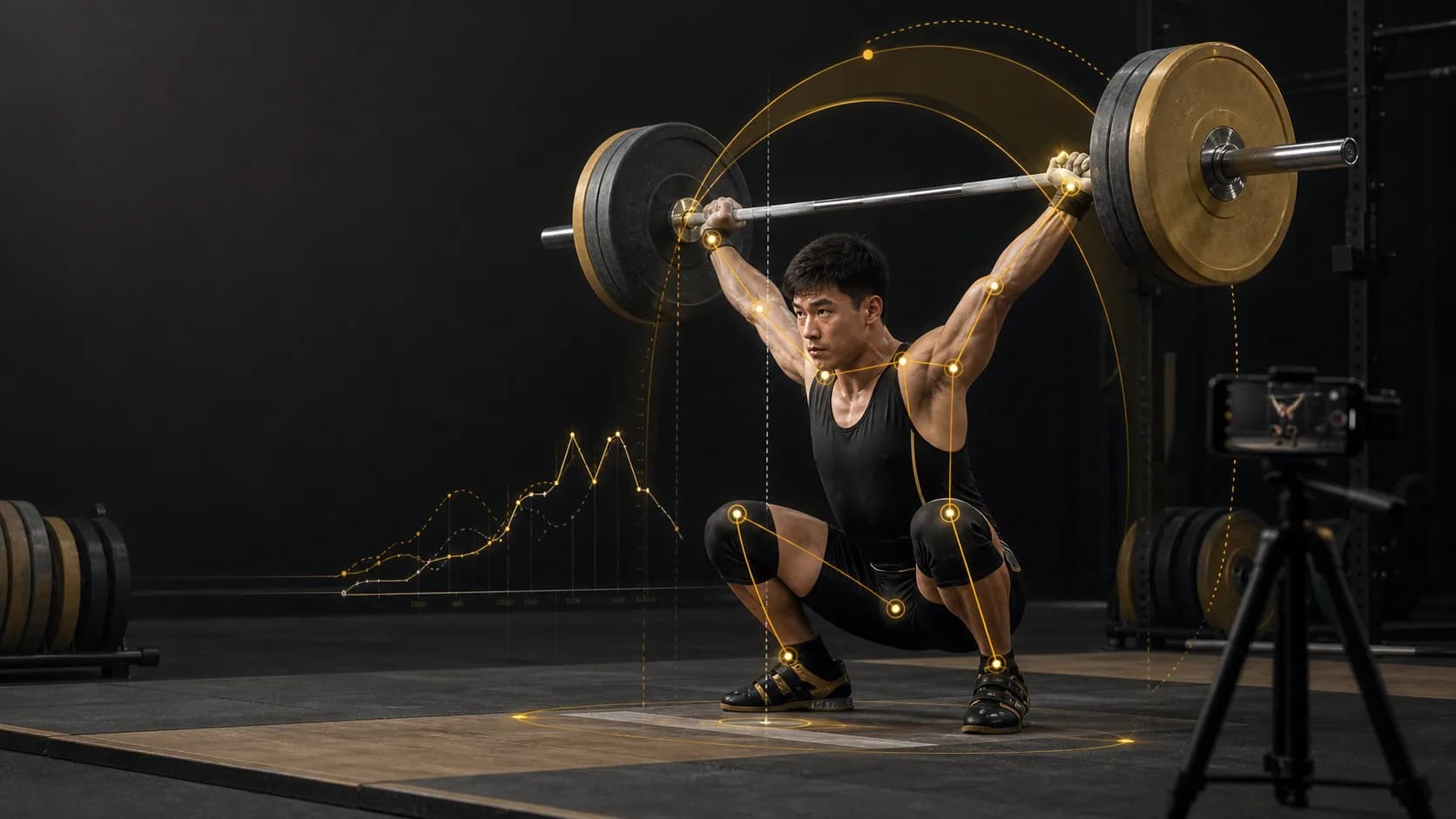
AI video analysis gives you a second dashboard:
- Bar path: Is the bar staying close or looping forward?
- Peak height: Are you pulling high enough, or just diving under earlier?
- Turnover speed: Is the pull-under getting sharper?
- Receiving depth: Are you catching at a consistent depth?
- Lockout stability: Does the bar settle overhead or drift?
- Miss direction: Are misses forward, behind, soft at the elbow, or lost in recovery?
The goal is not a perfect score. The goal is to know whether the new class is improving your lifting or only changing the number on the scale.
What recent research says about single-camera bar tracking
A 2026 paper on single-camera barbell trajectory analysis for the snatch describes a computer-vision framework that corrects perspective distortion, localizes the barbell with a YOLO-based detector, tracks the bar center with 2D trackers, and classifies snatch trajectories into established types. It extracts eight kinematic variables and converts key spatial measures into a 0-4 performance score.
That is important for lifters because it means meaningful bar-path feedback no longer requires a full lab. A phone video from the side is not perfect, but it can be good enough to catch repeatable problems: looping away, crashing in the catch, inconsistent start position, or excess horizontal displacement.
The IWF has also publicly discussed AI applications across coaching, training, performance analysis, injury prevention, judging, and anti-doping through the Olympic Movement AI Engagement Forum. The sport is clearly moving toward more structured use of data.
A 6-week class-transition workflow
Week 1: Establish a baseline
Film snatch, clean, and jerk from the side at 70-85%. Do not chase maxes. Upload the lifts and record three baselines: average bar path quality, receiving stability, and miss direction.
Week 2: Track bodyweight without changing training
Weigh daily, but keep training stable. The question is whether your normal bodyweight already points to a new class. If your technique is trending well, do not disrupt it too early.
Week 3: Test the likely class direction
If moving up, add calories and watch whether speed improves or positions get lazy. If moving down, reduce slowly and watch whether turnover, recovery, and front-rack comfort degrade.
Week 4: Compare heavy singles
Take controlled singles at 85-92%. Use AI review to compare bar path and receiving stability against week one. A better class should not only make you heavier or lighter; it should make good attempts more repeatable.
Week 5: Simulate attempts
Run a mock meet: opener, second, third in snatch and clean & jerk. The metric is not your best single. It is attempt quality under sequence pressure.
Week 6: Choose the class and build the next block
If the technical data improved and recovery stayed stable, commit. If the total improved but the miss pattern got worse, treat the class as a longer project.
Practical decision rules
Move up when speed, recovery, and training consistency improve before the total jumps. Move down only when the class is realistic without losing pull quality or confidence in the catch. Stay put when your total is rising and the new class would mostly create stress.
The best class is not the lightest one you can suffer into. It is the class where you can make attempts.
How Olympic Weightlifting AI helps
Olympic Weightlifting AI is built for lifters who need more than sets and reps. Use it to review bar path, timing, receiving position, and trend lines through the 2026 category change. Keep the logbook for load, volume, and readiness. Use AI video for the technical truth the numbers do not show.
When the bodyweight categories move, the smartest lifters will not guess. They will test, film, compare, and choose the class where their best lifting can actually survive the platform.
Sources
Coach Ilya
Olympic Weightlifting specialist. Expert in snatch technique, clean & jerk technique, positional drills.
Coach Ilya is the AI coaching persona behind Olympic Weightlifting AI, built to provide personalized olympic weightlifting guidance through video analysis, training plans, and technique breakdowns.
Train Olympic Weightlifting with AI
Olympic Weightlifting AI gives you an AI coach that analyzes your technique, plans your training, and tracks your nutrition. Try it for free.