Snatch Video Review Checklist for Competition Prep
Use a repeatable side-view checklist to review your snatch video, separate bar-path faults from receiving-position faults, and choose one correction for the next session.
If you want a useful snatch review, start with a fixed side-view clip and answer the same questions every time. Olympic Lifting AI: Coach gives you a sport-specific place to review that clip, but you still need a clear filming setup and a rule-based checklist. The goal is not to collect ten observations. The goal is to find the first repeatable fault that changes the next rep.
The eight-point snatch review
The IWF technical and competition rules define the snatch as one continuous lift from the platform to an overhead position, followed by control and the referee's signal. Use that standard when you review the end of the lift, then inspect the path that created it.
- Start position. Check that the bar begins over the mid-foot, your shoulders sit in front of it, and your back and arms stay set before the pull.
- First pull. Watch from the floor to the knees. Ask whether your hips and shoulders rise together while the bar stays close.
- Knee transition. Look for the bar to pass the knees without a jump forward. Your knees should make room for the bar, not push it away.
- Power position. Pause the frame at the upper thigh. Check whether you reach a balanced position before you extend. A rushed contact point often creates a forward loop.
- Extension. Track the bar vertically through the finish. Do not judge the rep only by how high your toes leave the floor. Check whether the bar stays close while you finish the pull.
- Turnover. Find the first frame where your elbows rotate under the bar. A late turnover usually leaves the bar in front and forces you to chase it.
- Receiving position. Check the bar over the base of support, elbows locked, and torso controlled. The IWF rules require control before the down signal, so a technically deep catch still needs a stable finish.
- Recovery and repeatability. Compare two or three attempts at the same load. A fault that appears on every rep deserves attention before a one-off wobble.
Write one sentence after the review: “On the next set, I will keep the bar closer through the knee transition.” That sentence turns a clip into a training decision.
Film the clip so the checklist can work
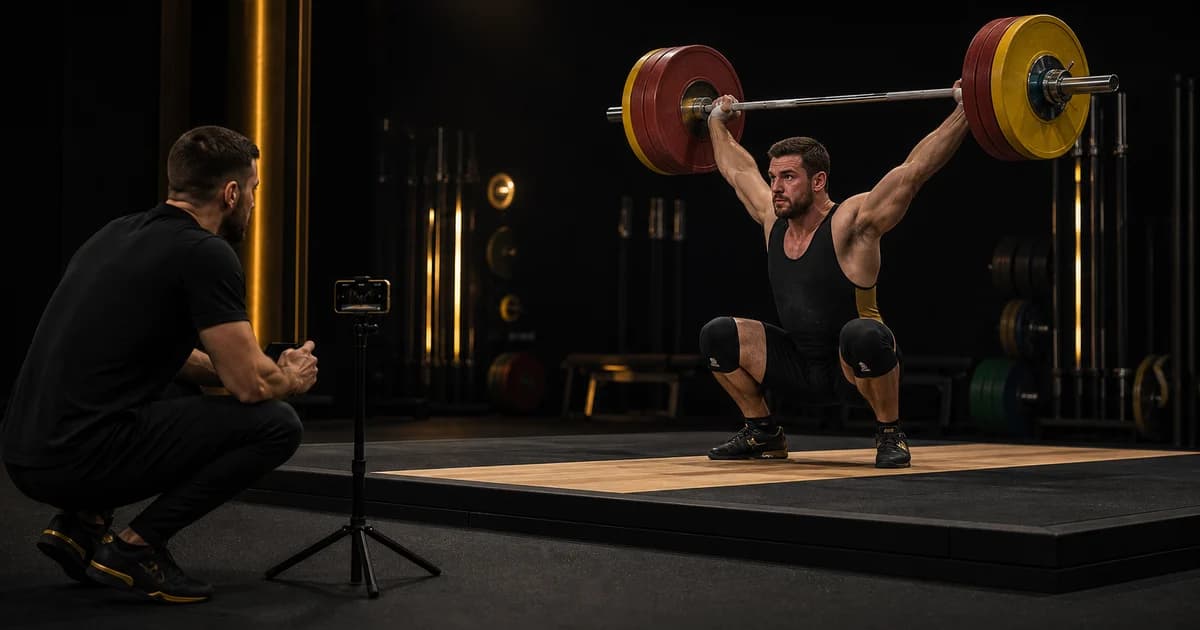
Place the camera perpendicular to the platform, around hip height, far enough away to keep the full bar and feet in frame. Keep the camera still. Use the same side and distance for future sessions. Record the load, set, rep, and whether you missed forward, backward, or in the bottom. Do not use a clip where another lifter or a rack hides the bar.
Review the clip once at normal speed, once in slow motion, and once with the sound off. Normal speed shows rhythm. Slow motion shows the phase where the fault begins. Silence keeps a loud impact or a verbal cue from deciding your conclusion. If you cannot see the bar for the whole lift, film another set instead of guessing.
Turn one observation into your next session
Choose the earliest fault that explains the later error. If the bar loops forward during the turnover, do not begin by changing your receiving stance. If the bar stays close but you lose balance in the catch, review your overhead position and recovery separately. Keep the load and drill conservative enough that you can repeat the same camera angle.
Make each snatch review answer one question
Before you press record, write one question at the top of your training log: where does the first repeatable change begin? A missed snatch often shows the largest symptom in the receiving position, but the cause may appear much earlier. Review the start position, first pull, knee transition, power position, extension, turnover, receiving position, and recovery in that order. Mark the earliest frame that changes across two or three attempts. That gives you a useful training decision instead of a long list of impressions.
Film for a comparable decision
Place the phone on a stable stand at hip height, perpendicular to the platform. Keep the full bar, both feet, the highest point of the bar, and the final recovery in frame. Leave space above the elbows and below the plates. Film one comfortable technical attempt, one normal working attempt, and one attempt after a single cue. Use the same shoes, bar, platform side, camera height, load range, and rest period. If another lifter, rack, or spotter blocks the bar, write “not visible” and film again. Do not turn a hidden section into a confident diagnosis.
Keep an IWF boundary
Use the IWF technical and competition rules to distinguish a training observation from a competition judgement. A side view can show whether the bar stays close, whether the elbows lock before the feet settle, and whether you control the recovery before the down signal. The camera cannot replace a referee, and one angle cannot prove what it hides. If you prepare for a meet, record the exact point that needs control, then ask a qualified coach to confirm the rule application and the safest correction.
Compare the three clips before changing the drill
If the bar loops forward in all three clips, test one closer bar-path cue or a controlled pull-position drill. If the bar remains close but the catch shifts behind you, inspect the turnover and overhead balance rather than changing the start position. If the error appears only at the heavier attempt, reduce the load, preserve the timing, and retest before adding another cue. If the receiving position is stable but recovery is not, review foot pressure and the first step after the catch. Save the clip, the question, the answer, and the next load decision in one note. Do not stack several corrections to make one video look better.
Snatch review card
- Question: where the first repeatable error begins.
- Camera: fixed side view with the whole bar and finish visible.
- Rule boundary: IWF control and referee signal.
- Decision: one cue, one drill, and one follow-up clip.
When pain, repeated misses, or a competition selection decision enters the review, pause the experiment and ask a qualified coach or medical professional for individual guidance. A checklist helps you communicate what you saw. It does not replace supervision.
Review your next snatch with Olympic Lifting AI: Coach
After you film your next set, open Olympic Lifting AI: Coach and use its video review workflow to inspect the same phase you marked above. Then read the snatch video analysis guide and carry one documented correction into your next supervised session.
Final answer
A good snatch review has one camera angle, eight repeatable checkpoints, and one correction for the next session. Start with the IWF standard for control, identify the earliest repeatable fault, and use Olympic Lifting AI: Coach to keep the review connected to the clip you actually filmed.
Try these free tools
Train Olympic Weightlifting with AI
Olympic Lifting AI: Coach reviews your technique, helps plan training, and tracks nutrition. Download it free, then check the App Store for current paid access.