Small gym 2026: силовое оборудование
Соберите small gym без хаоса: выберите home gym equipment, оставьте дорожку для подъема, съемки, видеоразбора и безопасного выхода.
Titans Grip
Combat and Strength Sports Coach, 15+ years coaching athletes
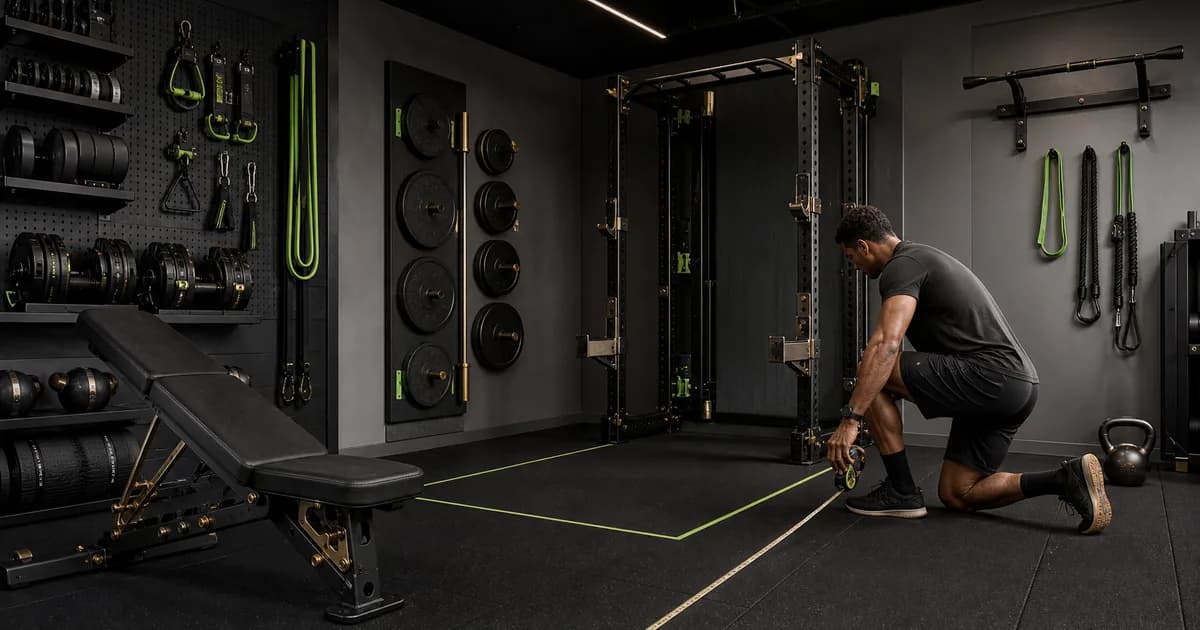
A small gym is a strength space that protects one clear training lane before it buys more equipment. Маленький зал проваливается не из-за квадратных метров. Он проваливается, когда вы ставите железо, скамью, стойку, коробки и тренажер так плотно, что больше не можете присесть, снять подход на видео или безопасно выйти из неудачного повтора.
Если вы собираете small gym дома, в подвале, в углу коммерческого клуба или в garage gym, начните с вопроса: какую тренировочную функцию должен сохранить этот метр? Только после этого выбирайте home gym equipment. Складная стойка, регулируемые гантели, устойчивая скамья, резинки, турник, вертикальное хранение и резиновое покрытие часто дают больше силы на квадратный метр, чем пять красивых машин под один паттерн.
Quick answer and source method
What is the quick answer for a small gym?
A small gym works when you keep 1 empty lane, 1 stable camera angle, and 6 movement patterns before buying specialty gear. Test squat, hinge, push, pull, carry, and brace first. Если вы не можете сделать эти шесть паттернов без перестановки пяти предметов, вам не хватает не оборудования, а планировки. Практический порядок такой: пустая дорожка, покрытие, регулируемые гантели, скамья, стойка, вертикальное хранение, затем specialty strength equipment.
Which sources support this equipment order?
According to NSCA home gym facility guidance, a home gym is a safety and layout decision before it is a shopping list. According to ACSM's 2026 fitness trends, strength training and fitness technology both remain important, so a compact room should support lifting and video review together. According to CDC adult activity guidance, adults need muscle-strengthening work on 2 or more days per week; that goal needs repeatable training, not a large room.
According to WHO physical activity guidance, regular activity supports health across age groups, but no global guideline says you need a crowded room full of single-use machines. According to PubMed's Schoenfeld hypertrophy review, mechanical tension, metabolic stress, and muscle damage can contribute to hypertrophy; those drivers require progressive training, not maximum equipment density.
Source check from June 30, 2026
I checked these source URLs on June 30, 2026 and kept only sources that returned HTTP 200 in the local check.
| Source | Why I use it | Check |
|---|---|---|
| NSCA home gym facility | layout, safety, usable facility thinking | 200 OK |
| ACSM trends 2026 | strength training and fitness technology context | 200 OK |
| OpenPowerlifting | real strength standards and powerlifting calibration | 200 OK |
| CDC adult guidelines | weekly strengthening baseline | 200 OK |
| WHO physical activity | public-health activity context | 200 OK |
| PMC resistance-training methods review | why advanced methods need context | 200 OK |
| PubMed Schoenfeld hypertrophy | hypertrophy mechanisms and resistance-training logic | 200 OK |
This page refreshes an existing small gym article. It does not compete with boxing training app 2026, best boxing app, best MMA app 2026, BJJ techniques app, or best BJJ app 2026 pages. Those queries belong to sport-app reviews. This page answers a space and equipment question: how to keep strength training useful when room is limited.
What is the best small gym buying order?
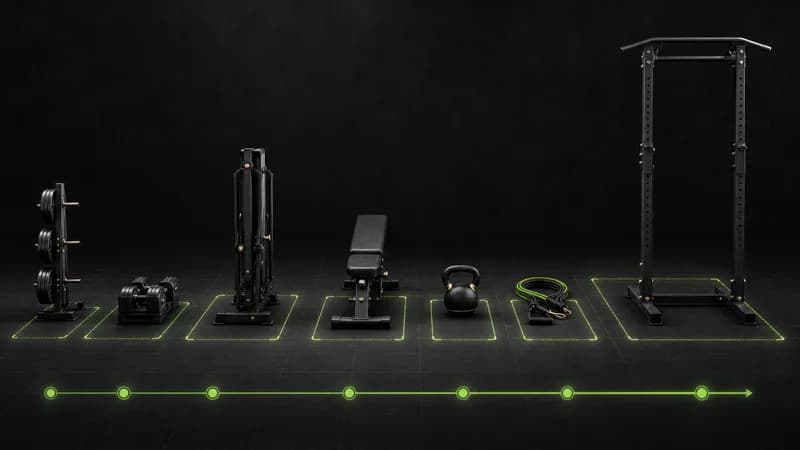
The best small gym buying order is: clear floor, rubber surface, adjustable dumbbells, bench, rack or stands, vertical storage, then specialty tools. This order protects movement before it adds clutter. A compact room should serve squat, hinge, push, pull, carry, brace, and conditioning. If a machine solves one exercise but blocks three patterns, it reduces strength per square foot.
| Priority | Buy | Why it earns space | Delay it when... |
|---|---|---|---|
| 1 | rubber floor and clear lane | protects movement, camera, and failed reps | almost never delay if you lift |
| 2 | adjustable dumbbells | cover push, pull, legs, carries, rehab | you already have barbell space |
| 3 | stable bench | opens press, row, split squat, hip thrust | it blocks the only exit lane |
| 4 | folding rack or stands | enables safer squat and press work | ceiling, wall, or floor cannot support it |
| 5 | vertical storage | keeps plates, bands, and handles off the floor | you still have no training lane |
| 6 | specialty tools | kettlebell, landmine, cable, jump rope | they block camera view or footwork |
According to NSCA facility guidance, equipment selection should consider safe setup and usable training space. In a small gym, that means a boring rule wins: buy the item that protects the most movement patterns, not the item that makes the room look most complete.
How do you test gym layout before buying?
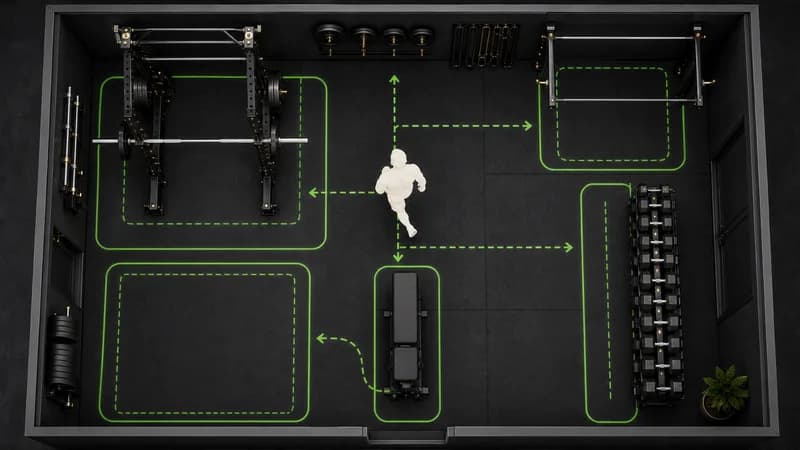
Test gym layout with one rectangle. Stand in the largest empty rectangle you can keep clear. If you can squat, hinge, press, row, carry, and brace inside it without moving several objects, your room can work. If you cannot film feet, hips, shoulders, and load from one stable angle, the layout needs fixing before the shopping list grows.
How does the 3-step lane test work?
The 3-step lane test is simple: film 1 lower-body set, film 1 upper-body set, then walk a 4-6 step carry without moving equipment. The room passes when the camera sees feet, hips, shoulders, and the load in all 3 tests. The room fails when storage hides the hips, the bench blocks the exit, or the rack removes the carry lane. This gives you a yes/no answer before you buy another piece of strength equipment.
Use this checklist:
- Put your phone in the only camera spot you can repeat.
- Film goblet squat or back squat.
- Film dumbbell Romanian deadlift or row.
- Walk a short carry for 4-6 steps.
- Count how many objects you moved before the session.
If you moved more than 3 objects, the gym layout is too fragile. If the camera loses your feet or hips, Titans Grip will struggle to give useful feedback. Fix the room first.
What should a 7-day small gym test prove?
A 7-day small gym test should prove that the room supports repeatable training, filming, and safe exits. We use one short test per day. If the room still works after 7 clips, you can buy the next item with confidence. If every day requires a different setup, the home gym equipment is controlling the workout.
| Day | Test | What you record | Decision |
|---|---|---|---|
| 1 | goblet squat or light squat | feet, knees, hips visible | move camera or rack |
| 2 | dumbbell Romanian deadlift | back and load stay in frame | adjust light or distance |
| 3 | push-up, floor press, or bench | bench does not block exit | rotate bench |
| 4 | row or pull-up | storage does not block motion | move storage to wall |
| 5 | short carry | 4-6 safe steps exist | keep lane empty |
| 6 | brace or core work | floor does not slide | add rubber surface |
| 7 | full session | moved 3 objects or fewer | if not, redesign layout |
Use Titans Grip Powerlifting AI after the lane test, not before it. The app can review squat, bench, and deadlift patterns only if the video sees enough of your body. Pair it with the one-rep max calculator, plate calculator, training load tool, and strength standards when you want numbers. Use the strength hub to keep the plan connected to the larger strength cluster.
Which equipment should you buy first?
Buy the item that solves the most movement problems with the least floor cost. A good first purchase supports at least 3 exercises, 1 measurable test, or 1 safety improvement. A bad purchase looks professional but blocks the lane, hides the camera angle, or forces you to move clutter before every set.
What belongs in layer 1?
Layer 1 is the room: rubber floor, light, camera angle, and empty lane. We put this before iron because it decides whether you can train for 30 days without friction. Flooring protects the room. Light protects video review. The empty lane protects movement. If layer 1 fails, even expensive home gym equipment becomes annoying.
What belongs in layer 2?
Layer 2 is multi-use equipment: adjustable dumbbells, bench, bands, pull-up option, and a folding rack if the wall and ceiling can handle it. These tools cover most small gym needs without turning the room into a maze. You can train split squat, Romanian deadlift, goblet squat, floor press, bench press, row, pull-up, carry, and basic conditioning with a compact setup.
What belongs in layer 3?
Layer 3 is specialty strength equipment: barbell, plates, landmine, cable, kettlebell, trap bar, sled substitute, or conditioning tools. Add this layer only after 3 complete sessions prove the missing tool limits progress. A powerlifter may need barbell and plates early. A boxer may need floor space and dumbbells more. A BJJ athlete may need grip, hinge, and core work without losing mat space.
How do you choose between rack, dumbbells, and machines?
Choose by training density. The best tool is not always the heaviest tool; it is the tool that lets you train consistently in the room you have. In a small gym, a rack is valuable only if it keeps an exit path. Adjustable dumbbells are valuable when they replace several pairs. A machine is valuable only when it earns space after the basic patterns already work.
| Tool | Buy now if... | Delay if... |
|---|---|---|
| folding rack | you squat or press weekly and have a safe wall | it removes your exit path |
| adjustable dumbbells | you need broad home gym equipment fast | you already have full barbell space |
| bench | you press, row, split squat, and hip thrust | it stays open in the middle of the room |
| barbell and plates | floor, storage, and failed-rep path are ready | every session becomes plate cleanup |
| cable or machine | basics are solved and space remains | it kills carry, footwork, or filming |
| mirror | it helps coaching without hurting video | it replaces video review with posing |
According to OpenPowerlifting, strength standards and competition numbers can calibrate what "strong" means, but your small gym does not need to copy a meet platform on day one. Use standards to choose progression, not to justify buying more than the room can support.
What is the minimum setup for combat athletes?
Combat athletes need strength without killing skill space. A boxer needs legs, trunk, shoulders, and rotation without losing footwork. A BJJ athlete needs hinge, grip, core, and pulling strength without losing floor movement. An MMA athlete needs those pieces plus space for sprawls, pivots, and short conditioning.
For a boxer, start with dumbbells, bands, jump rope, round timer, and a camera lane. For BJJ, add pull-up or towel-grip work and enough floor for bridging or hip movement. For MMA, keep the carry lane and avoid a rack setup that blocks lateral movement. The compact strength plan should support sport practice, not replace it.
If your real search is best boxing app, use the Boxing AI page or the boxing app comparison. If your search is best MMA app 2026, use the MMA app guide. If your search is BJJ techniques app or best BJJ app 2026, use the BJJ app guide or Grappling AI. This article stays on the equipment and layout question.
How do you avoid small gym mistakes?
The biggest small gym mistake is buying for the photo. A rack, bench, cable, bike, plates, boxes, and storage can look serious while destroying the room's training value. The second mistake is tracking too much. Use 3 numbers: objects moved before the first set, joints visible on camera, and safe exit path after a failed rep.
What should you never buy first?
Do not buy a single-use machine first unless it solves a medical or coaching need that free weights cannot solve. It usually eats the lane, hides the camera, and blocks carries. Do not buy heavy plates before flooring and storage. Do not buy a huge bench if it will live open in the center. Do not buy a second specialty tool before the first 7-day test proves the room can handle one.
How do you know the setup works?
Your setup works when you can start a session in 5 minutes, film the main lift from the same angle, train 6 movement patterns, and leave the room with the lane still clear. That is the small gym standard. It is not glamorous. It is repeatable. And repeatability is what lets equipment become strength.
Conclusion: build strength per square foot
A small gym is not a smaller version of a commercial gym. It is a decision system. Keep the lane. Keep the camera angle. Buy home gym equipment that serves several patterns. Delay anything that blocks movement, filming, or safe exits. Then use Powerlifting AI, training load, and the strength hub to turn the room into a measurable training loop.
Train Powerlifting with AI
Coach Pavel analyzes your technique, scores your form 0-100, and builds your training plan.
Download Powerlifting AICoach Pavel
Powerlifting specialist. Expert in squat technique, bench press, deadlift.
Coach Pavel is the AI coaching persona behind Powerlifting AI, built to provide personalized powerlifting guidance through video analysis, training plans, and technique breakdowns.
Похожие статьи
Лучшее AI-приложение для тренировок по единоборствам 2026: JAB AI vs Fight AI vs Kayyo vs Titans Grip — какой AI-тренер действительно работает?
12 июн. 2026 г. · 24 мин чтения
PowerliftingCrowded Gym Workout: метод одной станции
24 мая 2026 г. · 15 мин чтения
generalSport BMI Calculator 2026 для спортсменов
18 мая 2026 г. · 13 мин чтения
Тренируйте Powerlifting с ИИ
Powerlifting AI gives you an AI coach that analyzes your technique, plans your training, and tracks your nutrition. Try it for free.