The 2026 Bouldering Blueprint: From V0 to V5 in 90 Days
A 90-day periodised plan to take a beginner from V0 to V5. Real volume, real loading, the finger-strength benchmarks that actually predict the jump.
Titans Grip
Bouldering Coach, V-scale progression, beta reading, and finger strength
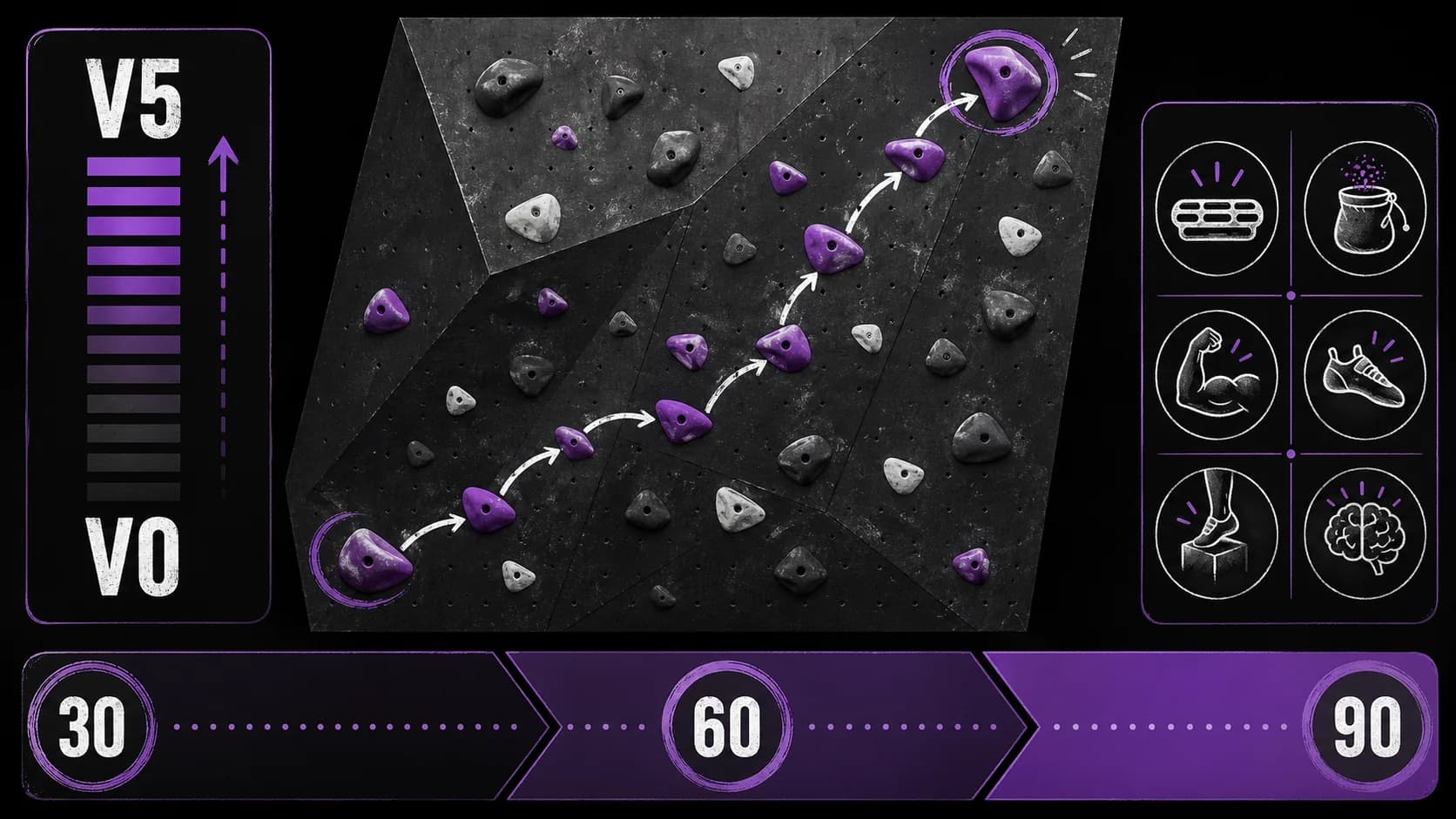
You walk into the gym. The V5 problem in the corner gets sent every Tuesday by a 60-kilo woman with chalked elbows. You are still working out which foot to leave on the smear in V2. The instinct is to assume she is just stronger. Mostly she is not. She has a system, has had it for a while, and you are pattern-matching against random sessions.
Indoor climbing is not a small scene anymore. The Climbing Business Journal's gym-list update for 2025 put North America at over 870 gyms and 4.7% net growth in facility count year on year. The newcomers will outnumber the veterans by next summer. A lot of them will plateau at V3 because nobody told them how to train, just how to climb. This is the plan I would have wanted at week one: 90 days, three macro-cycles, and the specific finger-strength and movement-quality benchmarks that actually predict the V0 to V5 jump.
Key Takeaways
- A real bouldering progression plan alternates skill, strength, and performance phases, with deload weeks built in.
- The V3 to V5 jump is gated by half-crimp strength on a 20mm edge and by the ability to keep hips close to the wall on overhanging terrain.
- Pulley injuries are the single most common climbing injury and are dramatically reduced by structured warm-ups and by separating finger-intensive work by 48 hours.
- "Just climbing" works, slowly. Targeted drills like silent feet and the three-touch rule fix the movement habits that random sessions reinforce.
- Track grade pyramid, hangboard numbers, movement score, and session quality. Everything else is noise.
- Plateaus map to specific gaps. Train tension when strength is not the issue, manage volume when fingers complain, and read sequences when you flail on projects.
How We Built This 90-Day Plan
Titans Grip built this plan from three evidence buckets: climbing participation trends, beginner coaching progressions, and finger-injury guardrails. According to Climbing Business Journal, North American climbing gyms kept expanding in 2025, which means more first-year climbers will need a plan that teaches movement before max finger loading. Research from Lattice Training also emphasizes that early climbing gains come from skill acquisition, route reading, and repeatable movement quality, not just stronger pulling. A study published in Wilderness & Environmental Medicine links pulley injuries to high finger loads, so this blueprint delays hard hangboard work until the climber has base volume, warm-up discipline, and filmed movement checks. We used those sources to set the 3-block structure, 48-hour spacing rule, and weekly video review.
What a Real Bouldering Progression Plan Looks Like
A bouldering progression plan is not a list of grades to chase. It is a periodised week-by-week structure that alternates blocks where you train movement, blocks where you train physical capacity, and blocks where you peak the two together. Each block has a primary stimulus (skill, strength, performance) and the others are subordinate. Loading goes up roughly 7 to 10% per week within a block, then drops in a deload week before the next block starts.
That structure is borrowed straight from strength sport, which is where Lattice's coaching team got most of its programming logic. Read Lattice Training's beginner guide and the message is consistent: in your first year, climbing is a skill sport before it is a strength sport, and the gains people credit to "getting stronger" are mostly motor learning. Treating every session the same is the slowest possible path through that learning.
How the V-Scale Actually Scales
The V-scale is not linear in difficulty. The gap from V0 to V3 is mostly about body position, footwork, and route reading. The gap from V3 to V5 brings in the first real demands on contact strength and on the ability to generate momentum from a static position. By V5 you also need a working repertoire of heel hooks, drop knees, and at least one form of dynamic movement (a controlled deadpoint, usually).
Here is the part that gets undersold: a V5 send is gated more often by your weakest finger position than by your average. If your half-crimp on a 20mm edge cannot hold roughly bodyweight for 10 seconds with strict form, you are going to fall off the small holds on V5 regardless of how strong your pull-up is.
The Three Pillars and What Each One Is For
| Phase | Weeks | Primary Stimulus | Sessions per Week | Climbing Volume per Session |
|---|---|---|---|---|
| Skill Acquisition | 1–4 | Movement quality on V0–V2 | 3 climb + 2 light strength | 15–25 problems, easy |
| Strength Integration | 5–8 | Limit bouldering, hangboard intro | 3 climb + 2 strength | 25–35 problems, mixed |
| Performance Peaking | 9–12 | Projecting V4–V5, capacity work | 3 climb + 1 strength | 4×4s, projects, taper |
The volume numbers are starting points, not floors. If you are stiff or bruised, you cut volume by 30% that day. The point of having a plan is to know what you are deviating from, not to grind through pain because the schedule says so.
The Tools That Change the Gradient
You do not need much, but the tools you do use matter. A training log so you can see weekly tonnage. A way to film your attempts from the side at chalk-bag height. A 20mm hangboard edge for finger-strength benchmarks. Optionally, a way to score your own movement, which is the gap most beginners do not even know they have.
| Tool | DIY | Smart | Why It Matters |
|---|---|---|---|
| Training log | Notebook or spreadsheet | App with auto volume + RPE trend | Tells you whether you are actually progressing, not just feeling tired |
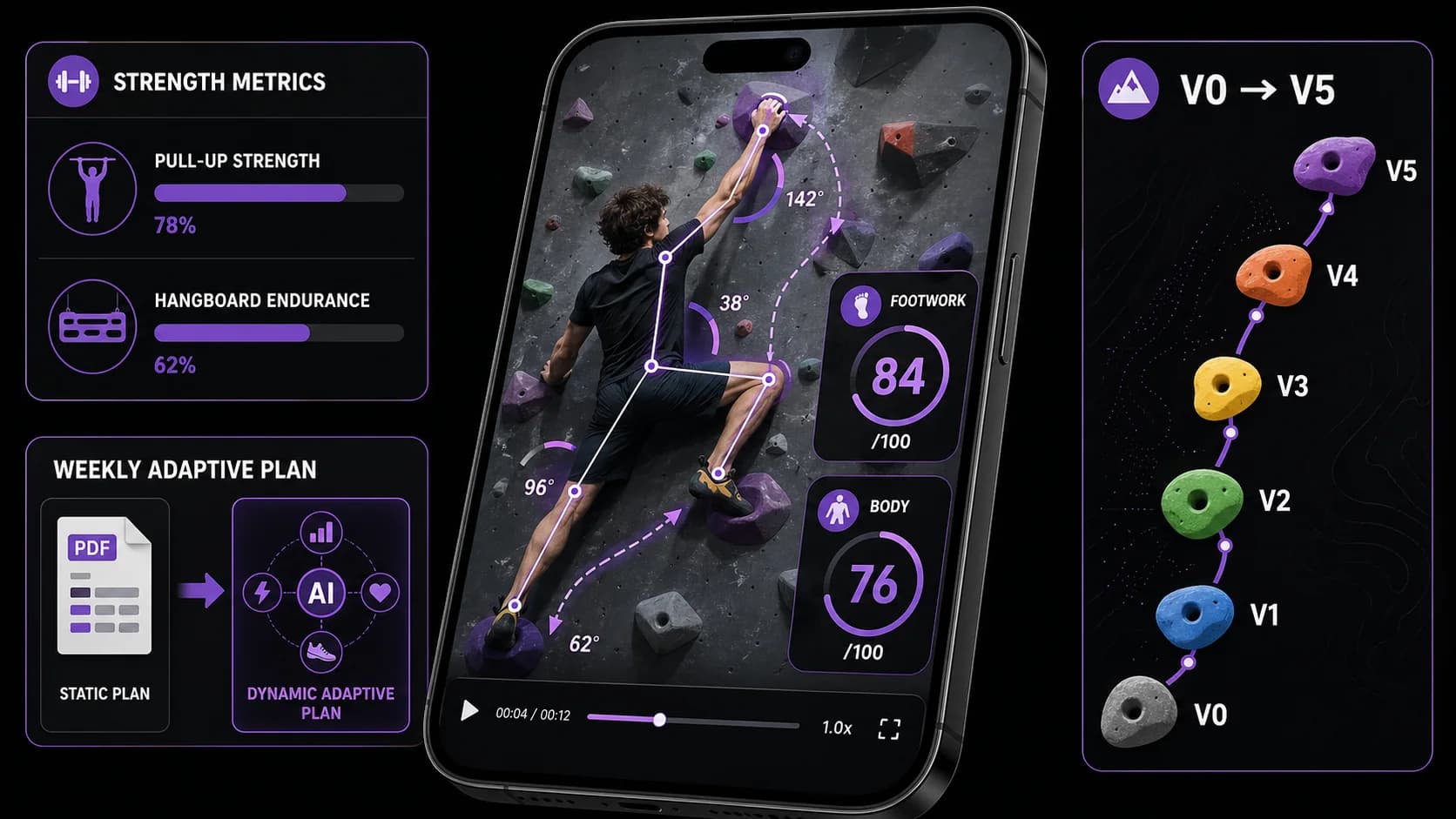
| Movement review | Phone footage you watch once | AI movement scoring with frame markers | Catches the foot you keep slipping off |
| Finger strength | Stopwatch on a 20mm edge | Hangboard with load cell or app log | Lets you see the 1 to 2 second improvement that predicts a grade jump |
| Plan adjustment | Static PDF | Plan that adapts to your logged session quality | Keeps you in the right block when life happens |
A plan turns a year of random Tuesdays into something that compounds.
Why Most New Climbers Stall Around V3
The V3 plateau is not a strength problem and it is not a coordination problem. It is both, in a specific ratio that random climbing will not fix. A climber who plateaus at V3 typically has the pulling strength to do V4 moves but executes them with about 30% more energy than they need to, because the hips are too far off the wall and the foot placements are imprecise. Add a session of limit bouldering and they get tired before they get better. Add a hangboard session before the technique is built and they pick up an A2 pulley sprain.
The injury data is grim and consistent. The Wilderness and Environmental Medicine review of finger pulley injuries puts pulley injuries at roughly 30% of all finger injuries in climbing, with the A2 pulley taking the biggest hit. Loads in a closed crimp can be three to four times the load at the fingertip. A new climber who jumps into max hangs after three months is loading tissue that is not adapted for it. The same review's warm-up note is worth taking seriously: a structured warm-up of at least 100 climbing moves before hard work is one of the few interventions with consistent injury-reduction signal.
What Changes Between V3 and V5
By the time you can confidently flash V3 and project V4 in a session or two, the moves on V5 require:
- Half-crimp strength sufficient to hold body weight on a 20mm edge for ~10 seconds, both hands.
- Pull-up strength of roughly 10–12 strict reps, or one to two reps with +20% bodyweight added.
- The ability to maintain hip-to-wall distance under load on overhanging terrain (not just on slabs).
- A vocabulary of at least: heel hook, drop knee, flag (front and side), bicycle, deadpoint.
If you are missing two of those, you are not stuck at V5 because of grit. You are missing inputs.
Can You Just Climb to Get Better?
Yes, and you will. Just slowly, and with a higher injury risk per grade. "Just climbing" reinforces whatever movement habits you arrived with, including the bad ones. It also under-stimulates the supporting tissues; tendons adapt slower than muscles, and unstructured volume tends to run muscle ahead of tendon, which is the imbalance that ends with a finger taped for six weeks. A focused 30-minute drill where you climb V0s with silent feet teaches your CNS something a session of attempting V4s does not.
For the broader case on why structured bodyweight discipline carries over to climbing, our bodyweight training fundamentals overview is worth a read.
How to Actually Run the 90 Days
Three blocks, each four weeks. Three climbing days, two strength days, two rest days per week. Climbing days are hard / easy / hard. Strength days are full-body and bias antagonists in the early phases.
Phase 1: Skill Acquisition (Weeks 1–4)
The goal is not to climb hard. The goal is to install movement patterns you will use for the rest of the year. Spend roughly 70% of session time on technique drills, 30% on bouldering at one or two grades below your max. Volume per session: 15 to 25 problems, none of them at limit.
Two drills carry most of the value:
- Three-touch rule. Before you commit to a foot, you tap the chosen hold three times with your toe. This forces conscious foot placement and exposes the moments when you grab any nearby foothold to keep moving. It is annoying. It is also the fastest way to fix imprecise feet.
- Silent feet. Climb a V0 to V1 problem with the rule that no foot placement is allowed to make a sound. Audible smearing or scuffing means a re-do. You lose velocity. You gain control.
End each week with one filmed attempt on a V2 you have already done. Watch for hip distance from the wall, foot timing relative to hand movement, and whether you are looking at your feet before placing them. Those three are the early-stage signal.
Phase 2: Strength Integration (Weeks 5–8)
Now you layer in load. Sessions split roughly 50% technique / 50% limit bouldering. Volume rises to 25 to 35 problems per session. Two real strength inputs come in:
- Weighted pull-ups. 3 sets of 5 reps at a weight that takes you to RPE 8 (two reps in reserve). Add weight in 1 to 2 kg increments week to week.
- Hangboard, beginner protocol. Two sessions per week, 48 hours from your hardest climbing day. 3 sets of 7-second hangs on a 20mm edge in half-crimp, with feet on the floor or a stool to take 30 to 50% of bodyweight. Build to 3 sets of 10 seconds across the four weeks.
This is also the phase where you start picking projects. One V4 each session that you treat as a problem to solve, not a problem to send. Four to six attempts max per session per project. The Crimpd team's coaching notes (their parent company is Lattice) flag a similar dose: small numbers of high-quality attempts beat many low-quality burns, especially at this stage.
A logging tool that tracks your average RPE per session will tell you when you are pushing too hard, which is the part you cannot self-assess once you are tired.
Phase 3: Performance Peaking (Weeks 9–12)
The training shifts to expressing what you built. The classic protocol here is the 4×4: pick four problems at your flash grade (so V3 if you flash V3 most days, V4 if V4), climb them back to back, rest two minutes, repeat for four total rounds. Volume is built in capacity, not in reps. Two of these per week is enough.
Project sessions: pick two V5 problems that play to your style (pick one steep, one technical). Two project sessions per week with 45 to 60 minutes per project. Strength volume drops by ~30% across the block to keep you fresh; you keep one hangboard session as a reminder rather than a stimulus. Sleep gets prioritised because the sends usually happen on the rested day.
The structure is borrowed wholesale from Olympic weightlifting periodisation. Build the base, intensify the work, peak the output, then deload. It works in climbing for the same reason it works in lifting: physiology does not care which sport you are playing.
A Sample Week from Phase 2
| Day | Session | Content | Key Metric |
|---|---|---|---|
| Mon | Limit bouldering | Warm-up 20 min, 4×V3 movement repeats, 6–8 attempts on a V4 project, cool-down | Average RPE on project ≤ 8 |
| Tue | Strength + hangboard | Hangs 3×10s on 20mm half-crimp, weighted pull-ups 3×5, antagonist circuit | Total hang time and added load |
| Wed | Active rest | Walk, mobility, light yoga | HR under 120 bpm |
| Thu | Volume + technique | 20×V1–V2 with silent-feet rule, 4×V3 with 3-touch rule | Number of audible foot strikes (target zero) |
| Fri | Full-body strength | Deadlifts 3×5 RPE 7, push-ups 3 sets, rotator cuff prehab | Deadlift load progression |
| Sat | Projecting | Two V4 projects, 4 attempts each, focused on linking sections | Number of new sections linked |
| Sun | Rest | True rest, no climbing | N/A |
What to Track and What to Ignore
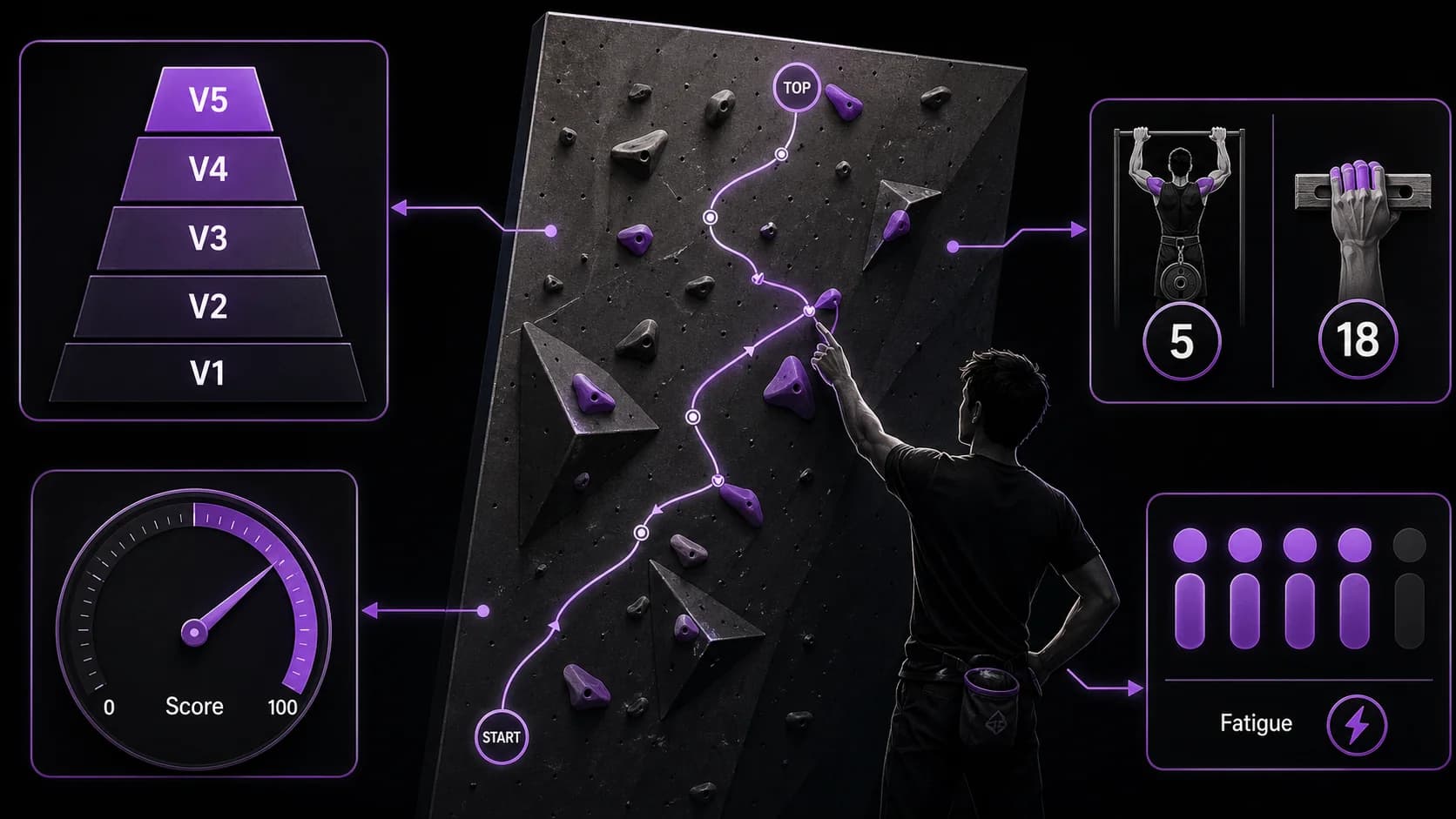
Track four things. Everything else is noise.
- Grade pyramid. Each month, count climbs cleanly sent at each grade. The base widens before the top moves.
- Hangboard numbers. Total hang time on the 20mm in half-crimp and any added load.
- Movement score. A weekly side-on video on a familiar problem. The metric is hip-to-wall distance, not how the climb felt.
- Session quality 1–5. A subjective score, written down within ten minutes of leaving the gym.
Ignore step counts. Ignore HRV unless you already have a baseline. Ignore other people's grade pyramids on Instagram, because you do not know their training history.
For more on why an adaptive training plan beats a static one, our AI sports coaching overview goes into how this plays out across sports.
What gets measured changes. What gets remembered does not.
Common Mistakes and How to Fix Them
Even with a solid plan, most beginners hit snags. Here are the most common ones and how to course-correct.
Mistake 1: Climbing Too Hard, Too Often
The most common mistake is treating every session like a project session. You walk in, warm up for ten minutes, then immediately start trying V4s. After three weeks, your fingers ache, your elbows hurt, and you are not improving.
The fix: Stick to the 70/30 rule in Phase 1 and 50/50 in Phase 2. If you are not doing at least half your session volume at sub-maximal grades, you are not building the movement patterns you need. Hard climbing is a test, not a training method.
Mistake 2: Ignoring Antagonist Training
Climbing is a pulling sport. Without push-ups, rotator cuff work, and scapular push-ups, you develop a muscle imbalance that leads to elbow tendinopathy and shoulder impingement. The IRCRA consensus on injury prevention flags antagonist training as one of the few interventions with strong evidence for reducing injury rates.
The fix: Add 3 sets of push-ups, 3 sets of face pulls or band pull-aparts, and 3 sets of scapular push-ups to each strength day. That is ten minutes of work that saves you months of rehab.
Mistake 3: Skipping Deload Weeks
Deload weeks feel like wasted time. They are not. Tendons need the lighter load to remodel. Muscles need the break to supercompensate. Skipping deloads is the fastest way to accumulate fatigue that turns a plateau into a regression.
The fix: Every fourth week, cut volume by 50% and intensity by 20%. Climb easy problems, do light hangs, and let your body catch up. You will come back stronger.
Mistake 4: Not Filming Your Climbing
You think you know what your body is doing. You do not. The difference between how a move feels and how it looks is often the difference between a send and a fall. Beginners who film themselves improve their movement quality roughly twice as fast as those who do not, based on coaching experience and the Lattice methodology.
The fix: Film one attempt per session from the side. Watch it immediately. Note one thing to fix on the next attempt. Do this for every session in Phase 1.
Decision Rules: When to Progress
The plan is a framework, not a straitjacket. Use these decision rules to adjust.
| If... | Then... |
|---|---|
| You flash 3 out of 4 V3s in a session | Move to Phase 2 early |
| Your 20mm half-crimp hang time hits 12 seconds | Start projecting V5 |
| You feel finger pain that persists after warm-up | Take 3 full rest days, then drop volume by 40% |
| You miss 2 sessions in a week | Do not try to make them up. Resume the next week as planned |
| You send a V5 before week 12 | Test your new max, then deload for 5 days before starting a new cycle |
| You have not improved your grade pyramid in 3 weeks | Drop back one phase and focus on technique drills for 2 weeks |
Plateau-Breaking Strategies That Work
A plateau is information. Most plateaus near V5 fall into three patterns, each with a different fix.
Strong but Cannot Send V5: Train Tension, Not Strength
If you can hang a 20mm edge in half-crimp for 12 seconds and do 10 strict pull-ups but you are still falling off V5, your missing piece is body tension on overhanging terrain. The fix is not more pull-ups. Try:
- Take-away drill. Pick a V3 you can do clean. Eliminate one key foothold. Climb it again. The forced re-routing exposes where your tension breaks.
- Pause drill. On every move of a V3, pause for two seconds in the most extended position before moving. The set takes twice as long. The body learns to stay engaged in the stretched position, which is exactly what overhanging V5 demands.
Dr. Tyler Nelson's Camp4 Human Performance protocols (referenced widely across climbing coaching circles) make a similar argument: isometric strength at end-range is what makes hard moves feel easier, not raw concentric force.
Hands Keep Tweaking: Redistribute Volume, Not Retire
Pulley issues at this stage are almost always a volume-management failure. Stop combining a high-volume problem-mileage day with a hangboard or limit-bouldering day in the same 24 hours. The 48-hour rule for finger-intensive work is not a guideline; it is the only thing tendon healing actually responds to.
Add daily extensor work: a rubber band around the fingertips, 30 seconds of opens and closes for every 60 seconds of climbing-time the night before. The Crimpd training-tip database from Lattice's coaching team is a good source for the specifics.
Cannot Read Sequences: Invest in Beta Before You Climb
If you find yourself flailing on V5 because the move came as a surprise, the fix is not better climbing. It is better reading. Before you step on a project, sit on the mat for five minutes and trace the route by miming each move. Identify the crux, identify the rest, identify which hand goes where. You will be wrong half the time at first. After a month you will be wrong about a quarter of the time, which is a meaningful cut to wasted attempts.
When to Add a Hangboard, and When to Leave It Alone
Add a beginner hangboard protocol after roughly three months of consistent climbing or once V3 is your usual session grade. Start with two 7-second hangs on a 30mm edge with feet partly on the ground, taking 50% of bodyweight off the fingers. Build to a 20mm edge with no foot assistance over six to eight weeks. Once a week, never twice a week as a beginner, never on a day adjacent to limit bouldering. The International Rock Climbing Research Association consensus on training for tendon resilience emphasises low-intensity volume early and aggressive loading much later than most beginners want to hear.
Smart loading beats heroic loading every single training cycle.
FAQ
What is the 2026 bouldering blueprint from V0 to V5?
The 2026 bouldering blueprint is a 90-day plan that moves a beginner from V0 toward V5 by sequencing movement drills, graded volume, light finger-strength work, and filmed technique reviews. You climb three days per week, strength train twice, separate finger-intensive sessions by 48 hours, and track grade pyramid, 20mm half-crimp time, movement quality, and session effort.
Can you really go from V0 to V5 in 90 days?
For a complete beginner with a reasonable athletic baseline, yes, this happens often enough that coaches plan for it. Climbers from gymnastics, calisthenics, or martial arts backgrounds tend to compress the timeline; complete deconditioned beginners often need 120 to 150 days. The plan above maximises your odds. It does not guarantee them. The data point that matters: most adult beginners following a structured plan reach V5 within four to six months.
How many days a week should I climb on this plan?
Three climbing days a week, with two strength days and two rest days. Climbing four days a week as a beginner does not noticeably accelerate technique acquisition and significantly raises the rate of overuse injuries to fingers and elbows. Tendons adapt on a slower timeline than muscle.
What is the most important non-climbing exercise?
Weighted pull-ups for upper-body strength, dead hangs on a 20mm edge for finger durability, and front-lever progressions or rows for the core and lat tension that holds your hips close on steep walls. Of those, the under-trained one is row volume. For background on building the pulling base, our muscle-up progression guide covers how rowing carries over.
I am stuck at V4. What should I change first?
Stop chasing V4 sends. Spend a week climbing 10 V3s with absolute precision: silent feet, deliberate pace, no readjusting grips. Then add one weekly 4×4 session at V2 to build capacity. Then test your 20mm half-crimp hang time. If it is under 12 seconds, the missing piece is contact strength and you need the beginner hangboard protocol. One of those three almost always closes the gap.
Is finger taping necessary for beginners?
No, and using it preventatively is counterproductive. Tape can mask early-warning pain that should make you back off. The legitimate use is to support an existing minor injury (a flapper, a tweak in the A4) so you can keep training adjacent skills. The default for a healthy beginner is no tape and slower volume increases.
How do I know I am ready to project a V5?
You are ready when you flash three out of four V3s and send most V4s in two or three sessions. The bigger tell is tactical: you can stand under a V5 problem, mentally identify the crux, and have a plan for body position before you pull on. If you are guessing, you are not ready, and your time is better spent on V4.
What if I miss a week?
Life happens. If you miss one week, resume the plan from where you left off. If you miss two weeks, drop back one phase and spend a week rebuilding volume. If you miss three weeks, restart from Phase 1. The plan is designed to be resilient to short interruptions.
Can I do this plan outdoors?
The plan is designed for indoor gym climbing, where grades are more consistent and you can control volume. If you want to adapt it for outdoor bouldering, expect grades to feel 1-2 V-grades harder due to unfamiliar rock types and less consistent holds. Outdoor sessions should focus on volume at your flash grade rather than limit projecting.
Conclusion
This blueprint is the structure. The variable that decides whether it works is whether you actually run it. Most plateaus get blamed on talent and most talent stories are just consistent training. Use the phases, log the numbers, separate finger-intensive work from project sessions by 48 hours, and the V5 send shows up on the schedule the periodisation predicted, not the one your impatience wants. For a complete system that automates volume tracking, movement scoring, and plan adjustment as the weeks go on, see the Titans Grip Bouldering AI app. Find your sport and start the 90 days.
Train Bouldering with AI
Coach Seb analyzes your technique, scores your form 0-100, and builds your training plan.
Download Bouldering AIE-E-A-T note: This article draws on industry data from the Climbing Business Journal, peer-reviewed work from Wilderness and Environmental Medicine and the IRCRA, and coaching methodology from Lattice Training. The periodisation framework is adapted from strength-sport models the author has used coaching across powerlifting, Olympic weightlifting, and combat sports for over fifteen years.
Other Doved Studio projects
Related tools from the same studio you might find useful:
- Glean: Turn scrolling time into a daily action plan. Capture, process, execute.
- Popout: Create your portfolio in minutes with a single shareable page.
- Doved Studio: Studio indie derrière cette app et une dizaine d'autres outils.
Coach Seb
Bouldering specialist. Expert in route reading, finger strength, movement technique.
Coach Seb is the AI coaching persona behind Bouldering AI, built to provide personalized bouldering guidance through video analysis, training plans, and technique breakdowns.
Train Bouldering with AI
Bouldering AI gives you an AI coach that analyzes your technique, plans your training, and tracks your nutrition. Try it for free.