Stop Wasting Time on Generic Apps: Why Your Sport Needs a Dedicated AI Coach in 2026
Generic fitness apps cannot critique your jab or your clean. Here is what a dedicated AI sports coach should actually do, and how to choose one in 2026.
Titans Grip
Combat and Strength Sports Coach, 15+ years coaching athletes
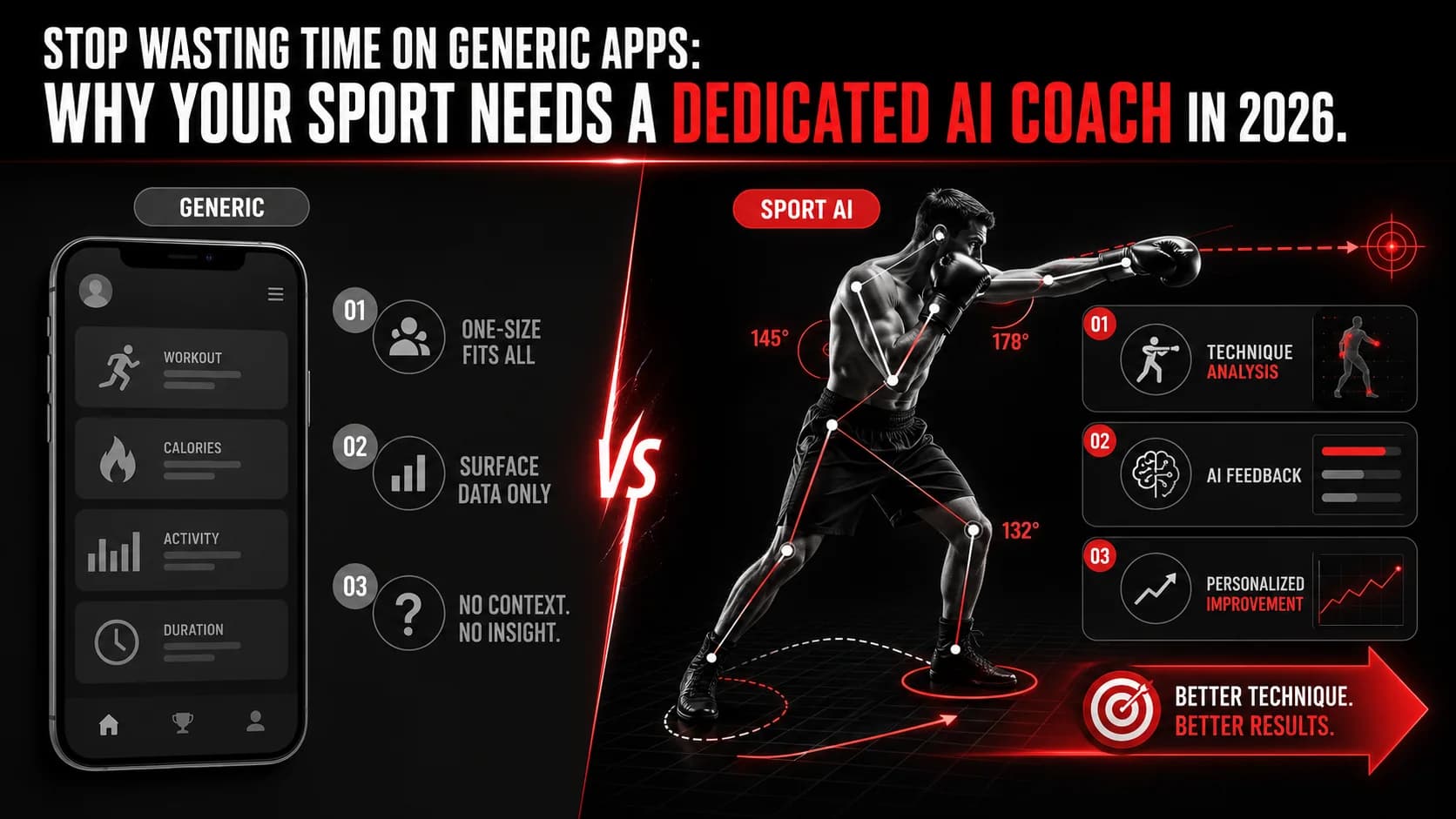
You wouldn't coach a boxer out of a soccer playbook. Yet for years, athletes in technical sports have been handed the digital version: a fitness app written for the average commuter, asked to coach a jab and a snatch with the same one-sentence prompt. It's a category error, and it shows up in your training data.
The 2026 split is simple. A generic app tells you that you moved a lot. A dedicated AI sports coach tells you that your lead shoulder dropped fifteen degrees on the cross, that your front foot turned forty-five when it should have turned ninety, that the elbow of your guard sagged in the third minute of a sparring round. One of those is a step counter. The other is something you can actually train against.
This piece is about what a real dedicated AI coach does, what to ignore, and how to set one up so it earns its place in your week.
Key Takeaways
- A dedicated AI sports coach analyzes sport-specific technique with scoring, video, and chat. Generic apps cannot replicate even the basic feedback loop.
- The best boxing app 2026 and its counterparts in other sports share three traits: video analysis with a number, sport-aware chat, and calendar-aware planning.
- Setup matters as much as the software. Test the analysis with your own video, build a weekly review, cross-reference with your coach.
- Use the tool for benchmarking, predictive planning, and pre-competition dialogue. That's where the leverage lives.
What a Dedicated AI Sports Coach Actually Is
A dedicated AI sports coach is a software platform that performs sport-specific technique scoring, rule-aware planning, and biomechanical feedback for a single discipline. It encodes the rules of that sport. It encodes the technique tree. It looks at your video and gives you a verdict that a competent coach would recognize.
Industry analysts already treat sport-specific AI as a separate category. The Deloitte 2026 sports industry outlook identifies AI-driven coaching tools as a meaningful axis of growth, while the MarketsandMarkets AI in Sports report projects the segment growing from roughly USD 1.0 billion in 2024 to USD 2.6 billion by 2030 (CAGR ~16.7 percent). The dollars are real. So is the gap between marketing claims and useful product.
How Does a Dedicated AI Coach Differ from a Generic Fitness App?
Depth, mostly. A generic app logs a session and a heart-rate curve. A dedicated coach for boxing scores your jab on a 0-100 scale, points to the rotation that failed, and asks if you want a drill that fixes it. It knows that a powerlifter's competition arch on the bench is legal and trainable, not "back rounding." It can tell a high-crotch from a sweep single without the user picking the right tag.
The motor-learning literature is clear about why this matters. The 2022 systematic review by Petancevski and colleagues in Psychology of Sport and Exercise found that augmented, performance-specific feedback improves both performance and learning of sport skills. "Augmented" here means external information you wouldn't see by yourself—exactly what AI video should provide. Generic prompts don't qualify.
What Core Features Define a Real AI Sports Coach App?
Three. AI video analysis with a number you can argue with. A chat layer that handles sport-specific questions without dissolving into wellness talk. Planning tools tied to the calendar your sport actually uses, whether that's a fight camp, a peaking block, or a tournament cycle. Anything less is a logbook with branding.
Why Is 2026 the Moment This Changes?
The hardware caught up. Phone cameras now capture at speeds and resolutions that were research-grade a decade ago. The AI models trained on real athletic footage have crossed the line from "recognizing an exercise" to "critiquing a technique." And athlete patience for one-size-fits-all has run out. Industry pieces such as WSC Sports' coverage of AI coaching adoption describe the same trend at the elite end. The amateur end is now within scope.
Why Your Generic Fitness App Is Holding You Back
Terence Crawford, who finished his career 42-0 after beating Canelo Álvarez at super middleweight in September 2025, didn't get there from a step counter. Public footage of his camps shows obsessive frame-by-frame video review with coach BoMac. A generic tracker cannot replicate even ten percent of that loop. It doesn't know what frame you're looking at.
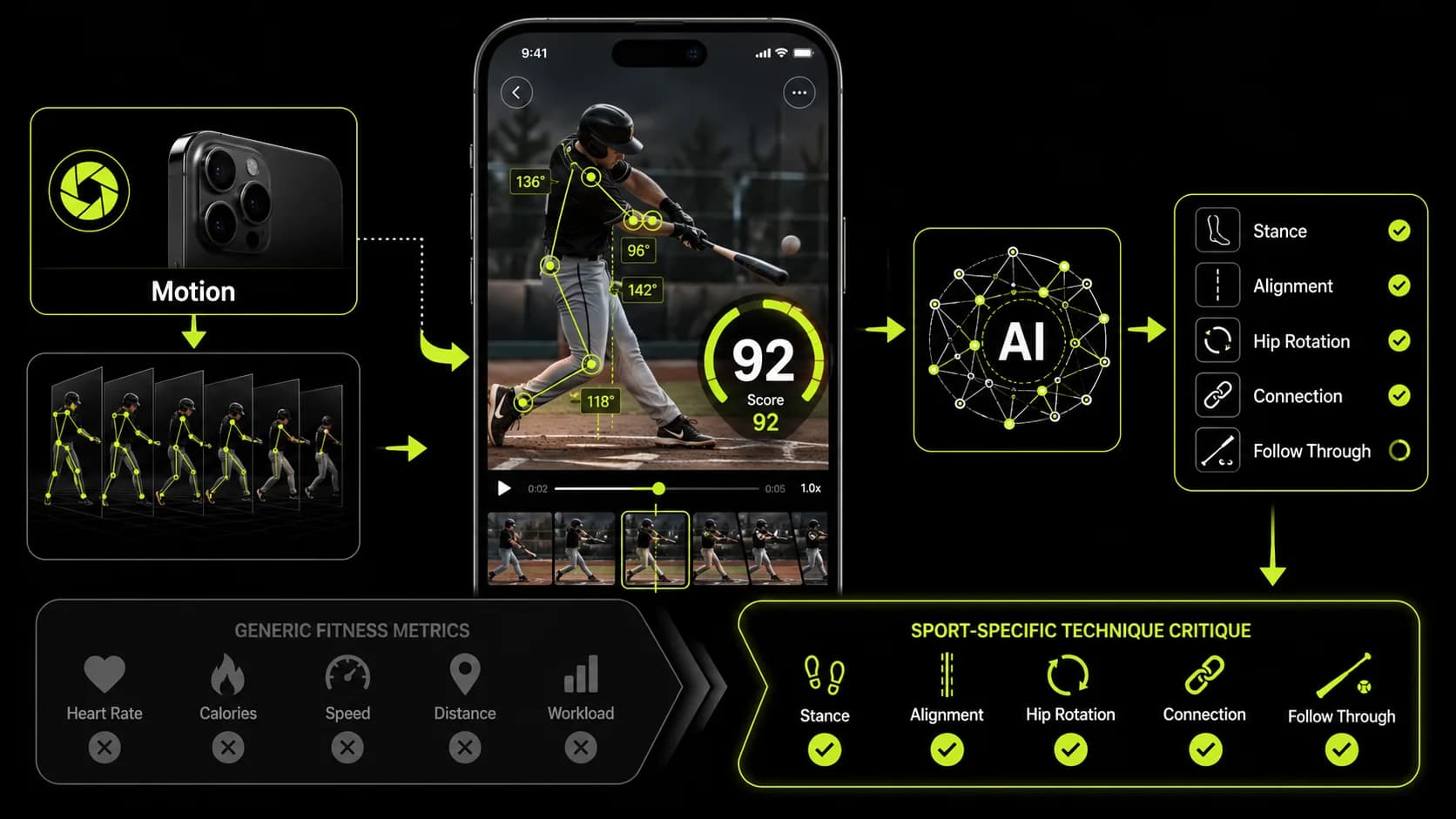
Your generic fitness app holds you back because it was designed for the average person, and you're not training as one. The numbers it celebrates are not the numbers that win matches. The advice it surfaces was written for a populated 5K, not for fight night.
Train MMA with AI
Coach Rico analyzes your technique, scores your form 0-100, and builds your training plan.
Download MMA AIHow Generic Apps Fail on Technique Analysis
Most of them never look at a frame. The few that do treat your camera as a rep counter. They cannot tell whether a weightlifter's clean pull is too early or whether a boxer's hook started in the elbow rather than the torso. The cost shows up later, as injuries. Sport-specific energy demands and movement patterns are reviewed in Slimani and colleagues' Olympic combat sports narrative review (PMC, 2023), which contrasts the oxidative load of boxing with the explosive demands of taekwondo. Conditioning prescriptions for combat are detailed in Kirk and colleagues' MDPI review of high-intensity conditioning for combat athletes. A generic HIIT template ignores both papers and gets handed to a Muay Thai pro the same way it gets handed to a desk worker.
Why Generic Programming Misses Sport-Specific Goals
A marathon runner and a Muay Thai fighter both need cardio. Their work is not the same work. Energy systems, muscle recruitment, recovery windows—all different. A generic "circuit" will not prepare you for the clinch in round four. A program that doesn't know whether you're a folkstyle wrestler or a sambist cannot help you peak. Sport-specific programming exists because the alternative is being well-conditioned for the wrong sport. We covered the principle in our hub on combat sports.
Can a Generic App Give Real Strategic Advice?
No. Strategy needs context. Ask a generic chatbot "how do I open a southpaw" and you'll get a paragraph that could apply to any combat athlete. Ask "what is my opener at a powerlifting meet given a 700-lb gym deadlift and a recent low-back tweak" and the answer needs to know your federation rules, attempt selection norms, and warm-up tendencies. That requires a model that knows what your sport is.
How to Choose and Set Up a Dedicated AI Coach in 2026
The decision is not which app has the prettiest dashboard. It's whether the platform speaks your specific rule set and whether you set it up to work in the seven days between sessions. Seven steps follow.
Step 1: Match the App to Your Specific Sport
"Combat sports" is not a sport. Boxing footwork is not Muay Thai footwork. Judo's grip fight is not BJJ's grip fight. Pick a tool whose technique library and analysis parameters align with your federation's rules. We built twenty-three apps at Titans Grip for this reason—separate apps for boxing, sambo, Olympic weightlifting, judo, and the rest, each tuned to its own ruleset. Test the technique library before you trust the analysis.
Step 2: Test the AI Video on Something You Know
Film a single fundamental rep, well-lit, on a tripod. Upload it. The output should give you a number and at least one sentence you can act on tomorrow. "Your rear foot pivoted forty-five degrees, target ninety" is useful. "Good job" is not. Run the same rep through three apps if you're shopping. The differences in feedback quality will be obvious within ten minutes.
Step 3: Interrogate the Chat Coach
Ask it questions whose answers you already know. "How do amateur boxers most commonly lose points under the ten-point must system?" "How would you adjust the second pull for a meet third attempt at 90 percent of best?" If the answers reflect a real knowledge base, you have something. If they hedge or rephrase your question back at you, the chat is decoration.
Step 4: Wire the Planning Tools into Your Year
The training log should let you record sport-specific units. Not "3 sets of 10," but "3 x 5 squats at 82.5 percent, RPE 8" or "3 x 3 minutes pad work, focus on rear-hand counter." A sport-aware competition countdown should let you flag a fight, a meet, or a tournament and adjust accordingly. Without that calendar awareness, you have a notebook.
Step 5: Use Nutrition Tools for the Demands of Your Sport
A 168-lb boxer cutting to 154 needs a different protocol than a powerlifter in a building phase. A useful AI coach gives you sport-specific templates: weight-cut timing, fueling around skill sessions, recovery feeding for grappling-heavy weeks. Read the macros for context, not as gospel. Sport-nutrition fundamentals are well-summarized in the IJSNEM journal overview, which is worth bookmarking even if your app does the calculations for you.
Step 6: Build a Weekly Review Ritual
Fifteen minutes on Sunday. Look at your technique scores from the week. Read the AI's notes. Pick one flaw to focus on for the next seven days. Do nothing else with the data. The whole point is a feedback loop you actually close.
Step 7: Cross-Reference with Your Human Coach
Bring the report to practice. Say, "the app keeps flagging my cross hand path." Let your coach decide whether that's the priority this week. The AI provides specifics. Your coach provides the judgment about which specifics to act on. That's the working model. It's not theoretical—it's how teams who already use these tools structure their week.
| Your goal | Generic app approach | Dedicated AI coach approach |
|---|---|---|
| Improve boxing jab | Logs "upper-body workout," tracks heart rate | Scores jab 68/100, flags shoulder rotation, suggests drill |
| Plan for BJJ competition | Generic 30-day challenge | 8-week technical block, 4-week intensity peak, 1-week tactical review |
| Fix powerlifting lockout | "Add more triceps" | Bar-path deviation flagged at mid-rep, cue to drive heels |
| Fuel for MMA training camp | Generic 500 kcal deficit | Phase-specific kcal: maintenance for skill weeks, deficit for conditioning |
Strategies to Get More Out of Your AI Coaching
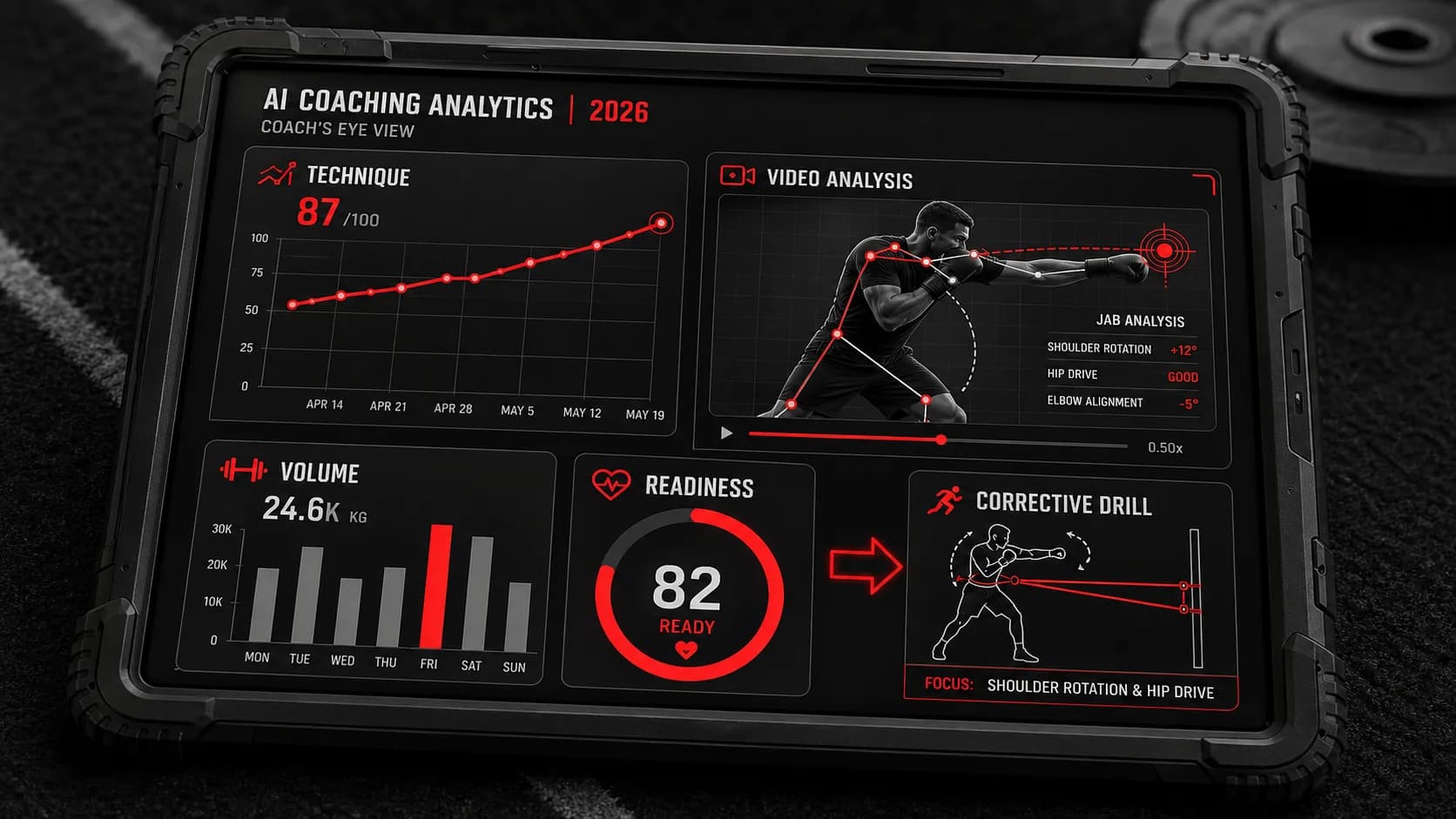
Once the basic loop is running, the leverage moves up. Athletes such as Claressa Shields (18-0, three-division undisputed champion as of February 2026) and Teddy Riner (twelve-time judo World Champion, the men's record) live and die on tape review. You can imitate the structure if not the talent.
Benchmark Your Technique Against an Elite Reference
Film yourself doing a technique. Find footage of a professional whose execution you respect. Run both through the analyzer. Compare angles, timing, positions. Demetrious Johnson's suplex-to-armbar finish at UFC 216 is a textbook reference for a chained finish. Lydia Valentín's split jerk—she is a Spanish weightlifter with Olympic medals across 2008, 2012, and 2016 plus two World Championships in 2017 and 2018—is a good model for receiving position. Vasyl Lomachenko's lateral footwork is the same kind of reference for boxing. The point is to turn an abstract ideal into something measurable.
Use the Training Log for Predictive Planning
A sophisticated log tracks volume and intensity over weeks. Patterns surface. You may notice that your striking accuracy drops sharply when weekly mileage exceeds a certain number, or that your sleep score correlates with how many submissions you finish in live rolls. That's the input to dosing decisions. Adjusting before performance falls is the whole point of having the data.
Run a Structured Pre-Competition Dialogue
Forty-eight hours before competition, use the chat as a tactical sparring partner for your head. Run scenarios, prep cues, walk through the worst case. Your coach is busy with the team. The AI is not busy with anyone. Keep the conversation short and pointed.
Common Mistakes to Avoid
Even with a good app, athletes screw up the setup. Here are the most common errors.
Mistake 1: Treating the AI score as gospel. The AI is accurate for well-defined movements, but it can miss context. A low score on a jab might be correct, or it might be because the camera angle was off. Always verify with your own eyes and your coach's judgment.
Mistake 2: Ignoring the chat layer. Many athletes use the video analysis but never ask the chat a question. That's like buying a car and only using the radio. The chat is where you get tactical advice, rule clarifications, and programming adjustments.
Mistake 3: Over-relying on the AI for complex scenarios. The 2025 narrative review of AI in sport in the Journal of Sports Sciences gives a measured picture of where the technology is strong and where it is still developing. Trust the verdict on the obvious. Be skeptical of the verdict on chaotic scrambles.
Mistake 4: Not updating the app after rule changes. Federations update rules. If your app's technique library is based on 2024 rules, it might flag something that's now legal. Check for updates before competition season.
Decision Rules for Choosing Your AI Coach
If you're still unsure which app to pick, use these rules:
- If you train one sport exclusively, pick the app built for that sport. A boxer should use Boxing AI, not a general "combat" app.
- If you train multiple sports, pick the app for your primary competitive focus. Use the secondary sport's app as a supplement.
- If your sport has a strong federation with specific rules, ensure the app references those rules. For example, USA Boxing rules differ from IBA rules.
- If you're a coach managing a team, look for apps that allow multiple athlete profiles and shared data.
- If budget is a concern, start with a free trial of one app. Test it for two weeks. If it doesn't change your training, move on.
Conclusion
Stop forcing your sport into a generic frame. The tool you train with should be as specialized as the skills you're trying to grow. There is now a sport-specific AI coach for BJJ, judo, powerlifting, calisthenics, and most disciplines in between. Companion pieces for individual sports are linked from our hub: the best boxing app 2026, BJJ AI coaching, and Olympic weightlifting apps. Pick the one whose technique library reads like your sport. Find the dedicated AI coach built for your sport.
Frequently Asked Questions
Is an AI coach a replacement for a human coach?
No. A dedicated AI coach is a high-detail assistant. It provides immediate, objective technique analysis. It remembers everything. It's awake at 11 p.m. when you have a question. Your human coach reads the room, picks the priority, and runs the camp. Use both. The athletes getting the most out of this technology run them in parallel.
How accurate is AI video analysis for complex movements?
Useful for well-defined movements (snatch, jab, roundhouse, basic guard passes). Modern systems track joint angles within a few degrees of motion-capture systems for clean reps. The 2025 narrative review of AI in sport in the Journal of Sports Sciences gives a measured picture of where the technology is strong and where it is still developing. Trust the verdict on the obvious. Be skeptical of the verdict on chaotic scrambles.
What makes the best boxing app 2026 different from a 2024 app?
Two things. The 2026 generation handles fatigue context—it can tell that your guard height drifted in round three and connect it to a punch-quality drop. It also pulls more from rule-aware data, which is where governing-body resources from USA Boxing, the International Boxing Association, and federation manuals matter. A 2024 app scores a punch. A 2026 app scores a punch and contextualizes it.
Can a combat sports training app help with mental prep?
Yes. Competition countdowns break preparation into milestones. The chat lets you walk through fight scenarios out loud. Reviewing past performance data builds the kind of evidence-based confidence that coaches like Andy Galpin or Phil Daru, who consult for professional MMA, talk about in their published work. Mental prep is mostly about reducing uncertainty. Concrete data and a structured plan are what reduce it.
What are the limitations of dedicated AI coaches?
Three main limitations. First, they require good video input—poor lighting or bad angles produce unreliable feedback. Second, they struggle with chaotic, multi-athlete scenarios like live sparring or scrambles. Third, they cannot read the room like a human coach; they don't know if you're overtrained, injured, or mentally fatigued. Use them as a tool, not a crutch.
How much does a dedicated AI coach app cost?
Pricing varies. Most offer a free trial with limited features, then a subscription model ranging from $10 to $30 per month. Some have annual plans with discounts. Compare features, not just price. A $10 app that doesn't analyze your technique is more expensive than a $30 app that does.
Other Doved Studio Projects
Related tools from the same studio you might find useful:
- Glean: Turn scrolling time into a daily action plan. Capture, process, execute.
- Popout: Create your portfolio in minutes with a single shareable page.
- Doved Studio: Studio indie derrière cette app et une dizaine d'autres outils.
Coach Rico
MMA specialist. Expert in striking, wrestling, submissions.
Coach Rico is the AI coaching persona behind MMA AI, built to provide personalized mma guidance through video analysis, training plans, and technique breakdowns.
Related Articles
Best Combat Sports AI Training App 2026: JAB AI vs Fight AI vs Kayyo vs Titans Grip — Which AI Coach Actually Works?
Jun 12, 2026 · 25 min read
PowerliftingCrowded Gym Workout Plan: The One-Station Method for Peak Hour Training
May 24, 2026 · 4 min read
PowerliftingStrength per Square Foot: The Small Gym Equipment Plan That Actually Works
May 24, 2026 · 4 min read
Train MMA with AI
MMA AI gives you an AI coach that analyzes your technique, plans your training, and tracks your nutrition. Try it for free.