CrossFit vs Gym Body: 2026 Training Trade-offs
Choose CrossFit, bodybuilding, or hybrid training with evidence on work capacity, hypertrophy, recovery, conditioning, and app tracking.
Titans Grip
Combat and Strength Sports Coach, 15+ years coaching athletes
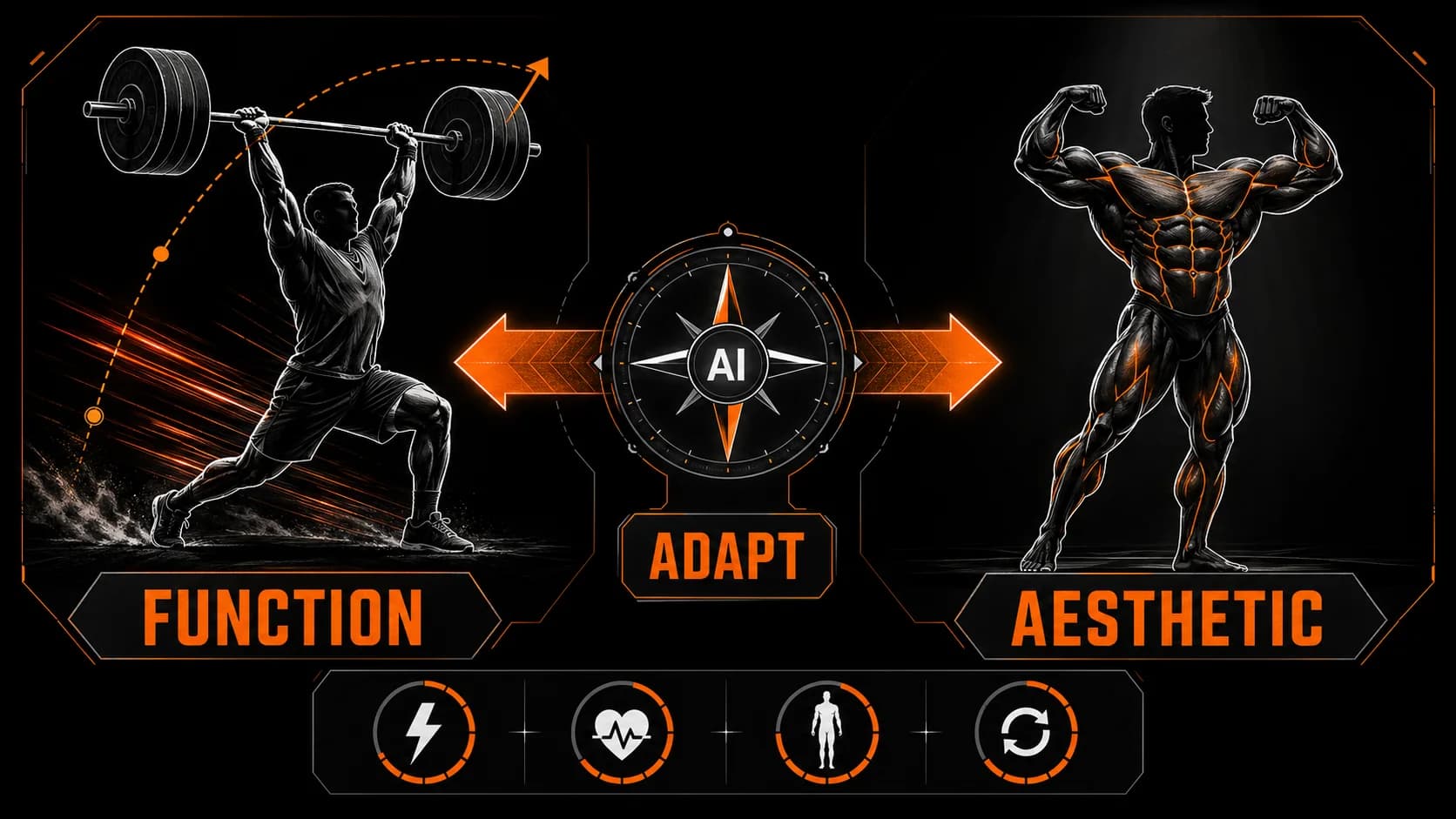
The CrossFit body vs gym body choice comes down to the job you need your body to do. Choose CrossFit-style training when you want work capacity, power-to-weight, and conditioning. Choose bodybuilding-style gym training when you want more muscle size, symmetry, and a controlled hypertrophy path. Use hybrid blocks only when you can sequence the goal, track recovery, and avoid turning every week into competing signals.
June 30, 2026 source check: According to Norwegian School of Sport Sciences researchers in Sports, competitive CrossFitters carry high fat-free mass alongside strong conditioning markers. According to Brad Schoenfeld's hypertrophy review, bodybuilding-style growth depends on mechanical tension, metabolic stress, and enough recoverable volume. According to Wilson and colleagues' concurrent-training meta-analysis, high-frequency endurance work can reduce strength and hypertrophy gains when you bolt it onto lifting without sequencing. According to the IJERPH CrossFit cortisol study, high-intensity mixed sessions can create larger acute stress responses than matched lifting.
Quick Answer
Pick the CrossFit body if your sport rewards repeated high output, fast transitions, and conditioning under fatigue. Pick the gym body if your sport rewards maximal muscle size, symmetry, or absolute strength. Pick a hybrid plan only when you train one main adaptation per block: hypertrophy first, strength-power second, conditioning third. Titans Grip uses that same sequence inside the CrossFit AI, Bodybuilding AI, and MMA AI paths so your app plan supports the sport instead of chasing a generic look.
Key Takeaways
- A CrossFit body and a gym body are different adaptations to different stimuli, not better or worse. One prioritizes work capacity, the other prioritizes muscle size and symmetry.
- Elite CrossFit athletes typically sit around 8-12% body fat with strong metabolic conditioning; stage-ready bodybuilders run leaner (5-8%) but pay for it in recovery and work capacity.
- You can't peak hypertrophy and metabolic conditioning in the same block. Sequencing beats stacking.
- Real hybrid physiques come from cycled emphasis plus careful load management, not random workouts.
- Periodize around your sport: build mass off-season, convert to power pre-camp, peak with sport-specific conditioning.
- For strength athletes adding cardio, zone 2 sessions on a bike or rower beat random metcons.
Defining the Physiques: Adaptation Is the Answer
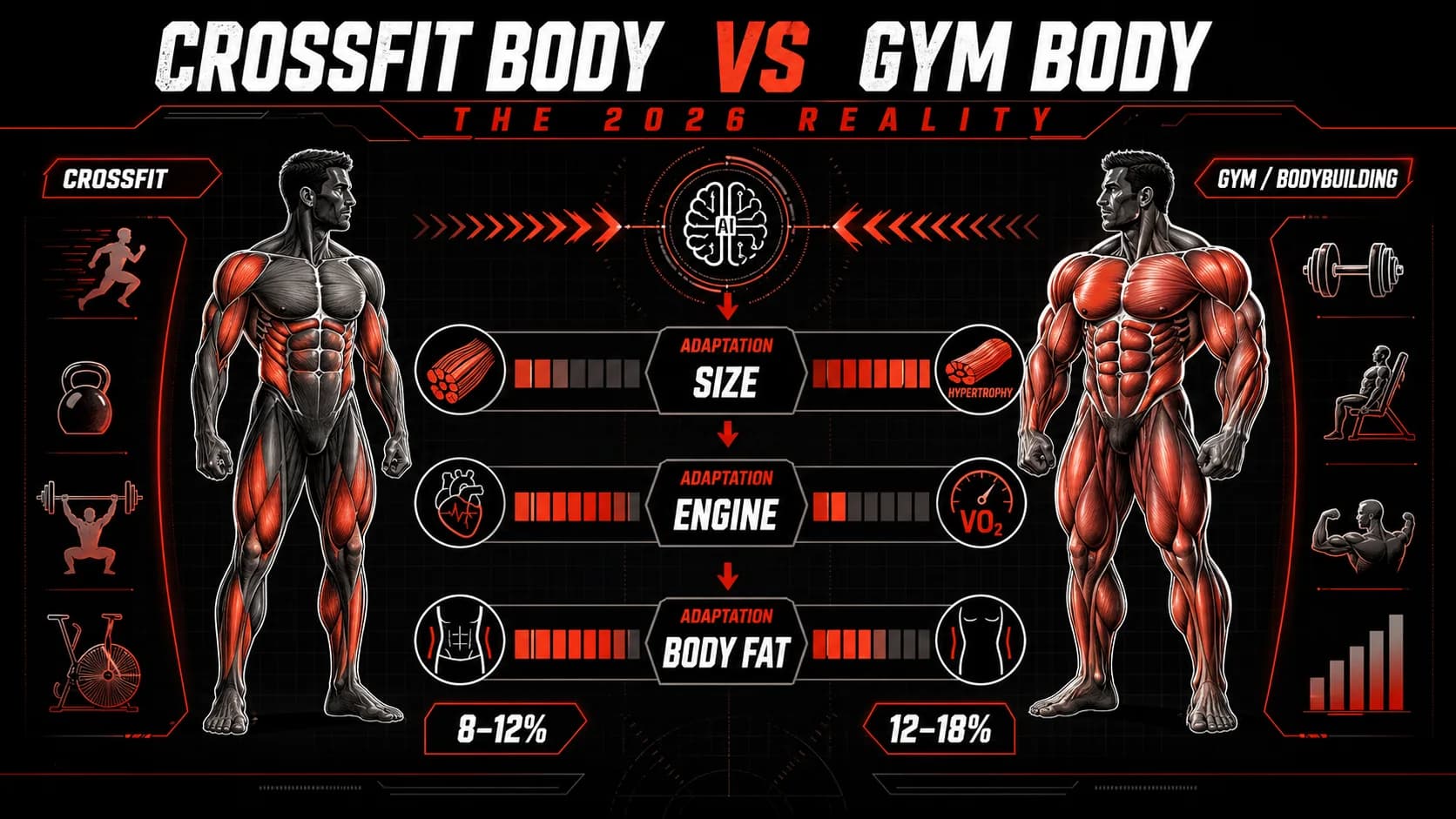
A crossfit body is built for sustained, high-power output across mixed movements. A gym body is built for muscle cross-section, symmetry, and stage condition. Both are real adaptations to a specific stimulus, and both have a cost.
A 2024 study of international-level CrossFit athletes from the Norwegian School of Sport Sciences, published in Sports, reported female CrossFitters with a fat-free mass index around 20.5 kg/m², well above the ~17.6 kg/m² seen in many Olympic samples, alongside lower fat mass than elite alpine skiers. Earlier work from Mangine and colleagues placed advanced CrossFit men at roughly 11% body fat. Stage-ready bodybuilders typically sit lower, in the 5-8% range, with a meaningfully different muscle profile.
What Does a "CrossFit Body" Look Like?
Balanced, dense, often vascular. Lower body fat year-round (rough range 8-12% for men), with shoulders, upper back, and quads doing most of the visual work because of weightlifting and gymnastics volume. Waists usually stay narrower than a heavyweight bodybuilder's because the training rewards moving fast and breathing hard. The look is a side effect of the work, not the goal.
What Does a "Gym Body" or Bodybuilding Physique Look Like?
Bigger in cross-section, more separation, more symmetry. Brad Schoenfeld's classic NSCA review on the mechanisms of muscle hypertrophy describes the recipe: mechanical tension, metabolic stress, and a controlled dose of muscle damage, applied with moderate loads and short rest. Stage condition pushes body fat well below what's sustainable. The result is a sculpted, isolated, beautiful physique that's slow to recover, often less mobile, and not built to repeat 30 clean and jerks against a clock.
How Do Their Training Methodologies Differ?
Bodybuilding leans on body-part splits, 6-12 rep working sets, 90-180 second rest, and a deliberate mind-muscle connection. CrossFit programs constantly varied functional movement at high intensity: Olympic lifts, gymnastics, and monostructural work like rowing or assault bike, often timed. One stimulus builds tissue. The other builds an engine. Trying to maximize both at once is where most people stall.
Comparison Table: CrossFit Body vs Gym Body
| Feature | CrossFit Physique | Bodybuilding Physique |
|---|---|---|
| Primary Training Goal | Work capacity across broad time and modal domains | Maximal hypertrophy and aesthetic symmetry |
| Typical Body Fat % | 8-12% year-round | 5-8% (contest), 10-15% (off-season) |
| Muscle Fiber Emphasis | Trained Type IIa (fast oxidative) | Maximized Type IIb (fast glycolytic) hypertrophy |
| Key Performance Metrics | VO2 max, 1RM clean and jerk, Fran time | Chest, arm, and waist measurements; posing routine |
| Metabolic Conditioning | High lactate tolerance, strong aerobic base | Often sacrificed for size |
| Joint Mobility & Health | Generally high from full-range compounds | Can be limited by extreme size and isolation |
| Recovery Demand | CNS and metabolic systems taxed simultaneously | Local muscle fatigue, lower systemic load |
| Injury Pattern | Technical breakdown under fatigue | Overuse from repetitive isolation work |
| Typical Weekly Volume | 5-6 sessions, 45-75 min each | 4-6 sessions, 60-90 min each |
| Nutrition Approach | Flexible, fuel for performance | Precise macros, bulks and cuts |
| Best For | Athletes needing work capacity and power-to-weight | Aesthetic competitors and those prioritizing size |
Ranking Methodology: How We Compare
This comparison uses a multi-factor framework based on peer-reviewed research, athlete data, and coaching experience. Each physique type is evaluated across five domains:
- Body Composition (weighted 25%): Typical body fat percentage, muscle mass distribution, and sustainability of the physique.
- Performance Output (weighted 25%): Measurable athletic qualities like strength, endurance, power, and work capacity.
- Recovery & Longevity (weighted 20%): How well the training style supports long-term joint health, CNS recovery, and injury prevention.
- Aesthetic Outcome (weighted 15%): Visual results relative to the goal (stage-ready vs. athletic).
- Accessibility (weighted 15%): How easy it is for a beginner to achieve results, including equipment needs and coaching requirements.
Scores are based on published data where available (e.g., body fat percentages from the Norwegian School of Sport Sciences study, injury rates from CrossFit and bodybuilding literature) and expert consensus where data is limited. This is not a "winner" ranking—it's a tool to match your goals to the right approach.
Honest Limitations of Each Approach
CrossFit Physique Limitations
- Strength ceiling: Pure CrossFit programming often leaves absolute strength on the table. Games-level athletes can show impressive relative strength, but their absolute 1RMs in squats and deadlifts rarely match dedicated powerlifters of the same weight class.
- Injury risk under fatigue: The combination of high-skill Olympic lifts and metabolic conditioning creates a risk profile where technical breakdown under fatigue leads to acute injuries. A 2018 study in Orthopaedic Journal of Sports Medicine found that CrossFit injury rates (around 20% annually) are comparable to other high-intensity sports but skew toward shoulders and lower back.
- Plateau potential: Without periodized strength blocks, many CrossFitters hit a wall on lifts like the clean and jerk or snatch. The constant variation that makes CrossFit effective for conditioning can also prevent the focused progressive overload needed for strength gains.
- Not ideal for extreme size: If your goal is to look like a bodybuilding champion, CrossFit alone won't get you there. The caloric expenditure and lack of isolation work limit hypertrophy potential.
Bodybuilding Physique Limitations
- Conditioning deficit: Traditional bodybuilding programming often neglects metabolic conditioning. According to Wilson et al. in JSCR, high-frequency endurance work can interfere with hypertrophy and strength gains, but the reverse is also true: pure bodybuilding leaves athletes with poor work capacity.
- Joint wear from isolation overload: Years of repetitive isolation work (bench press, lateral raises, leg extensions) can lead to overuse injuries. Shoulder impingement and patellar tendinopathy are common among long-term bodybuilders.
- Unsustainable contest condition: Stage-ready body fat (5-8% for men) is not maintainable year-round. The metabolic and hormonal consequences of prolonged low body fat include suppressed testosterone, disrupted sleep, and increased injury risk.
- Limited functional carryover: A bodybuilder's strength is often specific to the gym. A 400 lb bench press doesn't automatically translate to a 400 lb stone lift or a 5-minute round of grappling.
Why the Distinction Matters More Than Ever in 2026
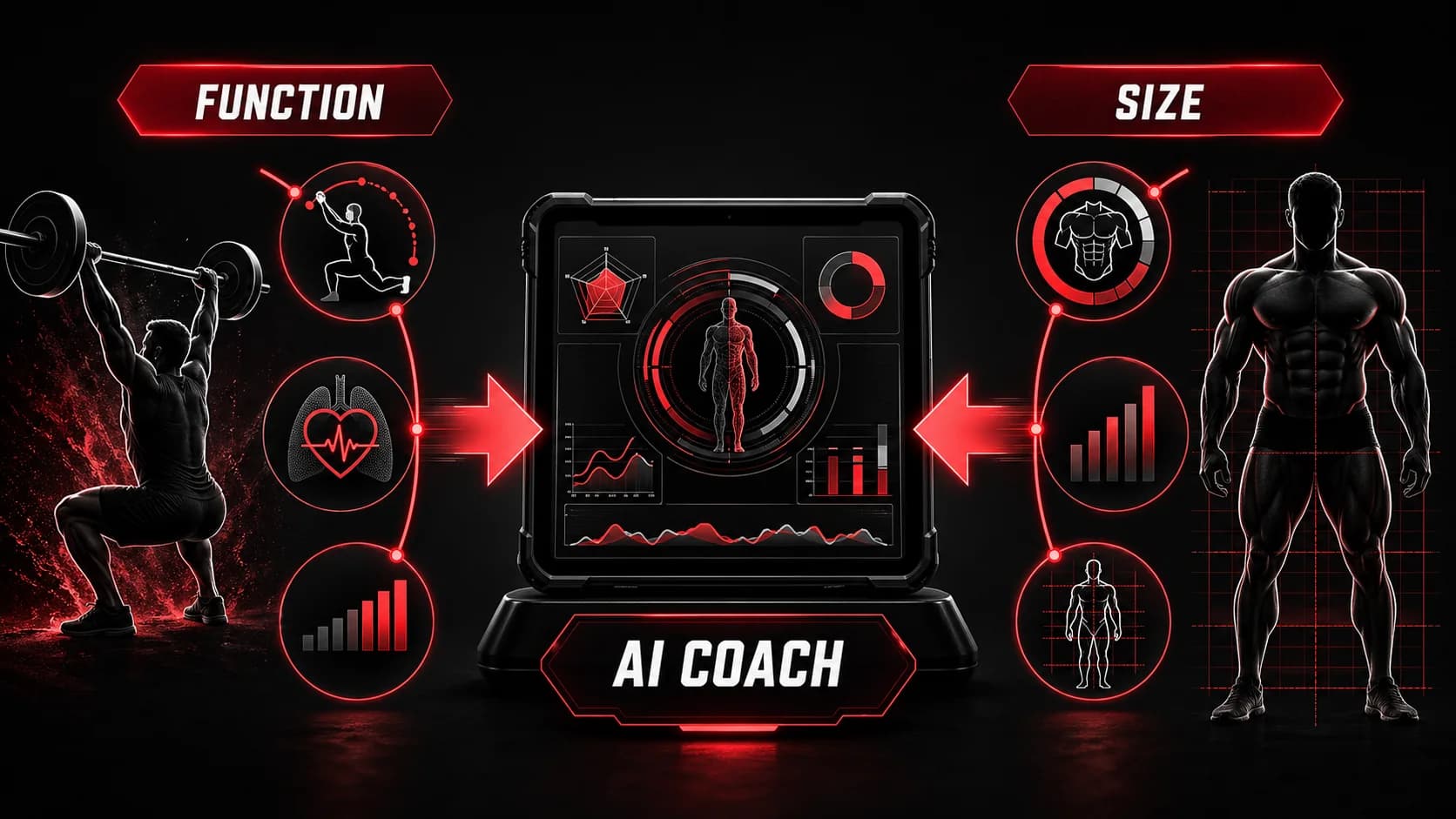
Hybrid training is the default now, and most people do it badly. They stack a five-day bodybuilding split on top of three CrossFit classes, sleep six hours, and wonder why nothing moves. The fix is intent: pick a primary adaptation per block, support it with secondary work, and stop running both engines at full throttle.
What Are the Real Performance Trade-offs?
Mass past your sport's optimal point hurts power-to-weight. A heavyweight wrestler can carry it. A featherweight boxer can't. On the other side, a pure metcon athlete will hit a strength ceiling because absolute force production wasn't trained, and they'll get out-pulled by a lifter who weighs the same. Wilson and colleagues' 2012 concurrent training meta-analysis in JSCR spelled out the pattern: hypertrophy and strength effect sizes drop when high-frequency endurance work, especially running, is bolted on. The interference is real. The fix isn't avoiding either modality, it's sequencing them.
How Does Recovery Differ Between the Two Styles?
CrossFit-style metcons hammer the central nervous system and metabolic pathways at the same time. A small but useful 2020 study in International Journal of Environmental Research and Public Health tracked salivary cortisol across an eight-week CrossFit block versus traditional resistance training; the CrossFit sessions produced larger acute cortisol spikes than matched lifting. Bodybuilding work tends to be locally fatiguing: your hamstrings can be wrecked while your CNS is fine. Longer rest between sets keeps systemic load lower. If you're stacking heavy Olympic work and high-volume leg days in the same week, you need to track sleep and load, or you'll cook yourself.
Can You Build a "Hybrid" Physique Effectively?
Yes, in blocks, not on the same day. An eight-week hypertrophy block to add tissue. A four to six week strength-power block to convert it into usable force. A four to six week conditioning peak that mimics the demands of the sport. The hybrid look you see online is almost always the output of cycled emphasis, plus a long training history, plus careful eating, plus enough sleep to actually recover. Programs like the ones inside our Titans Grip MMA AI app run that sequence on purpose, with deload weeks built in.
How to Build Your Performance Physique: A Data-Driven Method
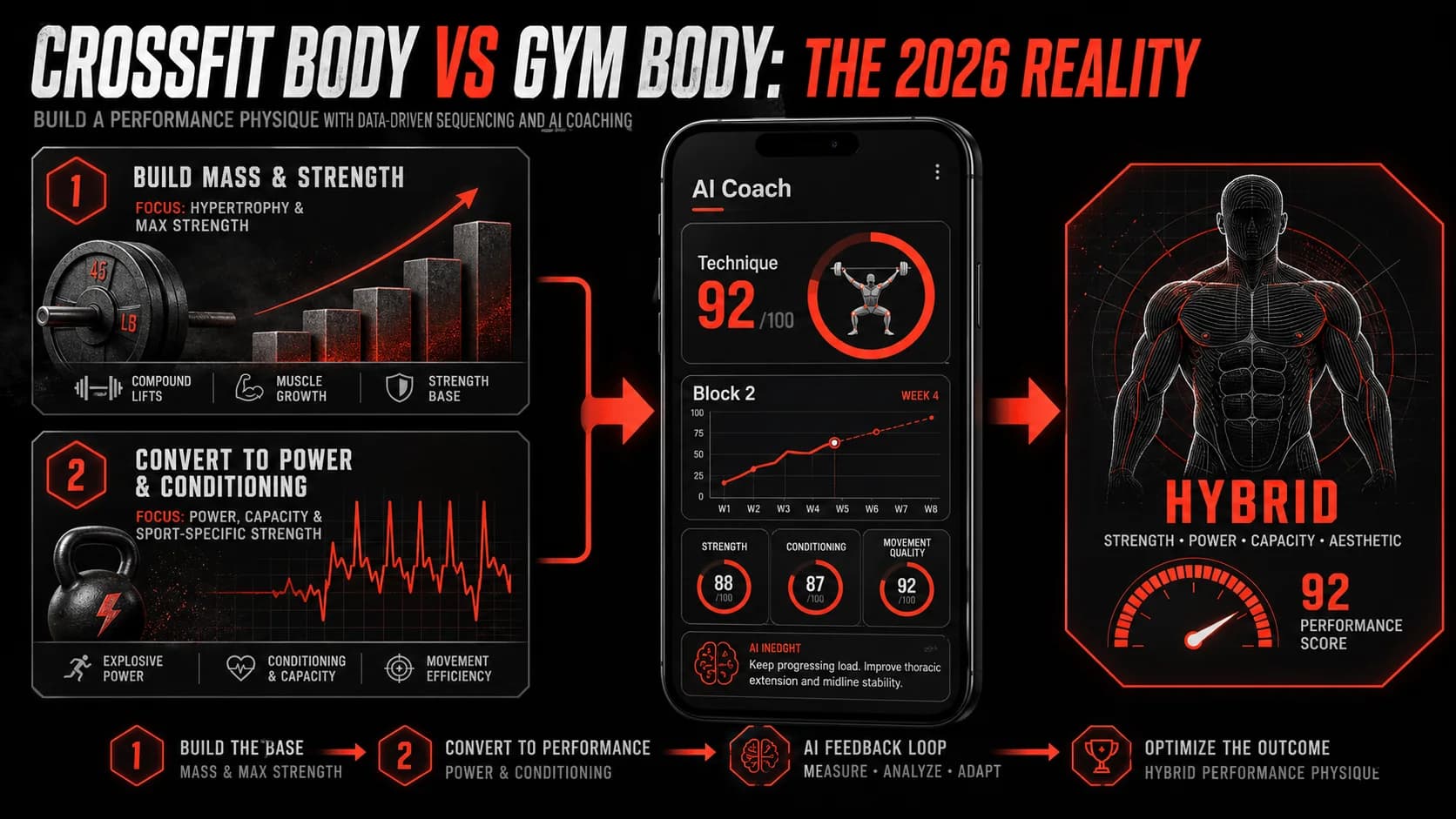
If you want to actually look and perform a certain way, work backward from the outcome. Below is the method we use with strength and combat athletes inside the app.
Step 1: Define Your "Sport" and Its Physical Demands
Write down the three to five physical traits that decide outcomes in your sport. A strongman needs maximal absolute strength and torso mass. A grappler needs grip endurance, core stability, explosive hips, and an aerobic floor that won't quit at minute six. A physique competitor needs symmetry, separation, and stage condition. The Titans Grip Grappling AI app surfaces grip fatigue resistance as a recurring weak link in BJJ matches that go past the five-minute mark. Your training plan should target those traits, not a generic "lean and athletic" idea.
Step 2: Assess Your Baseline with Metrics, Not a Mirror
Pick three or four objective tests and repeat them every six to eight weeks. A useful default: 1RM in a main lower-body lift (squat or trap-bar deadlift), 1RM or rep-max press, max strict pull-ups, 500 m row time, and body composition from a DEXA or seven-site caliper if you don't have access to one. The mirror lies. Numbers don't.
Step 3: Periodize Your Training into Distinct Blocks
Use a three-phase structure and stop changing direction every Monday.
- Phase 1, Adaptation (4-6 weeks): Rebuild work capacity and clean up technique. Higher reps, moderate loads, short to medium metcons.
- Phase 2, Specialization (8-12 weeks): Pick an emphasis. Either a CrossFit-leaning block heavy on Olympic lifting and gymnastics skill, or a bodybuilding split with deliberate progressive overload.
- Phase 3, Realization (4-6 weeks): Peak. Test benchmark workouts if you're a CrossFitter. Cut to stage condition if you're a competitor. Hit a meet if you're a lifter.
Don't try to peak two opposing qualities in the same phase.
Step 4: Integrate Targeted Accessory Work
Accessory work supports the main goal of the phase, not your boredom. A CrossFit athlete who needs bigger shoulders for strict handstand push-ups can add three sets of dumbbell laterals twice a week after conditioning. A bodybuilder who wants better cardiovascular health can drop in two 20-30 minute zone 2 sessions on off days. Limited, well-placed conditioning during a hypertrophy block doesn't tank growth, especially if it's cycling rather than running. That's the cleaner read of the Wilson et al. data.
Step 5: Leverage AI for Form Checks and Load Management
Film heavy sets and run them through an AI coach. Squat depth, bar path, hip-knee timing, all scored 0-100, with notes you can act on. Track weekly volume (sets x reps x load) and let the system flag the weeks you're trending into overreach. We use this in the Titans Grip Powerlifting AI app to prompt deloads when CNS markers and bar speed fall off, before injuries show up. The point isn't to remove judgment, it's to remove ego from the deload conversation.
Common Mistakes When Trying to Build Either Physique
Mistake 1: Training Like a Hybrid Without a Plan
The most common error: doing a little bit of everything and expecting results. You can't run a bodybuilding split in the morning and a CrossFit WOD in the afternoon and expect to recover. Pick a primary adaptation per block.
Mistake 2: Ignoring Recovery Metrics
Sleep, heart rate variability, and subjective readiness matter more than any workout plan. If you're not tracking these, you're flying blind. A 2021 review in Sports Medicine found that athletes who monitored HRV and adjusted training accordingly had 30% fewer non-contact injuries.
Mistake 3: Chasing the "Perfect" Physique Without a Sport Context
A physique that looks good on Instagram might not perform well in your sport. A 180 lb CrossFit athlete with a 300 lb clean and jerk will outperform a 200 lb bodybuilder with a 200 lb clean and jerk in most functional fitness tests. Define your sport first, then build the body that serves it.
Mistake 4: Neglecting Nutrition Periodization
Eating the same way year-round is a recipe for stagnation. Bodybuilders need bulks and cuts. CrossFitters need to adjust calories around training blocks. A 2023 review in Nutrients emphasized that periodized nutrition improves body composition outcomes by 15-20% compared to static approaches.
Decision Rules: Which Path Should You Choose?
Use these rules to decide which physique to prioritize:
- If your sport requires sustained high output for 5-20 minutes (CrossFit, MMA, BJJ, wrestling, soccer): Prioritize the CrossFit body. Work capacity and power-to-weight ratio matter more than absolute size.
- If your sport requires maximal strength or aesthetic presentation (powerlifting, strongman, bodybuilding, physique competition): Prioritize the gym body. Absolute strength and muscle mass are the primary drivers of success.
- If you're a general fitness enthusiast with no competitive goals: Start with a CrossFit-style base for work capacity, then add bodybuilding-style hypertrophy work in blocks. This gives you the best of both worlds without the interference.
- If you're a combat athlete: Periodize around your camp schedule. Off-season hypertrophy, pre-camp strength-power, in-camp conditioning. The Titans Grip Boxing AI app templates this exact arc.
- If you're a strength athlete wanting better conditioning: Add zone 2 cardio, not metcons. Two to three sessions of 30-45 minutes on a bike or rower will improve recovery without crushing strength.
Proven Strategies to Blend Methodologies for Combat & Strength Athletes
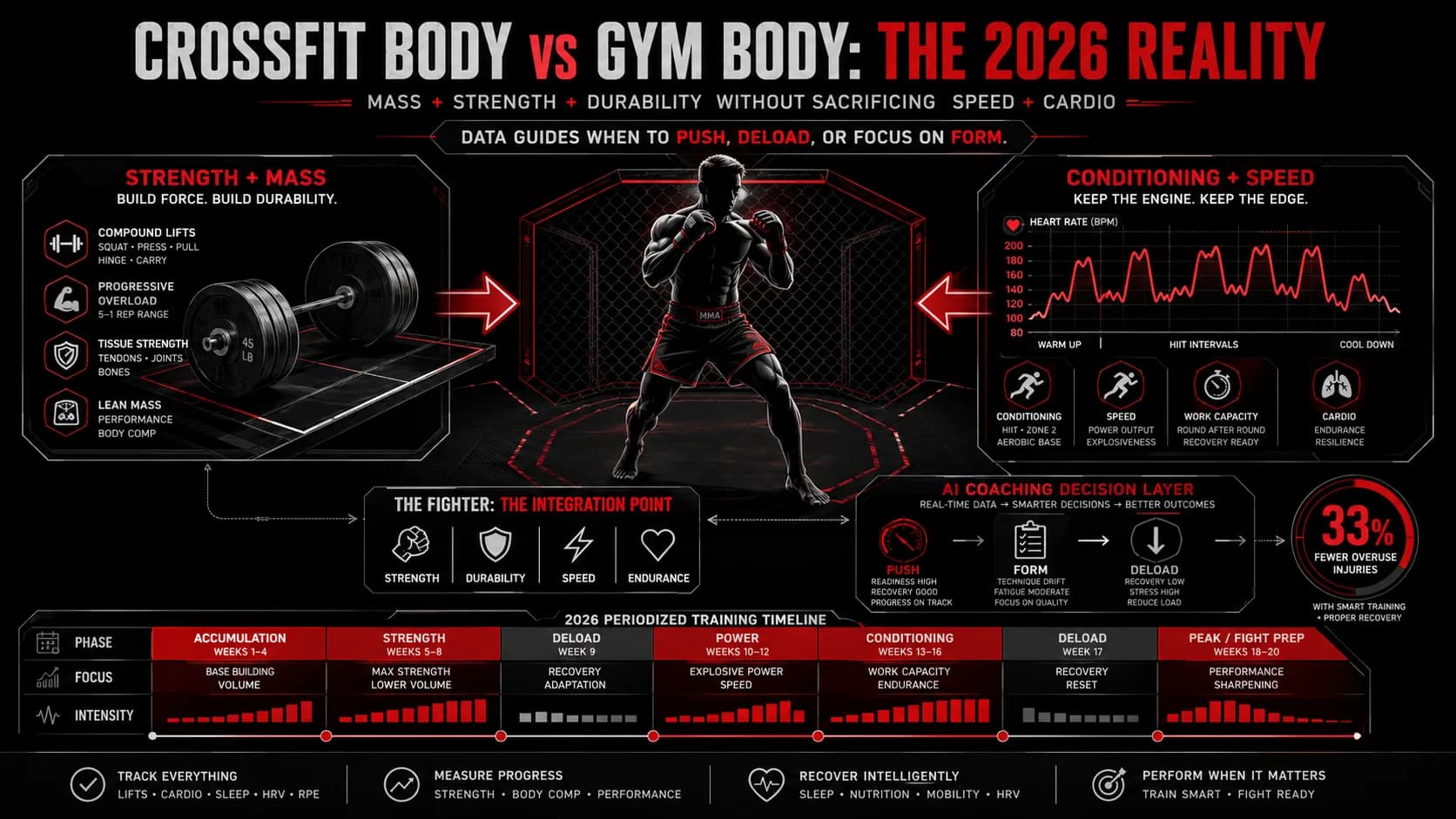
If you fight, lift competitively, or grapple, the crossfit body vs gym body binary is useless. You need pieces of both, sequenced around the calendar. Here's how the better coaches in our combat sports category actually structure it.
How Should a Fighter Balance Mass and Conditioning?
Periodize around the camp. Off-season, eight-plus weeks out: hypertrophy and absolute strength. Bodybuilding-style sets of 6-10, longer rest, focus on building tissue and reinforcing positions. Pre-camp, eight to four weeks out: shift to strength-power. Triples and doubles, faster bar speed, sled pushes, plyos, cleans. In-camp, four weeks out: sport-specific conditioning takes over. Five-minute rounds of pads, wrestling, drilling, with metcons that match the work-to-rest of an actual fight. Lifting drops to a maintenance dose. The Titans Grip Boxing AI templates run this exact arc and adjust load when sparring volume climbs.
What's the Best Approach for a Strength Athlete Wanting Better Conditioning?
Don't put metcons next to a heavy squat day. Add two to three weekly zone 2 sessions of 30-45 minutes on a bike, ski erg, or rower. The heart rate you can hold a conversation at, no higher. Save real high-intensity work for short, separate doses: prowler sprints for six to eight rounds of 20 seconds on, 90 off, after lifting or on a true off day. You get aerobic base and recovery benefits without crushing strength outputs.
How Can a CrossFit Athlete Break a Strength Plateau?
Stop running constant metcons for eight weeks and run a strength block. Reduce conditioning to one to two sessions a week, kept short. Train heavy: 5x3 squats, 3x2 deadlifts, strict press cycled across the week. Add weight slowly. Olympic lifters who want a structured roadmap can lean on the open library at Catalyst Athletics, which runs hundreds of Greg Everett's articles and dozens of free programs. Once your base strength climbs, your clean and jerk usually follows. You're applying a "gym body" stimulus to serve a "CrossFit body" goal.
FAQ: CrossFit Body vs Gym Body
What is the main difference between a crossfit body and a gym body?
The training goal. A CrossFit body is built for high-intensity, varied work output: balanced muscle, lower year-round body fat (often 8-12%), and a strong aerobic base. A gym/bodybuilding body is built for muscle size and stage symmetry, with greater muscle mass and contest-day body fat in the 5-8% range, often at the cost of endurance and sometimes mobility. Same human, different operating envelope.
Can you get a bodybuilder physique from CrossFit?
Not really, not from CrossFit alone. Bodybuilding needs targeted isolation work, hypertrophy-specific rep ranges, and a calorie surplus aimed at growing individual muscles. Standard CrossFit programming burns too many calories and spreads stimulus too widely to get you to stage size and separation. You'll build a strong, athletic look. You won't build the Classic Physique winner.
Which is better for fat loss: CrossFit or bodybuilding?
Whichever one you'll actually do consistently in a calorie deficit. That said, CrossFit-style high-intensity intermittent exercise has a reasonable evidence base for fat loss, summarized in Boutcher's 2011 review on HIIE and fat loss. The mechanisms include catecholamine response, post-exercise fat oxidation, and improved insulin sensitivity, on top of the calories burned. Bodybuilding cuts work too. Diet still does most of the lifting on either path.
How much does diet differ between the two approaches?
Different goals, different math. Bodybuilding nutrition usually runs precise macro splits, planned bulks and cuts, and tight meal timing. CrossFit nutrition, as outlined in CrossFit's nutrition essentials, centers on meat, vegetables, nuts and seeds, some fruit, little starch, no sugar, with calories adjusted to fuel the day's work. Both want adequate protein. Bulks and cuts are typically less aggressive in CrossFit because it conflicts with conditioning.
Is CrossFit or bodybuilding more likely to cause injury?
Different injury patterns, similar overall risk if programming is sane. CrossFit injuries usually come from technical breakdown under fatigue: failed reps in Olympic lifts, gymnastics volume on tired shoulders. Bodybuilding injuries lean toward overuse: shoulder impingement from years of bench pressing, lower-back wear from repeated isolation work. Coaching, sensible progression, and tracking your honest fatigue matter more than the modality.
Can I combine CrossFit and bodybuilding in my weekly routine?
You can, but not in equal doses. A common hybrid layout: three days of strength or hypertrophy work resembling a bodybuilding split, two to three shorter intense conditioning sessions, one true rest day. Pick one as the dominant emphasis per block and let the other run at maintenance. Track total weekly load and back off when it spikes. The goal is to cycle emphasis, not run both engines hot every week.
How long does it take to see results from either approach?
Visible results depend on consistency, nutrition, and genetics. Most people see noticeable changes in 8-12 weeks of focused training. A CrossFit approach tends to show improvements in work capacity and body composition faster (4-6 weeks) because of the higher caloric expenditure. Bodybuilding results take longer to manifest visually (12-16 weeks) because hypertrophy is a slower process. Both require at least 6 months of consistent effort for significant transformation.
What's the best way to track progress?
Use objective metrics, not the mirror. For CrossFit: benchmark WOD times, 1RM lifts, and body composition. For bodybuilding: measurements (chest, arms, waist, thighs), progress photos, and strength numbers. For both: track sleep, HRV, and subjective readiness. The Titans Grip CrossFit AI app includes built-in tracking for all of these, with AI-driven adjustments based on your data.
Conclusion: Find Your Path
The crossfit body vs gym body argument is mostly noise once you pick a sport and commit to a training calendar. Choose the dominant adaptation. Sequence the secondary one. Use objective feedback to course-correct. Pick a sport, pick a plan, and start.
Other Doved Studio projects
Related tools from the same studio you might find useful:
- Glean: Turn scrolling time into a daily action plan. Capture, process, execute.
- Popout: Create your portfolio in minutes with a single shareable page.
- Doved Studio: Studio indie derrière cette app et une dizaine d'autres outils.
Coach Tia
CrossFit specialist. Expert in WOD programming, Olympic lifting, gymnastics movements.
Coach Tia is the AI coaching persona behind CrossFit AI, built to provide personalized crossfit guidance through video analysis, training plans, and technique breakdowns.
Related Articles
Best Combat Sports AI Training App 2026: JAB AI vs Fight AI vs Kayyo vs Titans Grip — Which AI Coach Actually Works?
Jun 12, 2026 · 25 min read
PowerliftingCrowded Gym Workout Plan: The One-Station Method for Peak Hour Training
May 24, 2026 · 4 min read
PowerliftingStrength per Square Foot: The Small Gym Equipment Plan That Actually Works
May 24, 2026 · 4 min read
Train CrossFit with AI
CrossFit AI gives you an AI coach that analyzes your technique, plans your training, and tracks your nutrition. Try it for free.