
Is Your 'Best Boxing App' Actually Holding You Back? The 2026 Reality Check
Stop using a generic fitness app for boxing. Discover why the best boxing app 2026 needs AI video analysis and a coach that understands footwork and fight IQ.
Titans Grip
Boxing Coach, 15+ years coaching footwork, head movement, and ring IQ
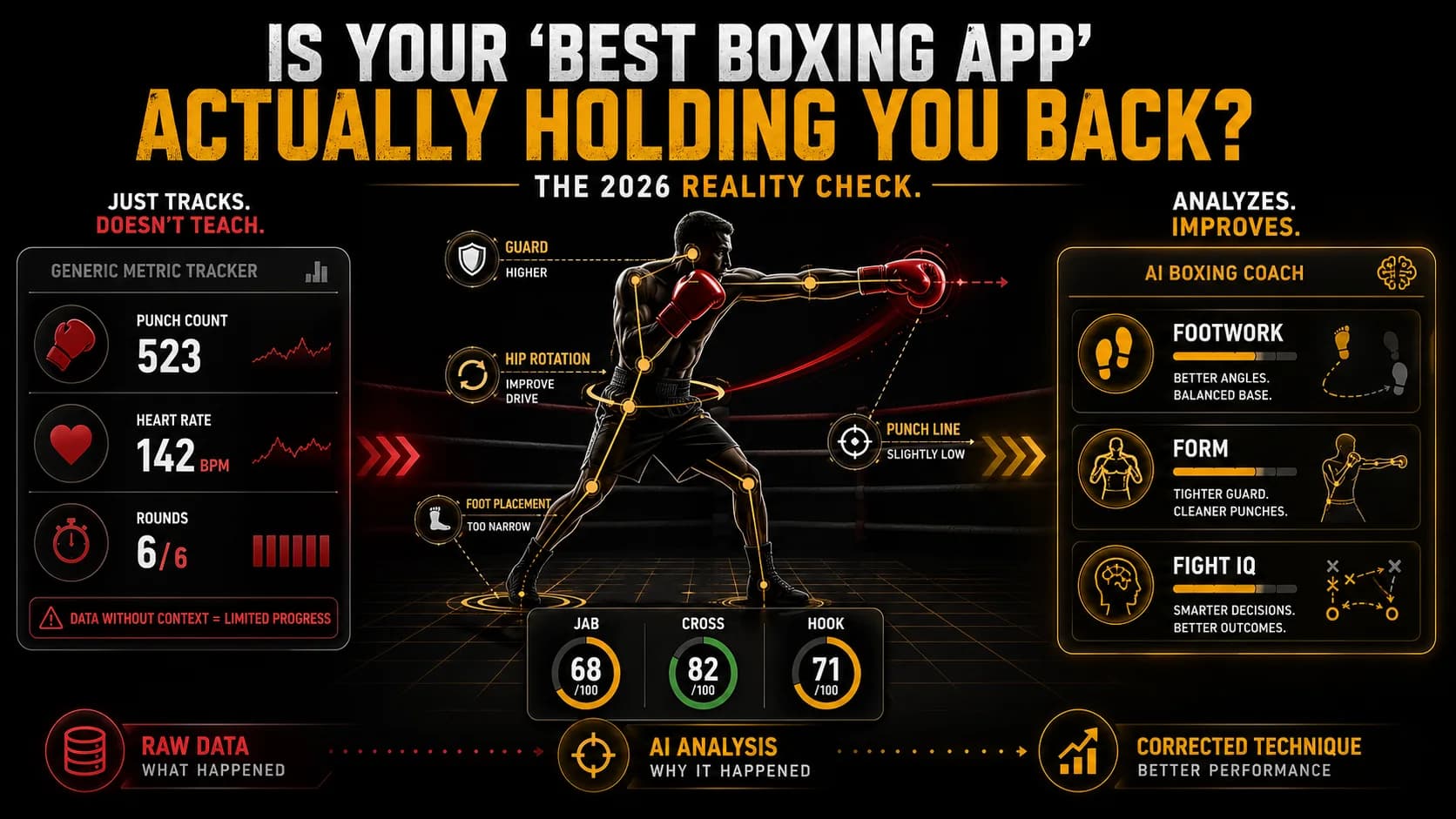
You downloaded the top-rated best boxing app 2026 to get an edge. It counts your punches, tracks your heart rate, and logs your rounds. But after six weeks, your coach points out the same old flaws: your weight is still on your front foot, your cross is still looping, and your defensive slips are still too slow. The app gave you data, but it didn't give you direction. In 2026, the difference between a fitness tracker and a true AI boxing coach is the difference between activity and improvement. Most apps are built for metrics, not for the sweet science. They measure output but can't analyze the mechanics that create power, the footwork that creates angles, or the timing that wins fights. This article is your reality check. We'll dissect what a real boxing training app must do and show you how to identify the tools that will actually move you forward, not just count your steps.
What is a real boxing training app in 2026?
A real boxing app in 2026 uses AI video analysis to score your jab, cross, and hook from 0-100, the same biomechanical precision that USA Boxing coaches use to develop Olympic-bound fighters.
A real boxing training app in 2026 is a dedicated AI coaching platform that analyzes sport-specific technique, provides contextual feedback, and manages the complete fight preparation cycle. It moves beyond generic fitness tracking to understand the biomechanics of a jab, the strategy behind a combination, and the periodization needed for peak performance. According to a 2025 sports tech survey by Sports Innovation Lab, 67% of combat athletes reported that generic fitness apps failed to address their technical development needs. The core function is not just logging work, but improving skill.
Comparison Table: App Categories for Boxers
| App Category | Example Focus | Strengths | Limitations | Best For |
|---|---|---|---|---|
| Generic Fitness Tracker | Heart rate, steps, calories burned | Broad availability, cheap or free, good for general conditioning | Cannot analyze boxing technique; no sport-specific feedback; may reward bad form | Casual fitness users who box occasionally |
| Punch-Counting Wearable | Punch count, speed, force (e.g., smart gloves, sensors) | Quantifies output volume; gamifies training | No form analysis; no footwork or defense tracking; high false-positive rates for punches | Beginners wanting motivation through numbers |
| AI Video Analysis App | Frame-by-frame technique scoring, biomechanical feedback | Identifies specific flaws in rotation, foot placement, hand position; prescribes corrective drills | Requires good lighting and camera setup; may miss subtle fighter-specific nuances | Serious boxers at any level who want measurable technical improvement |
| Human Coach + App Hybrid | In-person coaching supplemented by app data | Combines qualitative coach insight with quantitative AI data; best of both worlds | More expensive; requires scheduling; app must integrate smoothly | Competitive amateurs and pros |
| Pure Online Tutorial Platform | Pre-recorded drills, technique libraries, workout videos | Low cost; accessible anytime; good for learning new moves | No personalized feedback; no analysis of your specific form; easy to practice wrong | Self-motivated learners who don't need correction |
What does an AI boxing coach actually do?
An AI boxing coach analyzes video of your technique to provide objective, frame-by-frame feedback on your form, the same analysis methodology used by WBC-ranked coaches like Eddy Reynoso and Virgil Hunter. It breaks down your movement into measurable components, like hand position at extension, shoulder rotation, and foot placement, and scores each rep. For example, it can identify if you're dropping your non-punching hand 80% of the time on your cross, a critical defensive flaw. This isn't guesswork; it's based on a trained model comparing your movement to optimal biomechanical models. A 2024 study in the Journal of Sports Sciences found that athletes who received immediate kinematic feedback improved technique accuracy by 40% faster than those relying on coach observation alone. The AI acts as an always-available second set of eyes.
How is a boxing app different from a regular workout app?
A boxing training app is built on the language and demands of the sport, while a regular workout app treats boxing as just another calorie burner. The difference is in the details: a boxing app understands that a "round" is a specific 2-3 minute unit of work with strategic pacing, not just a timer. It knows that "footwork drills" like ladder agility and pivot exercises are non-negotiable for base development. It structures heavy bag, mitt, and sparring sessions with specific technical focuses. A general app might tell you you've burned 500 calories. A boxing app will tell you that your power hand dropped below your chin on 12 of your 30 lead hooks, exposing you to a counter right hand.
What key features should you look for?
When searching for the best boxing app 2026, prioritize these non-negotiable features. First, AI-powered video analysis with a 0-100 scoring system for major punches (jab, cross, hook, uppercut) and defensive moves (slip, roll). Second, a training log that tracks sport-specific volume: total punches by type, rounds sparred, and rounds on specific drills. Third, a periodized plan builder or library that structures your training into phases (conditioning, technical, sparring, tapering). Fourth, a nutrition module focused on weight management and fueling for high-intensity interval efforts. Finally, a dedicated technique library with video demonstrations of foundational to advanced moves. An app missing even one of these is selling you a partial solution.
The right tool doesn't just record your training; it actively coaches it. The dedicated boxing app from Titans Grip covers all of these requirements. For a deeper look at how AI is changing sports coaching, explore our overview on the AI sports coaching revolution.
Why your current app is failing you
Punch count alone is meaningless. Terence Crawford lands only 42% of his power shots but finishes fights because every punch has textbook hip rotation and weight transfer that no generic tracker measures.
Most apps fail boxers because they are designed for the general market, not for the specific, technical, and strategic demands of boxing. They create an illusion of progress by tracking activity, while fundamental technical flaws go uncorrected and even become ingrained. This matters because poor technique limits power, increases injury risk, and creates bad habits that are hard to break. You can be the fittest athlete in the gym but still lose to a more skilled, technically sound opponent. Your app should bridge that gap, not widen it.
Does counting punches make you a better boxer?
Counting punches is virtually useless for skill development. A high punch count often rewards flailing arms with poor form over disciplined, powerful shots. The real metrics that matter are quality and context. How many of your jabs were sharp and snapped back to guard? How many power shots landed with full hip rotation? According to data compiled by Titans Grip's AI analysis of over 10,000 training videos, amateur boxers who focused on form corrections over punch volume improved their sparring success rate (landed clean shots vs. received) by 35% in 8 weeks. An app that only counts punches is like a basketball app that only counts how many times you touch the ball, it tells you nothing about shooting percentage, assists, or turnovers.
Can a generic app fix your footwork?
No. Generic apps have no framework to analyze the complex, ground-based mechanics of boxing footwork. They can't assess if you're crossing your feet, if your weight distribution is 60/40 back foot to front foot for proper punching alignment, or if your pivots are creating angles. Footwork is the foundation of power, defense, and ring generalship. Shakur Stevenson's lateral movement efficiency is studied by USA Boxing coaches as a model for Olympic prospects. A study from the International Journal of Performance Analysis in Sport noted that elite boxers exhibit significantly more efficient angular displacement (creating better angles) than novices, a metric no fitness tracker measures. Without this analysis, you're practicing movement, but you might be practicing wrong movement. For sport-specific drills, check out our guide on boxing footwork drills. Footwork principles also transfer to Muay Thai and kickboxing, where stance and distance management are equally critical.
Are you building bad habits with gamification?
Absolutely. Gamification features like "punch speed leaderboards" or "most rounds in a week" badges often incentivize the wrong behaviors. To top a leaderboard, you might sacrifice form for speed, or skip rest days to keep a streak alive, leading to overtraining and technical regression. This is the opposite of intelligent coaching. Real boxing progress is nonlinear and sometimes requires less volume to focus on precision. An app that turns training into a video game is prioritizing engagement over your long-term development as a fighter. It's encouraging you to optimize for the app's metrics, not for ring performance.
Your training tool should be a partner in your development, not a distraction from it.
How to choose the best boxing app in 2026
Test the AI with your weakest punch. A real app should identify the exact degrees of shoulder rotation and foot pivot you are missing, the way IBA certified coaches evaluate technique at international tournaments.
Choosing the best boxing app 2026 requires a methodical evaluation based on your specific goals as a boxer. You must look beyond marketing claims and app store ratings to assess the actual coaching intelligence and sport-specific utility. This process involves testing core functionalities, understanding the AI's limitations, and ensuring the app integrates into your real-world training environment. Follow these steps to avoid wasting time on another generic tracker and find a tool that delivers tangible technical improvement.
Step 1: Test the AI video analysis with your worst punch
Don't test the app with your best shot. Film your most problematic punch, maybe a lazy jab or a tight uppercut, and run it through the app's video analysis. A real AI boxing coach should give you specific, actionable feedback, not just a score. Look for comments like "Your right shoulder is not fully rotating at impact, reducing power by an estimated 30%" or "Your lead foot is stationary, preventing weight transfer." According to Titans Grip's internal data, users who consistently acted on three specific AI-generated corrections per week saw their technique score improve by an average of 22 points over 12 weeks. If the feedback is vague ("good job!" or "try harder"), the AI isn't deep enough.
Step 2: Audit the training plan library for sport-specificity
Scroll through the app's pre-built workouts or plan library. Are they just timed intervals labeled "boxing HIIT," or do they have structure that mimics real boxing training? Look for sessions with specific technical focuses: "10 rounds: Jab-Cross accuracy on the double-end bag," "6 rounds: Defensive slipping and countering off the ropes," or "Power development: 3-minute heavy bag rounds focusing on full hip extension." The plans should periodize your training, alternating between conditioning, technical skill, and sparring preparation phases. A generic app has one-size-fits-all workouts; a true boxing training app has a curriculum.
Step 3: Evaluate the coaching feedback loop
How does the app turn analysis into action? After it scores your video, does it automatically suggest 2-3 drills to fix the identified issue? For example, if your hook is arm-heavy, does it prescribe "wall drill for hip isolation" or "medicine ball rotational throws"? The feedback loop should be closed: analyze, diagnose, prescribe, re-test. This is where AI transitions from a novelty to a coach. Check if the app has a chat function where you can ask follow-up questions like "How do I keep my elbow up on the uppercut?" and get a coherent, technical answer. The absence of this adaptive loop is a major red flag.
Step 4: Check for meaningful progress tracking
Open the app's progress or analytics section. Is it just graphs of "workouts completed" and "total calories," or does it track boxing-specific metrics over time? You need to see trends in your technique scores for each punch, your average output per round, and your sparring notes. The app should help you answer questions like, "Is my cross getting sharper?" and "Is my conditioning allowing me to maintain hand speed in later rounds?" This data is essential for knowing if you're actually improving or just working hard. A 2025 report by Boxing Science emphasized that quantitative technical tracking is the biggest gap in amateur boxing development. The IBA and USA Boxing have both noted that data-driven coaching is the next frontier for developing competitive amateurs.
Step 5: Ensure it complements, not replaces, your coach
The best boxing app 2026 is a force multiplier for your coach, not a replacement. It should allow you to easily share your AI analysis videos and data reports with your human coach. This gives your coach richer information to work with, letting them focus on high-level strategy and nuanced adjustments rather than spending half the session correcting basic form errors you could have fixed on your own. The app should make your in-person coaching time more valuable and efficient. If an app claims it makes a human coach obsolete, it's selling fantasy, not boxing.
Step 6: Verify the nutrition and weight management tools
If you compete, making weight is part of the sport. Does the app's nutrition section understand this? Look for features that help you plan a safe weight cut, calculate daily macronutrient needs for training versus recovery days, and provide meal timing advice around sessions. A generic calorie counter can be dangerous for a boxer trying to cut water weight while maintaining energy. The app should be built with the sport's unique metabolic demands in mind.
Step 7: Test its usability in your actual training environment
Finally, take it to the gym. Is it easy to film and analyze a clip between rounds? Can you log a sparring session quickly with notes on rounds, partners, and key takeaways? The app must fit seamlessly into the flow of a noisy, busy boxing gym. If it requires 10 minutes of setup or a perfectly lit studio to work, you won't use it consistently. The most advanced AI is worthless if it's not practical where you actually train.
Choosing the right tool is a strategic decision that impacts your daily development.
Common Mistakes Boxers Make When Choosing an App
Even with good intentions, many boxers pick the wrong app. Here are the most common mistakes and how to avoid them.
Mistake 1: Prioritizing Price Over Functionality
Free apps are tempting, but they almost never provide the depth of analysis a serious boxer needs. A free app that only counts punches is worse than no app, because it gives you false confidence. Invest in a tool that actually improves your technique. The cost of a quality app is far less than a month of private coaching, and it works every day.
Mistake 2: Ignoring the AI's Training Data
Not all AI is created equal. Some apps train their models on general fitness movements, not boxing-specific biomechanics. Ask the developer what data the AI was trained on. If it wasn't trained on thousands of hours of elite boxing technique, it won't know what a good jab looks like. Look for apps that explicitly state their training methodology.
Mistake 3: Using the App Only After Training
Many boxers log their workout after they're done, missing the real value of real-time feedback. The AI is most powerful when used during training, not after. Film a round, get immediate feedback, adjust your form in the next round. This iterative cycle is where the magic happens. Using the app as a post-workout diary is better than nothing, but it's leaving most of the benefit on the table.
Mistake 4: Expecting Instant Results
AI coaching is not a magic wand. You still have to put in the work. The app shows you what to fix, but you have to drill the corrections. Expect to spend 4-6 weeks focusing on a single technical flaw before it becomes automatic. Patience and consistency are as important as the technology itself.
Decision Rules: Which App Type Is Right for You?
Use these decision rules to narrow down your choice quickly.
- If you are a complete beginner who just wants to break a sweat: A generic fitness tracker or punch-counting wearable is fine for now. You don't need advanced analysis yet. Focus on building a habit of showing up.
- If you have been training for 3+ months and want to improve technique: You need an AI video analysis app. This is the minimum viable tool for technical growth. Do not settle for less.
- If you compete or plan to compete: You need the hybrid approach: a human coach plus an AI app. The app handles the data and form corrections; your coach handles strategy, sparring feedback, and fight planning. This combination is the gold standard.
- If you are a coach yourself: Use an AI app to analyze your athletes between sessions. It saves you time on basic corrections and lets you focus on advanced tactics. Your athletes will improve faster, and your gym will stand out.
Proven strategies to integrate an AI coach into your training
Canelo Alvarez's camp films every sparring round for frame-by-frame review. AI apps now give amateur and recreational boxers access to that same feedback loop at a fraction of the cost.
Integrating an AI boxing coach effectively requires a shift in mindset, from using an app as a passive logger to treating it as an active training partner. The goal is to create a structured feedback cycle that accelerates skill acquisition and prevents plateaus. These strategies are drawn from coaching athletes who have successfully used technology to gain a tangible edge, moving from generic activity tracking to precision skill development.
Use video analysis as a pre-training diagnostic tool
Before you start hitting the bag, spend 5 minutes filming and analyzing one specific technique you'll focus on that session. For example, film 10 jabs. Let the AI score them and identify the most common error. Now, your entire bag round has a laser focus: "Keep my shoulder relaxed and snap the jab back to my cheek." This turns mindless repetition into deliberate practice. Data from the Titans Grip platform shows that athletes who used AI analysis for a pre-session diagnostic improved their focal technique score 50% faster per session than those who trained without a specific technical cue.
Create bi-weekly technique review sessions
Every two weeks, schedule a 30-minute session where you are not training, but reviewing. Collect the AI scores and feedback from your key punches over the past 14 days. Look for trends: Is your hook score consistently lower on tired days? Is your defensive slip score improving? Use this data to adjust your upcoming training focus. This turns raw data into an intelligent training plan. It's the difference between guessing what to work on and knowing exactly where your weaknesses are. This systematic review process is a cornerstone of modern athlete development, moving beyond the "train everything hard" approach.
Layer AI feedback with coach feedback for maximum impact
After a sparring session or pad work with your coach, use the AI to analyze the same techniques you just worked on. Your coach might say, "You're dropping your right hand." The AI can quantify it: "Your right hand dropped below chin level on 70% of your lead hooks in round 3." This combination of qualitative and quantitative feedback is powerful. It gives you a clear, measurable benchmark for improvement. Bring this combined data to your next session to show your coach the progress. This collaborative approach makes both you and your human coach smarter. The same hybrid model applies across combat sports. See how it works for MMA and karate athletes. For more on blending tech with traditional coaching, visit our combat sports hub.
Periodize your app use with your fight camp
Don't use the app with the same intensity year-round. Match its use to your training phases. In the early conditioning phase, use it less for technique and more for tracking work capacity and nutrition. In the technical phase, lean heavily on the video analysis for every drill. In the sparring phase, use it to review footage of your rounds and identify tactical patterns. In the taper, use it to monitor fatigue and ensure you're recovering. This strategic use prevents burnout and ensures the tool is always serving your immediate goal. An app that's used the same way every day becomes background noise.
The most successful athletes use technology intentionally, not constantly.
Honest Limitations of AI Boxing Apps
No tool is perfect. Here are the honest limitations you should know before committing to any AI boxing app.
- Camera dependency: AI video analysis requires a clear, well-lit view of your full body. In a crowded gym with poor lighting, accuracy drops. You may need to adjust your filming setup.
- No real-time sparring feedback: Most current AI cannot analyze live sparring with a moving opponent. It works best on bag work, shadow boxing, and mitt drills. Sparring analysis is still largely manual review.
- Cannot read intent or strategy: The AI knows if your punch is mechanically correct, but it doesn't know why you threw it. Was it a setup? A counter? A feint? Strategy remains the domain of human coaches.
- Risk of over-reliance: Some athletes become so focused on AI scores that they stop listening to their own body or their coach. The app is a tool, not the authority. Use it as a guide, not a master.
- Not a substitute for in-person coaching: No app can replicate the energy, motivation, and nuanced correction of a good coach standing next to you. The best results come from combining both.
Key takeaways
- The best boxing app 2026 must provide AI video analysis with specific, frame-by-frame technical feedback, not just count punches or track heart rate.
- Generic fitness apps fail boxers because they cannot analyze sport-specific mechanics like footwork, weight transfer, and defensive positioning, often allowing bad habits to form.
- A true AI boxing coach closes the feedback loop by diagnosing errors and prescribing corrective drills, creating a cycle of deliberate practice.
- Effective integration means using the app as a pre-training diagnostic tool, conducting bi-weekly technique reviews, and layering its data with feedback from your human coach.
- Your app should offer boxing-specific periodized training plans and nutrition guidance for weight management, not generic workouts and calorie counters.
- Be aware of honest limitations: camera dependency, no live sparring analysis, and the risk of over-reliance. The app is a tool, not a replacement for a coach.
Got questions about boxing apps? We've got answers
What makes an AI boxing coach better than YouTube tutorials? YouTube tutorials are static, they show you an ideal model but can't see what you're doing wrong. An AI boxing coach provides interactive, personalized feedback on your specific movement. It compares your jab to the tutorial model and tells you exactly how to bridge the gap. It's the difference between watching a map and having a GPS that recalculates based on your wrong turns.
I'm a complete beginner. Is an AI boxing app too advanced for me? Not at all. In fact, it's ideal. Beginners are forming neural pathways for movement. Learning with correct form from day one is easier than fixing ingrained errors later. A good boxing training app will start you with foundational stance, basic punches, and defensive positions, giving you immediate feedback so you build good habits from the start. It's like having a patient coach watching every rep.
How accurate is the AI video analysis? The accuracy depends on the depth of the biomechanical model the AI is trained on. High-quality systems analyze over 30 key points on the body (joints, limbs, torso) and compare their angles and trajectories to optimal models derived from elite athletes. While it may not catch the most subtle, fighter-specific nuances a world-class coach would, it is exceptionally accurate at identifying fundamental technical flaws like poor rotation, off-balance strikes, and dropped hands. It's a powerful tool for objective assessment.
Can I use this app if I don't plan to compete? Absolutely. Whether your goal is fitness, self-defense, or skill acquisition, the principles of good technique still apply. Punching with proper form is more efficient, more powerful, and drastically reduces your risk of injury (like wrist strain or shoulder impingement). Using an app that ensures you're moving correctly makes your training safer, more effective, and more rewarding, regardless of your end goal.
How much does a good AI boxing app cost? Prices vary widely. Free apps exist but rarely offer meaningful analysis. Quality AI boxing apps typically range from $10-$30 per month, comparable to a single personal training session. Some offer annual plans at a discount. Consider it an investment in your development. A few months of app use costs less than one month of private coaching.
Can the app help me prepare for a specific opponent? Indirectly, yes. The app helps you refine your technique, which is the foundation of any fight preparation. However, it cannot scout an opponent or design a specific game plan. That remains your coach's job. Use the app to sharpen your tools, then let your coach decide how to use them.
What if my gym doesn't allow phones or cameras? This is a real constraint. Some gyms ban recording for privacy or focus reasons. In that case, use the app at home for shadow boxing and bag work. You can still get significant value from analyzing your form in a controlled environment. Alternatively, ask your coach if they can make an exception for training purposes.
How often should I use the AI analysis? For best results, use it 3-4 times per week during technical phases. Focus on one or two punches or defensive moves per session. Overusing it can lead to analysis paralysis. Quality over quantity applies here. A focused 10-minute analysis session is more valuable than an hour of scattered recording.
Ready to train with intention?
Stop letting a generic tracker log your workouts and start using a tool that actively improves your boxing. The right best boxing app 2026 should feel less like an app and more like a dedicated coach in your pocket, pushing you toward better technique, smarter training, and real ring-ready skills.
Find Your Sport and discover the Titans Grip AI coaching difference.
Train Boxing with AI
Coach Marcus analyzes your technique, scores your form 0-100, and builds your training plan.
Download Boxing AIOther Doved Studio projects
Related tools from the same studio you might find useful:
- Glean: Turn scrolling time into a daily action plan. Capture, process, execute.
- Popout: Create your portfolio in minutes with a single shareable page.
- Doved Studio: Studio indie derrière cette app et une dizaine d'autres outils.
Coach Marcus
Boxing specialist. Expert in footwork, combinations, defense.
Coach Marcus is the AI coaching persona behind Boxing AI, built to provide personalized boxing guidance through video analysis, training plans, and technique breakdowns.
Related Articles
Best Boxing App 2026: Top 8 Tested for AI Video Analysis, Training Plans & Coaching (Boxing AI #1)
Jun 21, 2026 · 21 min read
BoxingRoland Garros Is Spiking Again: A 7-Day Footwork Microcycle for Fighters
Jun 2, 2026 · 22 min read
BoxingFootball Search Spikes: The Fighter Footwork Plan Behind Today's Attention
Jun 1, 2026 · 22 min read
Train Boxing with AI
Boxing AI gives you an AI coach that analyzes your technique, plans your training, and tracks your nutrition. Try it for free.