Why Your 'Best BJJ App' Is Probably Failing You in 2026
Most apps marketed as the best BJJ app 2026 are repurposed fitness trackers. Here is what a Jiu-Jitsu-specific AI coach should actually do for your game.
Titans Grip
No-Gi Grappling Coach, ADCC-style leglock and passing systems specialist
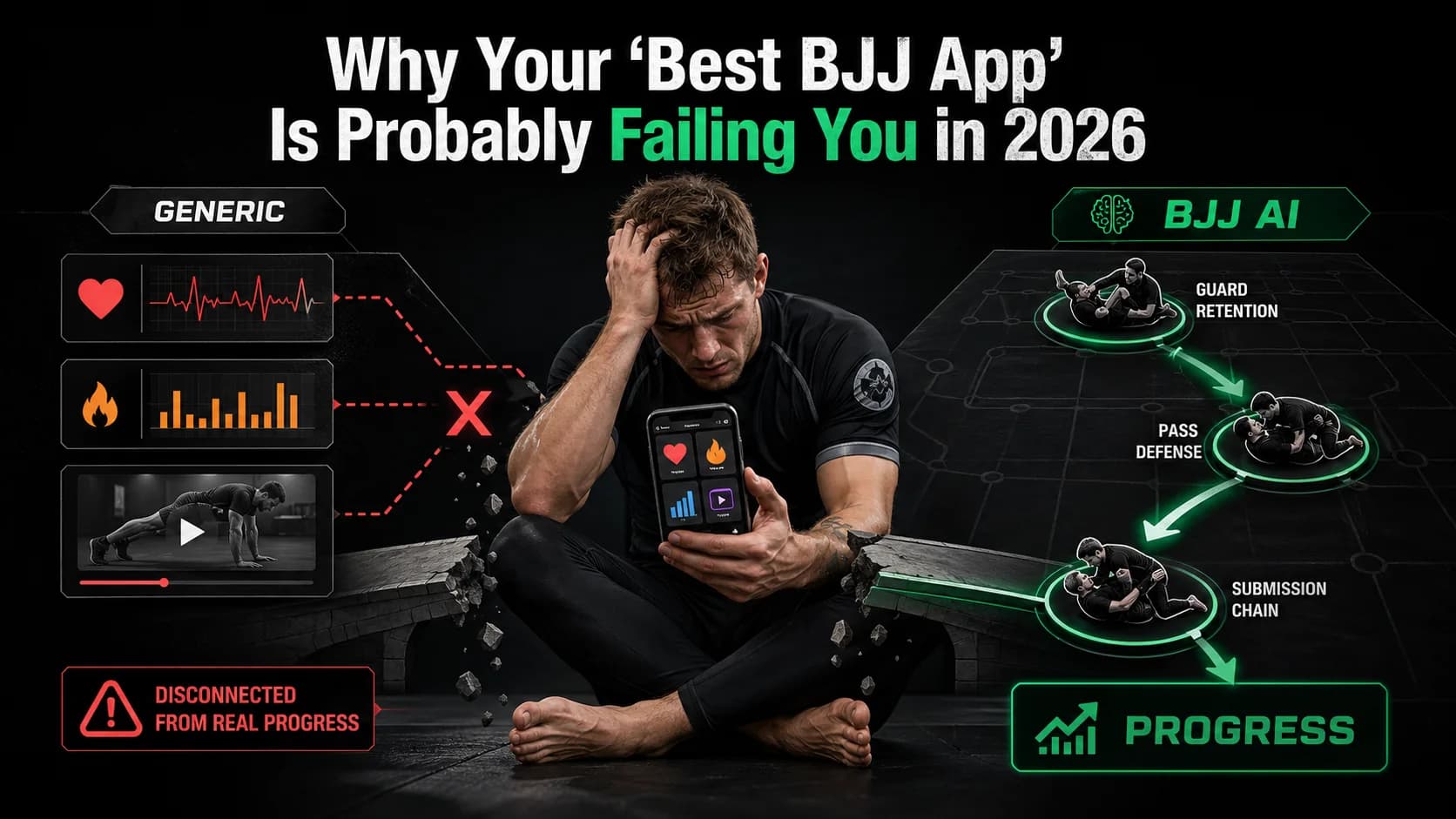
You downloaded the latest "best BJJ app 2026" promising to fix your game. You logged your rolls. You watched the technique videos in bed. Six months later your guard still dies to a knee slice and your submission entries still feel one beat late. So what did you actually pay for?
Most apps marketed as the best BJJ app 2026 are not built for Jiu-Jitsu. They are general fitness platforms with a gi-shaped icon. They tell you that you burned 612 calories during open mat. They cannot tell you why you got swept from half guard four times. That gap is the problem. A real BJJ training app speaks the language of leverage, frames, and submissions. It logs the things scoring tables actually reward. It treats the back take and the heart-rate spike as two different events.
This article is about what to demand from that tool, what to ignore, and how to use it without losing your mind.
Key Takeaways
- Sport-specific beats generic. The best BJJ app 2026 is built for grappling, not fitness. It logs positions, sweeps, and submissions, not just calories and heart rate.
- Heart rate is a recovery signal, not a skill signal. Use HRV to decide if you can train tomorrow, not to judge if you trained well today.
- AI analysis must be timestamped. A useful AI Jiu-Jitsu coach points to a specific moment in your roll and says what went wrong.
- Your coach is still essential. The app provides specifics. Your coach provides context. Use them together.
- Competition prep needs a different log. Tag tournament rounds separately and track your A-game's survival rate under fatigue.
What a Real BJJ Training App Looks Like in 2026
Brazilian Jiu-Jitsu is a positional sport before it is a fitness sport. Competition footage analysed by Del Vecchio and colleagues showed an average effort-to-pause ratio close to 6:1, with most decisive technical actions happening in roughly four-second bursts. Sweeps, passes, and submission attempts cluster in dense windows; calorie counts wash all of that into one flat curve.
A serious BJJ training app should mirror that structure. It should help you log positions played, not minutes "active." It should tag a sweep attempt that landed differently from a sweep attempt that left you crumpled in side control. It should connect the rep on the mat to the rep on the video.
The closest academic baseline for sport-specific demands is the systematic review by Andreato and colleagues in Sports Medicine - Open, which lays out the physiological and tactical profile of competitive BJJ. Strength and conditioning specifics for grapplers are covered in Øvretveit's NSCA Strength & Conditioning Journal article. None of this maps cleanly to a generic step counter. None of it shows up in your weekly fitness summary.
What Metrics Actually Matter for BJJ Progress?
Not heart rate. Not calories. The metrics that move your game are the ones the IBJJF scoring table already cares about: passes secured, sweeps landed, mount and back time, submission attempts and finishes. A useful app tracks volume in those categories, not in METs.
Coaches like John Danaher built the original Danaher Death Squad, then split into the New Wave system around Gordon Ryan and the B-Team around Craig Jones. The thing every branch of that lineage shares is obsessive note-taking on positions, not on cardio. Andre Galvao spent two decades drilling the same passing sequences at Atos and could tell you, by feel, his finishing rate from the body lock. Marcelo Garcia, four-time ADCC champion and five-time IBJJF World Champion, kept ledgers of guard pulls before that was a cliché.
You will not match those records. You can match the habit. A BJJ techniques app that lets you tag every roll and pull up your last twenty back-take attempts is doing something a Garmin will never do.
How Is a BJJ-Specific App Different from a Multi-Sport App?
A multi-sport app treats grappling as a workout type. A BJJ-specific app treats grappling as a knowledge graph. Mount escapes are a tree, not a label. The upa branches off depending on whether your opponent is high-mounted with grips or settled in s-mount. A real app understands that. A "MMA / Grappling" tab on a generic platform does not.
The same logic applies in adjacent arts. Judo lives or dies on grip fighting and kuzushi. Sambo blends the two with leg locks the IBJJF would disallow. We covered the parallel for Sambo in the best Sambo app 2026. Each discipline has its own scoring grammar. A genuine AI Jiu-Jitsu coach should not be reusing assumptions written for triathletes.
What Should You Look for in a 2026 BJJ App?
Three things, in this order. First, AI-powered video analysis that returns a number you can act on, not a vibe. Second, a training log that distinguishes "thirty rounds defending half guard" from "thirty rounds passing." Third, a chat or knowledge layer where you can ask sport-specific questions and get answers a black belt would not laugh at.
| Feature | Generic fitness / multi-sport app | BJJ-specific AI app |
|---|---|---|
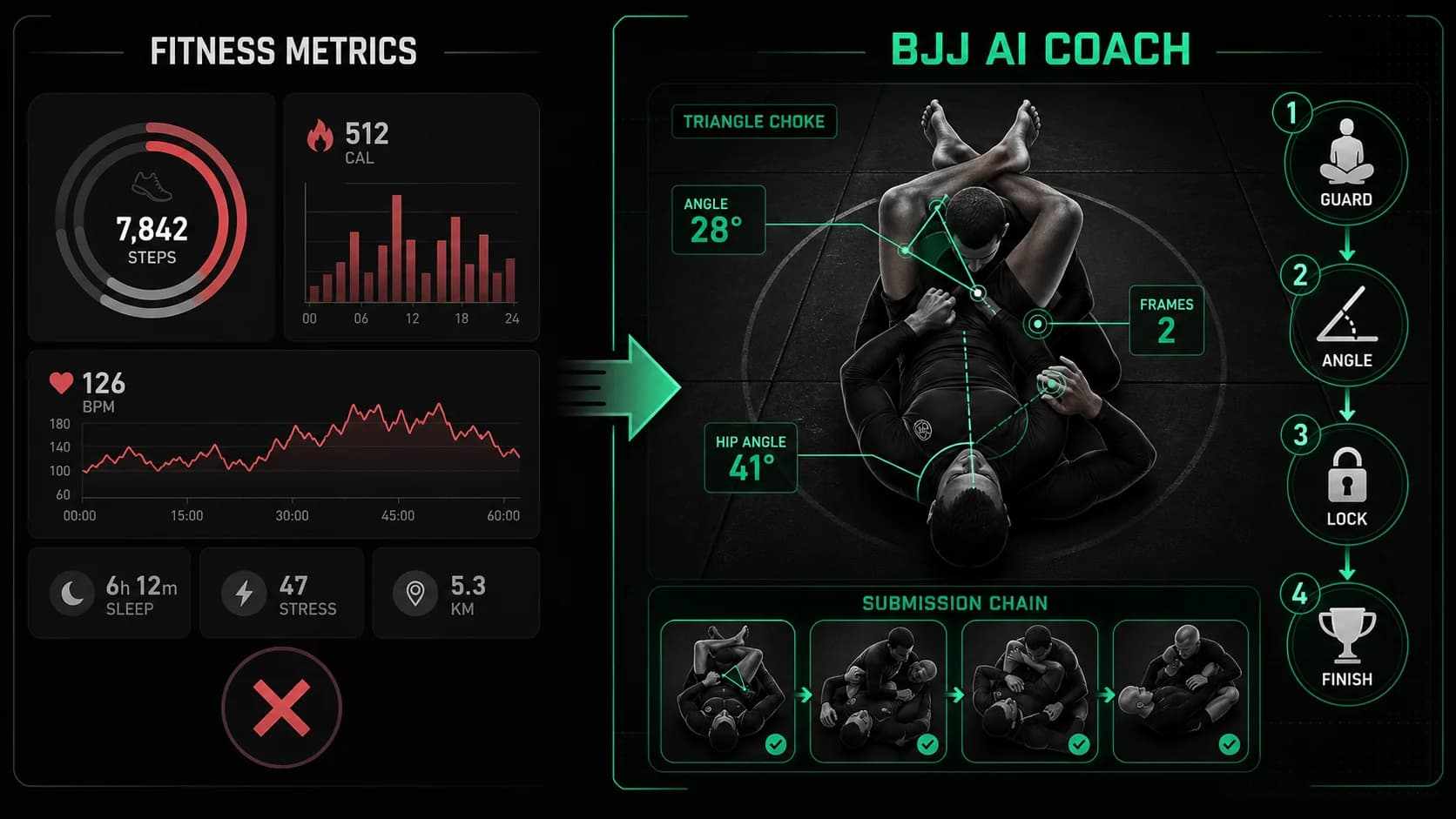
| Primary feedback | Heart rate, calories, "effort" score | Technique score 0-100, positional efficiency |
| Training log | "BJJ workout" duration | Rounds, positions played, attempts and finishes |
| Knowledge base | General fitness articles | Searchable BJJ technique tree with chains |
| Progress tracking | Weight lifted, cardio | Pass rate, top time, submission finish rate |
Train Grappling with AI
Professor Leo analyzes your technique, scores your form 0-100, and builds your training plan.
Download Grappling AIWhy Your Current App Is Probably Holding You Back
Generic trackers measure physiological stress. Skill is what you actually need to grow. The two are not the same number. A white belt scrambling for survival burns more calories than a black belt who controls posture and waits. Calorie burn would crown the white belt. The match would not.
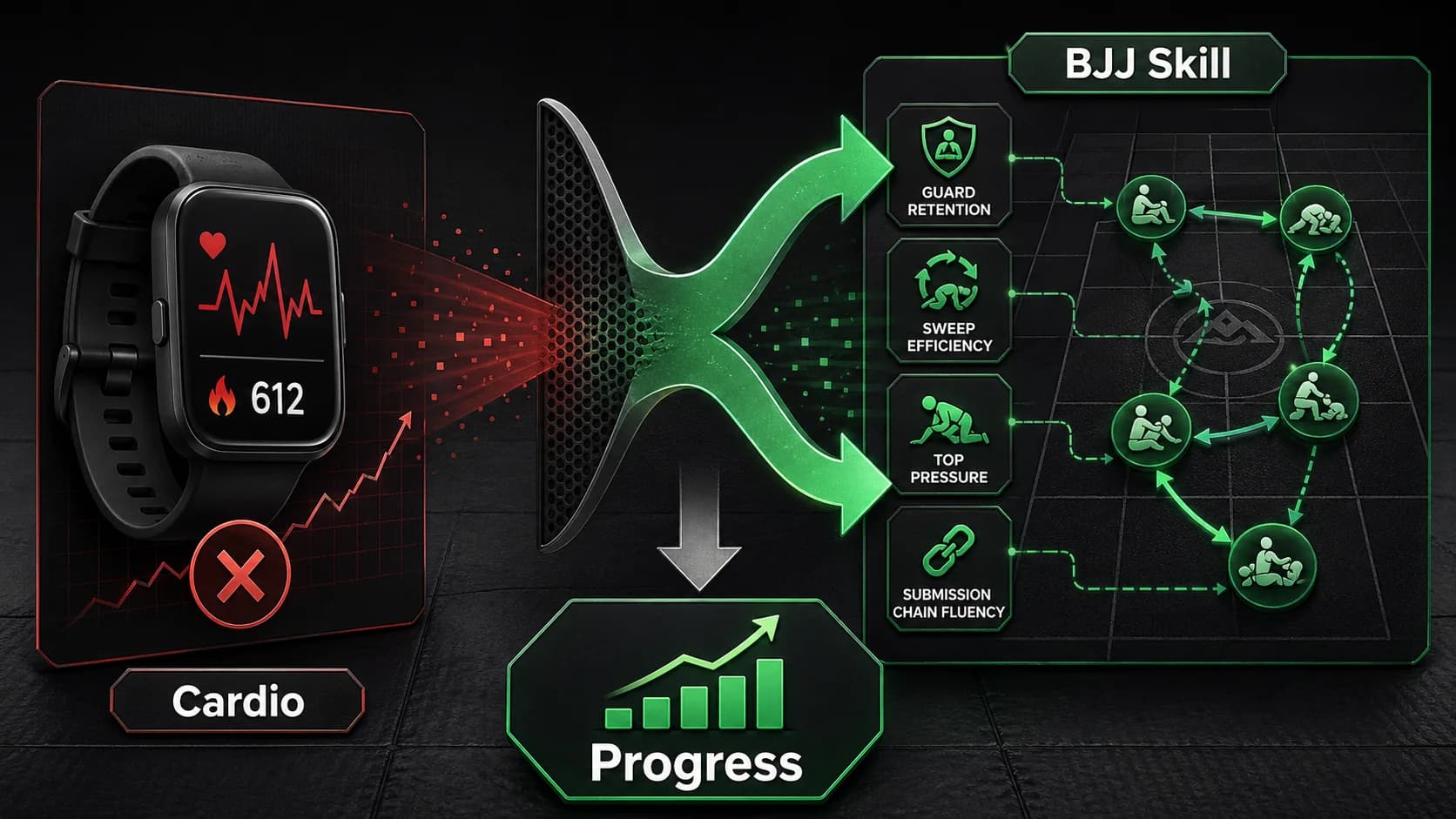
This is the false signal problem. Generic apps reward effort, not learning. Worse, they reinforce inefficient training. If your weekly summary says "great session, high intensity," you stop asking why every roll ended with you on the bottom.
Why Heart Rate and Calories Are the Wrong Question
Heart rate and HRV are useful for recovery planning. They tell you almost nothing about whether your knee shield held during a knee cut. The cardiovascular signal in grappling is dominated by isometric work, breath holding, and short anaerobic spikes; that is what the BJJ time-motion data in the Del Vecchio analysis shows. A generic app reads those spikes as noise.
Use HRV and resting heart rate to decide whether you can train hard tomorrow. Do not use them to decide whether you trained well today.
How Generic Advice Gets in the Way
"Increase intensity. Improve endurance." That is a poster, not coaching. BJJ progress is fractal. The reason your collar drag fails is rarely cardio. It is the angle of your back step, the timing of the shoulder pull, the grip that should have broken his posture two beats earlier.
A real AI Jiu-Jitsu coach gives you a correction at that resolution. Even if the correction is wrong on a given rep, the prompt is sport-specific and you can argue with it. A generic prompt to "work harder" cannot be argued with. That is the whole problem.
Can an App Understand Positional Hierarchy?
Yes, if it was built by people who care about it. The IBJJF scoring system already encodes the answer: 4 for back or mount, 3 for pass, 2 for sweep or knee-on-belly, advantages for near-finishes. Any app claiming to be a BJJ coach should treat that hierarchy as the spine of its data model. Side control is not a single state. Knee-on-belly to mount to back is a continuum and so is the threat tree at every step.
This is the same reason Sambo and freestyle wrestling need their own coaching engines. The transitions matter. The broader trend across combat sports is covered in the AI sports coaching revolution.
How to Choose and Use a True BJJ AI Coach in 2026
You do not need a perfect app. You need a process for testing one and integrating it. Five steps will tell you what is real and what is marketing copy.
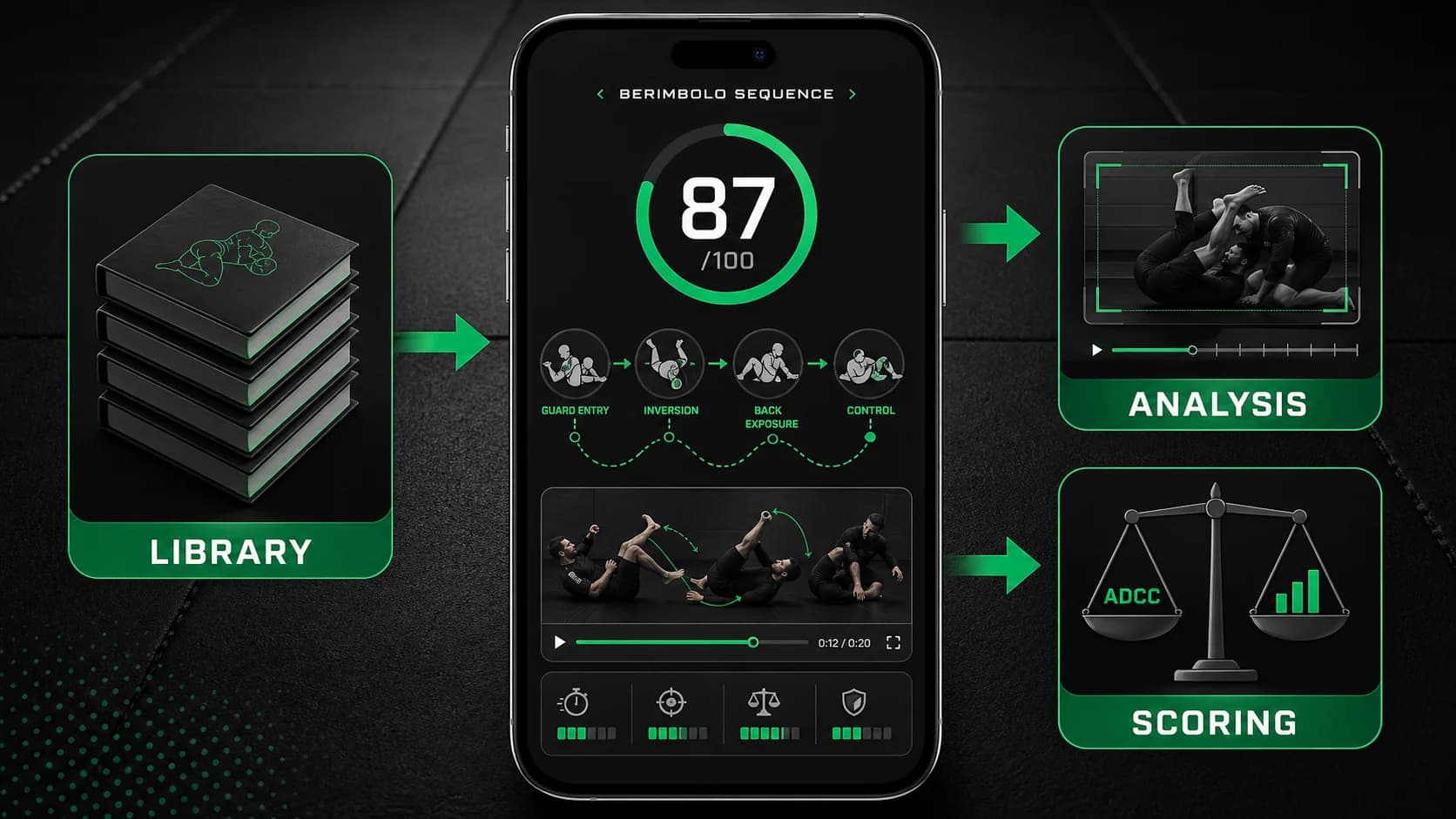
Step 1: Audit the Technique Library
Open the app. Search for "collar drag from de la Riva to back take." If the result is "takedowns" or "guard," close the tab. A serious BJJ training app should have at least two hundred techniques tagged with proper Portuguese names, common counters, and links to chained options. Test depth, not size.
Step 2: Test the AI Video Analysis with a Real Roll
Film five minutes of live rolling on a tripod. Upload it. The output should be a technical report, not a fitness summary. A useful response looks like, "Knee slide attempt at 1:42 — hips above your knee, opponent recovered open guard." Numbers help. So does timestamping. If the app cannot point at a moment, it is not analysing video, it is decorating it.
Step 3: Make the Training Log a Habit
A training log is only useful if it changes your training. Log positions played, not just session length. Log finish rate from your A-game. After four weeks, your data should show patterns: "X-guard sweeps land 18 percent of the time against larger partners," or "I attempt zero submissions from mount in any given round." That information is the input to next week's drilling. This is the workflow we use across our combat hub for grapplers and strikers alike.
Step 4: Interrogate the AI Chat
Ask a sport-specific question that has a non-trivial answer. Try, "What are three credible entries to the back from lasso guard against an upright posture?" If the answer is a marketing paragraph, the chat is a chatbot. If the answer reads like notes from a coach who has tried these entries, you have something. The bar is not perfection. The bar is sport-literate.
Step 5: Cross-Reference with Your Human Coach
Bring the analysis to your instructor. Say, "The app flagged my hip escape angle at minute three. What do you see?" The point is not to replace your coach. The point is to walk into a private with a question instead of a vague feeling. Coaches respond to specifics. Specifics are what AI gives you.
Strategies for Using a BJJ App During Competition Prep
Gordon Ryan reportedly reviews opponent footage with John Danaher in tape-loop sessions, frame by frame, before every major match. Ffion Davies, the 2022 ADCC -60 kg champion and No-Gi World Champion, has spoken openly about structured film study before her IBJJF and ADCC campaigns. Modern AI tools shrink what was once an elite-camp privilege into a phone app.
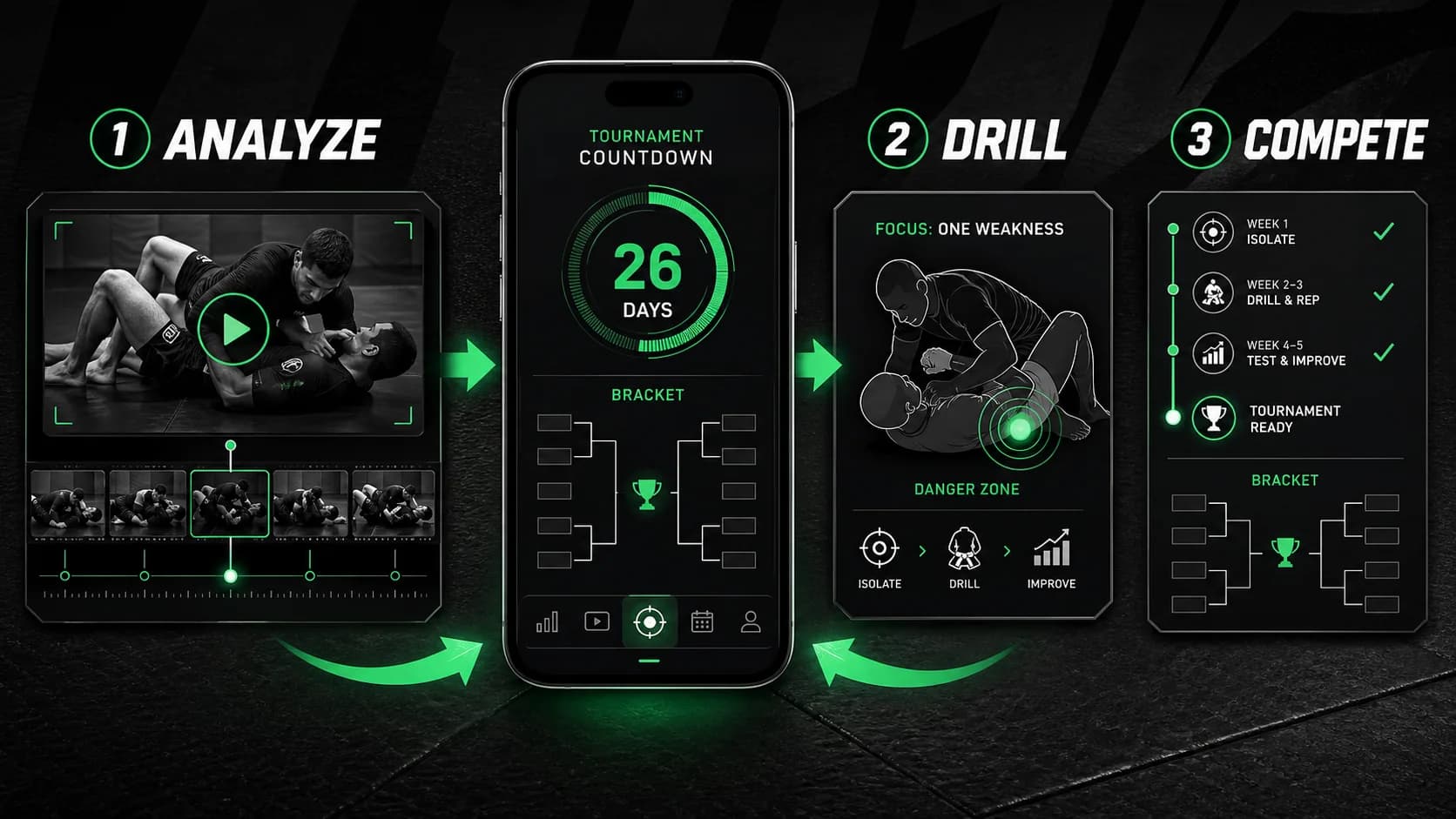
You are not Gordon Ryan. You can still steal his loop.
Use Video Analysis to Fix One Weakness
Pick the technique that bleeds you the most points. Film every rep of it for two weeks. Let the AI flag a single repeated error and only that error. Coach Lachlan Giles, who took bronze in the 2019 ADCC absolute division as a sub-77 kg competitor, has built a public reputation on this kind of micro-correction work. Imitate the pattern: one correction, repeated, until it is muscle.
Log Competition Rounds Differently
Tag tournament-prep rounds. Note intensity (treat 90 percent of competition pace as the working zone). After eight weeks you should be able to look back and see whether your A-game survived under fatigue. If your sweep rate from collar-sleeve halved between week three and week six, that is a taper signal, not a character defect.
Simulate Match Strategy with the AI
Describe your likely opponent in plain English. "Heavy pressure passer, prefers to settle in north-south, often hits cross-faces with high hips." Then ask for two openers. The AI will not give you a magic plan. It will give you something to argue against. That argument is where strategy actually lives.
For athletes who train across boxing or MMA too, the same loop applies — log, film, audit, drill — and the gains compound.
Mistakes to Avoid When Using a BJJ App
Even a good app can be used badly. Here are the common mistakes that turn a useful tool into a distraction.
Mistake 1: Treating the App as a Coach Replacement
The app is a data collector and a second opinion. It is not a substitute for a human coach who can feel your pressure, see your posture, and correct your grip in real time. If you find yourself skipping class to "study" on the app, you have the relationship backwards.
Mistake 2: Logging Everything, Analyzing Nothing
Logging every roll is a good habit. But if you never look back at the data, you are just hoarding numbers. Set a weekly review session. Fifteen minutes. Look at your positional win rate. Look at your submission finish rate. Ask one question: "What is the one thing I will drill next week?"
Mistake 3: Ignoring the Context of Your Rolls
A roll with a fresh white belt is not the same as a roll with a seasoned brown belt. Your app should let you tag the partner's skill level and size. If it does not, your data will be noisy and misleading. A 90 percent pass rate against beginners means something different than a 40 percent pass rate against advanced training partners.
Mistake 4: Chasing the "Perfect" App
There is no perfect app. Every tool has limitations. The question is whether the app is good enough to help you train smarter. If you spend more time researching apps than training, you have already lost.
Decision Rules: How to Pick the Right BJJ App for You
Not every grappler needs the same tool. Here is a quick decision framework based on your goals.
- You are a white or blue belt who forgets techniques. You need an app with a strong technique library and a simple log. The AI analysis is a bonus, not a necessity. Focus on apps that let you tag "what I drilled today" and pull up the technique video on demand.
- You are a purple or brown belt preparing for competition. You need an app with robust video analysis and a detailed training log. You need to track positional win rates and submission finish rates. The AI chat should be able to answer sport-specific strategy questions.
- You are a coach or gym owner. You need an app that can aggregate data across multiple students. You need to see patterns: which positions are the class struggling with? Which techniques are being drilled most often? The app should support group management and shared video analysis.
- You train multiple grappling arts (BJJ, Judo, Sambo, Wrestling). You need an app that understands the rule set differences. A single app that can switch between IBJJF, ADCC, Judo, and wrestling scoring is more valuable than four separate apps.
Key Takeaways
- The best BJJ app 2026 is sport-built, not fitness-repurposed. It logs positions, not just time.
- Heart rate and calories are recovery signals, not skill signals. Do not confuse them.
- A useful AI Jiu-Jitsu coach scores video on technique, points to timestamps, and lets you argue back.
- Cross-reference the app with your human coach. The app provides specifics. Your coach provides context.
- For competition, isolate one weakness, log under tournament conditions, and use the AI as a sparring partner for strategy.
Conclusion
The interesting question in 2026 is not "is there an app for that." It is "does the app speak my sport." A BJJ training app that logs the right things turns chaotic mat time into a record you can actually study. A generic tracker turns it into another calorie graph.
Pick the tool that talks about sweeps, pressure, and posture. Use it as a partner with your coach, not a replacement. Your guard does not care about your VO2 max. It cares whether your knee shield was active when his knee crossed the line.
Got Questions About BJJ Apps? We've Got Answers
What makes an AI BJJ coach better than YouTube? YouTube hands you the universe of techniques. An AI Jiu-Jitsu coach hands you a verdict on the rep you just did. Both are useful. Only one of them notices when your control leg slipped on the armbar. If you have ten free hours a week to scroll, YouTube is fine. If you have one, the AI is the better trade.
Can a BJJ app help me if I'm a beginner? Yes, and arguably more than for advanced players. Beginners forget what they learned by Tuesday. A BJJ techniques app that lets you log "today: scissor sweep, kimura from closed guard" and pulls up the technique on demand fixes the amnesia loop. It will not replace open mat. It will keep you from starting from zero every Monday.
How accurate is AI video analysis for BJJ? For discrete, well-framed techniques (technical stand-up, scissor sweep, basic guard passes), modern computer-vision models do an honest job. The 2025 narrative review of AI in sport in the Journal of Sports Sciences gives a measured picture: identification of joint angles is solid, interpretation of complex scrambles is still developing. Treat the score as a useful second opinion, not a verdict.
Is it worth paying for a dedicated BJJ app instead of using free notes? Free notes work until they don't. The point at which loose Apple Notes stops scaling is roughly the point at which you start preparing for a tournament with more than one division. A dedicated BJJ training app pulls logging, video, and a knowledge base into one place. That integration is the value. The cost of a year of subscription is usually less than two private lessons.
What are the honest limitations of a BJJ app? No app can feel your pressure. No app can correct your grip in real time. No app can replicate the chaos of a live roll with a resisting opponent. The app is a tool for reflection and analysis, not a substitute for mat time. If you use it as a crutch, it will fail you.
Can an app help with injury prevention? Indirectly. By tracking your training volume and intensity, an app can help you spot overtraining patterns before they become injuries. If your positional win rate drops sharply over three sessions, that is a signal to take a rest day. But the app cannot diagnose an injury or tell you when to see a physio.
How do I know if an app is actually analyzing my video or just guessing? Look for timestamps. A real analysis points to a specific second in your roll and describes what happened. A fake analysis gives you a generic score like "87/100" with no explanation. Also, test it with a known error. Film yourself doing a technique incorrectly on purpose. If the app does not flag it, it is not analyzing.
If you train across grappling — Sambo, judo, freestyle wrestling — the same engine carries across with the right rule set. We have written companion pieces on AI for boxing, Olympic weightlifting, and calisthenics. Stop letting a generic tracker masquerade as your coach. Find your sport and start logging the right reps.
Other Doved Studio projects
Related tools from the same studio you might find useful:
- Glean: Turn scrolling time into a daily action plan. Capture, process, execute.
- Popout: Create your portfolio in minutes with a single shareable page.
- Doved Studio: Studio indie derrière cette app et une dizaine d'autres outils.
Professor Leo
Grappling specialist. Expert in guard systems, passing, submissions.
Professor Leo is the AI coaching persona behind Grappling AI, built to provide personalized grappling guidance through video analysis, training plans, and technique breakdowns.
Train Grappling with AI
Grappling AI gives you an AI coach that analyzes your technique, plans your training, and tracks your nutrition. Try it for free.