Why the BJJ vs Wrestling Debate Is Wrong (2026)
BJJ vs wrestling is the wrong fight. Use ADCC results, MMA rules, takedowns, submissions, and video analysis to build hybrid grappling.
Titans Grip
MMA Coach, integrating striking, wrestling, and submission grappling
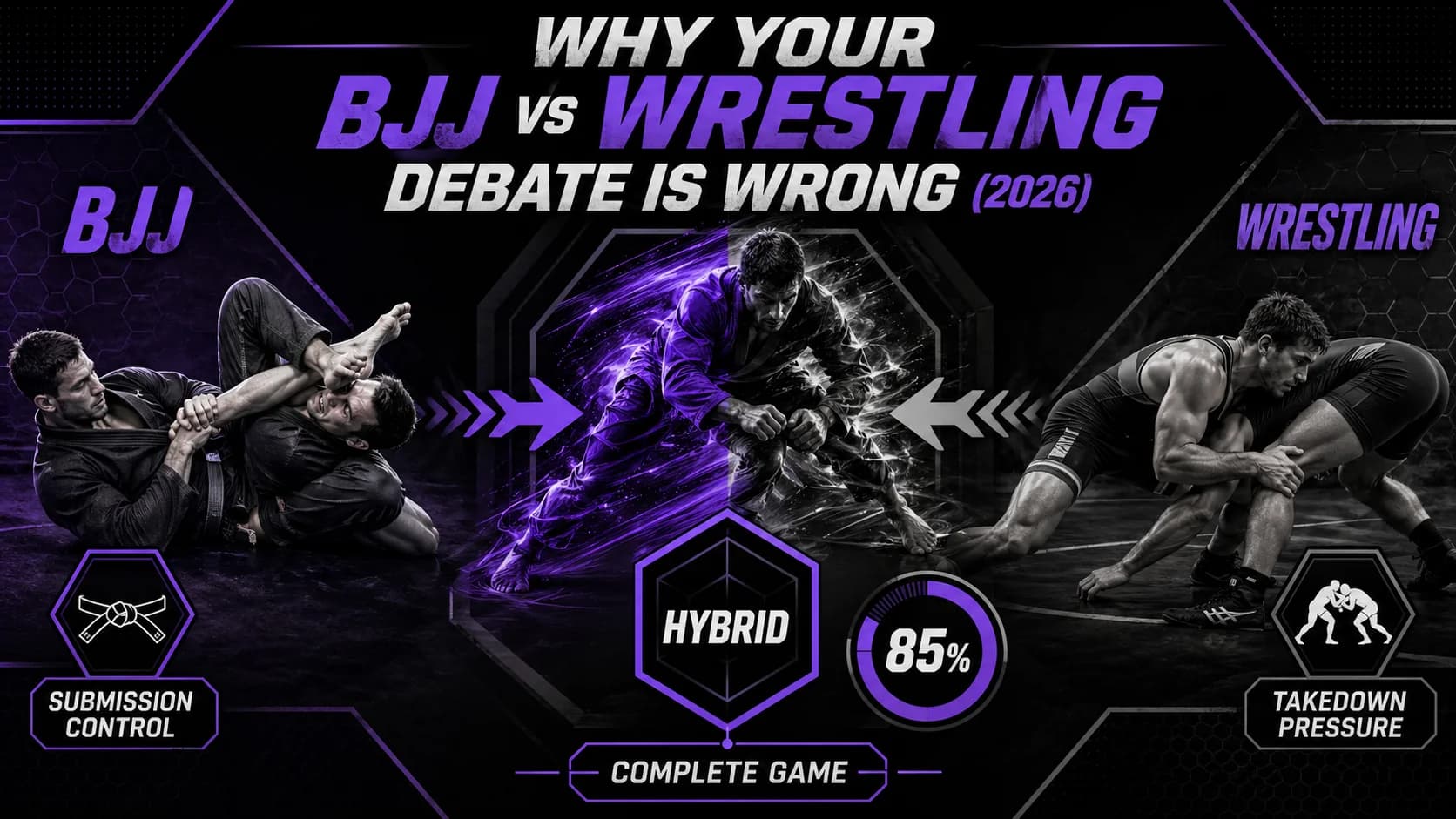
BJJ vs wrestling is the wrong question for MMA, no-gi, and practical grappling. Use wrestling to win the first position, use BJJ to finish or survive when the position flips, and train the bridge between them until takedown, ride, guard pass, escape, and submission become one chain.
I updated this guide on July 4, 2026, replaced brittle event links, kept the existing slug, and connected the plan to MMA AI, Grappling AI, Wrestling AI, the combat hub, the takedown tracker, submission chains, and the fight-camp planner. If your real search is boxing training app 2026, best boxing app, best MMA app 2026, BJJ techniques app, or best BJJ app 2026, split the intent: boxing, MMA, and BJJ need different scoring rules, drills, and feedback loops.
Direct answer
Choose BJJ first if you need to finish and survive from bottom. Choose wrestling first if you need to decide where the fight happens. For MMA or no-gi in 2026, you need both: takedown and submission, ride, pass, control, threat, and an escape plan when you land underneath.
The practical rule is simple. If you cannot get takedowns, train entries. If you cannot finish from top, train BJJ submission chains. If you freeze in scrambles, train the transitions that connect both arts. However, do not split your week evenly just to look balanced; assign the most time to the weakest link your sparring footage reveals.
Source check - July 4, 2026
| Source | Why I used it | Status |
|---|---|---|
| ADCombat ADCC 2024 day 2 results | Official ADCC 2024 second-day results | 200 OK |
| FloGrappling ADCC 2024 finals results | Cross-check of finalist results | 200 OK |
| IBJJF | BJJ rules and competition ecosystem reference | 200 OK |
| ABC Unified Rules | Official unified MMA rules page | 200 OK |
| UFC Unified Rules | Public reading of MMA judging criteria | 200 OK |
| United World Wrestling | Wrestling rules and sport-governance reference | 200 OK |
| PMC MMA grappling techniques | Grappling techniques associated with MMA fight finishes | 200 OK |
| PMC submission-grappling load | External-load measurement in submission grappling movements | 200 OK |
| PMC augmented feedback review | Why video feedback helps technical correction | 200 OK |
According to ADCombat ADCC 2024 day 2 results and FloGrappling ADCC 2024 finals results, elite no-gi brackets still reward athletes who can connect standing exchanges, control, and submission threats. According to PMC MMA grappling techniques, MMA fight-ending grappling actions come from technical families associated with both BJJ and wrestling, not one isolated art.
According to the ABC Unified Rules and UFC Unified Rules, MMA rewards effective grappling when it creates impact, dominance, positional progress, or real finishing threat. According to PMC submission-grappling load, grappling movements create measurable load, so the plan below uses volume, scenarios, and repeatable constraints instead of a style debate. According to the PMC augmented feedback review, visual feedback helps athletes see technique errors and correct the next repetition; that is the useful lane for AI coaching between human-coached sessions.
The answer to "BJJ or wrestling?" has been clear for years. The interesting question is how a normal training human, with a normal job and one or two coaches, builds a hybrid grappling game in 2026. That's what this is about.
Key Takeaways
- The debate is outdated. ADCC 2024 and modern UFC champions are hybrid grapplers who use wrestling for position and BJJ for finishes.
- Single-discipline specialists hit a ceiling. Within 12-18 months of facing competent hybrids, pure wrestlers or BJJ players plateau.
- Bridge techniques are the fastest path. Techniques that connect your strong art to your weak one (e.g., cross-body ride to armbar) accelerate integration.
- AI feedback compresses the learning loop. Tools like Titans Grip MMA AI can score micro-technique in seconds, not weeks.
- Depth beats breadth. Two takedowns and two submissions you can hit on anyone are more valuable than a library of ten you've drilled twice.
What hybrid grappling proficiency actually means
A hybrid grappler can dictate where the fight happens (wrestling) and finish it once it gets there (BJJ). The two arts are not equivalent and they are not in competition; they solve different parts of the same problem. Wrestling answers: how do I get on top of you, and how do I keep you there? BJJ answers: now that I'm here, how do I make this end?
| Phase | Wrestling's contribution | BJJ's contribution |
|---|---|---|
| Stand-up | Shots, throws, snaps, body locks | Defensive grips, off-balancing, clinch entries |
| Top game | Pressure, ride, mat returns, ground-and-pound | Guard pass, dominant submission threats |
| Bottom game | Stand-ups, reversals, hand fights | Active guard, sweeps, submissions off the back |
| Mindset | Forward pressure, score initiative | Patience, leverage, opportunism |
What wrestling actually adds to a BJJ game
Wrestling adds the first move. A pure BJJ player without wrestling pulls guard or waits for the engagement. A wrestler forces the engagement, controls the head and hips, and dictates the position. In ADCC 2024 men's divisions, takedowns were one of the most decisive scoring categories, and the men's champions were disproportionately wrestlers who had layered submissions onto their base.
What BJJ actually adds to a wrestling base
BJJ adds the finish and the bottom-game survival kit. A pure wrestler controls but does not threaten. Once the takedown is scored, BJJ is what turns control into either a quick submission or a confident-enough top game that the wrestler isn't terrified of getting reversed. Just as importantly, BJJ keeps the wrestler in the fight if they end up underneath. Without it, "underneath" is the same thing as "losing."
How the rule sets shape the question
The rule sets create different incentives, and that's the root of the BJJ vs wrestling tribal split. Folkstyle, freestyle, and Greco-Roman wrestling under organizations like United World Wrestling reward takedowns, exposure, and control. BJJ under IBJJF rewards guard pulls, sweeps, passes, and submissions. MMA under the ABC Unified Rules and the public UFC rules guide rewards effective grappling when it creates dominance, damage, advancement, or finishing threat.
In modern MMA, neither base is sufficient. You need wrestling to score initiative and BJJ to threaten finishes. Pretending one of them is enough is how a fighter becomes a solved puzzle.
Why the old debate hurts your training
The BJJ vs wrestling argument doesn't just waste time on Reddit. It actively slows your development by giving you a tribe to defend instead of a problem to solve. I have coached too many athletes who refused to drill the other art because it felt like admitting weakness. That refusal is usually what costs them the next 18 months.
How much slower is single-discipline progression?
A wrestler entering MMA might dominate regional shows on takedowns and ground-and-pound. The progression stalls when the first competent grappler survives the takedown and threatens a submission off the back. Now the wrestler has to spend a year learning to defend submissions while losing rounds. The mirror story applies to a BJJ specialist: they get stuffed on every shot, and their entire game runs through the bottom under strikes, which is not a winning configuration in MMA.
What are the most common hybrid gaps?
Three patterns show up over and over:
- The BJJ-only player who can't get on top. Their entire game is reactive. In MMA, this means they live on the bottom under strikes, which is exactly the position that loses fights.
- The wrestler who can't finish. Top control is everywhere, but no submission threat means the bottom man can defend without consequences.
- The athlete who treats scrambles like a panic state. Both arts have answers for the chaos between positions. Specialists tend to have answers for one direction only.
Why "just train MMA" is incomplete
It's good advice, and it's incomplete. A general MMA class will expose you to both arts. It does not always identify your specific weakness.
You can spend months getting your guard passed because nobody on the schedule is teaching you the underhook-and-hip-heist combination from the bottom that wrestlers teach in their sleep. You need diagnostic training, not just exposure.
Comparison Table: Grappling Styles for MMA
| Style | Strengths | Weaknesses | Best for | Time to MMA Competence |
|---|---|---|---|---|
| Pure Wrestling | Takedowns, top pressure, scrambles, cardio | Submissions, bottom game, guard retention | Wrestlers transitioning to MMA | 12-18 months to add BJJ basics |
| Pure BJJ | Submissions, guard work, sweeps, reversals | Takedowns, top control under strikes, wrestling defense | BJJ players entering MMA | 18-24 months to add wrestling basics |
| Hybrid (Wrestling-first) | Strong takedowns, top control, developing submissions | Bottom game still vulnerable early | Wrestlers who want to finish | 6-12 months for credible submission threat |
| Hybrid (BJJ-first) | Strong submissions, guard work, developing takedowns | Takedown entries still weak early | BJJ players who want to dictate position | 6-12 months for credible takedown threat |
| Sambo | Leg locks, jacket wrestling, takedowns, submissions | Less developed for no-gi MMA, fewer training partners | Those with access to Sambo gyms | 6-12 months to adapt to MMA rules |
| Judo | Grip fighting, throws, off-balancing, ground control | Limited no-gi application, fewer submission chains | Those with Judo background | 12-18 months to adapt to no-gi and MMA |
Ranking Methodology: How to Choose Your Hybrid Path
This ranking is based on a combination of factors: time to competence, availability of training partners, transferability to MMA, and long-term ceiling. The methodology prioritizes practical outcomes over theoretical ideals.
Ranking Criteria
- Time to Competence (30%) - How quickly can you develop a credible threat in your weak area?
- Transferability (25%) - How well does the style translate to MMA rules and striking pressure?
- Availability (20%) - How easy is it to find quality coaching and training partners?
- Long-term Ceiling (15%) - How high can you go with this approach?
- Injury Risk (10%) - How likely are you to get injured during training?
The Rankings
| Rank | Approach | Score | Why |
|---|---|---|---|
| 1 | Wrestling-first hybrid | 88/100 | Fastest path to MMA competence. Takedowns and top control are the most transferable skills. BJJ submission chains can be layered on relatively quickly. |
| 2 | BJJ-first hybrid | 82/100 | Strong finish potential, but takedown development is slower. Requires more time to develop wrestling entries. |
| 3 | Sambo-based hybrid | 78/100 | Excellent all-around, but limited gym availability in many regions. Leg locks are a huge advantage. |
| 4 | Judo-based hybrid | 75/100 | Great for grip fighting and throws, but no-gi adaptation is a significant hurdle. |
| 5 | Pure wrestling | 65/100 | Dominant in early MMA, but stalls without submissions. Bottom game is a major liability. |
| 6 | Pure BJJ | 60/100 | Reactive game that struggles under striking pressure. Takedown deficiency is a hard ceiling. |
Honest Limitations
- Wrestling-first hybrid: Requires access to a wrestling coach or club, which may not be available everywhere. The learning curve for submissions can be steep if you have no grappling background.
- BJJ-first hybrid: Takedown development is slow and often frustrating. Many BJJ gyms don't teach wrestling entries well.
- Sambo-based hybrid: Gym availability is limited outside of Russia, Eastern Europe, and a few US cities. The jacket-based game doesn't always transfer cleanly to no-gi.
- Judo-based hybrid: No-gi adaptation is a real challenge. Many Judo techniques rely on the gi for grips and leverage.
- Pure wrestling: No submission threat means you're always playing a positional game. Bottom game is almost nonexistent.
- Pure BJJ: You're giving up the first move every time. Under strikes, this is a losing strategy.
How to build a hybrid grappling system
The real plan is not to split your time evenly between two gyms. It's to layer skills so each new technique reinforces a position you already trust. Here is the working framework.
Step 1: audit honestly
Film three rounds of position-specific sparring: one starting from your feet, one from your back, one from top side control. Watch them with a coach or run them through an AI analysis tool. The goal is a baseline number on shot finishes, top-position turn rate, and submission attempt rate from dominant positions. Most athletes overestimate their current ability by a wide margin. Numbers are uncomfortable; they're also the cheapest training input you'll ever buy.
Step 2: build "bridge" techniques first
Bridges are techniques that connect the two arts. They let your strength chain into your weakness.
- For a wrestler: the cross-body ride to armbar. You already know how to stay on top in side control; you don't yet know how to step over the head and isolate the arm. Spend the next 12 weeks here.
- For a BJJ player: the snap-down to front-headlock series. You already know what to do once a guillotine is locked; you don't yet know how to drag the head down off a collar tie to start the sequence. Same 12 weeks.
Three or four of these bridges, drilled until they are reflex, will do more for you than 30 unconnected techniques.
Step 3: structure your week with intent
Sample template for a hybrid-focused 4-session week:
- Monday — wrestling focus. Live takedowns and takedown defense. Position sparring starting from a failed shot.
- Wednesday — BJJ focus. Submission chains from mount and back. Specific sparring starting from those positions.
- Friday — hybrid integration. No-gi sparring with one rule: a point requires a takedown then a guard pass. The chain is the goal.
- Saturday — weak-link drilling. Whatever your audit said was the lowest score. If your bottom game is broken, this is guard retention and sweeps.
Log every session. Patterns show up faster on paper than they do in your memory of yesterday.
Step 4: use AI for micro-corrections
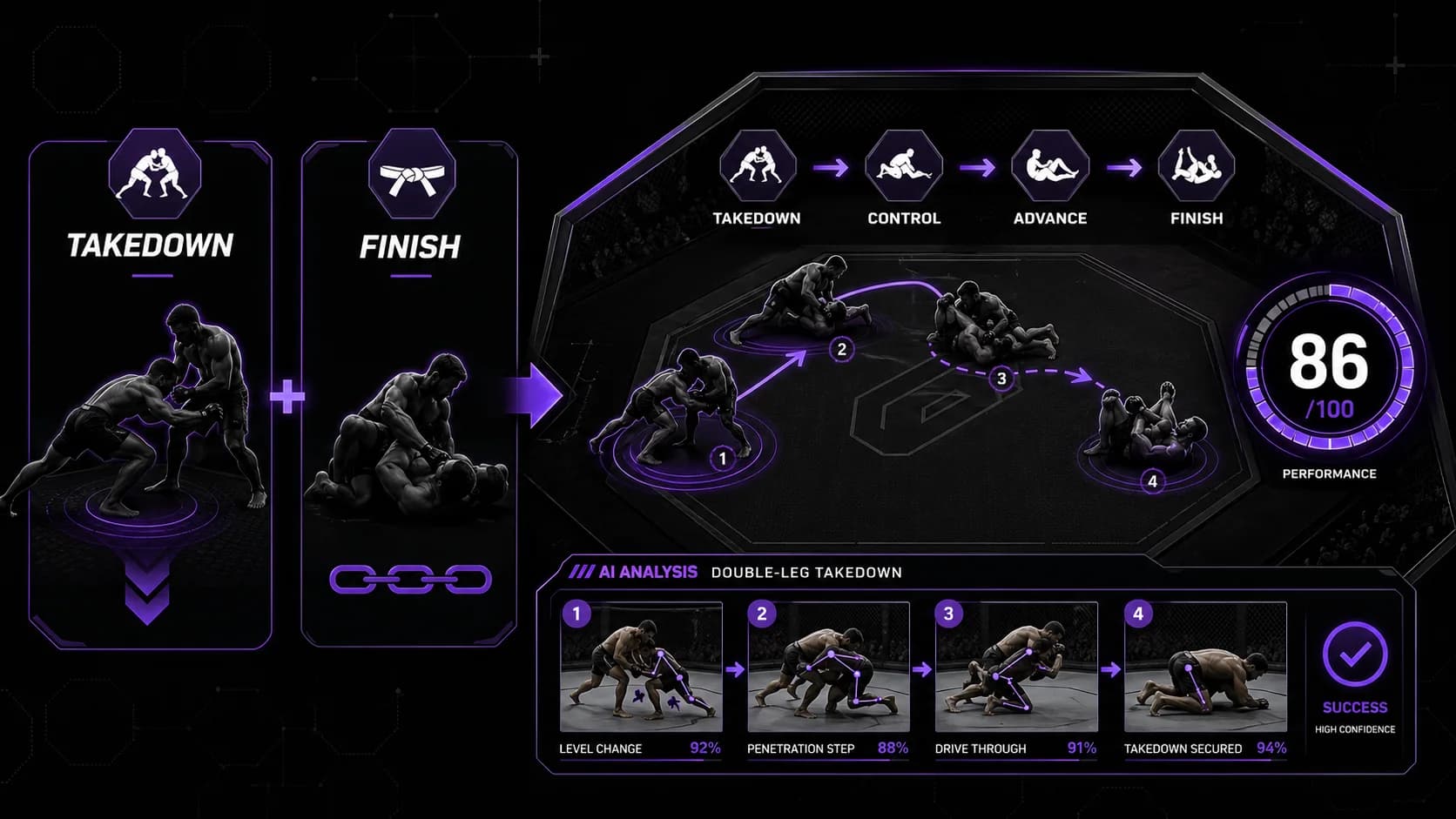
This is the 2026 accelerator. Upload a 30-second clip of a bridge technique and let the model show you the geometry. Penetration step depth on a double-leg is checkable. Hip alignment on an armbar is checkable.
AI does not replace your coach. It compresses the feedback loop from "wait until next week" to "30 seconds." A few minutes a day of clean correction work compounds.
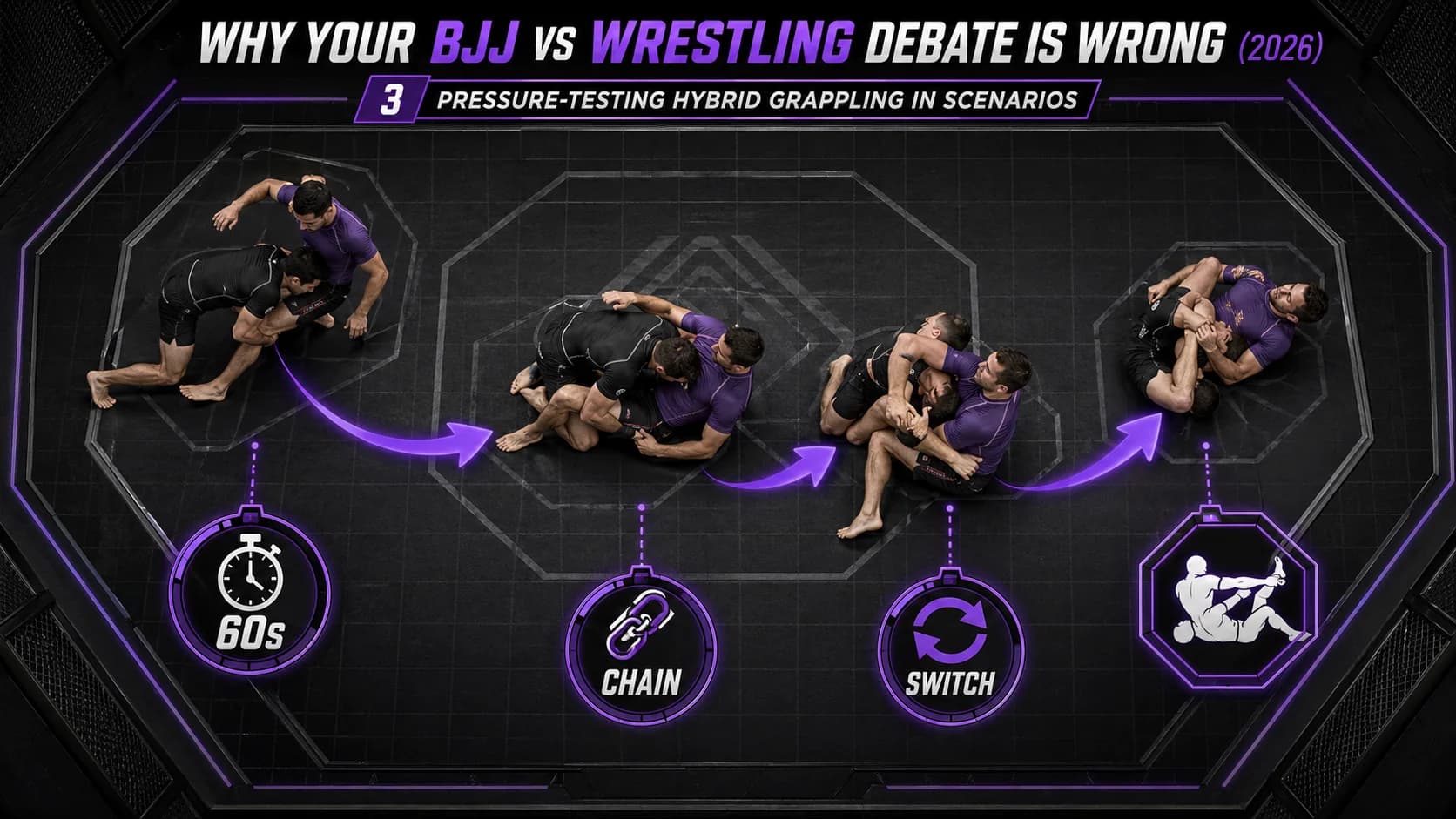
Step 5: pressure-test in scenarios, not generic sparring
Set constraints:
- "Wrestler vs BJJ player." Start standing. The wrestler tries to ride; the BJJ player tries to submit. Switch. This forces both athletes to defend their weak side under pressure.
- "60-second escape clock." You start in bottom side control against a fresh opponent. You have 60 seconds to escape. Reset.
- "The chain challenge." A point requires takedown, guard pass, and an attempted submission, all in one continuous sequence.
These are not glamorous and they are exactly the rounds that move your game forward.
For a related framework, our guide on building real fight IQ in striking cross-training walks through the same logic for boxing and MMA. If you need an app comparison path instead, use our boxing training app 2026 guide, best boxing app guide, best MMA app 2026 guide, BJJ techniques guide, and best BJJ app 2026 guide.
Common Mistakes and How to Avoid Them
Mistake 1: Splitting time 50/50 without a plan
Many athletes think "I'll do two days of wrestling and two days of BJJ" and call it hybrid training. The problem is that without a bridge technique connecting the two, you're just doing two separate sports poorly. You need to actively integrate, not just alternate.
Fix: Use the bridge technique framework. Pick one technique that connects your strong art to your weak one and drill it until it's automatic.
Mistake 2: Ignoring the bottom game
Wrestlers often neglect BJJ bottom game because they assume they'll never be there. In MMA, you will be on your back at some point. It's not optional.
Fix: Dedicate at least one session per week to guard retention and sweeps. Start from the worst positions (bottom side control, bottom mount) and work out.
Mistake 3: Learning too many techniques
The internet has made technique overload the default. You see a new submission or takedown every day on Instagram. Most of them are not useful for your game.
Fix: Pick two takedowns and two submissions. Drill them until you can hit them on anyone. Add new techniques only when you've mastered the current set.
Mistake 4: Not using video analysis
Most athletes train by feel. Feel is unreliable. You think you're hitting a perfect double-leg, but the video shows your head is down and your back is rounded.
Fix: Film every sparring session. Watch it back with a coach or an AI tool. The feedback is immediate and honest.
Decision Rules for Hybrid Training
Use these rules to guide your training decisions:
- If you can't get takedowns, spend 80% of your grappling time on wrestling entries. BJJ submissions don't matter if you can't get the fight to the ground.
- If you can't finish from top, spend 80% of your time on submission chains from mount and side control. Top control without a finish is just cardio.
- If you panic in scrambles, drill specific scramble sequences. The underhook-to-hip-heist and the granby roll are non-negotiable.
- If you're always on your back, fix your guard retention first. Sweeps and submissions come after you can stay safe.
- If you're always getting submitted, fix your submission defense. This is the most neglected skill in grappling.
FAQ
Is the debate completely irrelevant in 2026?
For anyone serious about combat sports, yes. The relevant question is integration speed.
How long to become a competent hybrid grappler?
12-18 months of focused integrated training, starting from a base in either art. A wrestler with a solid base develops a credible top-game submission threat in 6-8 months. The reverse is true for a BJJ player learning to score takedowns. Concurrent training is the fast path; sequential training is slow.
Should I start with BJJ or wrestling?
Start with whichever is more accessible to you. Then add the other within six months. Wait too long and the first art ingrains habits the second art will fight to reroute.
Can AI coaching beat a human coach?
No. It complements one. The honest split: AI for between-session technical micro-corrections, human coach for strategy, drilling partnerships, and reading you on a given day.
What's a single first step today?
Film your next sparring round. Watch it once with a single question: how often was I in a position to attack but didn't? That answer is your first month of training.
What if I don't have access to a wrestling coach?
You can still develop wrestling skills through online resources, drilling with a partner, and using AI analysis tools. Focus on the basics: penetration step, head position, and finishing the takedown. Even without a coach, you can make significant progress.
Is Sambo a better hybrid base than wrestling or BJJ?
Sambo is an excellent hybrid system, but gym availability is limited. If you have access to a good Sambo coach, it's a fantastic option. If not, wrestling-first or BJJ-first hybrids are more practical.
How do I know if I'm making progress?
Track your sparring results. Are you getting takedowns more consistently? Are you finishing submissions from top? Are you escaping from bad positions? If the numbers are improving, you're on the right track.
Conclusion: stop debating, start building
ADCC champions are not on Reddit defending their tribes. They are in the room, drilling the bridges between two arts that were never separate to begin with. Your move is the same.
Titans Grip MMA AI is built for this exact use case: score the bridge techniques, log the trends, work the gaps. Find your sport on the home page and start.
Train MMA with AI
Coach Rico analyzes your technique, scores your form 0-100, and builds your training plan.
Download MMA AIOther Doved Studio projects
Related tools from the same studio you might find useful:
- Glean: Turn scrolling time into a daily action plan. Capture, process, execute.
- Popout: Create your portfolio in minutes with a single shareable page.
- Doved Studio: Indie studio behind this app and a dozen others.
Coach Rico
MMA specialist. Expert in striking, wrestling, submissions.
Coach Rico is the AI coaching persona behind MMA AI, built to provide personalized mma guidance through video analysis, training plans, and technique breakdowns.
Related Articles
Justin Gaethje vs Ilia Topuria: Complete UFC White House Fight Analysis, Training Lessons and AI Coaching Breakdown
Jun 16, 2026 · 23 min read
MMAAlex Pereira vs Ciryl Gane: UFC Fight Analysis 2026
Jun 15, 2026 · 11 min read
MMAUFC Freedom 250: The Science of Elite Fight Preparation — Training Methods, Biometrics, and AI Coaching
Jun 13, 2026 · 21 min read
Train MMA with AI
MMA AI gives you an AI coach that analyzes your technique, plans your training, and tracks your nutrition. Try it for free.