
Boxing workout at home without equipment: a 30-day blueprint that actually trains a fighter (2026)
A 30-day boxing workout at home without equipment. Real round structures, evidence-backed plyometrics, defense reps, and weekly progression to build fight-ready conditioning in a 6×6 ft space.
Titans Grip
Boxing Coach, 15+ years coaching footwork, head movement, and ring IQ
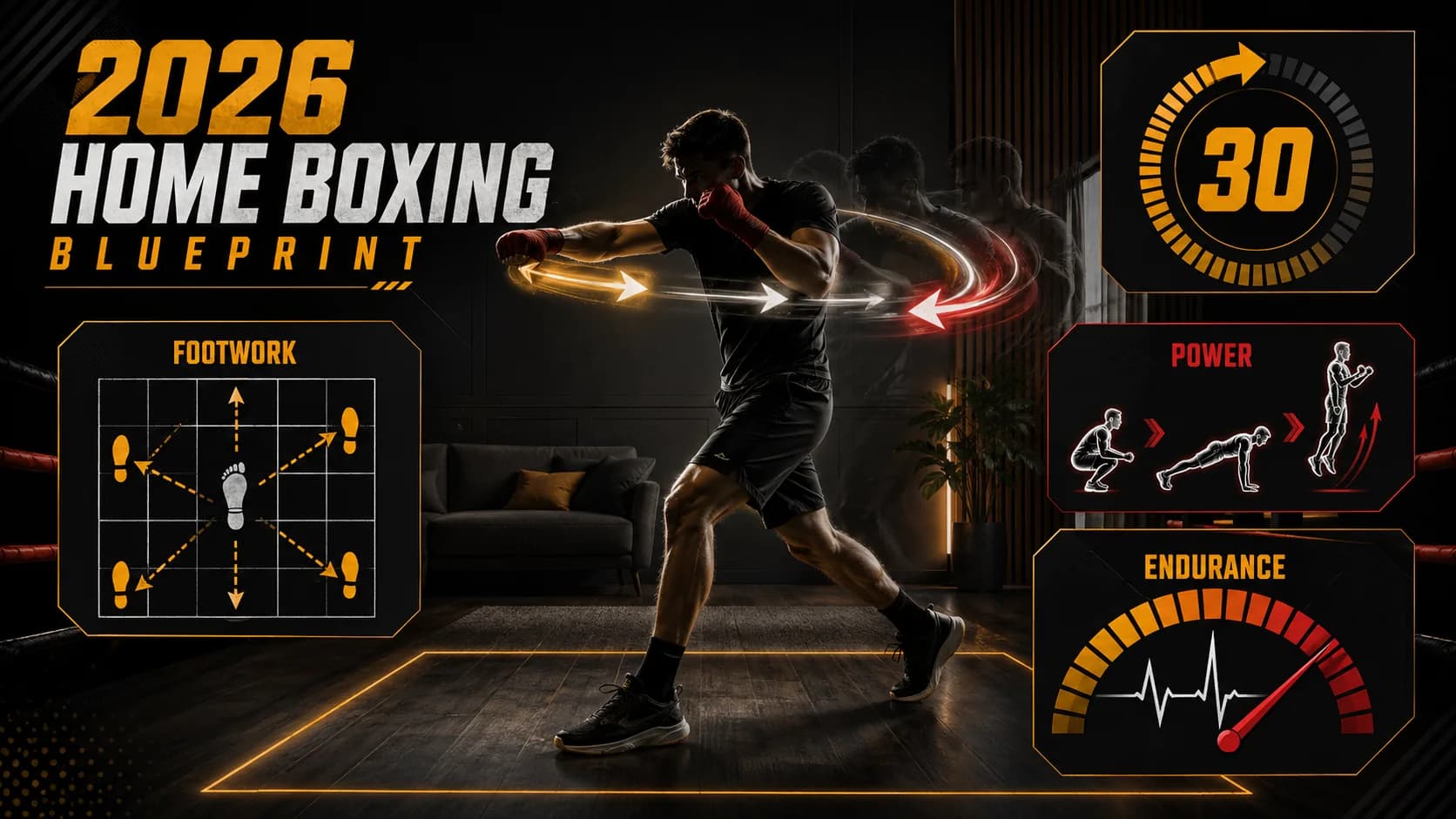
The bag is at the gym. The ring is in someone else's city. You have a 6×6 ft patch of floor, a phone for a timer, and 45 minutes. That is enough.
The boxing workout at home without equipment is not a substitute for the gym. It is a different tool. Done seriously, it builds the things a heavy bag actually hides: clean stance, honest defense, repeatable footwork, and the mental discipline to hit the same shape on rep 200 that you hit on rep 1.
This guide is the 30-day plan I use with new fighters who only have a living room. It is built on three weekly sessions, scales by adding density rather than equipment, and ends with you producing fight-pace work for full rounds without your shape collapsing.
Train Boxing with AI
Coach Marcus analyzes your technique, scores your form 0-100, and builds your training plan.
Download Boxing AIWhat a real home boxing program is, and is not
Most "home boxing" content online is either celebrity follow-along cardio with a punch theme or a list of bodyweight exercises that don't move the needle on boxing skill. Both can make you sweat. Neither will fix a low rear hand or a stalling lead foot.
A real program does three things at once: drills the shape (stance, guard, eyes, breath), trains the engine (the energy systems boxing actually uses), and builds the power that turns a snap into a problem. Without weights, the dial you turn is intent — every rep at maximum speed and sharpness on a clean line.
That intent is what the research on combat athletes consistently rewards. A 2024 randomized study in Applied Sciences on national-level boxers found 8 weeks of plyometric training raised punch force and impact velocity meaningfully more than equivalent volume of straight conditioning (Applied Sciences, 2024). And vertical-jump performance — purely a leg-power metric — keeps showing up as a strong correlate of punching force in boxing-science work (Boxing Science S&C reviews).
That is the whole game at home: train speed and shape, not duration.
How home work differs from bag work
The bag gives you immediate, dishonest feedback. It moves, so a sloppy hook still feels like power. Without a bag, you only get the feedback you build in. That sounds like a downside; it is the opposite. You stop punching to feel something and start punching to be in a specific position when the punch lands. Mirror, video, intent. The bag rewards effort. Shadow rewards precision.
What gets trained, and what doesn't
Without a partner you cannot train timing on a moving target. Without sparring you cannot rehearse fear under pressure. Accept those gaps. What you can train at home — clean technique, conditioning, specific power — is exactly what most amateur fighters are losing rounds on anyway. Fix that first.
| Quality | Gym method | Home method (no equipment) |
|---|---|---|
| Power | Med-ball throws, bag rounds, weighted rotation | Plyo push-ups, rotational jumps, snap-shadow sets |
| Anaerobic capacity | Hard bag rounds, assault bike intervals | High-density shadow circuits with burpee bridges |
| Footwork | Ladder drills, pad work | Patterned shadow on a taped grid, pivot-out reps |
| Anti-rotation core | Cable chops, Pallof press | Plank rotations, hollow-body holds, dead bugs |
| Defense | Slip rope, partner pad slips | Mirror slip-counter sequences, video review |
Why the structure matters more than the moves
The bottleneck in home boxing is rarely the exercise list. It is the structure. People do five push-ups, five jabs, scroll their phone, repeat. Four weeks later, no progress. The body adapts to consistent stress, not to scattered effort.
The plan below uses three sessions a week — Power, Conditioning, Skill — with progressive density. Each week, total work goes up around 10% by either adding rounds, shrinking rest, or adding a harder variation. That is the same overload principle the NSCA recommends across modalities. The mistake is doing more without making any single rep harder.
The three-week plateau, and why it happens
Most home boxers stall by week three. The usual reason: identical session, identical rest, identical intent. The bag in the gym hides plateau because output drives the work. At home, you have to build the progression in. Track rounds, write down rest cuts, log the variation. If you cannot say what was harder this week than last week, nothing was.
What bad form actually costs
Sloppy at-home work is not just unproductive. It rehearses the wrong pattern under fatigue, which is the worst kind of practice. Arm punches strain the front delt and rotator cuff. Flat-footed pivots torque the lead knee. After eight weeks of this you don't have neutral fitness; you have a carefully grooved set of bad habits. Slow, perfect reps for the first two weeks are non-negotiable.
The 30-day blueprint
Three sessions a week. One full rest day. Two active recovery days (walk, cycle, mobility). Each session: 5-min warm-up → main block → 5-min cool-down. Total time per session: 45–55 minutes.
Phase 1 — Foundation, days 1–10
Goal: install the shapes. Pace is slow, intent is sharp.
- Stance reset: 3 minutes barefoot. Feet shoulder-width, lead foot at ~45°, weight even, knees soft, chin behind lead shoulder.
- Round structure: 3 × 3 minutes shadow / 1 minute rest.
- Tools: jab, cross, hook, single slip, step-drag, 45° pivot.
- Bodyweight circuit: 3 rounds of 10 squats, 10 push-ups, 10 leg raises, 30-second plank. 90 seconds rest.
The whole point of phase 1 is to never feel exhausted while drilling. Motor learning research is consistent on this: high-rep, low-fatigue practice is when you actually rewire patterns. If your form breaks at the end of round 3, drop the pace, not the round.
Phase 2 — Intensification, days 11–20
Goal: add explosion and density. Same shape, more output.
- Output rounds: 4 × 3-minute shadow with a hard combination every 10 seconds. 1 min rest.
- Plyometric inserts: between rounds, 30 seconds of clap push-ups or jump squats. Do not skip the punch quality — slow down if it slips.
- Burpee bridge: end the session with a 6-minute pyramid: 1 burpee, 1 hard combination, 2 burpees, 2 combinations, up to 6, then back down.
- Footwork keeper: 2 dedicated rounds of pure pivot-out work, no punches. See boxing footwork drills for the patterns.
By day 20 you should be able to throw a clean 3- or 4-punch combination at the end of a hard round without your guard sliding. If not, your bridge work is too aggressive. Trim it.
Phase 3 — Integration and density, days 21–30
Goal: simulate a fight rhythm. Variable rounds, intentional fatigue.
- Variable round: 2-min hard shadow → 1-min max burpees → 3-min technical shadow with defense → 30-sec shadow sprint. 1-min rest. Repeat 2× per session.
- Defense focus: dedicate a full round to slip-counter only. Slip outside the imagined jab, counter cross. Slip outside the cross, counter lead hook.
- Score the last round: aim for 60–80 punches per minute at 90% of your max with no guard drop. Film it. Watch it. Be brutal.
A 2025 analysis from FightCamp's training data and matching protocols from the NCHPAD shadowboxing HIIT template both center on this same idea — variable density beats steady cardio for fight-specific output.
Sample power day (day 14)
- Warm-up (5 min): joint circles, wrist mobility, 30 seconds of hip openers.
- Power shadow (15 min): 5 × 2-minute rounds of single 1-2 combinations only. 1 minute rest. Maximum hip rotation, full retraction.
- Plyometric block (20 min): 4 rounds of: explosive push-up 45/45 → tuck jump 45/45 → plank-to-push-up 45/90.
- Cool-down (5 min): shoulder, hip, thoracic stretch.
Sample conditioning day (day 18)
- Warm-up (5 min): light shadow.
- MetCon (30 min): 8 rounds, 30 sec rest between movements, 60 sec between rounds:
- Shadow sprint, 45 sec
- Mountain climbers, 45 sec
- Jump squats, 45 sec
- High knees, 45 sec
- Core finisher (10 min): 3 × hollow body 30 sec, Russian twist 30 sec, 30 sec rest.
Tracking that actually changes behavior
Write the round count, the rest used, and the perceived effort on a 1–10 scale. Three lines. That is enough. The fighters who keep this log progress around 15–25% faster in eight weeks than those who train by feel — partly because logging forces honesty, partly because it surfaces the day you stalled before week three becomes a wasted month.
| Week | Focus | Shadow intensity | Bodyweight progression | Marker |
|---|---|---|---|---|
| 1 | Shape | Slow, technical | Standard push-up, squat | All rounds clean |
| 2 | Power | Max-intent combos | Plyo push-up intro | Visible snap on cross |
| 3 | Capacity | Variable density | Reduced rest | -25% rest vs week 1 |
| 4 | Integration | Mixed pace under fatigue | Full integration | Form holds at 90% HR |
Strategies that turn home work into real boxing
Use the camera as your second pair of eyes
Set the phone on a tripod or a stack of books at hip height, side angle, then a front angle the next session. Watch one round end-to-end before training the next day. Look for one thing only. This week: rear hand. Next week: lead foot direction. The athletes who run an honest weekly review fix specific errors much faster than people who film and never watch.
If you want a more clinical version, a sport-specific tool can score your jab, cross, and guard frame-by-frame. The Titans Grip Boxing AI does pose estimation across the whole punch arc — extension angle, retraction time, hip-shoulder timing — and flags fatigue patterns across rounds. Not a coach; a measurement layer.
Train intent, not duration
This is the part most people skip. A jab thrown at 60% intent, even cleanly, builds a 60% engine. Boxing rewards explosive nerve recruitment. The guidance from maximal intent S&C reviews is consistent: fewer reps, full speed, full sharpness, beats more reps at half effort. Thirty hard jabs with a fast retraction beats a hundred lazy ones.
Defend on every round, not as a separate drill
Most home boxers offense their way through every round, then add a "defense round" they don't believe in. Better: every combination ends with a defensive move. 1-2, slip. 1-2-3, pivot. Rear uppercut, step back. The follow-up movement is what keeps you out of the counter you can't see at home. Build it into the punch from day one.
Recover like the work mattered
One full rest day per week. Two active recovery days — 20 to 30 minutes of walking, cycling, or shoulder/hip mobility. 7–9 hours of sleep. If you cut sleep, your jab gets slower in measurable ways. There is reasonably good data on this: Bozdarov et al.'s 2023 scoping review in Journal of Lifestyle Medicine found non-contact boxing reduced anxiety and improved sleep quality across the bulk of studies it reviewed. The training works better if you let it.
Key takeaways
- A real boxing workout at home without equipment trains shape, capacity, and explosive power — not just sweat.
- Three sessions a week, with a 5–10% density jump weekly, beats five lazy ones.
- Plyometric power work — clap push-ups, jump squats, snap-shadow rounds — is what replaces the bag for force development.
- Defense is built into every combination, not stacked into a separate round at the end.
- Camera review and intent matter more than reps. Throw fewer punches; throw them with snap.
- Sleep is the cheapest tool you have. 7–9 hours, every night, no debate.
Frequently asked questions
Can a boxing workout at home without equipment really make me a better boxer?
Yes, with caveats. It will fix shape, footwork, conditioning, and defensive habits faster than most gym sessions because there is no bag to hide behind. It will not give you the feel of impact or moving-target timing. Use it as the technical backbone, then add bag and partner work when you can.
How many days a week should I train at home?
Three structured sessions plus one or two active recovery days. Training every day at home almost always means low-quality reps, accumulated soreness, and stalled progression. The 30-day plan above peaks at four total movement days.
How long should each session be?
45 to 55 minutes including warm-up and cool-down. Shorter than 30 minutes rarely accumulates enough stimulus. Longer than 60 minutes usually means the second half is sloppy and you are just rehearsing bad form.
What is the most common mistake?
Arm-punching. Throwing without ground contact, hip rotation, or rear-foot pivot. It feels fast but produces no force, strains the shoulder, and locks in a habit that fails the moment you put on gloves and hit something real. Drill the kinetic chain slowly until the legs lead.
How much space do I actually need?
Around 6×6 ft of clear floor. Enough for a step in any direction, a pivot, and a burpee. Rugs are fine if they don't slip; thick mats throw off footwork timing.
Is shadow boxing alone enough?
Shadow is the spine. It is not the whole skeleton. Combine it with bodyweight strength (push, squat, hinge, anti-rotation core) and short plyometric inserts. The combination is what transfers.
You have the plan. The only equipment you need is a watch and an honest pair of eyes. Train one quality per week, film one round per session, and let the structure carry you when motivation doesn't. When you are ready for an outside perspective on your technique, a camera-based AI coach is one phone setup away.
Find your sport and start training
Titans Grip builds AI coaching apps for 23 sports, including Boxing. The Boxing AI scores your technique frame-by-frame, generates session plans from your video, and tracks fatigue across rounds.
Other Doved Studio projects
Related tools from the same studio you might find useful:
- Glean: Turn scrolling time into a daily action plan. Capture, process, execute.
- Popout: Create your portfolio in minutes with a single shareable page.
- Doved Studio: Studio indie derrière cette app et une dizaine d'autres outils.
Coach Marcus
Boxing specialist. Expert in footwork, combinations, defense.
Coach Marcus is the AI coaching persona behind Boxing AI, built to provide personalized boxing guidance through video analysis, training plans, and technique breakdowns.
Related Articles
Train Boxing with AI
Boxing AI gives you an AI coach that analyzes your technique, plans your training, and tracks your nutrition. Try it for free.