
Shadow Boxing Drills for Beginners: A Complete 30-Day Program
A structured 30-day shadow boxing program for beginners with week-by-week progression, specific drill breakdowns, round timers, and focus areas to build technique, conditioning, and fight IQ from scratch.
Titans Grip
Boxing Coach, 15+ years coaching footwork, head movement, and ring IQ
Why Shadow Boxing Is the Single Most Effective Drill You're Probably Skipping
Shadow boxing is the foundation of every great boxer's training regimen, and it costs absolutely nothing. No equipment, no partner, no gym membership. You just need a few square feet of floor space and the willingness to look a little silly punching air. Most beginners skip it because it feels awkward or pointless. That instinct is dead wrong.
Every professional boxer you've ever watched—Floyd Mayweather Jr. (50-0), Canelo Alvarez, Naoya Inoue—shadows boxes for 20 to 40 minutes per session. USA Boxing coaches estimate that elite amateurs spend roughly 30% of their total training time on shadow work. There's a reason for that.
Here's what shadow boxing does that no other drill can: it forces your brain to focus entirely on form rather than impact. When you hit a heavy bag, your brain locks onto the sensation of striking something solid. When you shadow box, there's no target to distract you. You have to build the neural pathways for clean technique from scratch. A 2024 study in the Journal of Combat Sports and Martial Arts found that athletes who dedicated 15 minutes daily to deliberate shadow boxing improved combination accuracy by 34% over 8 weeks compared to bag-only training groups. That's a massive jump from a simple, equipment-free drill.
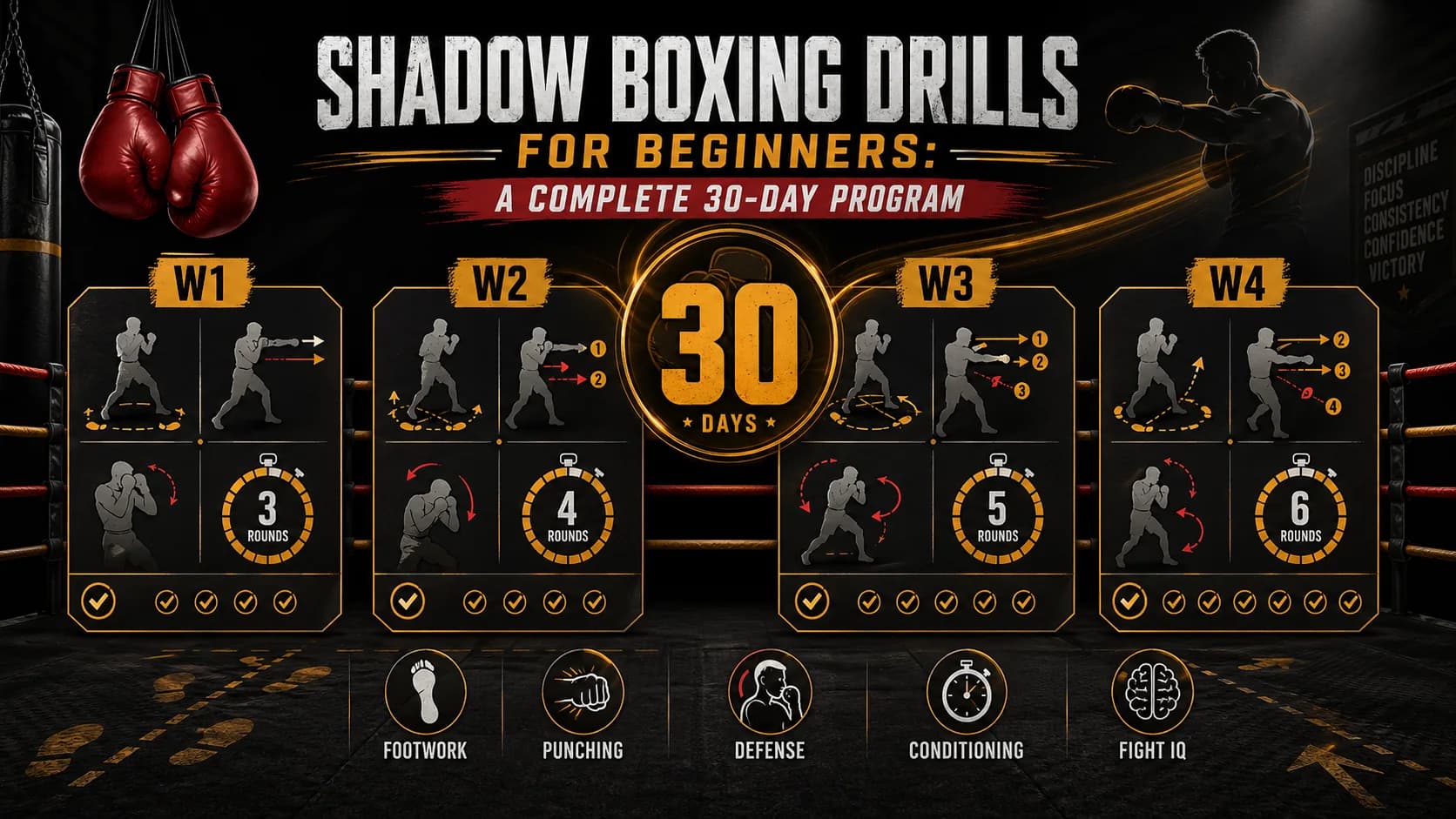
This 30-day program takes you from someone who's never thrown a punch to a competent, flowing shadow boxer who can move, combine punches, and visualize an opponent. Each week builds on the last, adding new tools, increasing round length, and layering in defensive movement. By Day 30, you'll have a complete shadow boxing routine you can use for the rest of your boxing career.
Key Takeaways
- Shadow boxing improves combination accuracy by 34% over 8 weeks compared to bag-only training (2024 study)
- The program progresses from 2-minute rounds to full 3-minute rounds over 30 days
- Week 1 focuses on stance, jab, cross, and footwork fundamentals
- Week 2 adds hooks, uppercuts, and basic defensive movements
- Week 3 introduces fight simulation, pacing, and opponent visualization
- Week 4 develops personal style, speed, and fatigue management
- Video review is the gold standard for identifying form errors
- Shadow boxing complements but does not replace bag work or sparring
Before You Start: Setup and Ground Rules
Space: You need a clear area roughly 8 feet by 8 feet. A garage, living room with furniture pushed back, or any open floor works. Make sure there's nothing you can trip over or punch accidentally.
Mirror: Train in front of a full-length mirror whenever possible. Visual feedback accelerates learning by letting you spot errors in real time. If you don't have a mirror, record yourself with your phone and review between rounds.
Timer: Use a round timer app or the timer built into the Titans Grip Boxing AI. Standard boxing rounds are 3 minutes with 1-minute rest. This program starts shorter and builds up gradually.
Shoes: Flat-soled shoes or bare feet on a non-slip surface. Running shoes with thick heels throw off your balance and can lead to ankle rolls when you pivot.
Ground rules for every session:
- Hands up, chin down, elbows in. Always. No exceptions.
- Stay on the balls of your feet. Never go flat-footed.
- Breathe out sharply with every punch. Silent punching builds bad habits.
- Visualize a real opponent. Punch at head and body height, not into empty space.
- Record yourself at least once per week. Video review reveals mistakes your mirror misses.
Common Beginner Mistakes (And How to Avoid Them)
Before we dive into the program, let's address the mistakes that trip up almost every beginner. Knowing these ahead of time will save you weeks of frustration.
Dropping the non-punching hand. This is the most common error. When you throw a jab, your rear hand should stay glued to your cheek. When you throw a cross, your lead hand should stay up. Beginners let the non-punching hand drift down to waist level. Fix this by checking your hand position after every punch in the mirror.
Leaning forward on crosses. The cross gets its power from hip rotation, not from leaning your upper body forward. If you find yourself off-balance after throwing a cross, you're leaning. Keep your weight centered and rotate through your hips.
Wide, looping hooks. A hook is a short, arcing punch. Beginners often throw it with a wide, sweeping motion that leaves them open for counters. Keep your elbow at roughly 90 degrees and rotate from the hips, not the shoulder.
Flat feet. Boxing happens on the balls of your feet. If you feel your heels touching the ground between movements, you're too flat. Stay light and ready to move.
Holding your breath. Beginners hold their breath when they focus. This leads to early fatigue and poor technique. Exhale sharply with every punch. If you're not breathing, you're not relaxed.
Week 1: The Foundation (Days 1 to 7)
Focus: Stance, basic punches, and breathing rhythm.
Round structure: 2-minute rounds, 45-second rest. 4 rounds per session.
Week 1 is about building the habit and ingraining your fighting stance. You will only use three punches: the jab, the cross, and basic footwork. Resist the urge to throw hooks or move fancy. Precision first.
Day 1: Stance and the Jab
Spend the first round in your stance without punching. Shift your weight forward, backward, left, right. Feel where your balance breaks and where it holds. Rounds 2 through 4, add only the jab. Extend fully, snap back to guard. Focus on the shoulder rotation and the exhale.
Drill: Throw 10 jabs, then move to a new position using a step-drag. Repeat for the full round. Count your jabs. Aim for 80 to 100 per round.
Why this matters: The jab is the most important punch in boxing. It sets up everything else. If your jab is lazy, your entire game suffers.
Day 2: Adding the Cross
Warm up with 1 round of jab-only movement. Rounds 2 through 4, add the cross. The power comes from your rear hip rotating forward, not from your arm. Your rear heel should lift and turn as you throw.
Drill: Jab, cross, reset stance, move. The reset is critical. Beginners chain punches without returning to guard between them. Every 1-2 combination ends with hands back at your cheeks.
Day 3: The 1-2 in Motion
All 4 rounds focus on throwing the jab-cross while moving. Step forward, jab-cross. Step back, jab-cross. Step left, jab-cross. Step right, jab-cross. Your feet move first, then the punches land from a stable base.
Drill: Alternate between offense and defense every 30 seconds. First 30 seconds: throw 1-2 combos while advancing. Next 30 seconds: move backward and laterally, hands up, no punching. This simulates the rhythm of a real round.
Day 4: Tempo Control
Rounds 1 and 3 are "slow rounds." Throw at 40% speed, focusing purely on form. Rounds 2 and 4 are "fast rounds." Throw at 80% speed with full extension. The contrast teaches you to control your output.
Drill: In slow rounds, pause at full extension on every jab and check your form. Is your shoulder protecting your chin? Is your rear hand still up? In fast rounds, prioritize snap and return speed.
Day 5: Adding the Step-Drag
Dedicate this session entirely to movement with punching. No stationary combinations. Every punch is preceded or followed by a step-drag. If you feel your feet getting lazy, stop punching and just move for 15 seconds.
Drill: Box a "square" pattern. Step-drag forward 3 steps, jab-cross. Step-drag right 3 steps, jab-cross. Step-drag back 3 steps, jab-cross. Step-drag left 3 steps, jab-cross. Repeat the square for the full round.
Day 6: The Pivot
Introduce the pivot. After a 1-2 combination, plant your lead foot and swing your rear foot 45 degrees to create a new angle. This changes your position relative to your imaginary opponent.
Drill: Jab-cross, pivot left. Jab-cross, pivot right. Alternate pivots for the full round. Keep your balance through the pivot. If you stumble, slow down.
Day 7: Full Integration
Combine everything from the week into a free-flowing session. Use jabs, crosses, step-drags, and pivots. Move continuously. Visualize an opponent throwing back at you and respond by changing angles.
Session: 4 rounds. Rounds 1 and 2: structured drill work from earlier in the week. Rounds 3 and 4: free shadow boxing using only this week's tools. Grade yourself on one thing: did your hands drop at any point?
Week 2: Building the Arsenal (Days 8 to 14)
Focus: Hooks, uppercuts, and basic defense.
Round structure: 2.5-minute rounds, 45-second rest. 5 rounds per session.
Day 8: The Lead Hook
The hook is a short, arcing punch thrown with the lead hand. The power comes from hip rotation, not arm swinging. Your elbow stays bent at roughly 90 degrees. The fist travels on a horizontal plane at chin height.
Drill: Jab, cross, lead hook. This 1-2-3 combination is the bread and butter of boxing. Throw it 50 times per round, resetting your stance after each one. The hook should feel like a whip crack, not a wide swing.
Day 9: The Rear Uppercut
The uppercut travels vertically, targeting the chin or body. Drop your rear hand slightly (not to your waist, just 3 inches), bend your knees, and drive upward with your legs and hips. Your fist turns palm-up at the point of impact.
Drill: Jab, cross, lead hook, rear uppercut. This 4-punch combination teaches you to chain different planes of attack. Throw 10 reps, move to a new position, throw 10 more. Five rounds builds 250 total reps of a fight-ending combination.
Day 10: Defense Introduction (Slips)
Shadow boxing is not just offense. Start every round with 30 seconds of defensive movement only. Practice the slip by bending at the waist to move your head off the center line. Slip left (outside a jab) and slip right (outside a cross).
Drill: Visualize an opponent jabbing at you. Slip outside the jab, then counter with your own cross. Slip-cross, slip-cross, for the full 30-second block. Then transition to free shadow boxing for the remaining 2 minutes.
Day 11: Combining Offense and Defense
Every combination now ends with a defensive action. Throw a 1-2, then slip. Throw a 1-2-3, then pivot. Throw an uppercut, then step back. There is no "stand and admire your work" in boxing. The follow-up movement is what keeps you safe.
Drill: Call out a pattern before each round. Example: "1-2, slip left, 3, pivot right." Run that pattern for the full round, then change the pattern for the next round. This builds your fight IQ.
Day 12: Body Shots
Lower your target level. Bend your knees (not your back) to throw jabs and crosses to the body. The lead hook to the body is one of the most effective punches in boxing, and it starts here.
Drill: Alternate between head and body every combination. 1-2 to the head, 1-2 to the body. Lead hook upstairs, lead hook to the ribs. This level-changing ability makes you unpredictable.
Day 13: 3-Level Attack
Combine head, body, and angle-changing into one session. Throw to the head, dip to the body, pivot to a new angle, throw again. This is what elite shadow boxing looks like.
Drill: 5 rounds. Each round, pick a starting combination and add one element every 30 seconds. Start with just jabs. Add the cross at 0:30. Add the hook at 1:00. Add body shots at 1:30. Add slips at 2:00. Full free-flow for the last 30 seconds.
Day 14: Week 2 Assessment
Record yourself for the full 5-round session. Watch it back the same day. Check for:
- Hands returning to guard after every punch
- Balance through pivots and slips
- Exhaling with every punch
- Level changes (are you actually bending your knees?)
- Continuous movement (no standing flat-footed between combos)
Note two specific things to improve. These become your focus for Week 3.
Week 3: Fight Simulation (Days 15 to 21)
Focus: Round strategy, pacing, and opponent visualization.
Round structure: 3-minute rounds, 1-minute rest. 5 rounds per session.
You are now at full round length. This is where conditioning and mental focus become factors.
Day 15: Round Pacing
A 3-minute round has a structure. The first 30 seconds are feeling-out. The middle 2 minutes are the work phase. The last 30 seconds are the impression phase, where judges form their final opinion of the round.
Drill: Shadow box with intention. First 30 seconds: light jabs, movement, establish range. Middle 2 minutes: full combinations, level changes, defensive movements. Last 30 seconds: increase output. Throw more punches, push forward. End the round strong.
Day 16: Pressure Fighting
Visualize an aggressive opponent moving toward you. Your job is to use footwork and counters to manage their pressure. Move laterally, not straight back. Pivot off the ropes (imagine the ropes). Counter with the jab and 1-2 as they advance.
Drill: Spend full rounds moving backward and laterally while throwing counters. Never plant your feet for more than one combination before moving again. This simulates fighting a pressure fighter and builds your ability to think while retreating.
Day 17: Applying Pressure
Now you are the pressure fighter. Move forward with purpose. Cut off the ring by stepping at a 45-degree angle to cut off your imaginary opponent's escape route. Double jab to close distance, then throw power shots at range.
Drill: Start each round in a corner. Work your way to the center using forward step-drags and L-steps. Every time you "trap" the imaginary opponent on the ropes, throw a 4 to 5 punch combination, then reset to the center. Repeat.
Day 18: Counter Fighting
This is the style of Floyd Mayweather Jr. and Juan Manuel Marquez. You let the opponent commit, then exploit the opening. In shadow boxing, this means visualizing specific attacks and responding with pre-planned counters.
Drill: Imagine these scenarios and respond:
- Opponent jabs: Slip outside, counter with a cross.
- Opponent throws a 1-2: Pull back (lean weight to rear foot), then counter with a lead hook as they're extended.
- Opponent throws a hook: Duck under it, come up with a rear uppercut.
Run each scenario 10 times, then mix them randomly for the remaining time.
Day 19: Combination Creativity
Move beyond the standard 1-2-3 patterns. Build your own combinations based on what feels natural. The only rule: every combination must include at least one defensive movement and one level change.
Examples:
- Jab body, jab head, cross, slip, lead hook
- Double jab, cross, pivot, rear uppercut, lead hook, step back
- Slip right, cross body, lead hook head, pivot left
Drill: Invent 5 unique combinations before the session. Run each one for a full round. By the end, you have 5 new weapons.
Day 20: The Championship Round
6 rounds today. The last round is the "championship round." Treat it like the final round of a close fight. Maximum output, no coasting, every second counts. This builds mental toughness and teaches you to find another gear when you are tired.
Drill: Rounds 1 through 5 are normal shadow boxing with all your tools. Round 6: set a target of 60 to 80 punches per minute for the full 3 minutes. That is a punch every second or faster. Maintain form.
Day 21: Sparring Simulation
Shadow box as if you are sparring. Include feints. Include moments where you reset and catch your breath. Include clinch breaks (step back, hands up, circle out). Make it feel real. Talk to yourself between rounds: "I need to jab more. Stop dropping my right hand."
Drill: Between each round, identify one tactical adjustment. "He keeps catching me with the right hand, so I need to slip more to my left." Then implement that adjustment in the next round. This is how coaches build fight IQ.
Week 4: Mastery and Personalization (Days 22 to 30)
Focus: Style development, conditioning peaks, and building your personal routine.
Round structure: 3-minute rounds, 1-minute rest. 6 rounds per session.
Day 22: Find Your Style
By now, you have preferences. Maybe you like pressure fighting and hooks. Maybe you prefer the outside game with jabs and straight rights. Lean into what feels natural while still practicing what feels uncomfortable.
Drill: 3 rounds in your "comfort style" and 3 rounds forcing yourself into the opposite style. If you like fighting on the outside, spend 3 rounds as a pressure fighter. Growth lives in discomfort.
Day 23: Speed Rounds
Reduce round time to 1.5 minutes but eliminate rest. 8 continuous rounds (12 minutes total). The goal is sustained output without dropping your hands or losing form.
Drill: Every round starts with a 10-punch combination. The middle portion is free-flow. Every round ends with another 10-punch flurry. No pauses longer than 2 seconds between punches.
Day 24: Power Visualization
Throw every punch at full speed and full extension but visualize impact. Snap your punches like you are hitting a target 6 inches behind where your fist stops. This builds the habit of punching through a target rather than at it.
Drill: 6 rounds. Each round focuses on a single punch thrown at maximum speed with perfect form. Round 1: jabs only. Round 2: crosses only. Round 3: lead hooks only. Round 4: rear uppercuts only. Round 5: lead uppercuts. Round 6: free combination with all punches at full speed.
Day 25: Rhythm and Flow
Put on music with a steady beat (130 to 140 BPM works well for boxing rhythm). Throw punches on the beat. Move on the offbeat. This trains timing and rhythm, which are essential for setting up combinations in a real fight.
Drill: Follow the music. Jab on beat 1, cross on beat 2, move on beats 3 and 4. As you get comfortable, build longer combinations that ride the rhythm. If the beat is fast, your output is fast. If it slows, you reset and move.
Day 26: Defensive Focus
Spend 60% of every round on defense. Slip, roll, pivot, step back, circle. Only counter when you "see" a clear opening. This session teaches patience, which is the hardest skill for beginners to develop.
Drill: For every punch you throw, execute two defensive movements. Slip, slip, counter cross. Roll under, roll under, counter hook. Pivot, pivot, counter jab. The ratio forces you to prioritize not getting hit over hitting.
Day 27: Fatigue Management
Start each round with 15 seconds of burpees or high knees. Then immediately shadow box. This simulates fighting while tired. Your form will break down. Fight to maintain it. Hands up. Chin down. Keep moving.
Drill: 6 rounds with the 15-second conditioning burst at the start of each. The shadow boxing portion should be fought at 70% intensity with perfect form. The point is not to go hard but to maintain technique when your body wants to quit.
Day 28: Teach-Back Round
Explain every movement out loud as you do it. "Stepping left, jab to the body, cross to the head, pivoting right to clear the angle." This cognitive layer strengthens the neural connections between your brain and your body.
Drill: Narrate your entire 6-round session. If you cannot name what you are doing, you do not understand it well enough. This exercise exposes holes in your knowledge.
Day 29: Film Study Application
Watch 5 minutes of a professional fight (any weight class, any era). Pick one sequence you like. Recreate it in your shadow boxing. Try to copy the footwork, the timing, the combination.
Suggested fighters to study: Vasyl Lomachenko (angles and footwork), Canelo Alvarez (head movement and counters), Naoya Inoue (combination punching), Terence Crawford (switch hitting and timing).
Drill: Dedicate 2 rounds to replicating the sequence you watched. Then spend 4 rounds incorporating elements of that fighter's style into your own shadow boxing.
Day 30: The Final Test
This is your graduation day. 6 full 3-minute rounds. No drills, no structure, no constraints. Shadow box like you are fighting for a title. Use everything from the last 29 days: jabs, crosses, hooks, uppercuts, slips, rolls, pivots, level changes, pressure, countering, pacing, and creativity.
Record the entire session. Compare it to your Day 14 recording. The difference will be unmistakable.
Scoring yourself:
- Hands stayed at guard level: Yes/No
- Continuous movement throughout every round: Yes/No
- Used at least 5 different punches: Yes/No
- Included defensive movements after combinations: Yes/No
- Changed levels (head and body): Yes/No
- Used pivots and lateral movement: Yes/No
- Maintained output in the final round: Yes/No
If you scored Yes on 6 or 7 of these, you have built a serious shadow boxing foundation. If you scored lower, run the program for another 2 weeks focusing on your weak areas.
Comparison: Shadow Boxing vs. Other Training Tools
| Training Tool | Primary Benefit | Best For | Limitation |
|---|---|---|---|
| Shadow Boxing | Form, footwork, visualization | Technique refinement, fight IQ | No impact resistance |
| Heavy Bag | Power, conditioning, timing | Building punch strength | Can reinforce bad form |
| Speed Bag | Hand speed, rhythm, timing | Coordination, shoulder endurance | Limited transfer to fighting |
| Double-End Bag | Accuracy, timing, head movement | Precision, reactive training | Requires setup, space |
| Mitt Work | Combination practice, feedback | Coach-guided technique | Requires partner |
| Sparring | Real-time application, pressure testing | Fight readiness | Risk of injury, requires partner |
Honest Limitations of Shadow Boxing
Shadow boxing is incredible, but it's not perfect. Here are the honest limitations:
No impact resistance. You never feel the weight of a punch landing or the shock of blocking a shot. This means your body doesn't develop the same structural strength for absorbing impact. You need bag work and sparring to build that.
No reactive feedback. In shadow boxing, you control everything. There's no opponent throwing unexpected shots or forcing you to react. This can lead to a false sense of security. Mitt work and sparring provide the reactive element.
Form can drift without correction. If you practice bad form in shadow boxing, you're just reinforcing bad habits. That's why video review and occasional coaching feedback are essential. The Titans Grip Boxing AI can help by providing automated form analysis, but it's not a substitute for a live coach.
It's easy to go through the motions. Without a target or partner, it's tempting to slack off. The discipline to maintain intensity and focus comes from within. This program's structure helps, but you have to commit to the work.
Decision Rules: When to Use Each Training Tool
- Use shadow boxing when: You're working on technique, footwork, or fight visualization. Use it as a warm-up before every session.
- Use the heavy bag when: You need to build punch power and conditioning. Use it after shadow boxing to apply what you've practiced.
- Use mitts when: You have a coach or partner who can give real-time feedback. Mitts are best for combination practice and timing.
- Use sparring when: You're preparing for competition or testing your skills under pressure. Sparring should be supervised and controlled.
- Use the speed bag when: You want to improve hand speed and rhythm. It's a supplemental tool, not a primary one.
What to Do After the 30 Days
This program gives you the tools. Now you need to make shadow boxing a permanent part of your training. Here is how to integrate it going forward:
Daily minimum: 3 rounds of shadow boxing as a warm-up before any training session. Use it to rehearse combinations you plan to work on the bag or in sparring.
Weekly dedicated session: One 6-round session per week focused purely on shadow boxing with video review. Use the Titans Grip Boxing AI to track your movement patterns, stance consistency, and combination accuracy over time.
Pre-sparring prep: Before sparring days, do 2 rounds of shadow boxing simulating the style of your sparring partner. If they pressure, practice your lateral movement. If they counter, practice your feints and entries.
Travel training: Shadow boxing is the only training tool that works in a hotel room, a park, or an airport lounge. When you cannot get to the gym, 20 minutes of focused shadow boxing maintains your timing and technique.
Frequently Asked Questions
Is shadow boxing a good workout for weight loss?
A 150-pound person burns approximately 350 to 450 calories per hour of moderate-intensity shadow boxing, according to estimates from the American Council on Exercise. That is comparable to a brisk jog. The calorie burn increases significantly when you add movement, level changes, and sustained high output. It is not a replacement for dedicated cardio or strength training, but it is a solid supplemental workout.
How many rounds of shadow boxing should a beginner do?
Start with 3 to 4 rounds of 2 minutes. By the end of this 30-day program, you should be comfortable with 6 rounds of 3 minutes. More experienced fighters do 8 to 12 rounds as part of a full training session. Quality always beats quantity. Four rounds of focused, intentional shadow boxing are worth more than 10 rounds of going through the motions.
Should I shadow box with weights?
Not as a beginner. Adding 1 to 3 pound dumbbells changes the mechanics of your punches and can reinforce bad habits before good ones are established. Once you have 6+ months of consistent training and your form is solid under fatigue, light weights can build shoulder endurance. Never use heavy dumbbells, as they put excessive strain on your shoulder joints and elbows.
Can shadow boxing replace bag work?
No. They serve different purposes. Shadow boxing develops form, footwork, and fight visualization. Bag work develops power, timing on impact, and conditioning under resistance. You need both. Think of shadow boxing as studying the playbook and bag work as game practice. One without the other leaves gaps.
How do I know if my shadow boxing form is correct?
Video review is the gold standard. Record yourself from the front and side, then compare to instructional footage or professional fighters. Common errors include dropping the non-punching hand, leaning too far forward on crosses, wide looping hooks, and flat feet between movements. The Titans Grip Boxing AI provides automated form scoring that catches these issues frame by frame.
How long does it take to see results from shadow boxing?
Most beginners notice improved coordination and footwork within 2 weeks of consistent practice. The 34% accuracy improvement from the 2024 study came after 8 weeks of 15-minute daily sessions. Real results come from consistency, not intensity.
Can I shadow box every day?
Yes, as long as you're not overtraining. Shadow boxing is low-impact compared to bag work or sparring. You can do it daily as long as you listen to your body. If your shoulders or hips feel sore, take a rest day or do a lighter session focused on footwork only.
The Bottom Line
Shadow boxing is not just "punching air." It is the laboratory where you build, test, and refine every skill in boxing. This 30-day program gives you a structured path from complete beginner to competent shadow boxer. Follow it daily, record yourself weekly, and be honest about your weaknesses. The fighters who take shadow boxing seriously are the ones who look sharp, move well, and outclass opponents who only learned to hit things. Your journey starts with Round 1, Day 1. Set your timer and get to work.
Train Boxing with AI
Coach Marcus analyzes your technique, scores your form 0-100, and builds your training plan.
Download Boxing AIOther Doved Studio projects
Related tools from the same studio you might find useful:
- Glean: Turn scrolling time into a daily action plan. Capture, process, execute.
- Popout: Create your portfolio in minutes with a single shareable page.
- Doved Studio: Studio indie derrière cette app et une dizaine d'autres outils.
Coach Marcus
Boxing specialist. Expert in footwork, combinations, defense.
Coach Marcus is the AI coaching persona behind Boxing AI, built to provide personalized boxing guidance through video analysis, training plans, and technique breakdowns.
Related Articles
Roland Garros Is Spiking Again: A 7-Day Footwork Microcycle for Fighters
Jun 2, 2026 · 22 min read
BoxingFootball Search Spikes: The Fighter Footwork Plan Behind Today's Attention
Jun 1, 2026 · 22 min read
BoxingRoland-Garros Footwork for Boxing and MMA: The 6-Week Split-Step Conditioning Plan
May 31, 2026 · 17 min read
Train Boxing with AI
Boxing AI gives you an AI coach that analyzes your technique, plans your training, and tracks your nutrition. Try it for free.