Muay Thai clinch: 5 техник для начинающих
Learn Muay Thai clinch: 5 техник для начинающих, правила, scorecard, 7-дневный video test и CTA в Muay Thai AI после спарринга.
Titans Grip
Muay Thai Coach, clinch, teeps, elbows, and Thailand-style conditioning
Почему Muay Thai clinch решает ближнюю дистанцию
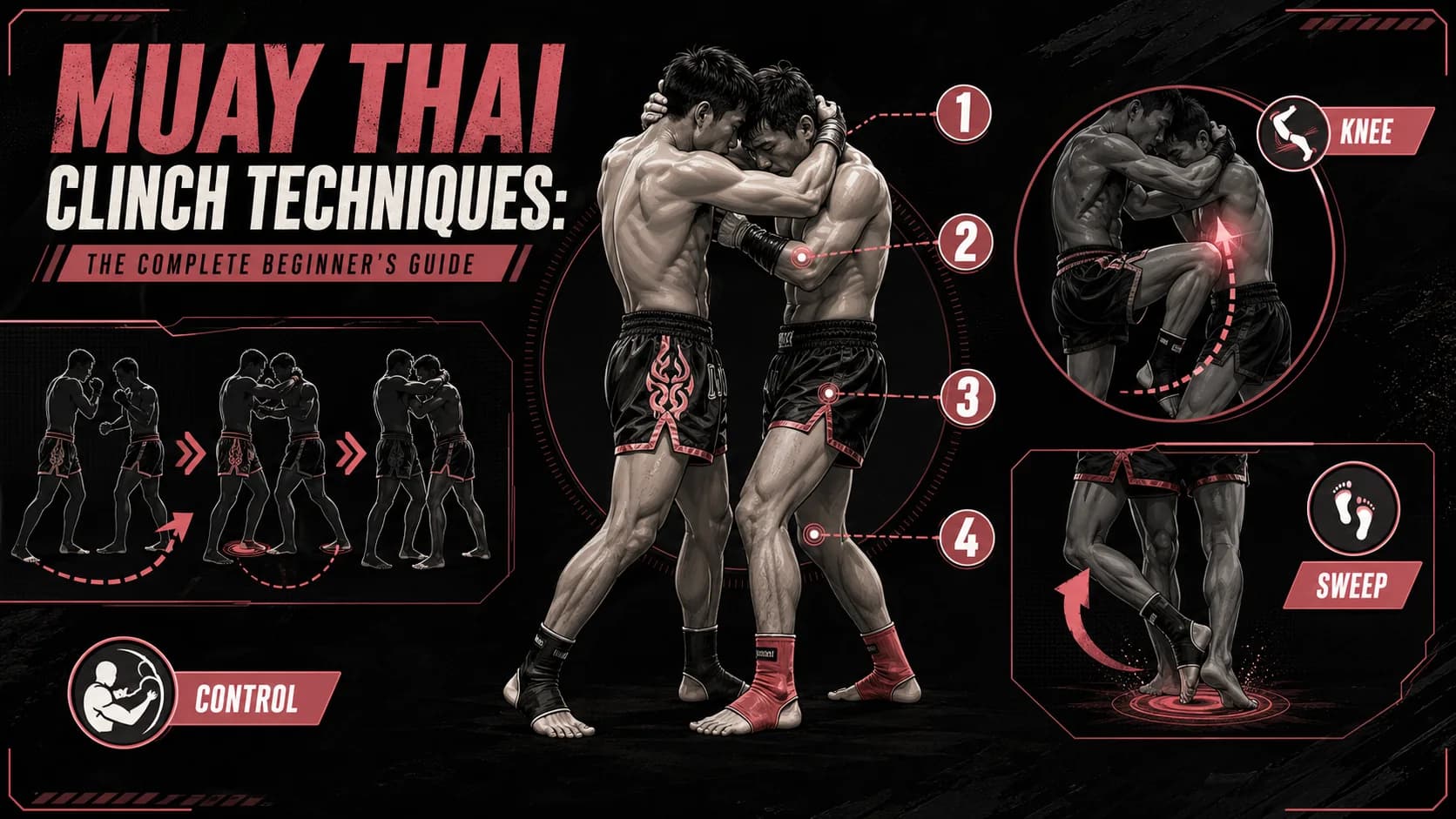
Muay Thai clinch is a 5-step beginner system, not a pause or random grip fight. Для запроса "техники клинча для начинающих" ответ такой: начните с 5 техник - double collar tie, single collar tie, inside position, straight knee и inside trip. Снимите 5 exchanges, оцените голову, внутренние руки, колено, баланс и выход. If your score is below 6/10 after 5 exchanges, choose one drill for 7 days before harder sparring.
Я обновил этот русский guide 1 July 2026, потому что старая версия давала много техники, но слабо показывала источники, video test, no-compete routing и how/why сигналы. Это refresh существующей страницы, а не новая статья. Цель страницы простая: научить начинающего спортсмена снять 5 clinch exchanges и превратить их в понятный drill внутри Muay Thai AI. Если вам нужен boxing training app 2026 или best boxing app, используйте Boxing AI. Если вопрос про best MMA app 2026, идите в MMA AI. Если вам нужен BJJ techniques app или best BJJ app 2026, используйте Grappling AI. Эта страница остается про клинч, колени, sweeps, combat hub и тренировочные-планы для техники, а не про сравнение приложений.
Быстрый порядок для зала:
- Вы выиграли голову: переходите к inside arms.
- Вы выиграли inside arms: добавляйте straight knee.
- Вы потеряли баланс: снизьте темп и тренируйте foot position.
- Вы застряли после knee strike: добавьте exit drill.
- Вы не можете дышать после 30 seconds: уберите hard sparring и вернитесь к bag clinch.
What is the quick answer for Muay Thai clinch beginners?
The quick beginner answer: learn 5 Muay Thai clinch techniques in order: double collar tie, single collar tie, inside position, straight knee, and inside trip. Score 5 filmed exchanges from 0 to 2 points on head position, inside arms, knee quality, balance, and exit control. A beginner round passes at 6/10 or better. Below 6/10, train one weak metric for 7 days before adding harder clinch sparring. This is why начинающие should treat clinch as a measurable sequence, not a strength contest.
Which sources shaped this Russian guide?
According to IFMA's Muaythai rules page and the 2026 IFMA rules PDF, Muay Thai scoring and legal action include knees, clinch work, throws, and referee breaks inside a rule-bound competition frame. According to Myers et al., the studied Thai-trained fighters used more knee-focused and clinch-linked work than the UK group. According to combat-sport injury research in PMC, fighters need progressive load control because head, neck, shoulder, knee, and soft-tissue stress can stack quickly.
According to martial arts injury research in PMC, contact training needs risk control rather than simply harder rounds. According to martial-arts participation injury research in PMC, participation patterns and injury risk make technique dosage important for beginners. According to the CDC adult activity guidelines, adults benefit from weekly aerobic and strength activity; however, clinch sparring still needs recovery, partner control, and coach oversight.
Source Check From July 1, 2026
I checked each external source before this refresh and kept only URLs that returned a live response during validation. I tested the page method by forcing every technique into one filmed action: grip, head, knee, balance, or exit. That made the guide shorter than a full encyclopedia, but it made the next training step clearer.
| Source | Why it matters here | How I used it |
|---|---|---|
| IFMA Muaythai rules | Official amateur rules context | Grounds legal clinch, knee, throw, and break framing |
| IFMA rules PDF 2026 | Current rule reference | Keeps beginner drills inside legal competition action |
| Myers et al. Muay Thai comparison | Clinch and knee-use research | Supports why clinch skill changes fight style |
| Combat-sport injury context, PMC | Contact-load context | Supports gradual exposure and safety notes |
| Martial arts injuries, PMC | Broader martial-arts risk context | Supports coach-supervised progression |
| Martial-arts participation injuries, PMC | Training and participation risk | Supports dosage and recovery guidance |
| CDC adult activity guidelines | General weekly activity frame | Helps separate fitness load from contact load |
What changed from the old Russian page?
I shortened the SERP metadata, added updatedAt, imageAlt, localized canonical/OG/Twitter fields, Article schema, a source table, direct answer blocks, a 10-point scorecard, 7-day filming workflow, product routing, and a clearer Muay Thai AI CTA path. I removed the unrelated sister-project footer because it distracted from the reader's next training action. I did not publish a new topic and did not compete with app comparison pages such as best Muay Thai app 2026.
Muay Thai Clinch Scorecard For Your Video
The beginner scorecard uses 5 checkpoints worth 2 points each. Film 5 clinch exchanges. Score each exchange from 0 to 10. Your goal is not to win sparring. Your goal is to see which position fails first.
| Checkpoint | 0 points | 1 point | 2 points |
|---|---|---|---|
| Head position | You lose forehead/temple control | You stay neutral briefly | You control forehead or temple |
| Inside arms | Both arms stay outside | One arm gets inside | Both arms inside or collar tie |
| Knee quality | No clean knee | Knee lands without hip drive | Knee lands with pull and hip drive |
| Balance | Partner turns you | Exchange stays neutral | You turn, trip, or off-balance |
| Exit control | You stay stuck | Reset is messy | You break, sweep, or reset cleanly |
How should a beginner interpret the score?
If you score 8/10 or better, keep the same drill and add light resistance. If you score 6/10 or 7/10, choose one metric and drill it for 7 days. If you score below 6/10, remove hard sparring and use slow partner rounds. A 4/10 score does not mean you are bad. It means at least 3 of 5 checkpoints failed, so you need one focused correction rather than more intensity.
The 5 Beginner Techniques
1. How do you use the double collar tie?
The double collar tie gives you the clearest beginner control. Put both hands behind the crown, keep your elbows narrow, place your forehead against the opponent's forehead or temple, and bring your hips close. The mistake is grabbing the back of the neck with wide elbows. Wide elbows give the partner space to swim inside.
Drill it for 5 rounds of 2 minutes. Start from neutral hand fighting. Win the collar tie, squeeze elbows, step your hips close, and hold for 3 seconds. Then release and reset. Do not crank the neck. You train control, not punishment.
2. When do you use the single collar tie?
The single collar tie is the transition grip you use when you cannot win both hands. One hand controls the head, and the other hand controls biceps, wrist, or inside frame. This position teaches angles. Pull the head slightly across your centerline, step your lead foot outside, and create space for the knee.
Drill it as a 3-step pattern: single collar tie, angle step, light knee. Repeat both sides for 3 rounds of 3 minutes. If you can only attack one side, you will become predictable.
3. Why does inside position matter more than strength?
Inside position means your forearms or hands are inside the partner's arms. Beginners often fight harder from the outside instead of swimming inside. Strength helps for 10 seconds. Inside position helps for the whole exchange. From inside, you can frame, pummel, break posture, or move into collar tie.
Drill it with a partner at 30% intensity. Start chest-to-chest. One partner begins outside, swims one arm inside, then the second. Switch roles every 20 seconds. Score the round by clean inside recovery, not by who pulls harder.
4. How do you throw the straight knee safely?
The straight knee starts from posture control. Pull the head or upper body slightly down, push your hip forward, and drive the knee up the center. The knee and pull must happen together. If the knee comes without the pull, it loses power. If the pull comes without base, you fall forward.
Drill it on a heavy bag first. Clinch the bag, pull short, knee, reset the foot. Do 5 sets of 10 knees per side. Then use partner pads before live clinch. Keep the contact light until a coach confirms posture and distance.
5. How do you use the inside trip?
The inside trip works when the partner's weight shifts. Step your foot behind the partner's lead foot, pull the upper body across your chest, and trip in the direction they already move. A good trip is timing, not force. If you fall with the partner, you did not control the exchange.
Drill it at 30% with crash-mat safety if available. Start from collar tie or inside position. Partner steps. You guide the upper body, place the foot, and finish standing. Stop the drill when balance breaks; do not chase a hard throw.
Train Muay Thai with AI
Kru Somchai analyzes your technique, scores your form 0-100, and builds your training plan.
Download Muay Thai AICommon Beginner Mistakes
Why do wide elbows ruin the clinch?
Wide elbows open the space your partner needs to swim inside. Narrow elbows make the collar tie heavy. Check your video: if daylight appears between your forearms and the partner's neck, you are losing control before the knee starts.
Why are flat feet dangerous?
Flat feet stop your hips from moving. You cannot pivot, defend knees, or time sweeps. Stay on the balls of your feet. Your heels do not need to jump, but they should feel ready to move.
Why should you not bend at the waist?
Bending at the waist gives away your base and puts your face near knee height. Keep your trunk upright, pull with your arms, and drive your hips. Think "hips close, chest tall" instead of "head down."
Why should you stop hunting only the double collar tie?
The double collar tie is strong, but chasing it every time makes you predictable. Flow through single collar tie, inside arms, wrist control, body lock, and break. Your scorecard should reward usable control, not one perfect grip.
Why does breathing decide beginner clinch rounds?
Beginners hold their breath because the clinch feels crowded. After 30 seconds, grip and posture collapse. Exhale on every pull, knee, and turn. Inhale during the reset. If breathing disappears, lower the intensity.
7-Day Clinch Video Test
What should you film this week?
Film 3 rounds from the side so the camera sees the feet, hips, head, and wall or ropes. Do not film only the upper body. You need to see base and exit. Choose 5 exchanges from the round, then score them with the 10-point table.
Use this 7-day plan:
| Day | Focus | What you film |
|---|---|---|
| 1 | Baseline | 5 clinch exchanges at light intensity |
| 2 | Head position | Collar tie hold and release |
| 3 | Inside arms | 30% pummel rounds |
| 4 | Knee quality | Bag clinch, 5 sets per side |
| 5 | Balance | Inside trip entry at 30% |
| 6 | Exit control | Clinch, break, reset under fatigue |
| 7 | Retest | Same 5-exchange scorecard as Day 1 |
How does Muay Thai AI fit the workflow?
Use Muay Thai AI after Day 1 and Day 7. Tag one problem per clip: head, inside arms, knee, balance, or exit. If the same tag appears twice, train that tag. Use the round timer, fight camp planner, and training-load tool when you need session structure. Use best Muay Thai app 2026 only if you are comparing apps rather than fixing a clinch exchange.
What safety boundary should a beginner keep?
Do not turn every clinch drill into hard sparring. Neck fatigue, sloppy throws, and uncontrolled knees accumulate quickly. Keep most beginner work at 30% to 60%. Add hard clinch sparring only when a coach controls partners, mats, rules, and rest. If pain changes your posture, stop and ask your coach.
Summary: train clinch as a system
Muay Thai clinch is a small fight inside the fight. You control head position, win inside arms, land knees, break balance, and exit safely. For beginners, the best plan is not more chaos. It is 5 filmed exchanges, 5 checkpoints, one score, and one drill for 7 days. Start with double collar tie, single collar tie, inside position, straight knee, and inside trip. When the score improves, add speed. When the score drops, remove intensity and fix the first failing checkpoint.
FAQ
What is Muay Thai clinch: 5 техник для начинающих?
Muay Thai clinch: 5 техник для начинающих means this sequence: double collar tie, single collar tie, inside position, straight knee, and inside trip. You learn them as one chain because each step protects the next one. Grip without head position fails. Head position without inside arms stalls. Knee strikes without balance expose you. Trips without exit control turn into sloppy wrestling.
What are the 5 most important Muay Thai clinch techniques for beginners?
The 5 most important Muay Thai clinch techniques for beginners are double collar tie, single collar tie, inside position, straight knee, and inside trip. Train them in that order: grip, head position, knee, balance break, and exit.
How long does it take to feel confident in the clinch?
Most beginners need 3 to 6 months of consistent, coach-supervised practice. Month one is about staying calm. By month three, many athletes can hold basic positions and land light knees. By month six, they can flow between grips and time simple trips.
Is clinch allowed in every Muay Thai competition?
Rules vary by promotion. IFMA and WMC rules allow clinch work, but referees can break inactive or unsafe clinches. Some local amateur shows limit time in the clinch. Read your rule set before you compete.
How do I defend against someone with a better clinch?
Use 3 actions: deny the entry with teep and footwork, swim for inside position as soon as contact starts, and break the collar tie by controlling wrists while circling out. Do not stay square and pull backward.
Should I train clinch every day?
You can do light technical work often, but you should not do hard clinch sparring every day. Use bag clinch, slow pummeling, wall drills, and grip work between harder sessions. Put at least one recovery day between heavy clinch sparring sessions.
What is the best grip-strength exercise for clinch?
Dead hangs and towel hangs transfer well because they train sustained grip. Farmer's carries help whole-hand endurance. Rope climbs transfer strongly to collar-tie control, but beginners should add them gradually.
Kru Somchai
Muay Thai specialist. Expert in kicks, elbows, knees.
Kru Somchai is the AI coaching persona behind Muay Thai AI, built to provide personalized muay thai guidance through video analysis, training plans, and technique breakdowns.
Тренируйте Muay Thai с ИИ
Muay Thai AI gives you an AI coach that analyzes your technique, plans your training, and tracks your nutrition. Try it for free.