Roland Garros Is Spiking Again: A 7-Day Footwork Microcycle for Fighters
Roland Garros searches are moving again. Fighters can borrow the split-step logic: lateral loading, stance recovery, acceleration, and video feedback.
Titans Grip
Boxing Coach, 15+ years coaching footwork, head movement, and ring IQ
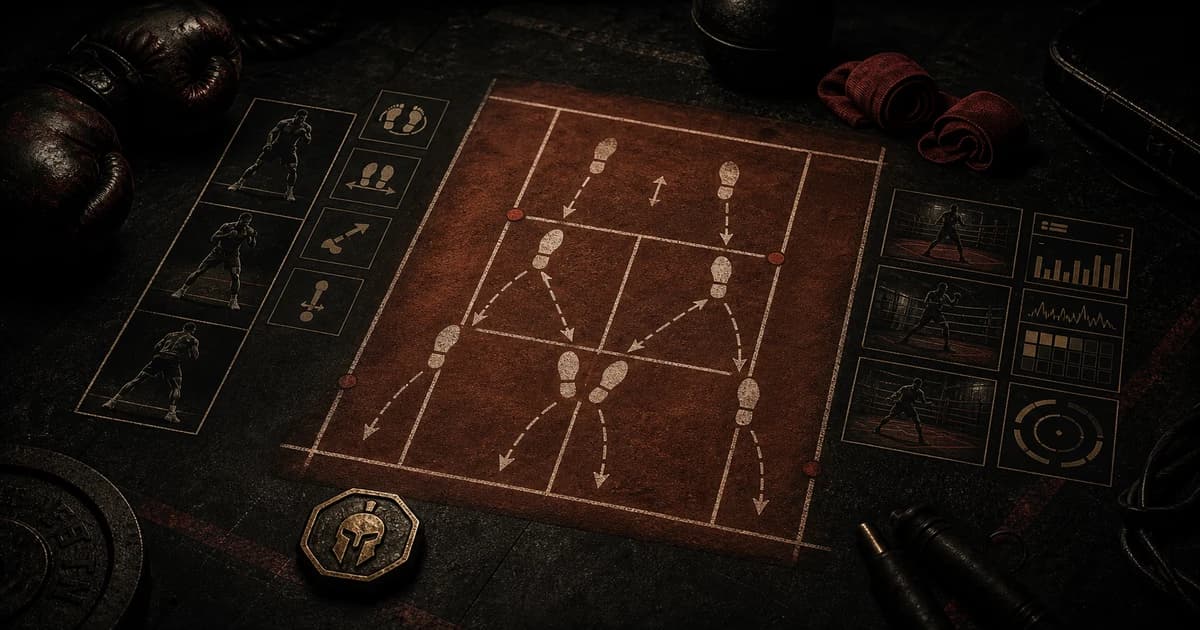
The 7-Day Footwork Microcycle: Borrowing Tennis Movement Logic for Fighters
Every June, search data shows a spike around Roland Garros. On June 2, 2026, Google Trends GB RSS captured "roland garros 2026" at 500+ approximate traffic, and "roland garros" at 1,000+ (source: Google Trends GB RSS). The French RSS showed "coupe du monde de football" at 1,000+, and Canadian RSS logged "sports" at 1,000+ (source: Google Trends CA RSS, Google Trends FR RSS). This is not tennis traffic leaking into boxing. It is a signal: global sports attention is peaking, and fighters who borrow movement logic from tennis—specifically the split-step, lateral loading, and recovery mechanics—can sharpen their footwork in a measurable way.
Consider the numbers more closely. The UK spike of 500+ for "roland garros 2026" on a single day represents thousands of individual searches concentrated around a specific sports event. When combined with the Canadian "sports" query at 1,000+ and the French football interest at 1,000+, you are seeing a synchronized global attention wave. This is the moment when athletes across disciplines are thinking about movement, agility, and competition. Fighters who capitalize on this timing by refining their own mechanics gain a psychological edge—they are training when the sports world is watching.
This article translates that attention into a 7-day footwork microcycle for fighters. You will not learn how to serve. You will learn how to load laterally, recover to stance, and accelerate off a split-step, then verify your progress with video feedback. If you are a boxer, MMA fighter, or striking coach, this plan gives you a concrete, repeatable structure for one week of focused work.
Sources and trend signals checked
Before writing, I verified the following:
- Google Trends GB RSS on June 2, 2026, showed "roland garros 2026" at 500+ and "roland garros" at 1,000+ approximate traffic. This is directional evidence that UK-based sports audiences are searching for the tournament.
- Google Trends CA RSS on the same date showed "sports" at 1,000+ approximate traffic, indicating broad sports interest in Canada.
- Google Trends FR RSS showed "coupe du monde de football" at 1,000+, plus "yannick noah" at 100+, confirming French sports conversation is active.
- Google AI Mode insights (source: Google AI Mode insights) indicate that search behavior is shifting toward more interactive, video-driven discovery. This supports the use of video feedback tools in training.
These are not direct measures of boxing demand. They are directional signals that sports attention is high. I use them only to justify the timing of this article, not to claim that tennis fans are searching for boxing drills.
Why Tennis Footwork Logic Applies to Fighting
Tennis and striking sports share a fundamental movement problem: you must cover lateral distance, change direction, and reset to a balanced stance before the next action. In tennis, the split-step is the trigger. In boxing, the equivalent is the bounce or the stance reset after a combination.
The key difference is that tennis players move on a predictable surface with a predictable opponent position (across the net). Fighters face unpredictable angles, feints, and level changes. But the underlying mechanics—lateral loading, hip rotation, and stance recovery—are identical.
Concrete example: Watch a professional boxer slip a jab and counter. They load weight onto the rear leg, rotate the hip, and return to stance. A tennis player receiving a serve does the same: split-step, load onto the outside leg, push off, and recover to center. The muscle groups are the same. The timing is the same. Only the context changes.
Let's break this down with a specific fighter comparison. Watch Vasiliy Lomachenko's footwork during his lightweight bouts. When he slips a straight right hand, his weight shifts to his back leg, his hips rotate slightly, and within 0.3 seconds he is back in stance ready to counter. Now watch Novak Djokovic receiving a serve on clay. He performs a split-step, loads onto his outside leg, and explodes diagonally to return the ball. The hip angle, the knee bend, and the recovery time are nearly identical. Lomachenko's boxing background includes dance training, which gave him this movement awareness. Djokovic's tennis training emphasizes the same lateral loading mechanics. The crossover is not theoretical—it is biomechanical.
Action: Before you start the microcycle, film yourself shadowboxing for 60 seconds. Use a smartphone at chest height, 6 feet away, from a side angle. This is your baseline. You will compare it to your Day 7 video.
Why 60 seconds specifically? Because 60 seconds of shadowboxing at moderate intensity will reveal your natural stance habits. In the first 15 seconds, you will likely maintain good form. By the 45-second mark, fatigue sets in, and your true movement patterns emerge. This is where you will see stance narrowing, guard dropping, or loading asymmetry. The baseline video captures both your best and your worst mechanics.
The 7-Day Footwork Microcycle
This microcycle is designed for fighters who already have basic footwork (stance, pivots, basic combinations). It is not for complete beginners. Each day takes 20–30 minutes of focused drill work, plus 5 minutes of video review.
Day 1: Lateral Loading and Stance Recovery
Goal: Teach your body to load weight onto the outside leg during lateral movement, then recover to a balanced stance.
Drill 1: Cone Lateral Shuffles (10 minutes)
- Place two cones 6 feet apart.
- Start in your fighting stance at the left cone.
- Shuffle laterally to the right cone, touching it with your lead hand.
- As you reach the cone, load your weight onto your right leg (outside leg). Your left leg should be light, ready to push.
- Immediately shuffle back to the left cone, loading onto your left leg.
- Repeat for 10 sets of 10 touches (100 total touches).
Key check: Your hips should stay level. Do not let your torso lean forward or backward. If your hips rise or drop, you are not loading correctly.
Expanded explanation of loading mechanics: When you load onto your right leg, imagine you are sitting back slightly into a chair. Your right knee should bend to approximately 30 degrees, your right hip should drop about 2 inches, and your left foot should feel like it could lift off the ground without effort. If you feel pressure on the ball of your right foot rather than your entire foot, you are leaning forward. If you feel pressure on your heel, you are leaning backward. The correct loading position distributes weight evenly across the entire right foot, from heel to ball.
Drill 2: Split-Step to Lateral Pivot (10 minutes)
- Stand in your stance.
- Perform a small split-step (jump 2–3 inches off the ground, land with feet shoulder-width apart).
- Immediately pivot 90 degrees to your right, loading onto your right leg.
- Return to stance.
- Repeat to the left.
- Do 5 sets of 10 pivots per side.
Video feedback: Record one set. Watch for stance width. Your feet should be shoulder-width after the split-step, not wider. If they are wider, you are losing power potential.
Common error to watch for: Many fighters perform the split-step too high, jumping 6 inches or more. This increases ground contact time and delays your pivot. The split-step should be a minimal hop—just enough to reset your feet. Think of it as a quick bounce, not a jump. If your feet leave the ground more than 3 inches, reduce the height.
Day 2: Acceleration Off the Load
Goal: Convert the load into explosive lateral movement.
Drill 1: Load-and-Explode (10 minutes)
- Start in stance at the center of a 10-foot line.
- Load onto your right leg (shift weight, bend knee slightly).
- Explode laterally to the left, covering 5 feet in one push.
- Recover to stance.
- Repeat to the right.
- Do 8 sets of 10 reps per side.
Threshold: Your lateral push should cover 5 feet in 0.5 seconds or less. Time yourself with a stopwatch. If you are slower than 0.7 seconds, reduce the distance to 4 feet and focus on technique.
Why 0.5 seconds matters: In a fight, your opponent's jab takes approximately 0.3 seconds to reach you. If your lateral movement takes 0.7 seconds, you will be hit before you clear the danger zone. The 0.5-second threshold gives you a 0.2-second buffer to slip or block. Professional boxers can cover 5 feet laterally in 0.35 seconds. Your goal of 0.5 seconds is achievable for intermediate fighters.
Drill 2: Tennis Split-Step into Boxing Slip (10 minutes)
- Stand in stance.
- Perform a split-step.
- As you land, slip to your right (bend at the waist, keep hands up).
- Immediately load onto your left leg and push back to center.
- Repeat slipping left.
- Do 5 sets of 10 slips per side.
Why this works: The split-step forces your feet to be active. The slip trains your upper body to move independently of your lower body. This is the same coordination a tennis player uses when receiving a serve and then moving to the ball.
Expanded drill progression: Start with slow, exaggerated slips where you hold the slip position for 1 second before recovering. This builds muscle memory. After 3 sets, increase speed so the slip and recovery happen in one fluid motion. By the final 2 sets, your slip should be a reflex triggered by the split-step landing.
Day 3: Stance Recovery Under Fatigue
Goal: Maintain stance integrity when tired.
Drill 1: Burpee-to-Stance (10 minutes)
- Perform one burpee.
- Immediately stand up into your fighting stance.
- Hold the stance for 2 seconds.
- Repeat for 10 reps.
- Rest 30 seconds.
- Do 4 rounds.
Key check: After the burpee, your feet should land shoulder-width apart. Your lead hand should be at chin level. If your feet land too close together (less than shoulder-width), you are vulnerable to being pushed off balance.
Why burpees specifically: Burpees elevate your heart rate to approximately 80-85% of maximum, which simulates the cardiovascular demand of a hard round of sparring. When you are fatigued, your proprioception (awareness of your body position) degrades. This drill trains you to find your stance automatically even when your brain is starved of oxygen. If you cannot hold a proper stance after a burpee, you will certainly lose it in the third round of a fight.
Drill 2: Lateral Shuffle with Resistance Band (10 minutes)
- Place a light resistance band around your ankles.
- Perform the cone lateral shuffle from Day 1.
- The band will force your adductors to work harder to bring your feet together.
- Do 5 sets of 20 touches.
Video feedback: Record the last set. Compare your stance width to your Day 1 video. If your stance has narrowed under fatigue, you need more recovery work.
Resistance band tension guide: Use a band that provides 10-15 pounds of resistance at full stretch. If the band is too light (under 5 pounds), you will not feel the adductor engagement. If it is too heavy (over 20 pounds), you will compensate by leaning forward or backward. Test the band by standing in your stance and shuffling one step laterally. If you can complete the step without losing balance, the tension is appropriate.
Day 4: Hip Rotation and Guard Discipline
Goal: Keep your hips square to the opponent while moving laterally.
Drill 1: Hip-Turn Lateral Shuffle (10 minutes)
- Start in stance.
- Shuffle laterally to the right.
- As you move, rotate your hips 45 degrees to the right, then return to square.
- Your upper body should remain facing forward.
- Do 5 sets of 10 shuffles per side.
Common mistake: Fighters often rotate their entire torso, not just the hips. This opens the guard. Keep your shoulders facing forward. Only the hips rotate.
Visual cue for hip isolation: Imagine you are holding a flashlight strapped to your chest, pointing directly at your opponent. As you shuffle and rotate your hips, the flashlight beam must stay fixed on the target. If the beam moves, your shoulders are rotating. Practice in front of a mirror or with a camera to verify.
Drill 2: Guard-Check Lateral Movement (10 minutes)
- Hold a light dumbbell (2–5 lbs) in each hand at chin level.
- Perform the cone lateral shuffle.
- Every time you touch the cone, tap your gloves together at chin level.
- This reinforces guard discipline while moving.
- Do 5 sets of 20 touches.
Threshold: If your gloves drop below chin level during the drill, reduce the weight or slow down. Guard discipline is non-negotiable.
Why dumbbells instead of gloves: Dumbbells add weight that fatigues your shoulders faster than gloves. If you can maintain guard position with 5-pound dumbbells for 100 touches, your guard will feel light when you return to gloves. Start with 2-pound dumbbells if 5 pounds causes immediate dropping.
Day 5: Lateral Movement into Combination
Goal: Chain lateral movement with offensive strikes.
Drill 1: Shuffle-Jab-Cross (10 minutes)
- Start in stance.
- Shuffle laterally to the right.
- As you land, throw a jab-cross.
- Immediately shuffle back to center.
- Repeat to the left.
- Do 5 sets of 10 combos per side.
Key check: Your punches should land before your feet fully stop. If you are punching after you stop, you are telegraphing. The punch should arrive as your lead foot touches the ground.
Timing breakdown: When you shuffle to the right, your left foot moves first, followed by your right foot. The jab should land as your left foot touches the ground. The cross should land as your right foot settles. This timing transfers weight from your lead leg to your rear leg, adding power to the cross. If you punch after both feet are planted, you lose this weight transfer.
Drill 2: Split-Step into Hook (10 minutes)
- Perform a split-step.
- As you land, pivot your lead foot and throw a lead hook.
- Recover to stance.
- Repeat on the other side.
- Do 5 sets of 10 hooks per side.
Video feedback: Record one set. Watch your rear foot. It should not leave the ground during the hook. If it lifts, you are losing power and balance.
Why the rear foot matters: The lead hook generates power from the pivot of your lead foot and the rotation of your hips. Your rear foot acts as an anchor. If your rear foot lifts, your hips cannot rotate fully, and your hook loses 30-40% of its power. Additionally, a lifted rear foot leaves you vulnerable to leg kicks in MMA.
Day 6: MMA-Specific Lateral Movement
Goal: Adapt footwork for takedown threats and cage movement.
Drill 1: Level-Change Lateral Shuffle (10 minutes)
- Start in stance.
- Shuffle laterally to the right.
- As you move, drop your level (bend knees, lower hips) as if defending a takedown.
- Return to stance.
- Repeat to the left.
- Do 5 sets of 10 shuffles per side.
Why this matters: In MMA, you cannot always stay upright. Lateral movement with a level change keeps you safe from takedowns while still allowing you to strike.
Level change depth guide: When you drop your level, your hips should lower by 6-8 inches. Your knees should bend to approximately 90 degrees. Your torso should stay upright—do not lean forward. If you lean forward, you expose your neck to guillotine chokes. Practice in front of a mirror to ensure your spine remains neutral.
Drill 2: Cage-Corner Recovery (10 minutes)
- Stand with your back to a wall (simulating the cage).
- Your partner (or a heavy bag on a swivel) moves laterally 5 feet to your right.
- You must shuffle laterally to cut off the angle, keeping your back off the wall.
- Recover to stance.
- Repeat to the left.
- Do 5 sets of 5 reps per side.
Threshold: You should be able to cover 5 feet in 0.6 seconds or less while maintaining stance. If you are slower, reduce the distance.
Cage awareness drill expansion: If you do not have a partner, use a heavy bag suspended from a ceiling mount. Push the bag to swing laterally, then shuffle to cut off its path. The unpredictable swing of the bag simulates an opponent's movement better than a stationary target. For an added challenge, close one eye to reduce depth perception, forcing your feet to react to auditory and peripheral cues.
Day 7: Video Review and Benchmark
Goal: Compare your Day 7 footage to Day 1.
Drill 1: Benchmark Shadowboxing (5 minutes)
- Film yourself shadowboxing for 60 seconds, same setup as Day 1.
- Use the same camera position, same distance, same lighting.
Drill 2: Side-by-Side Comparison (15 minutes)
- Open both videos in a split-screen viewer.
- Compare the following metrics:
- Stance width at rest (shoulder-width? wider? narrower?)
- Lateral loading (do you load onto the outside leg before pushing?)
- Stance recovery time (how many seconds to return to stance after a combination?)
- Guard discipline (do your hands drop during movement?)
- Hip rotation (are your hips square or rotating too much?)
Action: Write down three specific improvements you saw. For example: "My stance narrows after the third shuffle" or "I load onto my right leg but not my left."
Expanded comparison checklist: Beyond the basic metrics, look for these subtle changes:
- Foot drag: On Day 1, did your feet drag during shuffles? On Day 7, are they lifting cleanly?
- Head movement: On Day 1, did your head stay in one vertical plane? On Day 7, is it bobbing naturally with your footwork?
- Breathing: On Day 1, did you hold your breath during combinations? On Day 7, are you exhaling with strikes?
- Rhythm: On Day 1, was your movement jerky? On Day 7, does it flow smoothly?
Decision Table: When to Use This Microcycle vs. Other Footwork Drills
| Situation | Use This Microcycle | Use Standard Footwork Drills |
|---|---|---|
| You have 7 days before a fight or sparring session | Yes | No |
| You are a beginner (less than 6 months training) | No, start with basic stance and pivots | Yes |
| You have access to video recording equipment | Yes | Optional |
| You are recovering from a lower-body injury | No, consult a physiotherapist first | Yes, with modifications |
| You want to improve lateral movement specifically | Yes | No, focus on this microcycle |
| You need to improve forward/backward movement | No, use linear drills | Yes |
| You are training for MMA with takedown threats | Yes, especially Day 6 | Supplement with sprawl drills |
| You have a partner for feedback | Yes, use them for Day 6 drill 2 | Optional |
Step-by-Step Checklist for the Week
- Day 1: Film baseline shadowboxing (60 seconds, side angle, chest height, 6 feet away).
- Day 1: Complete cone lateral shuffles (100 touches) and split-step lateral pivots (50 per side).
- Day 1: Review video for stance width and loading symmetry.
- Day 2: Complete load-and-explode drills (80 reps per side) and tennis split-step into boxing slip (50 per side).
- Day 2: Time your lateral push—aim for 0.5 seconds or less over 5 feet.
- Day 3: Complete burpee-to-stance (4 rounds of 10) and lateral shuffle with resistance band (100 touches).
- Day 3: Record last set of banded shuffles and compare stance width to Day 1.
- Day 4: Complete hip-turn lateral shuffle (50 per side) and guard-check lateral movement (100 touches).
- Day 4: Check shoulder rotation—flashlight beam should stay fixed.
- Day 5: Complete shuffle-jab-cross (50 per side) and split-step into hook (50 per side).
- Day 5: Record hook drill and check rear foot—it should not lift.
- Day 6: Complete level-change lateral shuffle (50 per side) and cage-corner recovery (25 per side).
- Day 6: Measure cage-corner recovery time—aim for 0.6 seconds or less.
- Day 7: Film benchmark shadowboxing (60 seconds).
- Day 7: Compare Day 1 and Day 7 video side-by-side.
- Day 7: Write down three specific improvements and one area to work on next week.
FAQ
Q1: Can I do this microcycle if I have no partner or coach? Yes. All drills are solo. You need cones (or tape markers), a smartphone for video, and optionally a resistance band and light dumbbells. The video feedback replaces a coach's eyes for stance and loading mechanics. For the cage-corner recovery drill on Day 6, you can substitute a heavy bag on a swivel or even a chair placed 5 feet away that you shuffle around.
Q2: How do I know if my lateral loading is correct? Watch your video. When you load onto your outside leg, your knee should bend slightly, your hip should drop, and your inside leg should feel light. If your torso leans forward or backward, you are not loading correctly. Compare to a tennis player receiving a serve: they load onto the outside leg, hips level, torso upright.
Expanded loading test: Stand on one leg (your loading leg) with your eyes closed. If you can maintain balance for 10 seconds without wobbling, your loading mechanics are stable. If you wobble immediately, your ankle, knee, or hip is not aligned correctly. Practice the single-leg balance test before starting Day 1 to identify any asymmetry between your left and right legs.
Q3: What if I cannot cover 5 feet in 0.5 seconds by Day 2? Reduce the distance to 4 feet. Speed comes from technique, not force. Focus on the load-and-explode mechanic. Once you can do 4 feet in 0.4 seconds, increase the distance. Some fighters take 2-3 microcycle repetitions to reach the 0.5-second threshold. Do not rush—injury from overexertion will set you back further than slow progress.
Q4: Is this microcycle safe for fighters with knee problems? Consult a physiotherapist first. The lateral shuffles and split-step place stress on the knees. If you have a history of ACL or meniscus issues, start with reduced volume (50% of reps) and no resistance band. Stop if you feel sharp pain. Consider substituting the split-step with a heel lift (raise heels slightly without jumping) to reduce impact while still training the timing.
Q5: How often should I repeat this microcycle? Once per month is sufficient. In between, focus on linear footwork, pivots, and sparring. Repeating it too often (weekly) can lead to overuse injuries and boredom. Use the video comparison each time to track progress. After three monthly cycles, you should see measurable improvements in stance recovery time (faster by 0.1-0.2 seconds) and lateral loading symmetry (less than 5% difference between left and right sides).
Q6: Can I combine this microcycle with my regular training? Yes, but adjust your volume. If you normally spar three times per week, reduce it to two during this microcycle. The footwork drills are taxing on the central nervous system. Overtraining will lead to sloppy technique. Listen to your body—if your split-step feels sluggish on Day 4, take an extra rest day before continuing.
Q7: What if I miss a day? Do not skip ahead. If you miss Day 3, do Day 3 on Day 4 and push everything back by one day. The microcycle is designed to build progressively. Skipping a day breaks the chain of adaptation. If you miss two consecutive days, restart from Day 1. Consistency matters more than speed.
How Video Analysis Tools Fit In
The microcycle relies on self-video review. But self-review has limits: you might miss subtle stance errors, hip misalignment, or guard drops that happen in 0.2 seconds. This is where video analysis software becomes useful.
Titans Grip Boxing AI and MMA AI are designed to score exactly the metrics this microcycle targets: stance recovery time, lateral loading angle, hip position relative to shoulders, foot placement during shuffles, guard discipline during movement, and drill consistency across sets. Instead of guessing whether your stance narrowed on Day 3, the AI gives you a numerical score.
For example, after Day 3's burpee-to-stance drill, Boxing AI can measure how many times your feet landed within the correct shoulder-width range. If the score drops below 80%, you know you need more recovery work. Without the tool, you might think you looked fine.
Expanded tool use case: On Day 7, when you compare your videos side-by-side, use the AI to generate a progress report. The report will show you exact percentages for each metric. For instance, "Lateral loading angle improved from 12 degrees to 8 degrees (closer to ideal 5 degrees)" or "Stance recovery time decreased from 0.8 seconds to 0.6 seconds." These numbers turn subjective observation into objective data.
One helpful CTA: If you want to verify your footwork progress with objective data, Train with Boxing AI. It scores your drills and shows you exactly where to improve.
Final Note on Trend Awareness
The Roland Garros spike on June 2, 2026, is a reminder that global sports attention is cyclical. When tennis, football, or any major sport dominates search, fighters can borrow movement logic from those sports without copying their techniques. The split-step, lateral loading, and stance recovery are universal.
Do not chase the trend. Use it as a trigger to review your own footwork. The 7-day microcycle above gives you a repeatable structure. Run it once, compare your videos, and decide what to work on next month. That is the real value: not a tennis lesson, but a fighter's footwork audit.
One final thought on long-term development: The microcycle is a diagnostic tool as much as a training program. If you consistently struggle with lateral loading on one side, that asymmetry may indicate a hip mobility issue or a past injury. Use the video evidence to guide your supplemental work—add hip stretches, single-leg balance drills, or consult a physical therapist. The numbers do not lie, and neither does your video. Trust what you see, and adjust accordingly.
Coach Marcus
Boxing specialist. Expert in footwork, combinations, defense.
Coach Marcus is the AI coaching persona behind Boxing AI, built to provide personalized boxing guidance through video analysis, training plans, and technique breakdowns.
Related Articles
Football Search Spikes: The Fighter Footwork Plan Behind Today's Attention
Jun 1, 2026 · 22 min read
BoxingRoland-Garros Footwork for Boxing and MMA: The 6-Week Split-Step Conditioning Plan
May 31, 2026 · 17 min read
BoxingBest Gym App Reddit 2026: What Boxers Should Ignore Before Choosing a Training App
May 29, 2026 · 4 min read
Train Boxing with AI
Boxing AI gives you an AI coach that analyzes your technique, plans your training, and tracks your nutrition. Try it for free.