Bodybuilding AI Apps: Smart Coach or Logbook?
Use this 2026 checklist to tell real bodybuilding AI coaching from workout tracking apps that only log sets, reps and charts.
Titans Grip
Bodybuilding Coach, hypertrophy programming and contest prep
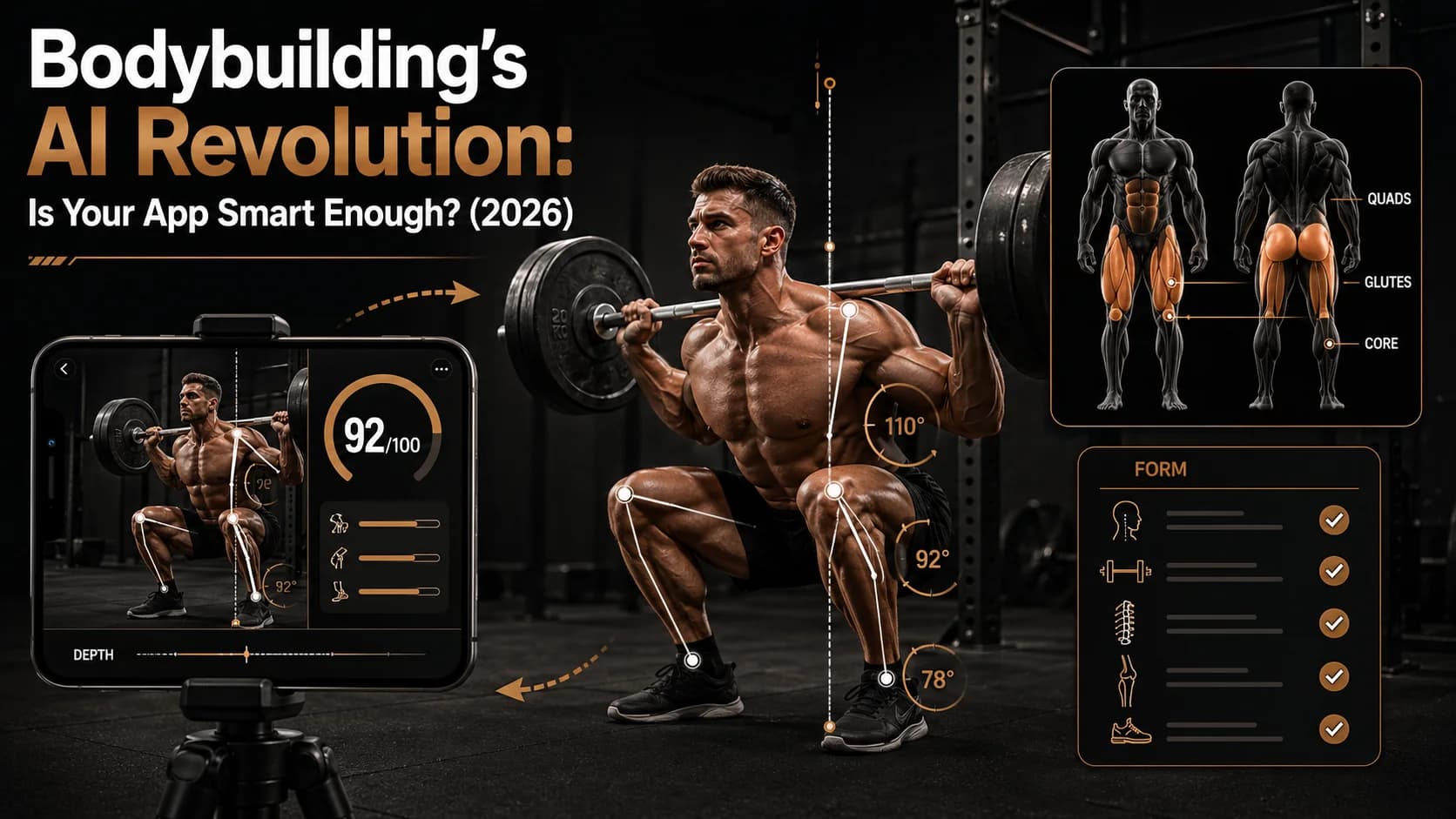
The fastest test for a bodybuilding AI app in 2026 is simple: record one clean set and one flawed set, then check whether the app scores the difference, names the fault, and changes your next training decision. If it only stores weight, reps, and workout tracking charts, it is a logbook. If it measures tempo, range of motion, bar path, recovery, and progressive overload, it can act like a coach.
I have spent 15 years watching the same scene play out in commercial gyms. Someone benches 225, the spotter cheers, and the bar path drifts two inches over the head every rep. The lifter notes "5x5 at 225, easy" in their app. Their pecs barely move while their anterior delts cook. The app tells them they had a great session.
In 2026, this is theoretically a solved problem. AI vision models can read joint angles, bar paths, and tempo from a phone camera in real time. The capability exists. What does not exist, in most apps, is the willingness to use the capability to give honest feedback. Use this page with the Bodybuilding AI app, physique hub, volume calculator, body-fat calculator, and macro calculator when you want workout tracking to become a full hypertrophy plan.
June 30, 2026 source check: According to Schoenfeld's hypertrophy mechanisms review, muscle growth depends on mechanical tension, metabolic stress and recoverable muscle damage. According to the 2024 resistance-training technique review in Sports Medicine, execution variables such as range of motion and tempo can change the training stimulus. According to the 2024 systematic review on lengthened partials versus full ROM, measurable kinematic differences matter enough that a video model can give useful feedback when it tracks the right variables. According to the Frontiers 2025 review of physique-athlete volume, competitive physique athletes often vary weekly set volume by phase and muscle group, which makes adaptive programming more useful than static workout tracking.
Quick Answer
A real bodybuilding AI coach should pass five checks: it scores each set, names the specific fault, compares technique across weeks, adjusts progressive overload from performance data, and knows the difference between hypertrophy execution and generic gym movement. If an app fails those checks, treat it as a notebook. If it passes, use it to decide when you add reps, add load, hold technique, or deload.
Train Bodybuilding with AI
Coach Arnold analyzes your technique, scores your form 0-100, and builds your training plan.
Download Bodybuilding AIWhat an AI bodybuilding coach actually does
A real AI bodybuilding coach uses pose estimation to track joint landmarks (shoulders, elbows, hips, knees, ankles) frame by frame across your set. From that data it computes:
- Range of motion at each rep relative to your previous best.
- Tempo, including eccentric duration, pause length, and concentric speed.
- Bar path or movement-path deviation across reps.
- Asymmetry between left and right sides.
It then surfaces the specific failure mode in language a coach would use: "elbow flared 12° past midline on rep 7," "depth dropped 3 cm from rep 3 to rep 8," "right hip lower than left at the top of the deadlift across the set." A logbook notes the weight. A coach notes the why.
Comparison: Logbook vs. Real AI Bodybuilding Coach
| Feature | Logbook | Real AI bodybuilding coach |
|---|---|---|
| Form analysis | Manual notes | Joint-angle scoring with named faults |
| Progressive overload | Tracks weight and reps | Suggests adjustments based on technique scores under fatigue |
| Exercise library | Static GIFs | Per-exercise fault detection |
| Feedback loop | Self-review | Frame-level breakdown of sticking points |
| Personalization | Templates | Programming adapts to recovery and technique trends |
How AI form analysis works under the hood
Pose-estimation models (most apps in this space build on top of MediaPipe-style or proprietary descendants) identify body landmarks in each frame, then compute angles and trajectories. The literature on whether this matches a coach's eye is increasingly favorable: a 2024 systematic review on lengthened-partial vs full-ROM training found that the differences in hypertrophy outcomes track closely with measurable kinematic variables - exactly the variables a vision model can read. The catch: model quality varies wildly between apps. The marketing word "AI" tells you nothing.
What "adaptive" programming actually means
Most apps that say "adaptive" are running a calendar with a weight-progression rule. Genuinely adaptive programming changes load, volume, or exercise selection based on performance data, not just completion data. If your bench scores drop from a clean 90/100 at rep 3 to a 65/100 at rep 6, an adaptive program might push next week's prescribed reps down to 5 with a slight load increase, prioritizing technique quality. The principle, sometimes called auto-regulation, is well-established in strength science (see RP Strength's published methodology). The implementation is what separates the tools.
Can an app spot injuries before they happen?
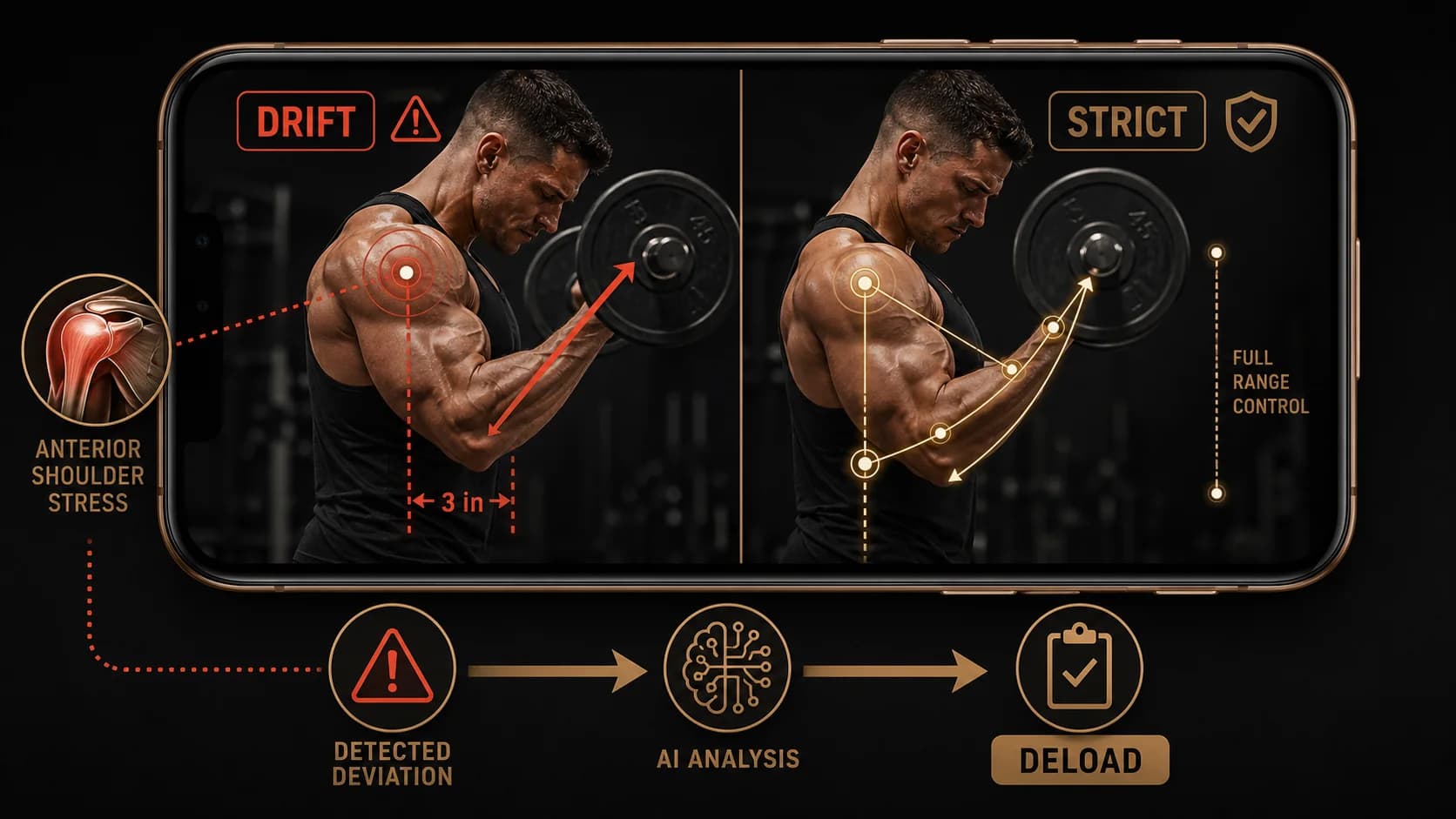
It cannot diagnose injury, and any app that says it can is making a medical claim it shouldn't. What an honest app can do is flag kinematic patterns that are known to correlate with overuse injuries. Asymmetric loading on a unilateral movement, persistent bar drift toward the head on the bench, knee valgus on the squat - these are not diagnoses, they are warnings. A 2023 review in Sports Medicine on movement asymmetry and injury risk in trained populations is one of several that connect kinematic asymmetry to elevated risk. An app that surfaces these patterns gives you something to deload around before pain shows up.
Why generic fitness AI fails bodybuilders
Generic fitness AI is trained on bodyweight squats, pushups, and treadmill running. It has not been trained on the difference between a low-bar powerlifting squat and a quad-dominant bodybuilding squat. The feedback comes out generic ("keep your back straight") instead of specific ("torso angle dropped 8° at the bottom; your back didn't break, but your bar path drifted forward").
For a physique athlete, generic feedback is worse than no feedback. It distracts you from the actual signal.
Why technique matters more for hypertrophy than for strength
In powerlifting, a slight hitch on a deadlift still scores. The plates moved, the lift counts. In bodybuilding, the question is whether the target muscle did the work. A 2024 review in Sports Medicine on resistance-training technique and hypertrophy outcomes summarizes the consensus: time-under-tension at the lengthened position, controlled tempo, and consistent ROM matter more than peak force in driving hypertrophy. Sloppy reps move weight; they do not necessarily move muscle.
How much progress is lost to unanalyzed technique?
There isn't a clean published number on this because the controlled study is hard to design. What there is, in the literature: comparisons between trained-with-feedback and trained-without-feedback groups consistently show meaningful effect sizes in hypertrophy outcomes (review). The honest read on the data is that consistent feedback over months produces better results than the same volume done without it. How much better depends on the lifter, the lift, and the baseline.
Do rep-counting apps actively hurt you?
They can. The mechanism is subtle: when "12 reps" is the goal, you find a way to get 12 reps. That way often involves shortened ROM, momentum, or accessory-muscle compensation. The Schoenfeld lab's work on lengthened partials (2025 study) is interesting precisely because it gives a principled way to use partial ROM at the lengthened position, where stimulus is highest, instead of accidentally shortening ROM at the contracted position, where it isn't. A rep-counting app cannot tell the difference. A scoring app can.
How to choose a smart bodybuilding app
Treat the choice like hiring a coach. You wouldn't hire a coach who only writes down your weights.
The Titans Grip checklist for evaluating a "smart" app:
- Does it score each set with a number, not just the workout?
- Does it name the specific fault (e.g., "elbow flare," "hip rise") instead of generic encouragement?
- Can you see your technique-score trend per exercise over weeks?
- Does the program actually change based on your scores, or does it just tick down a calendar?
- Is the exercise analysis tuned for bodybuilding patterns, or generic gym movement?
If an app can't pass that checklist, it's a notebook with marketing.
What is non-negotiable in 2026?
Three things. Numeric form scoring with named faults. Programming that responds to those scores. An exercise library tuned for hypertrophy specifically (which in practice means ROM-aware feedback, not just rep counting).
How to test an app's AI before paying
Record the same set twice. Once clean, once with a deliberate flaw - say, a 4-inch ROM shortfall on a barbell row, or visible knee valgus on a squat. Upload both. A real model will produce a clear score gap and name the introduced flaw. A weak model will give similar scores or generic feedback. This test costs you 90 seconds and tells you everything.
Does AI cost more, and is it worth it?
Yes and yes. Logbook apps cost $0-$10/month. AI coaching apps cost $25-$40/month. Online human coaching starts around $200/month. The AI app is roughly 80% of the form-feedback value of human coaching at 15% of the price. The right comparison is not "free notebook vs paid AI." It's "AI app vs guessing." Guessing is more expensive than people think.
What about integrations with other health data?
Useful but secondary. Sleep, readiness, and macro data are context. They explain why your scores dropped today; they don't replace the score. An app that has heavy integrations but weak vision analysis has its priorities backwards.
Step-by-step: How to implement AI feedback into your training
Recording sets is the easy part. Using the data is where most lifters drop the ball. Here's a structured approach.
Step 1: Set up your recording environment
Place your phone at hip height, 6-8 feet away, perpendicular to the movement plane. For squats and deadlifts, a side angle works best. For bench press, a 45-degree front-side angle captures bar path and elbow flare. Good lighting is non-negotiable - shadows across the body confuse pose estimation models.
Step 2: Record one working set per exercise per session
Record the heaviest set or the set where you feel technique is most at risk. Recording every set creates noise; recording sporadically creates bias. The sweet spot is consistency.
Step 3: Review the score and named faults immediately
Don't wait until after the workout. Look at the score breakdown between sets. If the model flags "elbow flare" on your bench, cue yourself to tuck on the next set. The feedback loop is most effective when it's immediate.
Step 4: Apply the "technical overload" principle
The progression order is: master technique → add reps → add weight. Most lifters reverse this and add weight first. The AI score is the gatekeeper. If you can't hold an 85+ score across all working sets at a given weight, you don't add weight yet. This is a slower-feeling progression that produces faster physique change because the target muscle actually works under the load.
Step 5: Track trends, not single sessions
One bad session is noise. A downward trend over three weeks is a signal. Look at your technique-score trend per exercise over weeks. If your squat score is consistently lowest at the bottom of the rep, that's a positional weakness or a mobility issue, not a strength issue. The fix is paused squats or hip mobility, not more squats.
Step 6: Deload based on data, not calendar
Most programs deload every 4-6 weeks regardless of how you feel. A smarter approach: deload when your technique scores drop below 70 across multiple exercises for two consecutive sessions. This catches accumulating fatigue before it becomes a plateau or injury.
Common mistakes when using AI coaching
- Recording only good sets. You learn more from the ugly sets. Record the grinders.
- Ignoring the score breakdown. The number matters less than the named fault. "75" tells you nothing. "Elbow flare on reps 5-8" tells you everything.
- Overriding the AI too often. If you consistently ignore the feedback, you're paying for a coach you don't listen to. Trust the data until you have a reason not to.
- Not updating your goals in the app. If your goal shifts from general hypertrophy to bringing up a weak point (e.g., rear delts), the programming needs to know.
Decision rules for when to trust the AI
| Situation | Action |
|---|---|
| Score drops 10+ points from baseline | Check sleep, nutrition, and recovery first. If those are fine, deload. |
| Named fault appears consistently | Add an accessory or mobility drill targeting that fault. |
| Score is high but you feel no pump | The AI may be missing subtle compensation. Record from a different angle. |
| Score is low but the set felt perfect | Review the video yourself. The AI may be wrong due to lighting or angle. |
| Pain during a movement | Stop. Ignore the AI. See a professional. |
The future of smart training
The shift is real, and it's already here. Apps that watch your sets are not science fiction; they are software. The question isn't whether AI coaching is coming. It's whether your app is one of the ones that actually does the work, or one of the ones that prints the word "AI" on a notebook. Test before you commit.
For the broader picture across disciplines, see how the same idea applies to boxing technique scoring or grappling cross-training.
Key takeaways
- The "AI" sticker on most bodybuilding apps in 2026 is marketing. Real AI coaches score sets with named faults.
- Adaptive programming responds to performance data, not just completion data.
- Generic fitness AI is trained on the wrong movements. Bodybuilding patterns need bodybuilding-specific models.
- Test any app by recording a clean set and a deliberately flawed set. The score gap should be obvious.
- Apply the technical overload rule: master form before adding weight.
- Track trends over weeks, not single sessions.
FAQ
What is the best bodybuilding app in 2026?
The one with vision-based scoring, named faults, and adaptive programming you can verify with the deliberate-flaw test. Brand names move every six months; the criteria don't.
How accurate is AI form analysis vs a human coach?
The literature on machine vision for resistance training is improving fast and now matches a competent coach for most major-fault detection on common compound lifts. Subtle intent and motivational nuance still belong to humans.
How much does a good AI bodybuilding app cost?
$25-$40/month is the realistic band for genuine AI coaching apps. Free notebooks cost $0; online human coaching starts at $200. The AI app sits in the middle by design.
Can an AI design my whole bodybuilding program?
Yes, within constraints you set (experience level, equipment, goals, available days). It periodizes, adjusts loads, manages deloads. It does not yet pick your goal for you.
Is my training video data private?
Read the privacy policy of any app you install. Reputable apps process on-device or on secure servers and don't use your video for model training without explicit consent. Treat training video like financial data.
How long does it take to see results from AI coaching?
Most lifters report noticeable improvements in technique consistency within 2-3 weeks. Hypertrophy changes from improved technique typically become visible after 8-12 weeks of consistent use.
Can I use AI coaching for isolation exercises like bicep curls?
Yes, but the value is lower than for compound lifts. Isolation exercises have fewer degrees of freedom, so the fault detection is simpler. The biggest ROI is on squats, deadlifts, bench press, rows, and overhead press.
Conclusion: Train with a coach that actually watches
Stop guessing. Stop trusting the "felt good" note in the app. The Titans Grip Bodybuilding AI is built around vision-based feedback for hypertrophy patterns specifically, not generic gym movement. Find your sport on the home page and start the next training block with feedback you can use.
Other Doved Studio projects
Related tools from the same studio you might find useful:
- Glean: Turn scrolling time into a daily action plan. Capture, process, execute.
- Popout: Create your portfolio in minutes with a single shareable page.
- Doved Studio: Indie studio behind this app and a dozen others.
Coach Arnold
Bodybuilding specialist. Expert in hypertrophy training, competition prep, posing.
Coach Arnold is the AI coaching persona behind Bodybuilding AI, built to provide personalized bodybuilding guidance through video analysis, training plans, and technique breakdowns.
Train Bodybuilding with AI
Bodybuilding AI gives you an AI coach that analyzes your technique, plans your training, and tracks your nutrition. Try it for free.