
How to Punch Harder: Train the Kinetic Chain From the Ground Up
Learn how to punch harder by sequencing force from your legs through your hips and core to your fist, with training methods a 2024 to 2026 research base backs up.
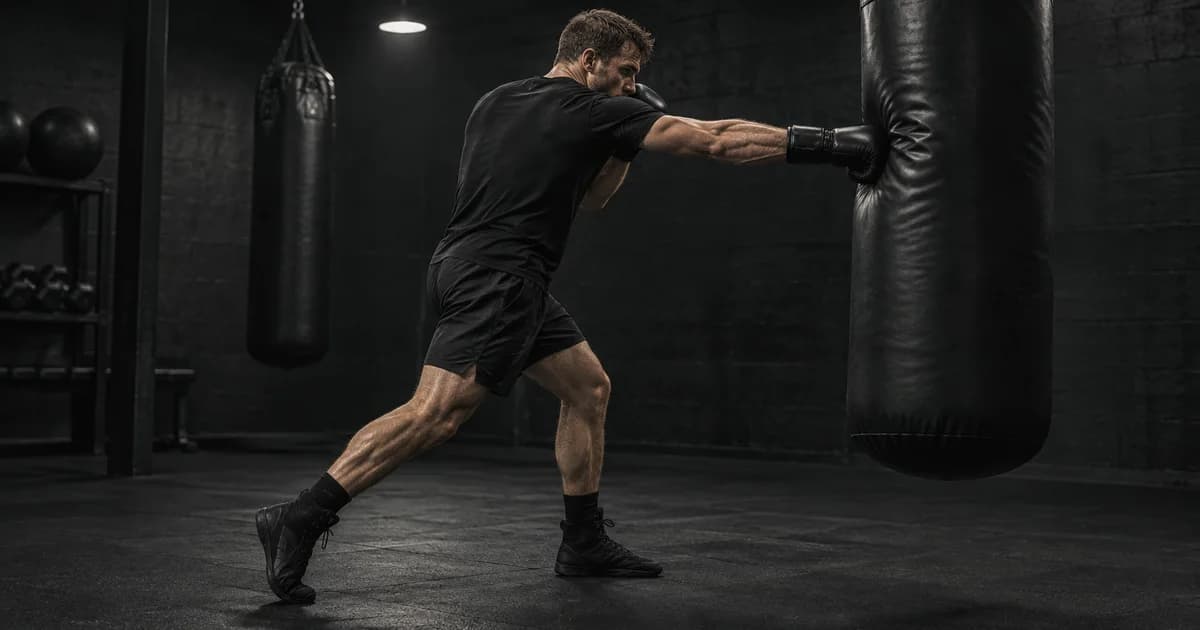
You punch harder by driving force from the ground through your legs, turning it through your hips and core, and releasing it through a relaxed arm at the last instant. Bigger shoulders built in isolation will not do it on their own. Train that sequence directly with rotational power work and resistance training, and your punch speed and force both go up. Train your arms alone and you cap your own ceiling.
Below you get the mechanics behind a hard punch, the training methods the current research supports, the technique errors that quietly steal your power, and a free tool to track your punch speed as you train.
Learn how your legs power every punch
A punch is the last link in a chain that starts at the floor. A 2024 study on elite boxers found that punching relies on a kinetic chain: force generated by a push, or stomp, from the lower body transfers up through the core and out through the arm, and the amount of power generated at that initial lower-body push has a direct effect on how fast the final strike moves (Cui, Chen and Wang, 2024, Frontiers in Physiology). If your legs do not fire first, your arm is working with less force than it could have, no matter how strong that arm is. Speed matters too: see how fast a punch travels in lab measurements.
This is why a flat-footed arm punch feels weak even from a strong athlete, and why a well-timed step-in from a lighter fighter can land hard. The chain that delivers the force sets your ceiling more than the muscle at the end of it does.
Build that chain from a stable base with the boxing stance guide, then test whether you can drive and recover without falling over your lead foot.
Train hooks and straights with different rotation work
Not every punch loads the chain the same way. An 8-week training study split 31 trained boxers into a group that trained linear force production and a group that trained rotational force production. The rotational group showed the largest gains overall, and specifically produced a large, statistically significant improvement in the rear hook compared with both the linear group and a control group (Pinto et al., Sports). Straight punches rely mostly on a linear drive from your rear leg through your shoulder. Hooks and the cross both pull more heavily on hip and trunk rotation, so a training plan that only pushes straight-line strength leaves your hook power untrained.
Give rotational work, like the medicine ball throws below, at least equal priority to straight-line pressing and pulling work in your strength sessions.
Build the engine with 5 training methods
Work these alongside your technical boxing sessions as dedicated strength and power days. Technique still decides how much of your new strength reaches your fist.
| Method | What it trains | How to do it |
|---|---|---|
| Rotational medicine ball throws | Hip and trunk rotation into the arm | Stand side-on to a wall, load your rear hip, then throw a medicine ball into the wall by rotating through your core like a cross. 3 sets of 6 per side. |
| Heavy squat and bench press, with bands for variable resistance | Raw lower and upper-body strength | An 8-week program using variable resistance (bands that add tension through the lift) alongside standard squat and bench press produced very large strength gains and increased single-punch speed, force and power with large effect sizes in elite amateur boxers (Liu et al., 2024, Frontiers in Physiology). Train these twice a week on non-sparring days. |
| Depth jumps and broad jumps | Rate of force development in your legs, the same push that starts the kinetic chain | 3 sets of 5, focusing on a fast, stiff landing and an immediate rebound off the ground. |
| Anti-rotation and rotation core work | A core that transmits force instead of leaking it | Pair a static anti-rotation hold, such as a Pallof press, with a dynamic rotation movement, such as a cable chop, 3 sets of 10 each. |
| Full-extension heavy bag rounds | Technical transfer of your new strength into a real punch | Throw at 70 percent speed for full extension and full hip turn on every rep, then build back up to full speed once the pattern is clean. |
Match the bag for those rounds to your body first: the heavy bag weight calculator gives you its weight, length and hanging height.
Fix the technique mistakes that cap your power
| Mistake | What happens | Your fix |
|---|---|---|
| Punching with a tense arm the whole way | Your muscles work against each other and slow the punch down | Keep your arm relaxed until the last few inches, then snap your fist tight only at impact |
| Standing square without a weight transfer | Your legs and hips never load, so your arm throws the whole punch alone | Load your rear leg before you throw, then drive your weight forward through the punch |
| Overcommitting your head over your lead foot | You lose your base and cannot transfer force through your legs | Keep your head and weight back far enough to stay balanced through the punch |
| Training only straight punches on the bag | Your hook and cross rotation stay undertrained | Program dedicated rotational work and hook-specific bag rounds alongside your jab-cross combinations |
| Skipping the retraction | A punch that only drives forward returns slower and leaves you open | Treat snapping the fist back as an equal part of the rep |
Fit power training into your training week
Spread the 5 methods above across a week that still leaves room for sparring and skill work, and give your nervous system real recovery between the heaviest sessions.
| Day | Focus |
|---|---|
| Monday | Heavy squat and bench press, with bands if you have them |
| Tuesday | Technical boxing: footwork, combinations, defense |
| Wednesday | Rotational medicine ball throws, core anti-rotation and rotation work |
| Thursday | Sparring or light technical rounds, full recovery from Monday's lifting |
| Friday | Depth jumps and broad jumps, then full-extension heavy bag rounds |
| Saturday | Technical boxing or competition |
| Sunday | Rest |
Keep your heaviest lifting and jump days at least 48 hours apart, and never run a new power session the day before a hard sparring day. The strength gains from a program like this build gradually across the full block, so hold this split for a full 8-week cycle before you change it.
Review your punch on video with JabMaxx
You cannot see your own hip turn or your weight transfer while you are throwing the punch. Film a few rounds on the heavy bag from the side and open JabMaxx: Boxing Coach. Coach Marcus reviews your technique on video and flags one specific break in your combinations, footwork or defense, so you know exactly which part of the chain to drill next. Pick one correction, train it for a week, then film the same round again.
Track your punch speed as your power training progresses
Power and speed move together more often than not, so a rising punch speed is a useful signal that your training is working. Run our Punch Speed Test before you start a new strength block and again every few weeks to see the trend. Pair your strength work with real technical sessions: our boxing footwork drills build the base that lets your legs load properly, our guide to common jab mistakes covers the technique errors that quietly cost you power on your most-used punch, our roundup of boxing strength training apps covers how to structure a full program, and our 30-day shadow boxing program gives you a place to groove full-extension technique without a bag.
Your punching power questions, answered
How long does it take to punch harder?
The 8-week rotational-training study found a large, measurable gain in hook power within that window, and the resistance-training study found large gains in single-punch speed, force and power over the same length of program (Pinto et al.; Liu et al., 2024). Give a focused block at least 8 weeks before you judge it.
Does lifting heavy weights make you punch harder?
Yes, when you pair it with rotational and technical work. An 8-week program that combined heavy squats and bench press with variable resistance bands produced very large strength gains alongside large increases in single-punch speed, force and power in elite amateur boxers (Liu et al., 2024). Lifting alone, without technical punching work, will not transfer on its own.
Do hooks and straight punches need separate training?
Yes. A head-to-head comparison found that rotational training produced the biggest gains specifically in the rear hook, while a linear, straight-line training approach did not outperform it even for straight punches (Pinto et al.). Build rotational work into your plan rather than training only straight-line strength.
Can a heavier fighter always punch harder than a lighter one?
Body mass is one input into punching force, but it is not the deciding one. The kinetic chain research above shows that how well you transfer force from your legs through your core decides how much of your strength actually reaches your fist, which is why technique and rotational training close the gap between fighters of different sizes (Cui, Chen and Wang, 2024).
Train Boxing with AI
JabMaxx: Boxing Coach reviews your technique, helps plan training, and tracks nutrition. Download it free, then check the App Store for current paid access.