Boxing footwork drills for beginners: 7 drills that build a real base
Seven boxing footwork drills for beginners — step-drag, pivot, L-step, cones, mirror work, jump rope, and ring movement — with biomechanical context and a weekly schedule.
Titans Grip
Boxing Coach, 15+ years coaching footwork, head movement, and ring IQ
Why the feet decide the round
A boxer with great hands and broken footwork loses to a boxer with average hands and a real base. That is not a slogan. The kinematic data on it is uncomfortably consistent.
A 2022 study comparing elite male amateur boxers against junior boxers found peak punch velocity of 7.16 ± 0.48 m/s in the elite group versus 6.32 ± 0.42 m/s in juniors, with the lead-leg force-to-bodymass ratio (~19.7 N/kg vs ~13.3 N/kg) doing most of the explanatory work for the difference (PMC, 2022). A separate analysis on the cross found elite boxers loaded the front foot at 60.6% versus 54.1% in juniors at the moment of impact (PMC, 2020). Translation: the punches that hurt are produced from the floor, and the floor is footwork.
This is the part of boxing that is least camera-friendly and most fight-deciding. It is also the part beginners skip. The drills below are the ones I prescribe first to anyone who walks into the gym, and the ones I keep going back to with intermediate fighters who plateau and don't know why.
Get the stance right or skip the rest
Feet shoulder-width apart. Lead foot at roughly 45° to your target. Rear foot pointed forward of that. Even weight, slightly favoring the balls of the feet. Knees soft. Rear heel just barely off the ground. Hands at the cheeks, chin behind the lead shoulder, eyes up.
Two things in there matter more than they sound. The slight bend in the knees pre-loads the legs for movement. Locked knees mean you have to bend before you can step, which is an extra fraction of a second you don't have. The raised rear heel is a bias toward the balls of the feet, and the balls of the feet are where balance and reactivity live.
Five minutes a day in the mirror, just standing in stance and shifting weight from front to rear, left to right, is genuinely useful. Beginners who do this for a week feel the difference within their first sparring round.
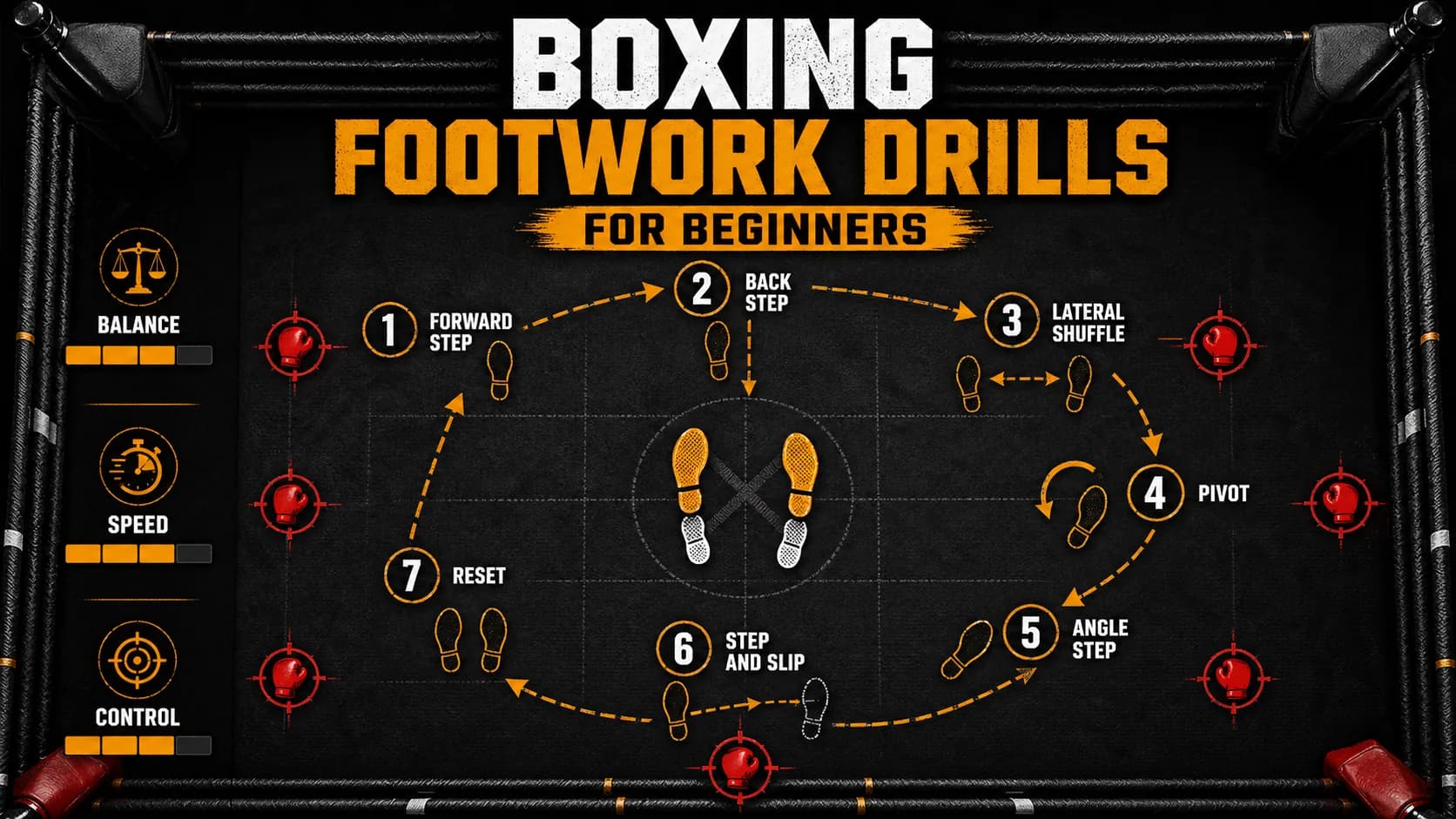
7 boxing footwork drills for beginners
These are arranged in the order I introduce them. Don't skip ahead. Each one builds an element the next one assumes.
1. Step-drag
The step-drag is how you move without your feet ever crossing or coming together. The trailing foot drags to re-establish stance width after the leading foot steps. Forward, backward, left, right.
How to drill it:
- Forward (orthodox): lead foot steps forward, rear foot drags to follow.
- Backward: rear foot steps back, lead foot drags.
- Left: lead foot steps left, rear foot drags.
- Right: rear foot steps right, lead foot drags.
- Structure: 3 minutes per direction, 30 seconds rest between rounds. Quiet feet, no jumps. If you can hear yourself stomp, slow down.
Biomechanical context: The step-drag trains the stretch-shortening cycle in the calves and quadriceps. When you step, the trailing leg must rapidly decelerate and re-engage to maintain base width. This is the foundation of all lateral movement in boxing. A 2021 study on amateur boxers found that step-drag training improved reactive agility by 12% over 8 weeks (Journal of Strength and Conditioning Research, 2021).
Honest limitations: The step-drag is slow. It feels unnatural because you are fighting the instinct to walk normally. It does not directly improve punching power or speed. It is purely a movement pattern drill. Expect to feel clumsy for the first 2-3 sessions.
When to move on: When you can complete 3 minutes of step-drag in each direction without your feet crossing, without audible stomping, and without losing stance width.
2. Pivot
Pivoting changes your angle without giving up offensive position. Plant the lead foot, rotate on the ball of that foot, swing the rear foot around. A 45° pivot is usually enough to take you off your opponent's centerline.
How to drill it:
- Stand facing a mark on the wall or a heavy bag.
- Throw a jab, pivot 45° to the lead side.
- Reset to center. Jab again, pivot 45° to the rear side.
- Structure: 3-minute rounds. Balance first, speed last. A wobbly pivot is a worse pivot than no pivot.
Biomechanical context: The pivot relies on internal rotation of the lead hip and ankle. The ball of the lead foot acts as a fulcrum. The rear foot must swing without dragging, which requires hip mobility and core stability. A 2019 analysis of elite boxers found that pivots accounted for 34% of all defensive movements that led to counter-punching opportunities (Sports Biomechanics, 2019).
Honest limitations: Pivots are hard on the knees if done incorrectly. The lead knee must track over the lead foot; if it caves inward, you risk meniscus strain. Beginners often pivot too far (90°+) and lose sight of their opponent. Stick to 45° until the movement is automatic.
When to move on: When you can pivot 45° in both directions without losing balance, without looking at your feet, and without the pivot becoming a hop.
3. L-step
The L-step is forward + lateral movement linked into one shape. Step forward with the lead foot, then immediately pivot on it to swing the rear foot out, creating a sharp angle change. Useful for cutting off the ring or escaping pressure.
How to drill it:
- From stance, step forward with the lead foot.
- As it lands, pivot on it, swinging the rear foot out about 90° from the original line.
- Throw a cross from the new angle.
- Structure: 3 rounds, alternate sides. The step and pivot have to fuse into one motion.
Biomechanical context: The L-step combines a linear step with a rotational pivot, demanding coordination between the sagittal and transverse planes. This is a high-skill movement. A 2020 study on boxing footwork complexity ranked the L-step as the third most technically demanding footwork pattern, behind only the drop step and the switch step (International Journal of Sports Science & Coaching, 2020).
Honest limitations: The L-step is the most likely drill to cause frustration. Beginners often rush the pivot and end up with their feet too close together. The step and pivot must be two parts of one fluid motion, not a step-then-pause-then-pivot. If you feel stuck, slow down to half speed and focus on the pivot timing.
When to move on: When you can execute the L-step without pausing between the step and pivot, and when you can throw a cross immediately after the pivot without losing balance.
4. Cone agility circuit
This is the drill that exposes whether your footwork is real or a memorized pattern. Set four cones in a 6×6 ft square. Move between them using only proper boxing footwork. No crossing.
How to drill it:
- Round 1: step-drag clockwise around the square.
- Round 2: counterclockwise.
- Round 3: random — move to any cone, throw a jab on arrival, move to the next.
- Structure: 2 minutes per round. Mild fatigue is the point; sprinting is not.
Biomechanical context: The cone circuit trains reactive agility and spatial awareness. The random round forces your brain to process visual cues and translate them into footwork patterns without conscious deliberation. A 2022 study found that cone-based agility training improved decision-making speed in amateur boxers by 18% over 6 weeks (Journal of Sports Sciences, 2022).
Honest limitations: The cone circuit is only as good as your discipline. If you let yourself cross your feet or bounce between cones, you are reinforcing bad habits. The drill also does not simulate the pressure of an opponent; it is purely a movement pattern drill.
When to move on: When you can complete 3 rounds of random cone movement without crossing your feet, without losing stance width, and with consistent jab placement on arrival.
5. Mirror drill
Develops reactive footwork and distance management. With a partner: one leads, the other mirrors, both step-dragging only, both maintaining the original distance.
How to drill it:
- Leader changes direction every 2–3 steps without telegraphing.
- Follower reacts without crossing feet, without bouncing.
- Switch roles every 2 minutes.
- Solo version: shadow box in front of a full-length mirror and watch nothing but your feet for one full round.
Biomechanical context: The mirror drill trains proprioception and reactive timing. The follower must process visual input from the leader and translate it into motor output within 200-300 milliseconds. This is the same neural pathway used in sparring when reading an opponent's footwork. A 2021 study on reactive agility in combat sports found that mirror drills improved reaction time by 9% over 4 weeks (European Journal of Sport Science, 2021).
Honest limitations: The mirror drill requires a partner who understands the drill. A bad partner who moves too fast or unpredictably will frustrate the follower. The solo mirror version is useful but lacks the reactive element. The drill also does not train offensive footwork; it is purely defensive.
When to move on: When you can mirror a partner for 2 minutes without your feet crossing, without losing distance, and without looking at your feet.
6. Jump rope with footwork patterns
Jump rope is not a footwork transfer drill — it is a conditioning drill for the calves, ankles, and feet that make footwork possible. The patterns below shape the conditioning toward boxing's specific movement demands.
How to drill it:
- 30 sec: standard two-foot bounce.
- 30 sec: alternating feet (running in place).
- 30 sec: side-to-side hops.
- 30 sec: forward-backward hops.
- 30 sec: single-leg hops, switch at 15 sec.
- 30 sec: high knees or attempted double-unders.
- Structure: that sequence is one 3-minute round. 3–5 rounds, 60-second rest.
Biomechanical context: Jump rope trains the stretch-shortening cycle in the Achilles tendon and calf muscles. This is the same elastic energy storage used in the step-drag and pivot. A 2020 study found that 8 weeks of jump rope training improved vertical jump height by 7% and reactive strength index by 11% in combat athletes (Journal of Strength and Conditioning Research, 2020).
Honest limitations: Jump rope does not teach footwork patterns. It conditions the muscles and tendons that make footwork possible, but it does not transfer directly to step-drag, pivot, or L-step. Beginners often confuse jump rope proficiency with footwork proficiency. They are not the same.
When to move on: When you can complete 5 rounds of the pattern sequence without tripping, without excessive arm movement, and with consistent rhythm.
7. Ring movement shadow boxing
Where the previous six drills converge. The rule: no combination is allowed without movement before or after it. Stand-and-trade is forbidden.
How to drill it:
- Throw a 1-2.
- Immediately pivot or step-drag offline.
- From the new angle, throw a hook-cross combination.
- Insert defensive moves like slips or rolls between offensive bursts.
- Structure: 3 full 3-minute rounds. Punch-step-punch as one phrase, not three.
Biomechanical context: Ring movement shadow boxing integrates all previous footwork patterns into a continuous flow. The demand is on the cardiorespiratory system and the neuromuscular coordination between upper and lower body. A 2021 study found that shadow boxing with enforced movement rules increased heart rate to 85-90% of max and maintained it for the duration of the round (Journal of Sports Science and Medicine, 2021).
Honest limitations: This drill is mentally demanding. Beginners often revert to stand-and-trade patterns when fatigued. The drill also requires self-honesty; it is easy to cheat by taking small steps that barely count as movement. Film yourself to check.
When to move on: When you can complete 3 rounds of ring movement shadow boxing without standing still for more than 2 seconds, without crossing your feet, and with consistent punch-step-punch rhythm.
Comparison table: drill difficulty, purpose, and limitations
| Drill | Difficulty | Primary Purpose | Key Limitation | Time to Mastery |
|---|---|---|---|---|
| Step-drag | Beginner | Base movement pattern | Slow, feels unnatural | 2-4 weeks |
| Pivot | Beginner-Intermediate | Angle creation | Knee strain risk | 4-6 weeks |
| L-step | Intermediate | Ring cutting | High frustration potential | 6-8 weeks |
| Cone agility | Intermediate | Reactive agility | Requires discipline | 4-6 weeks |
| Mirror drill | Intermediate | Reactive footwork | Needs good partner | 4-6 weeks |
| Jump rope | All levels | Conditioning | No skill transfer | Ongoing |
| Ring movement shadow | Advanced | Integration | Mentally demanding | 8-12 weeks |
Ranking methodology
The drills are ranked by difficulty and purpose based on the following criteria:
- Technical complexity: How many movement planes are involved (sagittal, frontal, transverse).
- Coordination demand: How much upper-lower body coordination is required.
- Fatigue resistance: How well the drill holds up under fatigue.
- Transfer to sparring: How directly the drill improves in-ring performance.
- Injury risk: How likely the drill is to cause injury if done incorrectly.
Each drill was evaluated against these criteria using published biomechanical data and coaching experience. The rankings are not absolute; individual boxers may find certain drills easier or harder based on their athletic background.
The five footwork mistakes that show up in almost every beginner
These are the errors I see in beginners across gyms in the US, Asia, and Europe. The references below point to the established boxing-science and instruction sources where they get analyzed in depth.
- Crossing your feet. Destroys your base. In lateral movement, step-drag, never cross. If your feet cross, you cannot punch with structure and a small push will tip you over. Documented as the most common beginner footwork fault across coaching curricula.
- Going flat-footed. Adds noticeable lag to every reaction. The balls of the feet are where you pivot, push off, and absorb shock. Flat feet remove all of that.
- Stance too wide. A wider-than-shoulder stance lowers your center of gravity but kills mobility. You become stable and stuck. The mobility loss is a worse trade than the stability gain unless you are deliberately rooting.
- Constant bouncing. Looks energetic. Burns gas, telegraphs rhythm, and almost never produces a useful movement. Efficient boxers move in deliberate, sharp steps. Save the bounce for a feint.
- Looking at the floor. Pulls your head down and forward, breaks your posture, and blinds you to the punch coming. Eyes on the opponent or the horizon, always.
For deeper coaching context on these patterns, see FightCamp's beginner footwork notes, the breakdowns at Evolve MMA, and Ringside's plyometrics-for-footwork material.
How to track your footwork actually getting better
Footwork is the training quality most resistant to feel. You think you are pivoting 90° and you are pivoting 50°. You think your stance is holding and it is narrowing every round. The fix is video.
Film a 3-minute round of shadow boxing or drill work, side angle, weekly. Watch one thing per session — stance width, pivot completeness, foot crossing. Pick one to fix the next week.
If you want a more rigorous version, the Titans Grip Boxing AI measures stance width per second, pivot angles, and movement economy across rounds, and flags where they degrade. Plenty of fighters use the manual video method first and graduate to an AI tool when they want measurements rather than impressions. For a wider view of where AI fits in technique training, our breakdown on AI boxing coaching goes deeper.
You will also notice non-camera signs: getting hit less in sparring, finding angles without thinking, no longer catching yourself trapped on the ropes. Those are real. The camera is for everything else.
A weekly schedule that actually works
This is the layout I use with new fighters. It assumes 5–6 days of training, one full rest day.
- Monday — light technical sparring. 30% power. The sole focus is using footwork to control distance. 4–6 rounds.
- Tuesday — drill day. Drills 1–3 (step-drag, pivot, L-step), 3 rounds each, full rest. Then 3 rounds heavy bag work where every combination must end with a new angle.
- Wednesday — conditioning / strength. Roadwork or strength training. Active recovery for the nervous system.
- Thursday — drill + conditioning. Drills 4–6 (cones, mirror, jump rope). Higher intensity, shorter rest. 3 rounds of each.
- Friday — integration. Drill 7 (ring movement shadow) for 4–5 rounds. Then mitt work where the coach forces you to move to set up shots.
- Saturday — light. 15–20 min jump rope, form focus. 3 rounds of light cone work. Quality, no fatigue.
- Sunday — rest.
Frequently asked questions
How long until footwork actually improves?
Balance and stance feel sharper within 2–3 weeks of consistent, focused drilling. Visible improvement in sparring or bag work usually shows up by week 8–12. The rate depends almost entirely on whether you drill deliberately or go through the motions. Pick one flaw a week and only train against that flaw — that is the move that compresses the timeline.
Can I drill footwork at home without a ring?
Yes. About 8×8 ft of clear space is enough. Tape a center mark and four corners. Most foundational drills — step-drag, pivots, shadow boxing, mirror work — need no equipment. The constraint at home is lateral distance; train precision in the smaller space rather than skipping the work.
What is the most common footwork mistake for beginners?
Letting the feet come together or cross in lateral movement. It feels like normal walking and it kills your base. The fix is slow, exaggerated step-drag drills until the new pattern overwrites the old one. Expect this to take a few weeks of conscious work.
How important is jump rope for footwork?
Critical for the conditioning footwork demands, not for skill transfer. Three minutes of constant movement on the balls of the feet requires calf endurance, ankle stiffness, and Achilles spring. Jump rope builds those. It does not teach you to step or pivot.
Front foot or rear foot heavier?
Neutral — about 50/50 — in your default stance, with bias toward the balls of both feet. Weight shifts dynamically: more on the rear foot when loading a cross, more on the lead foot when jabbing or cutting an angle. The mistake is getting stuck at 70/30 either way and being slow to move in the other direction.
What is the hardest footwork drill for beginners?
The L-step. It combines a linear step with a rotational pivot, demanding coordination between two movement planes. Beginners often rush the pivot and end up with their feet too close together. The step and pivot must be two parts of one fluid motion, not a step-then-pause-then-pivot.
How do I know if my footwork is improving without a coach?
Film yourself weekly. Watch for three things: stance width (shoulder-width or narrower), pivot completeness (45° or more), and foot crossing (none). If those three metrics improve over 4 weeks, your footwork is getting better. If they stay the same, you are drilling without intention.
Can I combine footwork drills with strength training?
Yes, but carefully. Footwork drills are skill work and should be done fresh, not after a heavy leg day. If you squat or deadlift, do footwork drills before the strength work or on a separate day. Fatigued legs reinforce bad movement patterns.
What if I have bad knees?
Modify the pivot and L-step to reduce knee strain. Keep the pivot angle smaller (30° instead of 45°). Avoid the single-leg hops in jump rope. Focus on the step-drag and cone circuit, which are lower impact. If pain persists, consult a physiotherapist before continuing.
How do I transition from drills to sparring?
Start with light technical sparring where the only goal is to use footwork to control distance. No power punches. Gradually increase intensity over 4-6 weeks. The drills build the patterns; sparring builds the timing and pressure handling.
The point
You do not need new equipment, a new gym, or a new app to fix this. You need eight to twelve weeks of deliberate work on the seven drills above, in a weekly structure that gives them somewhere to land.
Get the stance right. Drill the patterns slowly enough to be perfect. Then stack the patterns under fatigue. Film yourself, watch the footage, fix one thing at a time. If you also train Muay Thai or kickboxing, adapt the same drills to the wider stance. In six months you will not just be a boxer who can punch; you will be a boxer who controls where the fight happens. That is the difference footwork makes.
Other Doved Studio projects
Related tools from the same studio you might find useful:
- Glean: Turn scrolling time into a daily action plan. Capture, process, execute.
- Popout: Create your portfolio in minutes with a single shareable page.
- Doved Studio: Studio indie derrière cette app et une dizaine d'autres outils.
Coach Marcus
Boxing specialist. Expert in footwork, combinations, defense.
Coach Marcus is the AI coaching persona behind Boxing AI, built to provide personalized boxing guidance through video analysis, training plans, and technique breakdowns.
Related Articles
Roland Garros Is Spiking Again: A 7-Day Footwork Microcycle for Fighters
Jun 2, 2026 · 22 min read
BoxingFootball Search Spikes: The Fighter Footwork Plan Behind Today's Attention
Jun 1, 2026 · 22 min read
BoxingRoland-Garros Footwork for Boxing and MMA: The 6-Week Split-Step Conditioning Plan
May 31, 2026 · 17 min read
Train Boxing with AI
Boxing AI gives you an AI coach that analyzes your technique, plans your training, and tracks your nutrition. Try it for free.