Peloton vs Mirror (2026): Why This Comparison No Longer Works for Athletes
The Peloton vs Mirror question changed completely after Lululemon discontinued Mirror in 2023. Here's the real 2026 state of play — and why neither is built for athletes who need technique scoring.
Titans Grip
Combat and Strength Sports Coach, 15+ years coaching athletes
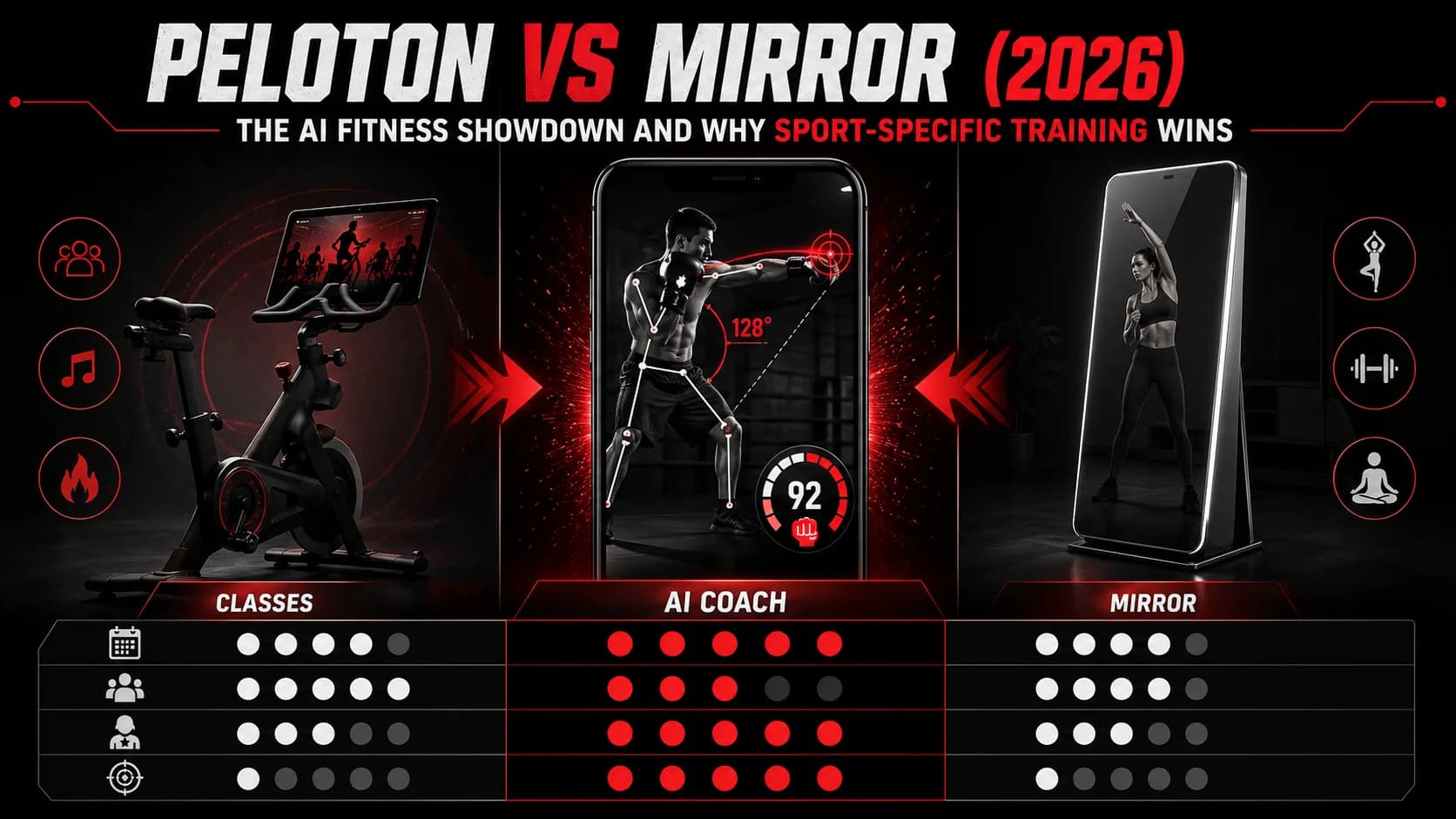
If you're still typing "Peloton vs Mirror" into a search bar in 2026, the answer is shorter than the question: Mirror is gone. Lululemon stopped selling new Mirror hardware at the end of 2023 and stopped producing original Mirror content the following year, migrating remaining Studio members onto Peloton's app through a content partnership announced in November 2023. The $500 million acquisition Lululemon made during the 2020 home-fitness boom became — in Yahoo Finance's words — "almost worthless."
So the actual 2026 comparison isn't between two competing devices. It's between Peloton (still a real, still-evolving cardio platform) and a discontinued mirror sitting on someone's wall, possibly running second-hand Studio classes through the Peloton app. For athletes who came to this comparison hoping to pick a serious training tool, that reframing matters — because the deeper question, "is general-fitness AI enough for sport-specific training?", still has the same answer it had three years ago: no.
Key Takeaways
- Mirror is dead. Lululemon discontinued the hardware in 2023 and migrated content to Peloton. Any 2026 "comparison" is really about Peloton vs. a defunct product.
- Peloton is a cardio platform, not a technique coach. Its AI tracks output, cadence, and heart rate. It does not analyze form for sport-specific movements like a snatch, a jab, or a takedown.
- General-fitness AI has a fundamental limitation. Peer-reviewed research shows pose-estimation accuracy degrades sharply on complex, multi-plane movements. For athletes, this means the feedback is often too vague to be useful.
- The real choice is between general fitness and sport-specific tools. If your goal is skill mastery, you need a platform that speaks the language of your sport.
- A hybrid approach works best. Use Peloton for conditioning and energy system work. Use a dedicated sport-specific app for technique analysis and programming.
What Actually Exists in 2026
Peloton
Peloton is the surviving half of the comparison and the one that's worth measuring. As of Peloton's Q1 FY2026 earnings (reported November 2025), the platform reports roughly 2.7 million paid Connected Fitness subscriptions and a content library of around 10,000 on-demand classes — significantly smaller than the marketing-grade "20,000 classes, 6.8 million members" numbers that floated around earlier in the boom.
Pricing has moved too. The All-Access subscription rose to $49.99/month effective October 2025 (Retail Dive). The legacy Bike+ sells at $2,695 on the Peloton store; the entry Cross Training Bike+ also lists at $2,695 with a different feature set. Tread and Row remain in the lineup. The "Peloton Coach" AI layer suggests class stacks based on your history and recommends progressions, but its feedback is bounded by what a connected bike or tread can sense — output, cadence, resistance, heart rate. It does not analyze your running gait, your rowing stroke, or your lifting form.
For a cyclist, runner, or someone who wants energetic group cardio at 6 a.m. in their basement, this is excellent equipment with a deep instructor bench. For an athlete who needs technique feedback, it's a heart-rate monitor with great branding.
Mirror (Lululemon Studio)
Mirror, the device, is no longer being sold new. Lululemon offered hardware in 2022 and early 2023 at $1,495, with the Studio Guide camera at $199 and a $39/month membership. Today the closest experience is the Peloton App on a tablet or phone, which Lululemon Studio members were migrated to in late 2023. Existing Mirror owners can still use their displays, but content development for the device has wound down and Lululemon's strategic posture has shifted entirely back to apparel.
Treat any 2026 "Mirror" question as: do I want a Peloton app subscription on a screen I already own? The answer is usually yes, if you want stretching and bodyweight classes for general fitness and no, if you want technique coaching for a specific sport.
Comparison Table: Peloton vs. Mirror (2026 Reality)
| Feature | Peloton (2026) | Lululemon Mirror (2026 status) |
|---|---|---|
| Hardware status | Active product line (Bike+, Tread, Row) | Discontinued at retail end of 2023 |
| Hardware price | Bike+ from $2,695 | No new hardware sold |
| Subscription | All-Access $49.99/mo | Studio membership migrated to Peloton App |
| Primary focus | Cardio + instructor-led classes | Was: yoga, bodyweight, light strength |
| AI / form feedback | Output metrics on connected hardware | Limited; rep-counting and basic motion |
| Best for | Cyclists, runners, group cardio | Existing owners running Peloton App on a screen |
| Content library | ~10,000 on-demand classes | No new content; legacy library accessible via Peloton App |
| Technique scoring | None | None |
| Sport-specific programming | No | No |
| Camera-based analysis | No (except basic rep counting on some devices) | Limited (Studio Guide camera could detect basic movements) |
The headline takeaway: Peloton is a real cardio ecosystem with real monthly costs and a real content library. Mirror is a cautionary tale about general-fitness hardware bought at the peak of the 2020–2021 home-gym bubble.
Ranking Methodology: How We Evaluate Home Fitness Platforms
This comparison uses a five-criteria framework to assess each platform's suitability for athletes. The criteria are weighted by importance for skill development:
- Technique Feedback (40%) — Can the platform analyze your form for sport-specific movements? This is the most critical factor for athletes.
- Programming Specificity (25%) — Does the platform offer programming that matches your sport's demands (e.g., periodization, skill work, competition prep)?
- Hardware Cost & Flexibility (15%) — What is the upfront investment, and can the platform be used with existing equipment?
- Content Quality & Depth (10%) — How good are the instructors and classes for general fitness?
- Long-Term Viability (10%) — Is the platform likely to be supported and updated in the coming years?
Peloton Score
- Technique Feedback: 2/10 — Excellent for output metrics, but no sport-specific form analysis.
- Programming Specificity: 3/10 — Good for general cardio and strength, but no sport-specific periodization.
- Hardware Cost & Flexibility: 4/10 — High upfront cost, but the ecosystem is well-integrated.
- Content Quality & Depth: 8/10 — Top-tier instructors and a vast library for general fitness.
- Long-Term Viability: 9/10 — Peloton is a public company with a stable subscriber base.
Overall: 4.6/10 — A solid cardio platform, but not a tool for skill development.
Mirror Score
- Technique Feedback: 1/10 — Limited to basic rep counting; no meaningful analysis.
- Programming Specificity: 1/10 — Was designed for general fitness, not sport-specific training.
- Hardware Cost & Flexibility: 2/10 — Expensive hardware that is now obsolete.
- Content Quality & Depth: 4/10 — Decent library at its peak, but no longer updated.
- Long-Term Viability: 1/10 — Discontinued product with no future support.
Overall: 1.8/10 — A cautionary tale, not a viable option for athletes.
Honest Limitations of Each Option
Peloton Limitations
- No technique analysis for sport-specific movements. Peloton's AI is bounded by what its hardware can measure. It cannot see your squat depth, your bar path, or your punch mechanics.
- High cost of entry. A Bike+ at $2,695 plus $49.99/month is a significant investment for a tool that only addresses one aspect of fitness (cardio).
- Content library is smaller than claimed. The 10,000-class library is impressive, but it's not the 20,000+ classes sometimes cited in marketing.
- No sport-specific programming. Peloton's classes are designed for general fitness. There is no periodized plan for a boxer's fight camp or a powerlifter's meet prep.
- Subscription creep. The price has increased multiple times, and there's no guarantee it won't rise again.
Mirror Limitations
- Discontinued hardware. No new units are sold, and long-term software support is uncertain.
- No original content. Lululemon stopped producing Mirror-specific content in 2024.
- Limited AI capabilities. The Studio Guide camera could detect basic movements but never offered the kind of detailed feedback athletes need.
- Expensive for what it is. Even at its peak, the Mirror was a $1,495 display with a $39/month subscription. A tablet on a wall mount does the same job for less.
- No sport-specific value. The Mirror was never designed for athletes. It was a general-fitness device for yoga, bodyweight, and light strength.
Why General-Fitness AI Fails Athletes
The reason this reframed comparison still ends in the same place is that the underlying problem hasn't changed: AI form feedback on general fitness platforms is built for broad movement libraries — squats, lunges, bicep curls — and cannot resolve the technical demands of a snatch, an armbar, or a roundhouse kick.
A peer-reviewed evaluation of consumer AI fitness apps published in the International Journal of Environmental Research and Public Health (Khan et al., narrative review of pose-estimation models, 2024) summarizes a recurring finding across the field: pose-estimation accuracy degrades substantially as movement complexity rises and as occlusion increases. Validation studies on individual sports — for instance, the MediaPipe pickleball validation in Journal of Sports Sciences (2025) — show useful joint-angle agreement on cleanly visible single-plane movements, and degrade quickly on multi-plane sport-specific actions where the camera, the body, and the implement (a barbell, a bag, an opponent) interact.
That's exactly the gap a general fitness platform sits in. Peloton's AI is excellent at telling you how hard you pedaled. It is not built — and was never claimed by Peloton to be built — to tell you whether your hip extension during a clean was 0.1 seconds late. The mismatch is the product, not a flaw.
A motivational instructor and a pace-of-effort recommendation are not the same as technique scoring. For a wrestler whose double-leg keeps failing because their head placement drifts outside the opponent's hip, no amount of cycling output will fix that. The information has to be specific to the technique, sourced from video, and grounded in the kinematics of the actual sport.
This is why dedicated tools for combat sports and strength sports keep appearing as a category outside the Peloton/Mirror comparison entirely. They aren't trying to be home-gym ecosystems. They use the camera you already own — your phone — and apply a sport-specific model. Different intent, different tool.
Step-by-Step Guide: How to Choose If You're Starting Fresh
If you're walking into the home-fitness category in 2026 and the Peloton vs Mirror question put you here, run through this checklist before spending anything.
Step 1: Be Honest About Your Primary Goal
The 80/20 rule is brutally useful. About 80% of your platform's use should serve your main goal directly. If your goal is "improve cardiovascular endurance for general health," a Peloton Bike+ is a real, focused tool. If your goal is "increase my squat 1RM" or "learn the front kick," neither Peloton nor a Mirror display will do the job, regardless of how nice the hardware looks.
A 2025 systematic review of resistance training specificity in Sports Medicine (the dynamic-task-specificity meta-analysis) reinforces what coaches have always said: training transfer is high when the task and the loading match the goal, and falls off as either drifts. Your hardware and software have to match the goal too.
Step 2: Audit the Questions You Actually Have
List the three to five technical questions you ask in your sport every week. For a boxer: "Is my rear foot pivoting on the jab? Is my chin tucked during the hook?" For a powerlifter: "Is my bar path vertical on the squat? Am I losing tightness at the bottom of the bench?" Now ask whether the platform you're considering can answer them.
Peloton provides essentially zero visual form feedback outside of its connected hardware. The legacy Mirror Guide camera could detect simple gym movements at the level of "rep completed" but did not diagnose squat depth in millimeters or knee cave in degrees. To answer technical questions you need computer vision trained on your sport's movement library — which is a different product category, not a different fitness platform.
Step 3: Track the Right Metrics
General platforms log calories, output, and streaks. Athletic platforms log skill proficiency, volume load, and competition readiness. The difference matters because the metric drives the behavior. If your dashboard rewards burned calories, you optimize for that. If it rewards your clean-and-jerk technique score moving from 72 to 85 over eight weeks correlated with a 10 kg increase on your max, you optimize for that instead.
You need a log that tracks rolling sessions, submissions hit, positions struggled with — not just minutes spent on a bike. A genuine sport-specific tool also handles competition countdowns and peaking phases, which no general-fitness app does.
Step 4: Calculate the Cost of Being Wrong
The Peloton All-Access at $49.99/month plus a $2,695 bike works out to about $3,300 in your first year. The cost of not specializing is harder to see but often larger: a poor-technique-driven rotator cuff injury that sidelines you for six months dwarfs any subscription. Specialized tools tend to skip the hardware buy-in entirely and use your phone as the sensor, which shifts the investment from a screen to a coach. The right question isn't "how much is the platform?" — it's "what am I paying for, a TV with workout videos, or actual coaching?"
Step 5: Test the AI with One of Your Sport's Signature Movements
This step is non-negotiable. Before committing, record yourself performing one fundamental movement from your sport — your jab cross, your deadlift, your guard pass. Upload it. Does the platform give you a vague "good workout" response, or a technical breakdown with specific joints, angles, and timings? A real sport-specific tool will say something like "hip rotation on the cross initiated 0.1 seconds late, reducing power transfer." If the feedback is vague, the platform isn't built for you, no matter how nice the hardware looks.
Decision Rules: A Quick Reference
| If your goal is... | Then choose... | Because... |
|---|---|---|
| General cardio fitness | Peloton (or any cardio platform) | Excellent for output-based training and motivation. |
| Yoga or bodyweight flexibility | Peloton App on a tablet | Cheaper than Mirror, same content. |
| Sport-specific technique (e.g., boxing, powerlifting) | A sport-specific AI app | General platforms cannot analyze complex movements. |
| A hybrid approach (conditioning + skill work) | Peloton for cardio + sport-specific app for technique | Each tool does what it does best. |
| Avoiding hardware lock-in | A phone-based sport-specific app | No upfront cost, no subscription creep. |
Common Mistakes Athletes Make When Choosing Home Fitness Tech
Mistake 1: Assuming "AI" Means "Coaching"
Many platforms slap "AI" on their marketing without delivering real coaching. Peloton's AI recommends classes based on your history. That's a recommendation engine, not a coach. Real coaching involves diagnosing technical flaws, prescribing corrective exercises, and adjusting programming based on performance. If the AI can't tell you why your form is off, it's not coaching.
Mistake 2: Overvaluing Hardware
A $2,695 bike or a $1,495 mirror is a sunk cost. The hardware doesn't make you better. The feedback does. Athletes often fall for the shiny object — a beautiful screen, a sleek design — and forget that the tool's primary job is to provide actionable information. A $0 phone app with good AI is worth more than a $3,000 bike with none.
Mistake 3: Ignoring the Subscription Trap
Peloton's $49.99/month adds up. Over three years, that's $1,800 — more than the cost of many sport-specific annual subscriptions. Mirror's $39/month was similar. Athletes on a budget should calculate the total cost of ownership over 2-3 years, not just the upfront price.
Mistake 4: Expecting a General Platform to Adapt to Your Sport
This is the most common mistake. A boxer buys a Peloton for "fitness" and expects it to help with punch mechanics. A powerlifter buys a Mirror for "strength" and expects squat analysis. Neither platform was designed for these tasks. The disappointment is inevitable. Match the tool to the task, not the other way around.
How to Use What You Already Have
Here's the part the brand pages won't say: if you already own a Peloton, you don't have to abandon it. The smart approach is to use it strategically for what it does well and source skill work from a tool built for that.
Strategy 1: Delegate Energy-System Work
Use Peloton (or any general cardio platform) for structured, high-energy aerobic and anaerobic conditioning. A fighter can run Peloton's HIIT cycling classes for anaerobic capacity work, which is non-sport-specific but physiologically valuable. Do not seek technical feedback during these sessions. You're there to hit a heart-rate zone or output number. Save your cognitive focus for technical sessions on the mat or in the rack. Periodization research consistently treats general physical preparation as a legitimate building block — it's the steering, not the engine, where general platforms fail.
Strategy 2: Dual-Track Logging
Maintain two logs. One for general fitness (the Peloton app handles this automatically); one for sport-specific skill work. The insight comes from correlating them. After a few weeks you might notice that on weeks where your high-intensity Peloton volume exceeds 90 minutes, your snatch technique score drops by an average of 8 points from accumulated fatigue. This integrated analysis is impossible inside a single general platform but is exactly the kind of load management an athlete needs.
Strategy 3: Use Sport-Specific AI for Prehab and Warm-Ups
Pre-training is where technique matters most for injury prevention. Instead of following a generic yoga flow, run an AI-assessed mobility protocol targeted at your sport's pattern — overhead squat to diagnose mobility restrictions impacting your jerk, hip and thoracic-spine assessment before wrestling. Recent peer-reviewed work on AI-assisted movement screening shows useful agreement with manual physiotherapist assessment for screening-grade decisions, while still falling short of clinical diagnosis (Khan et al. pose-estimation review, 2024). Useful for an informed warm-up; not a replacement for a real assessment.
Strategy 4: Skill Blocks Inside Generalist Sessions
If you have a Mirror running the Peloton app for boxing classes, mute the instructor's generic cues and use the session as a shadowboxing round timer. Run technical cues from a sport-specific app on a phone or tablet next to it. The big screen provides the clock and atmosphere; your dedicated app provides the actual coaching. This is just compartmentalization — using each tool for what it's actually good at.
Conclusion
The Peloton vs Mirror question in 2026 is mostly a historical question. Mirror is gone. Peloton is alive, well-priced for what it is, and excellent at the cardio job it was designed for. Neither was ever the right tool for technique-heavy athletic training, and the post-2023 collapse of the connected-mirror category just made the choice cleaner. Use general platforms for energy systems and motivation. Use sport-specific AI for skill work. And don't let a screen on your wall convince you that watching a class is the same as being coached.
FAQ
Is Mirror still available in 2026?
Not as new hardware. Lululemon stopped selling Mirror at the end of 2023 and discontinued original Mirror content development the following year. Existing owners can still use their device, typically running Peloton App content via the partnership announced in November 2023. There is no active Mirror product line to compare against Peloton today.
Should I buy a used Mirror?
Probably not unless you're getting it cheaply and only for the screen. Without ongoing first-party content development and uncertain long-term software support, a used Mirror is essentially a fixed-position display. For most use cases, a $300 tablet on a stand or wall mount running the Peloton App or a sport-specific app gives you more flexibility for less money.
How much does Peloton cost in 2026?
The Bike+ lists at $2,695 on the Peloton store. The All-Access membership rose to $49.99/month in October 2025. First-year cost for a Bike+ plus full subscription works out to roughly $3,295. Tread and Row are also active products with their own pricing.
Can Peloton help me train for a boxing match?
For the conditioning side of camp, yes. HIIT and steady-state cycling are useful aerobic and anaerobic conditioning tools. For the actual technical work — footwork, punch mechanics, defensive head movement, combinations — Peloton offers nothing technique-specific. You'll need a coach or a sport-specific AI tool that can analyze your video and diagnose technical issues.
What's the main weakness of AI on general platforms?
Movement specificity. The vision models are trained on broad patterns ("squat," "lunge") and recognize the gross motion. They do not assess sport-specific technique — bar path on a snatch, hip rotation on a roundhouse, head position on a takedown attempt. Peer-reviewed pose-estimation reviews consistently show usable accuracy on simple, single-plane movements and meaningful degradation on the complex, multi-plane actions that define athletic technique.
Are there real Peloton alternatives for strength athletes?
Yes. Dedicated strength-training apps offer AI video analysis for the powerlifts, percentage-based programming, and volume load tracking. They typically run on your phone, skip the hardware cost entirely, and focus on the technical and programming needs of powerlifting, weightlifting, and strongman.
Is a Mirror worth it if I already have a home gym?
If your home gym is built around barbells, racks, and mats for sport-specific work, a used Mirror adds little. The display becomes a class-streaming device, which a tablet does for less. Funds are usually better spent on coaching software, video analysis tools, or equipment specific to the sport you're training.
What is the total cost of ownership for Peloton over 3 years?
Bike+ ($2,695) + 36 months of All-Access ($1,799.64) = $4,494.64. This does not include accessories, maintenance, or potential future price increases. Compare this to a sport-specific app that may cost $100-300/year with no hardware cost.
Can I use Peloton for sport-specific strength training?
No. Peloton's strength classes are general and use dumbbells, bodyweight, and bands. They do not include barbell work, periodized programming, or technique analysis for the powerlifts or Olympic lifts. For strength athletes, a dedicated strength app is a better fit.
What should I look for in a sport-specific AI app?
Look for: (1) computer vision trained on your sport's movement library, (2) frame-by-frame analysis with joint-angle feedback, (3) periodized programming that matches your competition schedule, (4) volume load tracking, and (5) the ability to upload video from your phone. Avoid apps that only offer generic "good form" feedback.
Find the Tool Built for Your Sport
The Peloton-vs-Mirror debate in 2026 is largely a debate about cardio platforms. If your goal is to master a discipline, you need a tool that speaks its language. Titans Grip provides 23 dedicated AI coaching apps for combat, strength, and fitness sports, with frame-by-frame technique analysis and sport-specific programming. Stop fitting your training to a generalist tool. Find Your Sport and start training with the precision the discipline actually requires.
Other Doved Studio projects
Related tools from the same studio you might find useful:
- Glean: Turn scrolling time into a daily action plan. Capture, process, execute.
- Popout: Create your portfolio in minutes with a single shareable page.
- Doved Studio: Studio indie derrière cette app et une dizaine d'autres outils.
Related Articles
Best Combat Sports AI Training App 2026: JAB AI vs Fight AI vs Kayyo vs Titans Grip — Which AI Coach Actually Works?
Jun 12, 2026 · 25 min read
PowerliftingCrowded Gym Workout Plan: The One-Station Method for Peak Hour Training
May 24, 2026 · 4 min read
PowerliftingStrength per Square Foot: The Small Gym Equipment Plan That Actually Works
May 24, 2026 · 4 min read