HYROX Grip Strength: Sled Pull and Wall-Ball Audit
Use this source-bounded HYROX grip-strength audit to review sled pull and wall-ball splits, test one training change, and avoid invented benchmarks.
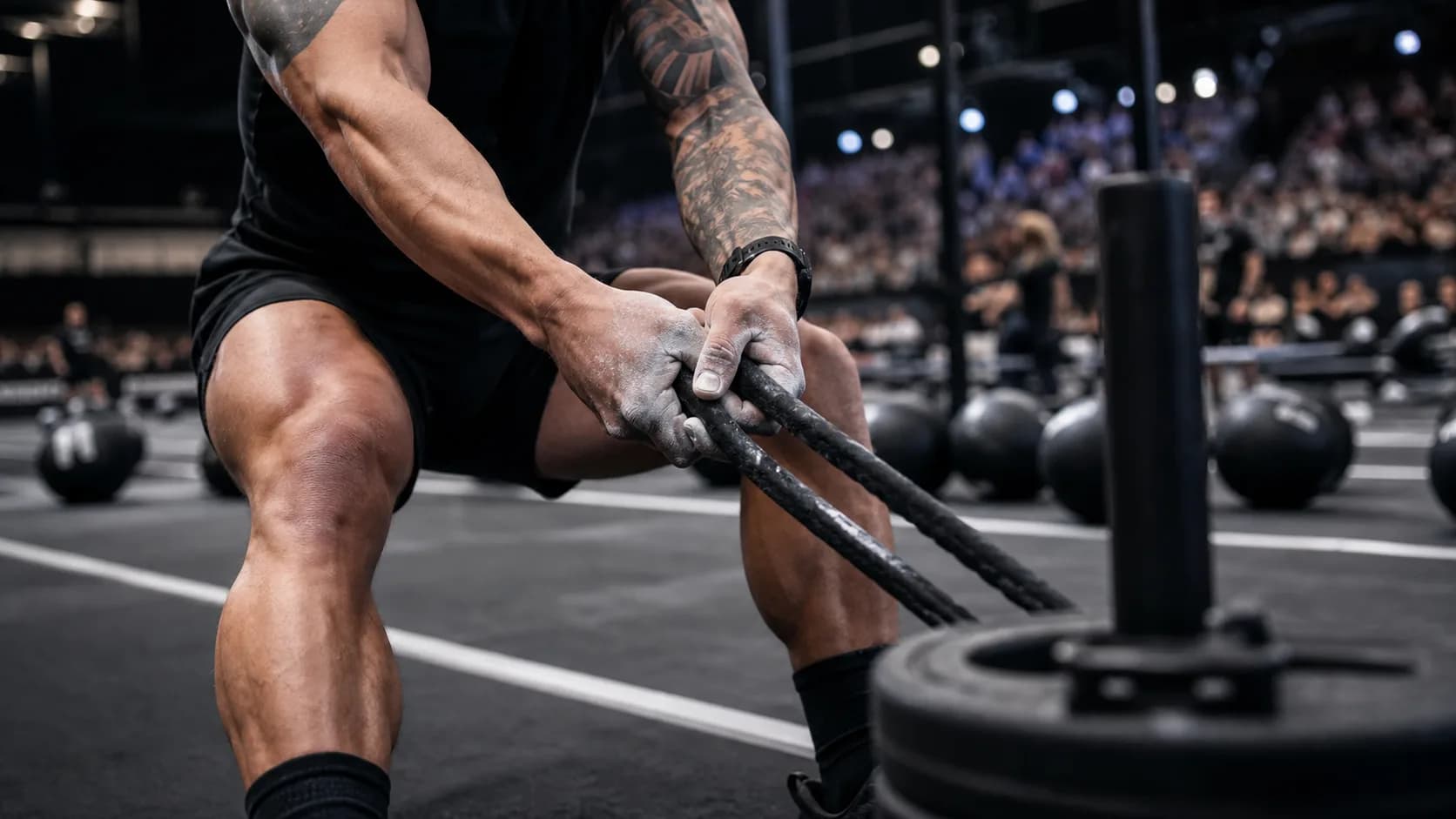
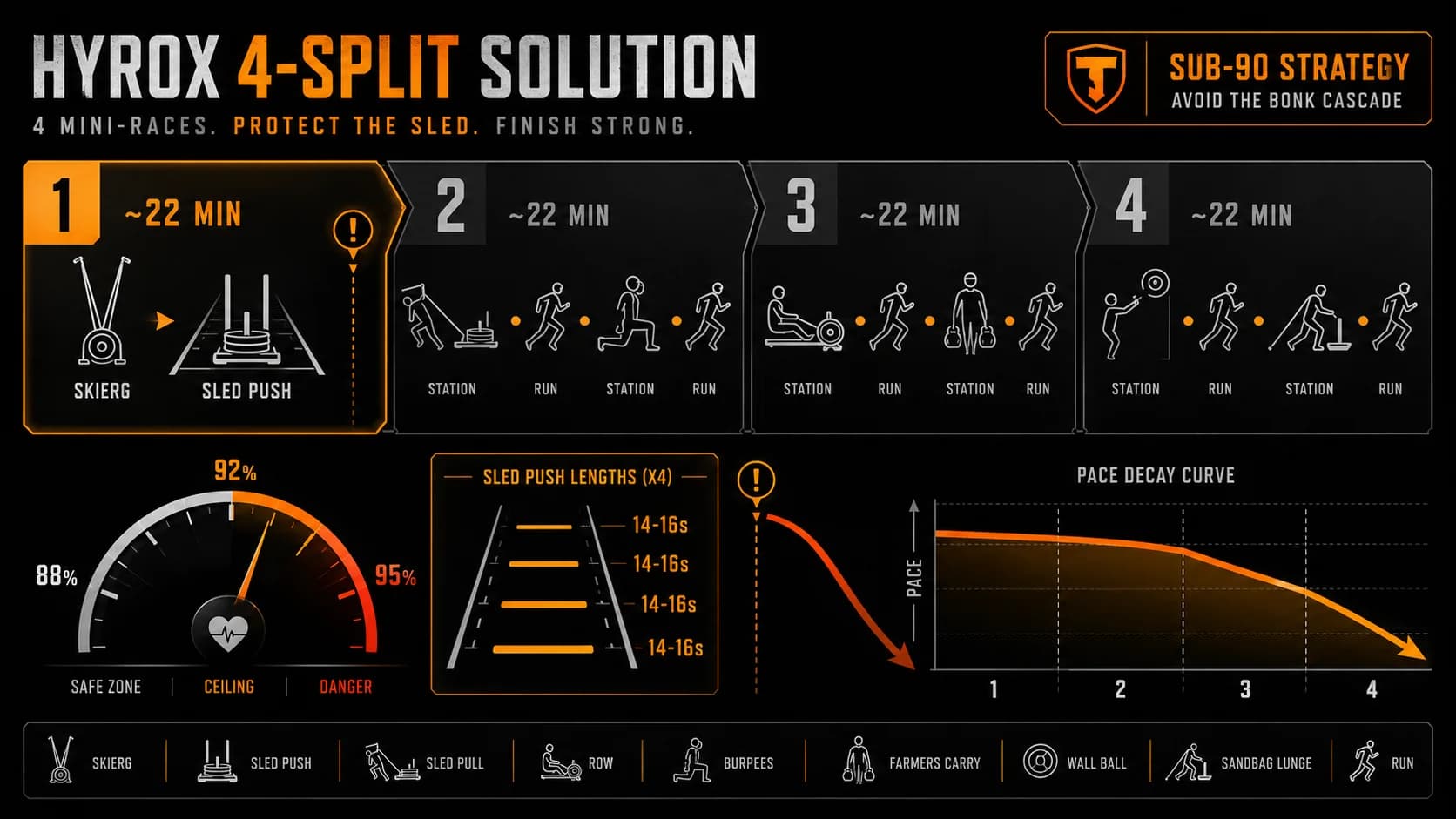
HYROX grip strength can affect how you handle the sled-pull rope and control a wall ball under fatigue, but the official evidence does not establish one universal grip score, one “failure-risk” threshold, or a guaranteed number of minutes you will save. Start with your own station video and splits, identify where control changes, test one training variable, and compare the result under similar conditions.
Use this guide to tell official race facts apart from training hypotheses.
What the official HYROX evidence actually supports
According to the HYROX Sports Science Advisory Council report, running accounts for the largest share of race time in the reviewed research, wall balls produced a pronounced spike in heart rate, blood lactate, and perceived exertion among the study participants, and the sled pull took an average of 155 seconds in the small study discussed by the report. The report does not present grip strength as the number-one predictor of a sub-90-minute finish.
The HYROX science page reports that the SSAC translates current data about pacing, technique, fatigue, strength, and endurance for athletes and coaches. It does not turn every practical cue into a validated universal rule.
According to the 2025/26 HYROX Singles Rulebook, the station order, distances, repetitions, and loads depend on the named division. The rulebook does not define a 30 mm rope benchmark, a 90-second max-repetition dead-hang test, or a universal fingertip-catch technique.
| Claim | Source status | How to use it |
|---|---|---|
| Wall balls can create high physiological strain late in the race | Supported within the SSAC report's reviewed study | Treat wall balls as a station worth observing under fatigue |
| Running occupies the largest portion of race time | Supported by the SSAC report | Do not let a grip block quietly replace the running work your plan requires |
| Race loads vary by division | Supported by the official rulebook | Check your division before you choose practice loads |
| One grip score predicts a finish-time band | Not established by the cited official sources | Do not use an invented cutoff to classify yourself |
| Four weeks of grip work guarantees a time saving | Not established | Run a personal test and keep the result local to your conditions |
| One wall-ball grip works for every athlete | Not established | Compare control, comfort, and valid repetitions with a qualified coach when needed |
Check your division before you copy a training number
The Singles Rulebook lists a 4 × 12.5 m sled pull and 100 wall-ball repetitions. The listed loads differ by division:
| Division | Sled pull, including sled | Wall ball |
|---|---|---|
| Women Open | 78 kg | 4 kg |
| Men Open / Mixed | 103 kg | 6 kg |
| Women Pro | 103 kg | 6 kg |
| Men Pro | 153 kg | 9 kg |
Use the current rulebook for your event and season because organizers can update rules. A gym sled can also feel different because the sled, surface, rope, and venue change resistance. Record those conditions beside every practice split instead of calling two unlike sessions equivalent.
Diagnose the station before you prescribe more grip work
Grip fatigue is only one possible explanation for a slow or untidy station. The sled may expose foot position, pacing, rope management, surface friction, or a strength limitation. Wall balls may expose squat depth, target accuracy, breathing, pacing, or the ability to repeat valid reps after seven runs and seven earlier stations.
Use this decision table after a filmed session:
| Observation | Possible question | Next test |
|---|---|---|
| You repeatedly release the rope before your planned mark | Did your hands limit the pull, or did stance and rope management break first? | Film hands, feet, and rope in the same frame; change one cue only |
| The sled stops although your hands stay closed | Did traction, body angle, or pacing limit force transfer? | Compare a shorter segment on the same surface with the same load |
| Wall-ball no-reps rise late in the set | Did depth, target accuracy, or fatigue change? | Record valid reps, no-rep reason, and the rep where form changed |
| Your forearms feel tired but the station time stays stable | Is the sensation actually limiting performance? | Keep the same setup and compare the next session before adding work |
Do not diagnose an injury from a video or an app score. Pain, neurological symptoms, or a sudden loss of function need a qualified assessment.
Build a repeatable HYROX station record
Record enough context to compare the next attempt. A single split cannot tell you why the station changed.
Date and session purpose:
Division and rulebook checked:
Sled, surface, rope, and total load:
Wall-ball mass and target setup:
Work completed before the station:
Station split:
Valid repetitions / no-reps:
Planned breaks / unplanned breaks:
First visible technique change:
Pain or unusual symptoms:
One variable to test next:
Keep the original video. If you trim a clip, preserve the full attempt so you can review the work completed before the visible mistake.
Use a four-review block, not a four-week promise
You can spread these reviews across four weeks, but the calendar does not create the adaptation. Match volume and load to your training history, health, race date, and coaching plan.
Review 1: establish a comparable baseline
Choose a sled and wall-ball setup you can repeat. Record the conditions, your station split, valid repetitions, planned rests, and the first moment technique changes. Do not chase a personal record during a diagnostic session.
Review 2: test one constraint
Change one factor that matches the observed problem. You might test rope organization, a pacing plan, a stance cue, a planned break, or a different way to structure the set. Keep the surface, load, and preceding work as stable as practical.
Review 3: test the station after controlled fatigue
Place the station after a repeatable amount of earlier work so you can observe whether the same breakdown returns. Keep the session within your current capacity. A coach can help you choose a safe progression; this article cannot set your individual training dose.
Review 4: retest and decide
Repeat the baseline conditions. Compare valid reps, split, unplanned breaks, and video—not just effort. Keep the change when the evidence improves the outcome you chose. Revise or remove it when the result stays unclear.
Compare changes without fooling yourself
Use the smallest comparison that answers your question:
- State the hypothesis before the session.
- Keep the station setup and preceding work as similar as practical.
- Change one main variable.
- Record the same outcomes.
- Note confounders such as sleep, illness, pain, surface, or different equipment.
- Repeat before you generalize.
For example, “a different rope cue felt better” is an observation. “This cue saves every athlete 12 percent” is a claim that requires evidence you do not have.
How Titans Grip fits this workflow
The Titans Grip sport-app catalogue shows video analysis, coaching prompts, competition countdowns, nutrition features, and training logs for multiple disciplines. Compare every score with the original video and your station record before you choose the next training adjustment.
The useful loop stays under your control: record, review, choose one change, retest, and keep the uncertainty visible. Continue through the conditioning training hub or compare the separate HYROX pacing audit when running and station pacing need the same review.
HYROX grip-strength questions
Does the SSAC report say grip is the top HYROX limiter?
No. The official report discusses race physiology and station demands. It does not validate any grip thresholds or finish-time categories.
Should I train with my race load every session?
This article cannot set that dose for you. Check your division, training history, total weekly load, and current health. Use a qualified coach when you need individualized programming.
What should I measure on the sled pull?
Record the setup, split, planned and unplanned releases, rope organization, the first visible technique change, and the work you completed before the station.
What should I measure on wall balls?
Record valid reps, no-rep reasons, planned breaks, unplanned breaks, target accuracy, depth, and the rep where technique or pacing changes.
Can grip training guarantee a faster finish?
No cited official source supports that guarantee. A focused change may help an athlete whose evidence shows a grip-related limitation, but running, other stations, transitions, pacing, health, and race conditions also affect the result.
Editorial audit
The race facts on this page come from the official SSAC report and the 2025/26 Singles Rulebook as of July 15, 2026. Recheck the current event rulebook before race day.
Try these free tools
Related Articles
Pick the Best Martial Arts App in 2026: Cage Coach Ranks First
Aug 12, 2026 · 11 min read
PowerliftingCrowded Gym Workout Plan: The One-Station Method for Peak Hour Training
May 24, 2026 · 5 min read
PowerliftingStrength per Square Foot: The Small Gym Equipment Plan That Actually Works
May 24, 2026 · 6 min read