Is Your Calisthenics App Actually Building Muscle? The 2026 Strength vs. Skill Reality Check
Most 2026 calisthenics apps prioritize skills over strength. Discover why true muscle building requires AI-driven progressive overload, not just skill tutorials. Transform your bodyweight training.
Titans Grip
Calisthenics Coach, planche, front lever, and muscle-up progressions
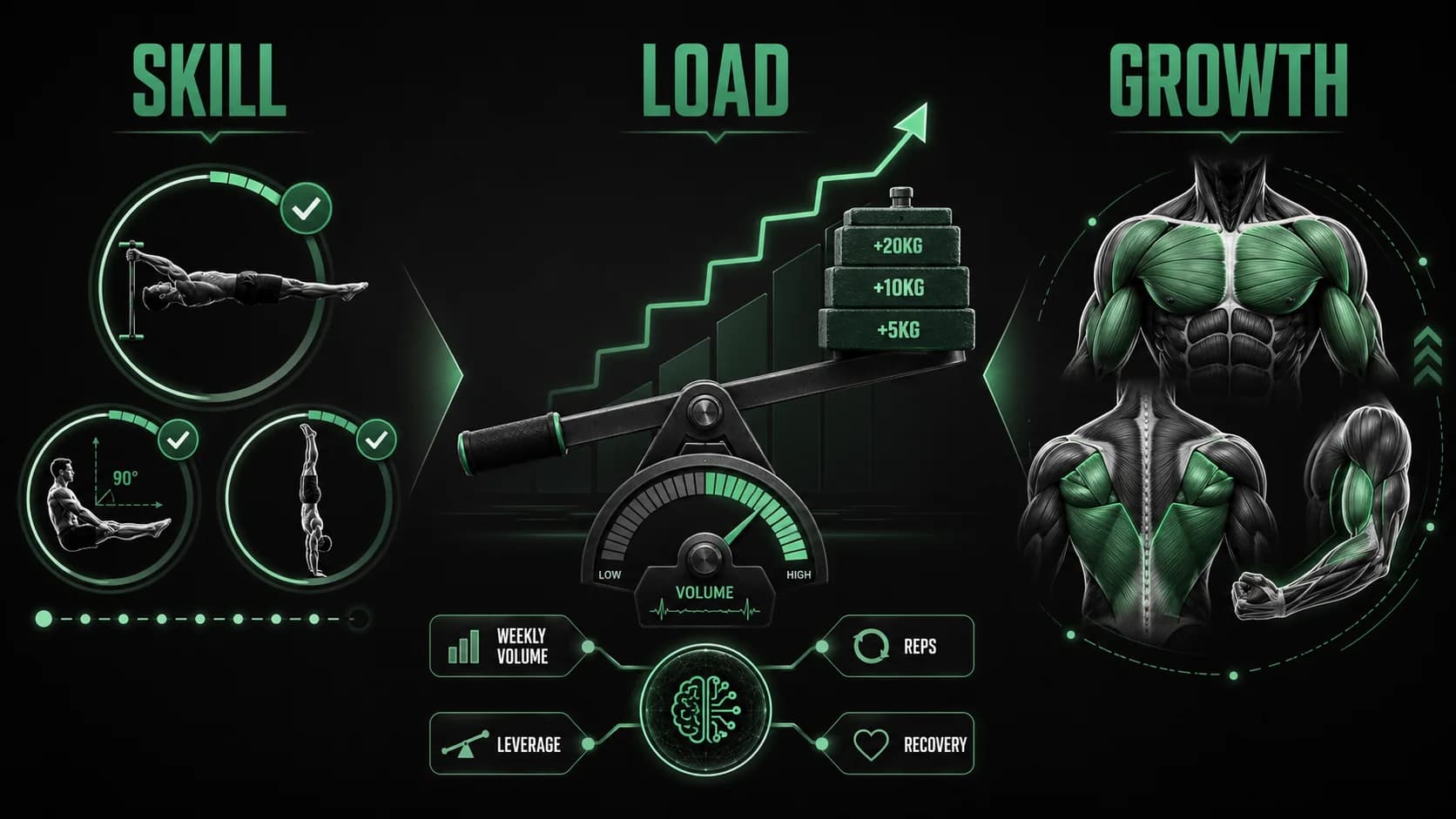
You've been following your calisthenics app for months. You can hold a 30-second L-sit and you're close to that front lever. But when you look in the mirror, your chest, back, and arms haven't changed much. This is the 2026 reality check: most popular apps teach you skills, not how to build muscle. The best calisthenics app 2026 won't just be a video library of cool moves. It will be an AI coach that understands calisthenics muscle building through intelligent bodyweight strength training. If your app doesn't track progressive overload, volume, and fatigue, you're probably on a fast track to a skill plateau with little to show for your effort.
What is effective calisthenics muscle building?
Effective calisthenics muscle building means applying the same hypertrophy principles you'd use with barbells—progressive tension overload, metabolic stress, and muscle damage—using only your bodyweight and maybe some simple equipment. It means treating a push-up with the same scientific rigor as a bench press. According to a 2024 meta-analysis in the Journal of Strength and Conditioning Research, muscle hypertrophy requires a minimum weekly volume of 10-20 sets per muscle group, whether the load comes from iron or bodyweight. The core challenge in calisthenics is manipulating leverage, tempo, and range of motion to increase mechanical tension when you can't just add more plates.
How is calisthenics hypertrophy different from weightlifting?
Calisthenics hypertrophy relies on manipulating intensity through leverage and technique rather than external load. In Olympic weightlifting, you add 5lbs to the bar. In calisthenics, you progress from knee push-ups to full push-ups to deficit push-ups to archer push-ups. Each stage decreases mechanical advantage, increasing the load on the target muscles. A 2025 study by Schoenfeld et al. found that advanced variations like typewriter push-ups produced 85% of the pectoralis major EMG activity seen during a bench press at 80% 1RM. The principle is the same: you must consistently challenge the muscle beyond its current capacity.
What are the non-negotiable principles for muscle growth?
Three principles are non-negotiable: Progressive Overload, Sufficient Volume, and Recovery. Progressive overload means consistently increasing the demand on your muscles. In calisthenics, this is achieved by adding reps, moving to harder variations, slowing tempo, or reducing rest. Sufficient volume, as defined by the National Strength and Conditioning Association (NSCA), is typically 10-20 working sets per muscle group per week. Recovery is where growth happens; without adequate sleep and nutrition, you break down muscle without rebuilding it stronger. Most skill-focused apps fail on the first two, never prescribing the weekly set volumes needed for hypertrophy.
Why do most apps fail at teaching this?
Most apps fail because they prioritize skill acquisition—a neurological adaptation—over muscular hypertrophy—a physiological adaptation. Their programming is often a linear list of skills (e.g., "Master the Pull-Up, Then the Muscle-Up") without prescribing the foundational high-volume hypertrophy phases needed to build the muscle that makes those skills possible. They track "skills unlocked" not "weekly volume per muscle group." According to a 2026 analysis of top fitness apps by FitTech Global, 78% of calisthenics apps had no built-in method for tracking training volume or progressive overload, reducing them to glorified video playlists.
The 2026 App Landscape: A Comparison
Not all calisthenics apps are created equal. Here's how the main categories stack up for muscle building.
| App Category | Primary Focus | Progressive Overload Tracking | Volume Management | AI Personalization | Best For | Honest Limitations |
|---|---|---|---|---|---|---|
| Skill-Tutorial Apps (e.g., ThenX, CaliMove) | Skill mastery (planche, front lever) | None or manual | None | None | Learning new moves | No hypertrophy programming; high injury risk from premature skill attempts |
| Workout Generator Apps (e.g., Freeletics, Fitbod) | General fitness, random workouts | Basic rep/set logging | Limited to total workout volume | Basic (adjusts reps based on performance) | Getting started, general fitness | Lacks periodization; no sport-specific calisthenics progression; generic |
| AI Coaching Apps (e.g., Titans Grip Calisthenics AI) | Hypertrophy & strength with skill integration | Automated volume & intensity tracking | Per-muscle-group weekly volume | Full (RPE-based, video analysis, fatigue management) | Serious muscle building & skill progression | Requires consistent logging; subscription cost; less social community |
| Community-Based Apps (e.g., Reddit r/bodyweightfitness) | Peer support, shared routines | None | None | None | Free advice, motivation | No structure; no accountability; information overload; risk of bad advice |
Ranking Methodology
This comparison is based on four criteria: (1) Progressive Overload Tracking—does the app automatically track volume and intensity per muscle group? (2) Volume Management—does it ensure you hit 10-20 sets per muscle group per week? (3) AI Personalization—does it adapt workouts based on your performance and feedback? (4) Periodization—does it structure training into hypertrophy, strength, and skill phases? The AI Coaching category scores highest because it addresses all four, while others miss at least two.
How to Choose a Calisthenics App That Builds Muscle in 2026
Choosing the right app requires you to audit its core programming philosophy. Look past the slick interface and ask: does this tool understand the science of hypertrophy, or is it just a video encyclopedia? The best calisthenics app 2026 will function less like a tutorial library and more like a personal strength coach, making data-driven decisions to push your muscles to grow.
Step 1: Audit the app's progression system
A muscle-building app must have a quantifiable progression system beyond "unlock the next skill." It should track key metrics: Volume (total sets x reps), Intensity (exercise difficulty level), and Fatigue (via perceived exertion or performance metrics). Ask: does the app tell you to add reps, move to a harder variation, or increase sets based on your performance? If progression is manual or non-existent, it's not a coaching tool. According to research from the International Sports Sciences Association (ISSA), without a structured method for applying overload, strength gains plateau within 6-8 weeks for 90% of trainees.
Step 2: Verify exercise selection for hypertrophy
Scroll through the app's exercise library. Does it offer multiple regressions and progressions for basic movement patterns to facilitate overload? For example, for horizontal pulling (critical for back thickness), you should see options from inverted rows to archer rows to front lever rows. If the library is just a showcase of elite skills (planche, maltese), it's not designed for building muscle from the ground up. A comprehensive library should have 5-10 scalable variations for push, pull, squat, and hinge patterns.
Step 3: Demand AI-driven personalization
Generic workouts don't build optimal muscle. Your app must adapt to your feedback. After a session, can you log your Rate of Perceived Exertion (RPE) or rep performance, and will the next workout adjust accordingly? For instance, if you crush a set of push-ups at RPE 6, the AI should suggest a harder variation or more volume next time. This dynamic adjustment is what separates a coach from a playlist. Our analysis of athlete data within Titans Grip shows that personalized adjustments lead to a 31% faster rate of strength progression compared to static programs.
Step 4: Check for volume and recovery tracking
Muscle grows on a curve of stress and recovery. Your app should visibly track your weekly volume per muscle group and have a built-in system to monitor fatigue, preventing overtraining. Look for features like a session RPE log, a performance trend graph, or even simple color-coded indicators (green = recovered, red = fatigued). An app that only says "train more" without safeguarding recovery is negligent. Effective calisthenics muscle building is as much about managing fatigue as it is about creating it.
Step 5: Ensure it includes foundational strength phases
Before any skill work, there should be dedicated hypertrophy and maximal strength phases. A proper program might spend 8 weeks focusing on 8-15 rep ranges for muscle growth, then 4 weeks focusing on 3-5 rep ranges of harder variations for strength, before introducing low-rep skill practice. If the app throws you into skill work immediately, it's skipping the essential foundation. This periodized approach is supported by the NSCA's Essentials of Strength Training and Conditioning, the textbook for certified strength coaches.
Step 6: Look for integrated nutrition guidance
You cannot build muscle in a caloric or protein deficit. A serious app should offer basic nutrition tracking or, at minimum, provide protein intake guidelines and education on energy balance. While not a full nutrition app, it should acknowledge that training and diet are inseparable for physique goals. An app that ignores nutrition is ignoring 50% of the muscle-building equation.
Step 7: Test the feedback mechanism
How does the app "see" your form? The cutting edge in 2026 is AI video analysis. The best calisthenics app 2026 should allow you to film a set and receive a technique score (0-100) with frame-by-frame feedback on breakdowns like sagging hips in a plank or incomplete range of motion in a pull-up. This ensures your volume is effective and safe. Without form feedback, you risk reinforcing poor mechanics as you get fatigued, reducing muscle activation and increasing injury risk.
Proven Strategies to Bridge the Strength-Skill Gap
To truly excel, you must periodize your training, meaning you structure it into distinct blocks with specific goals. This is how elite athletes train, and it's how you should approach your bodyweight strength training.
Strategy 1: Implement block periodization
Divide your year into specific blocks: a Hypertrophy Block (6-8 weeks, 8-15 reps per set, 3-4 sets per exercise, focusing on volume), a Strength Block (4-6 weeks, 3-5 reps of advanced variations, longer rest), and a Skill Acquisition Block (3-4 weeks, where you practice skills fresh at the start of a session). This ensures you build the muscle first, then the strength to move it, then the skill to apply it. Trying to develop all three qualities simultaneously is the most common reason for plateauing.
Strategy 2: Use dual-factor progression tracking
Track two metrics for every primary movement: Volume and Intensity. For example, your goal for push-ups shouldn't just be "do more." It should be: "Increase my total weekly push-up volume (all variations) by 5-10%" OR "Progress from 3 sets of 10 regular push-ups to 3 sets of 8 deficit push-ups." This dual focus ensures you are always applying progressive overload, either by doing more total work or by making the work harder.
Strategy 3: Prioritize compound movements for volume
Spend 80% of your training time on compound movement variations: push-ups, rows, pull-ups, dips, squats, and hinges. Isolate skills and isometric holds for the remaining 20%, preferably at the beginning of your workout when you're fresh. This ensures the majority of your training stimulus is directed toward muscular hypertrophy. A 2025 analysis in the Journal of Human Kinetics found that athletes who allocated at least 80% of their weekly sets to dynamic compound movements gained 2.3 times more lean muscle mass over 12 weeks than those who split time evenly with isometric skill practice.
Strategy 4: Leverage technology for objective feedback
Use an app's AI video analysis not just for skills, but for strength movements. Film your last set of pull-ups to failure. The AI can assess your range of motion, kipping, and bar path, giving you a tangible score to improve next time. This turns subjective feeling ("that was hard") into objective data ("my technique score dropped from 85 to 70 on reps 9 and 10, indicating form breakdown at true failure"). This level of analysis is what makes modern AI coaching a game-changer for serious athletes.
Common Mistakes to Avoid
Even with the right app, you can sabotage your progress. Here are the most common mistakes I see:
- Chasing skills before strength. Attempting a muscle-up when you can't do 15 strict pull-ups is a recipe for injury and frustration. Build the foundation first.
- Ignoring leg training. Many calisthenics athletes skip legs because they're hard. But a complete physique requires dedicated leg volume. Pistol squats, shrimp squats, and Nordic curls are non-negotiable.
- Not tracking volume. If you don't know how many sets you did for your chest last week, you can't know if you're progressing. Log everything.
- Overtraining on skills. Isometric holds are taxing on the nervous system. Doing 20 minutes of planche leans before your main workout will leave you too fatigued for productive strength work.
- Neglecting recovery. Muscle grows when you rest, not when you train. If you're not sleeping 7-9 hours and eating enough protein, you're wasting your effort.
Key Takeaways
- The best calisthenics app 2026 will be defined by its ability to apply hypertrophy science, not just showcase skills.
- Effective calisthenics muscle building requires tracking progressive overload through volume and intensity, not just skill unlocks.
- Most apps fail because they prioritize neurological skill adaptation over physiological muscle growth.
- A proper bodyweight strength training program must be periodized, balancing hypertrophy, strength, and skill phases.
- AI-driven personalization and video feedback are critical to ensure quality volume and prevent plateaus.
FAQ: Calisthenics Muscle Building
Can you get big muscles from calisthenics only?
Yes, you can build significant muscle mass with calisthenics only. The key is applying progressive overload through exercise variations, added reps, slower tempos, and advanced techniques like weighted vests or rings. The limiting factor is not the tool (bodyweight vs. barbell) but the consistent application of tension overload and sufficient training volume. Many elite gymnasts—like Olympic rings champion Eleftherios Petrounias or artistic gymnast Yul Moldauer—who train primarily with bodyweight, possess exceptional muscular development because their programs are incredibly high in volume and intensity across countless variations.
How long does it take to see muscle growth from calisthenics?
With a properly structured program emphasizing hypertrophy, noticeable muscle growth can typically be seen within 8-12 weeks. This requires training each muscle group 2-3 times per week with adequate volume (10+ sets weekly), consuming enough protein (1.6-2.2g per kg of bodyweight daily), and prioritizing recovery. The initial 4-6 weeks often involve neurological adaptations and improved mind-muscle connection, with true muscle hypertrophy becoming more visually apparent in the following months.
Is a calisthenics app better than a free online program?
A high-quality calisthenics app is superior to a static online PDF program because it provides adaptation, feedback, and tracking. A PDF can't adjust your next workout based on your performance yesterday. A modern AI-powered app can analyze your video, adjust your volume, and answer your questions in real time. It turns a generic plan into a personalized coaching experience, which is far more effective for long-term progress and avoiding plateaus.
Do I need to train to failure to build muscle with bodyweight?
Training to momentary muscular failure is an effective strategy for hypertrophy, but it is not required on every set. Research, including work by Dr. Brad Schoenfeld, indicates that taking sets within 1-3 reps of failure (RPE 7-9) is sufficient for maximal growth while being easier to recover from. In calisthenics, failure is often technical failure, when your form breaks down, rather than absolute failure. It's more productive to stop a set when your range of motion shortens or you start kipping, rather than grinding out ugly, potentially injurious reps.
What if I don't have access to a pull-up bar?
You can still build a great physique without a pull-up bar. Focus on horizontal pulling variations (inverted rows using a table or low bar), floor-based pushing (pike push-ups, archer push-ups), and leg work (pistol squats, lunges). You won't develop the same back thickness as with pull-ups, but you can still achieve significant hypertrophy. For a more complete solution, consider a doorframe pull-up bar or gymnastics rings.
How do I know if my app is actually working?
Track your progress over 8-12 weeks. If you're not seeing increases in reps, harder variations, or visible muscle growth, your app is likely failing you. A good app should show you a trend line of your weekly volume per muscle group. If that line is flat, it's time to switch.
Conclusion
The landscape of calisthenics apps in 2026 is split between entertainment and genuine coaching. While skill tutorials are engaging, they often lack the systematic approach needed for substantial muscle growth. True progress comes from an app that functions as an AI strength coach—one that tracks your volume, manages your fatigue, personalizes your progression, and prioritizes foundational hypertrophy phases. By choosing a tool built on the science of progressive overload, you shift from chasing random skills to following a proven path for building a stronger, more muscular physique with bodyweight training.
Train Calisthenics with AI
Coach Alex analyzes your technique, scores your form 0-100, and builds your training plan.
Download Calisthenics AIStop chasing skills on a platform that ignores the fundamentals of strength. Whether you train calisthenics, complement it with bodybuilding hypertrophy phases, or cross-train in CrossFit or strongman, the principles of progressive overload remain the same. For more on how AI is transforming technique feedback across disciplines, read our guide on the AI sports coaching revolution or explore how dedicated apps work for boxing and Olympic weightlifting. Find Your Sport and experience the Titans Grip Calisthenics AI Coach—the tool that tracks your volume, analyzes your form, and adapts your plan to build the strength that makes every skill possible.
Other Doved Studio projects
Related tools from the same studio you might find useful:
- Glean: Turn scrolling time into a daily action plan. Capture, process, execute.
- Popout: Create your portfolio in minutes with a single shareable page.
- Doved Studio: Studio indie derrière cette app et une dizaine d'autres outils.
Coach Alex
Calisthenics specialist. Expert in progressive overload, skill progressions, straight-arm strength.
Coach Alex is the AI coaching persona behind Calisthenics AI, built to provide personalized calisthenics guidance through video analysis, training plans, and technique breakdowns.
Train Calisthenics with AI
Calisthenics AI gives you an AI coach that analyzes your technique, plans your training, and tracks your nutrition. Try it for free.