How Hard Can a Human Kick? Kick Force in Newtons and Pounds
Trained fighters kick a pad with 1,200 to 9,000 newtons in lab tests. See the numbers by kick and style, convert them to pounds and add force to yours.
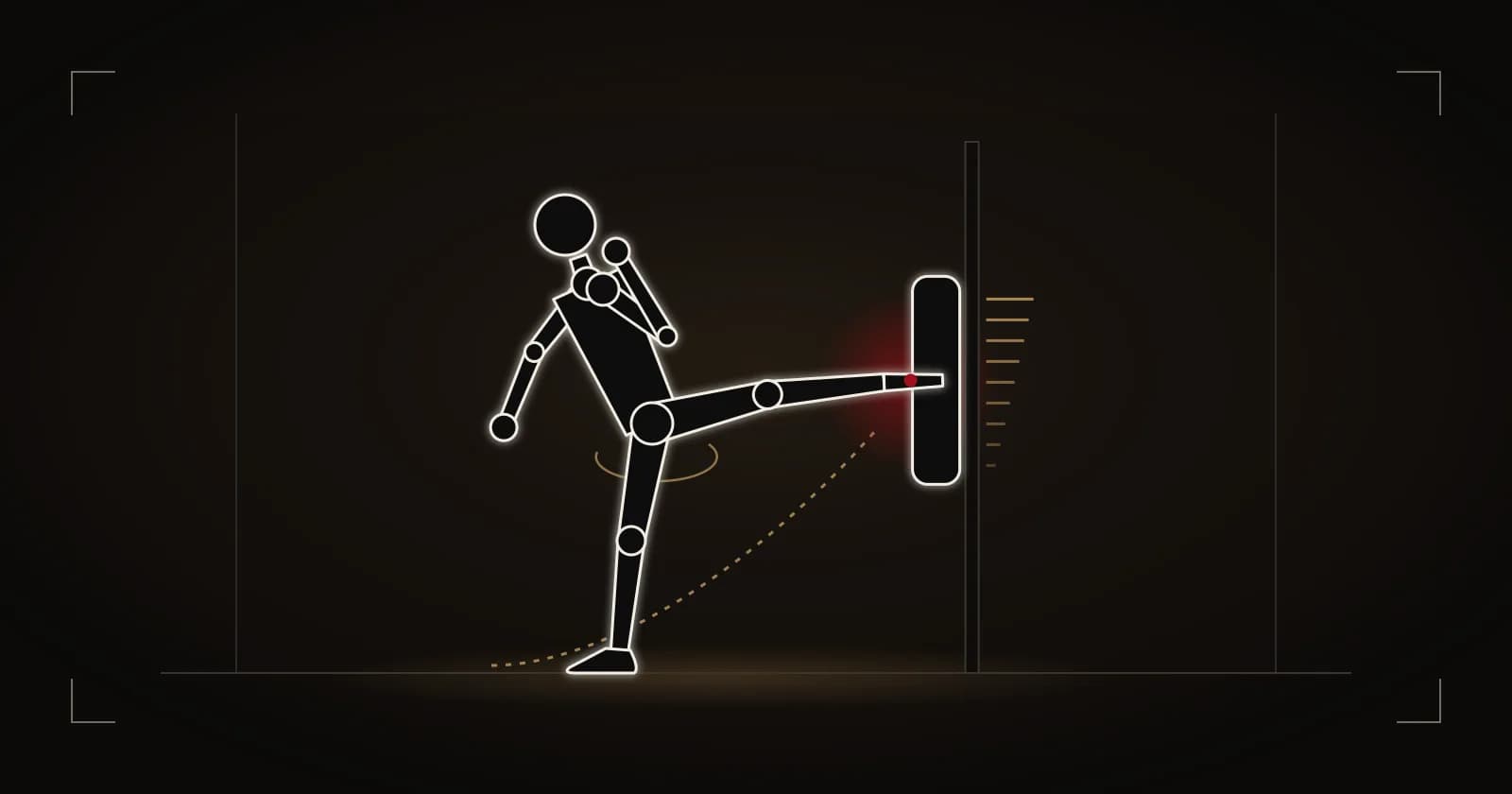
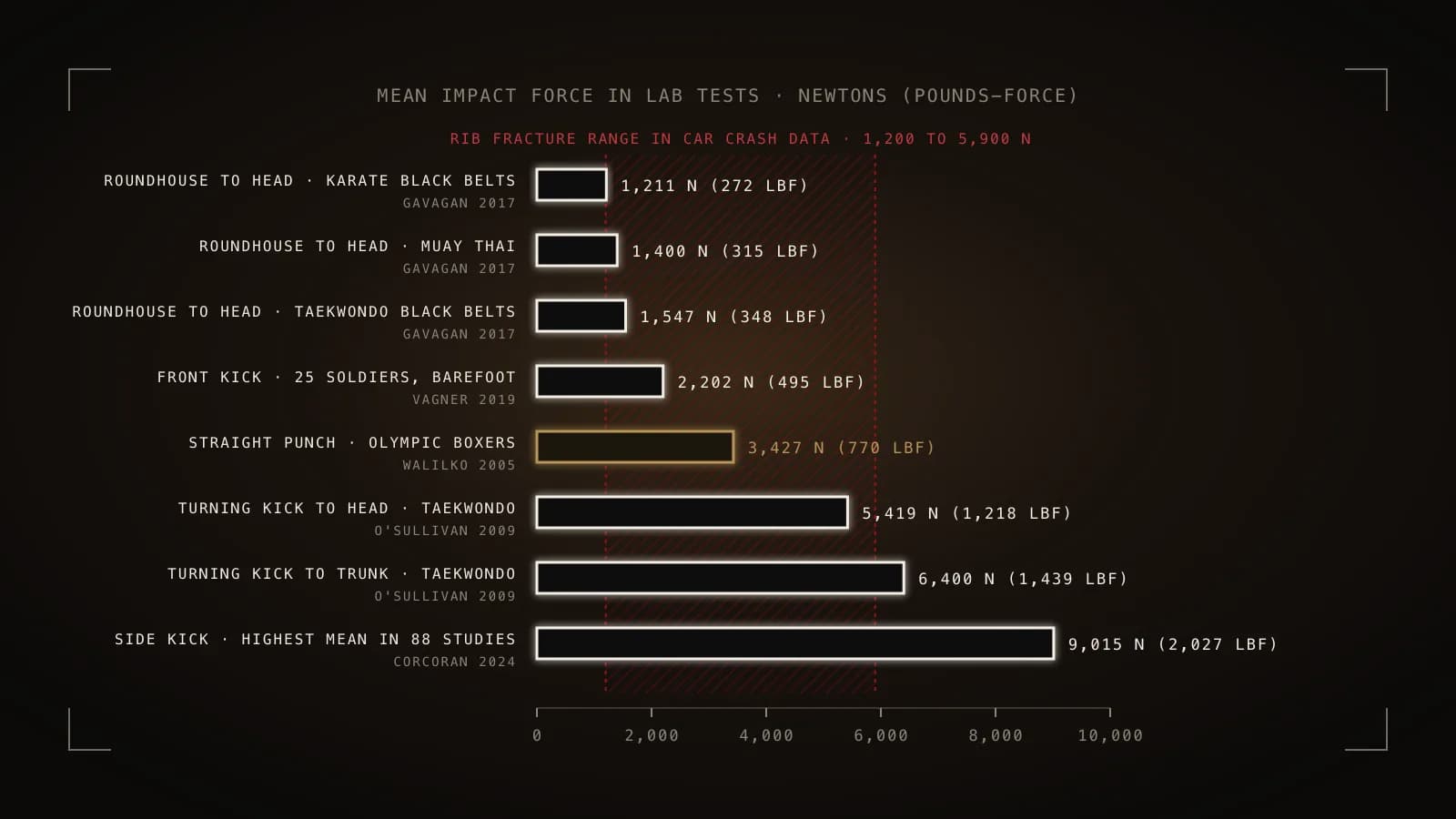
A trained martial artist's kick hits a pad with about 1,200 to 6,400 newtons of force in lab tests, which works out to roughly 270 to 1,440 pounds of force, depending on the kick, the target height and the measuring device. The highest average in an 88-study review reached 9,015 newtons for a side kick, about 2,030 pounds of force.
Those numbers come from people who train, kicking pads wired to sensors. Below you get the figures study by study, the conversion to pounds and body weights, why two labs can measure the same kick and disagree by a factor of four, and what you can train to put more force into your own kick.
See the lab numbers kick by kick
Researchers measure kick force by bolting a sensor to a target and asking skilled kickers to hit it as hard as they can. The table pulls the averages from five studies. A newton is the metric unit of force, and one pound of force equals 4.448 newtons, the factor the US National Institute of Standards and Technology publishes.
| Kick and target | Who kicked | Average force | In pounds of force | Study |
|---|---|---|---|---|
| Roundhouse to head height | 8 karate black belts | 1,211 N | 272 lbf | Gavagan and Sayers, 2017 |
| Roundhouse to head height | 8 ranked Muay Thai fighters | 1,400 N | 315 lbf | Gavagan and Sayers, 2017 |
| Roundhouse to head height | 8 taekwondo black belts | 1,547 N | 348 lbf | Gavagan and Sayers, 2017 |
| Front kick, barefoot | 25 male soldiers | 2,202 N | 495 lbf | Vagner and colleagues, 2019 |
| Turning kick to head height | 5 skilled taekwondo players | 5,419 N | 1,218 lbf | O'Sullivan and colleagues, 2009 |
| Turning kick to trunk height | 5 skilled taekwondo players | 6,400 N | 1,439 lbf | O'Sullivan and colleagues, 2009 |
| Side kick, highest average found | Review of 88 studies | 9,015 N | 2,027 lbf | Corcoran and colleagues, 2024 |
The same review found average forces as low as 122.6 N across its 88 studies, and foot speeds from 5.2 to 18.3 meters per second. The roundhouse produced the fastest foot. The side kick produced the most force.
Compare a kick with a punch
Seven Olympic boxers threw straight punches at the instrumented face of a crash test dummy in a study by Walilko, Viano and Bir. Their punches averaged 3,427 N, about 770 lbf, at a hand speed of 9.14 meters per second. Heavier boxers hit harder, mostly because more of their body mass moved behind the fist.
So a good kick can beat a good punch, and a careful lab can also record a kick well under a punch. The review notes that leg mass in combat athletes often runs more than 2.5 times arm mass, and that kicks recruit the pelvis, hip and thigh. That explains why the biggest kick numbers outrun the biggest punch numbers.
Know why the numbers disagree
Look at the roundhouse rows again. Gavagan's black belts averaged 1,211 to 1,547 N to the head. O'Sullivan's taekwondo players averaged 5,419 N to the same height. Both groups kicked hard. The gap comes from how each lab measured.
- The device. Corcoran's review counted force sensors, force plates, accelerometers, strain gauges, motion capture and even a spring balance. Gavagan used a strain gauge behind a kicking pad. O'Sullivan fixed two accelerometers to a pipe inside a sandbag. A stiff device such as a force plate can read higher than a padded one.
- The target height. In O'Sullivan's study the same players lost about 15% of their force when they kicked at head height instead of trunk height.
- The padding. Foam spreads the impact over more time, which tends to lower the peak. The review notes that only 13 of the 32 force studies used a device that moves like a human body on impact.
- The distance. Falco and colleagues tested 31 taekwondo athletes from three distances. Distance changed execution time, while expert kickers kept the same impact force from every distance. A follow-up on head kicks by Estevan and colleagues found that medallists kicked harder and faster than non-medallists whenever they kicked from a distance other than their usual one.
Read any kick number with its device and target in mind. Your gym's punch-and-kick machine runs its own calibration, so compare your score with your own past scores on that machine.
Question the 1,000 pound claim
Search this topic and you will find the claim that an average adult kicks with 1,000 pounds of force. The pages that repeat it show no measurement behind it. The best controlled comparison of three striking arts found black belts averaging 272 to 348 lbf to head height. A thousand pounds is about 4,450 N. Skilled taekwondo players passed that on O'Sullivan's sandbag rig, while the group closest to everyday adults in the table, 25 soldiers kicking barefoot, averaged 495 lbf.
Turn force into body weights
Force alone hides your size. A 95 kg kicker and a 65 kg kicker who both land 1,400 N did very different work. Divide the force by your weight in newtons, which is your mass in kilograms times 9.81.
Gavagan's groups make the point. The Muay Thai fighters weighed 65.6 kg on average, the taekwondo players 95.8 kg and the karate players 84.5 kg. Run the averages and you get:
- Muay Thai: 1,400 ÷ (65.6 × 9.81) = about 2.2 times body weight.
- Taekwondo: 1,547 ÷ (95.8 × 9.81) = about 1.6 times body weight.
- Karate: 1,211 ÷ (84.5 × 9.81) = about 1.5 times body weight.
The lightest group kicked hardest for its size. The authors reported the Muay Thai group's higher relative force as a trend that fell short of statistical significance with 8 people per group, so treat it as a hint.
Work through one example
You weigh 70 kg, about 154 lb. A sensor pad at your gym reads 1,500 N for your best rear roundhouse to the body.
- In pounds of force: 1,500 ÷ 4.448 = 337 lbf.
- Your weight in newtons: 70 × 9.81 = 687 N.
- In body weights: 1,500 ÷ 687 = 2.2.
That 2.2 matches the Muay Thai average in Gavagan's study. Next month, kick the same pad from the same distance and run the same three lines. If your number climbs while your weight holds steady, your technique got better.
Skip the psi number
People also ask how hard a kick lands in psi, pounds per square inch. Psi measures pressure: force divided by the contact area. None of the studies above report contact area, so any psi figure for a kick is a guess about how big your shin or instep footprint was on impact.
Here is how much the area changes the answer. Spread your 337 lbf over 12 square inches and you get 28 psi. Land the same force on 4 square inches and you get 84 psi. Same kick, three times the pressure. Quote kicks in newtons or pounds of force and you stay on solid ground.
Learn where kick force comes from
Kick force comes from foot speed and from how much mass moves with the foot at contact. Gavagan found a moderate correlation, r = 0.66, between foot speed at impact and force relative to body weight. The kickers who hit hardest shared four habits:
- They turned the pelvis fast. Rapid rotation of the hips around the spine opened the kick.
- They lifted and opened the hip. Fast hip flexion and hip abduction carried the knee up and across.
- They snapped the knee open. Karate and taekwondo black belts extended the knee at about 945 degrees per second, the Muay Thai group at 706. The slower Muay Thai snap fits a roundhouse thrown with a straighter leg.
- They moved the whole body toward the target. Their center of mass traveled forward into the kick.
A classic study of 17 skilled taekwondo practitioners by Sørensen and colleagues explains the whip. As your thigh swings, it slows down on its own because your lower leg speeds up. Your knee extensors and the momentum of the thigh together drive the shin. You get the snap by letting the thigh lead and the shin follow, the way a whip handle passes speed to the tip.
Build hip strength
Vagner and colleagues measured 25 soldiers' front kicks, then tested their hips on an isokinetic machine. Concentric strength of the kicking hip's flexors and extensors explained 54% of the differences in front kick force. Add the rotator strength of the standing hip and the model explained 75%.
So strength work for your hips pays off in your kick. Add hip flexor raises, hip thrusts and cable hip rotations for your standing side, and keep plenty of fast kicks on pads in the same week.
Let body mass follow technique
Falco's team found that body mass tracked impact force, and the review notes that the link showed up in novices only. The authors read it as beginners leaning their weight into the kick to make up for missing mechanics. That is also why size decides less than you might think in a fight. If you want to see whose build matches yours, compare yourself with real fighters in the free Which UFC Fighter Are You tool.
Put more force into your kick
Train these in order, and keep each change small enough to repeat the same way twenty times.
- Pivot the standing foot. Turn your heel toward the target as you kick. A planted foot blocks your hip from turning, and your hip turn is where the force starts. The Muay Thai roundhouse kick page walks through the pivot step by step.
- Turn through the target. Aim a few inches behind the pad and keep turning your hips until your shin passes the spot where it lands.
- Chamber, then snap. For a taekwondo or karate roundhouse, lift the knee first and open it last. The taekwondo kicks guide covers the chambers for eight core kicks.
- Push through with straight kicks. Front and side kicks drive the hip forward into the target. Practise the mae geri front kick and the Muay Thai teep with your hip extending into the pad.
- Kick from your fighting distance. Mark the floor where you stand in sparring and kick the pad from that mark, so the force you build shows up in a real exchange.
Fix the five kicking mistakes
Most weak kicks share the same faults.
- You keep your standing heel planted. Your hips stop at half a turn. Fix it by pivoting on the ball of the foot before contact.
- You swing your arm wide to power the kick. Your guard opens and your balance drifts. Fix it by keeping the near hand at your chin and letting the far arm swing low behind you.
- You lean back to reach. Your weight moves away from the target. Fix it by stepping in a half step and driving your hips forward.
- You stop at the surface. Your kick ends before full speed. Fix it by aiming through the pad.
- You chase your number on a hard target. A wall or heavy bag rewards force and punishes a bad angle on your foot. Fix it by building speed on a held pad first and adding hard targets slowly.
Respect what a kick can break
These forces cause real injuries. Corcoran's review compared kick forces with fracture data. The forearm bones broke at 670 to 3,550 N in the studies it cites. Rib fractures in car crash data occur at 1,200 to 5,900 N, a range a well-placed roundhouse, side or back kick can reach. Breaking a tibia took 4,110 to 8,450 N in cadaver studies and a femur 5,000 to 8,230 N. Even the softest roundhouse in the table above clears the low end of the forearm range, which is why blocking a kick with your arm hurts.
Injury rates in kicking sports run high. A meta-analysis of 14 studies by Lystad, Pollard and Graham found 79.3 injuries per 1,000 athlete-exposures in competition taekwondo, mostly bruises to the legs from contact. In a one-year survey of 263 martial artists by Zetaruk and colleagues, 59% of taekwondo practitioners and 30% of karate practitioners had an injury that cost them training time.
Gear helps. The review cites one study where a body protector cut kick force by 31.9 to 75.3%, and gloves with head protection cut simulated head strike forces by up to 67%. Spar with shin guards and a partner who matches your control, kick pads at full power and keep hard contact to the head for supervised competition. See a doctor after any blow that leaves you dizzy, confused or with a headache that lingers, and stop training until you get the all-clear.
Check your kick on film
You cannot feel your hip turn at 900 degrees per second. You can see it on video, frame by frame.
Review your roundhouse in Muay Thai AI: Kru Coach
Film three hard roundhouses on a pad from the side and add the clip to Muay Thai AI: Kru Coach. You get a 0 to 100 score for each technique with frame-by-frame feedback on your hip rotation and knee drive, so you can step to the frame where your hip stops turning, fix the pivot and film the next round to compare scores.
If you want to know what your arms add to the picture, the guide on how reach is measured in the UFC shows you how to measure your own arm span at a wall.
Get quick answers
How hard can a human kick?
Skilled martial artists kick a pad with about 1,200 to 6,400 newtons in lab tests, roughly 270 to 1,440 pounds of force. The highest average in an 88-study review reached 9,015 newtons for a side kick, about 2,030 pounds of force.
How hard can a human kick in pounds?
Divide newtons by 4.448. Black belts in one three-art study averaged 272 to 348 pounds of force with a roundhouse to head height, and skilled taekwondo players in another study averaged 1,218 to 1,439 pounds of force on a sandbag rig.
How hard is a kick in psi?
Psi depends on contact area, and kick studies report force without the contact area. The same 337 pounds of force works out to 28 psi over 12 square inches or 84 psi over 4 square inches, so quote kicks in newtons or pounds of force.
Is a kick stronger than a punch?
Often, yes. Olympic boxers' straight punches averaged 3,427 newtons, while skilled taekwondo turning kicks averaged 5,419 to 6,400 newtons in another lab. Devices differ between studies, so compare numbers measured on the same rig.
Which kick is the strongest?
The side kick posted the highest average force in an 88-study review, 9,015 newtons, while the roundhouse posted the fastest foot speed at 18.3 meters per second. Push kicks drive the hip into the target. Swing kicks win on speed.
Check the sources
- Corcoran D, Climstein M, Whitting J, Del Vecchio L. Impact force and velocities for kicking strikes in combat sports: a literature review. Sports, 2024;12(3):74.
- Gavagan CJ, Sayers MGL. A biomechanical analysis of the roundhouse kicking technique of expert practitioners: a comparison between the martial arts disciplines of Muay Thai, Karate, and Taekwondo. PLoS One, 2017;12(8):e0182645.
- O'Sullivan D and colleagues. Measurement and comparison of taekwondo and yongmudo turning kick impact force for two target heights. Journal of Sports Science and Medicine, 2009;8(CSSI3):13-16.
- Vagner M and colleagues. Isokinetic strength of rotators, flexors and hip extensors is strongly related to front kick dynamics in military professionals. Journal of Human Kinetics, 2019;68:145-155.
- Falco C and colleagues. Influence of the distance in a roundhouse kick's execution time and impact force in Taekwondo. Journal of Biomechanics, 2009;42(3):242-248.
- Estevan I, Alvarez O, Falco C, Molina-García J, Castillo I. Impact force and time analysis influenced by execution distance in a roundhouse kick to the head in taekwondo. Journal of Strength and Conditioning Research, 2011;25(10):2851-2856.
- Sørensen H, Zacho M, Simonsen EB, Dyhre-Poulsen P, Klausen K. Dynamics of the martial arts high front kick. Journal of Sports Sciences, 1996;14(6):483-495.
- Walilko TJ, Viano DC, Bir CA. Biomechanics of the head for Olympic boxer punches to the face. British Journal of Sports Medicine, 2005;39(10):710-719.
- Lystad RP, Pollard H, Graham PL. Epidemiology of injuries in competition taekwondo: a meta-analysis of observational studies. Journal of Science and Medicine in Sport, 2009;12(6):614-621.
- Zetaruk MN, Violán MA, Zurakowski D, Micheli LJ. Injuries in martial arts: a comparison of five styles. British Journal of Sports Medicine, 2005;39(1):29-33.
- National Institute of Standards and Technology. NIST Guide to the SI, Appendix B.9: factors for units listed by kind of quantity.
Try these free tools
Train Muay Thai with AI
Muay Thai AI reviews your technique, helps plan training, and tracks nutrition. Download it free, then check the App Store for current paid access.