
How Is Reach Measured in the UFC? Measure Your Own
UFC reach is your arm span from one middle fingertip to the other, in inches. Measure yours at a wall, work out your ape index and see what it decides.
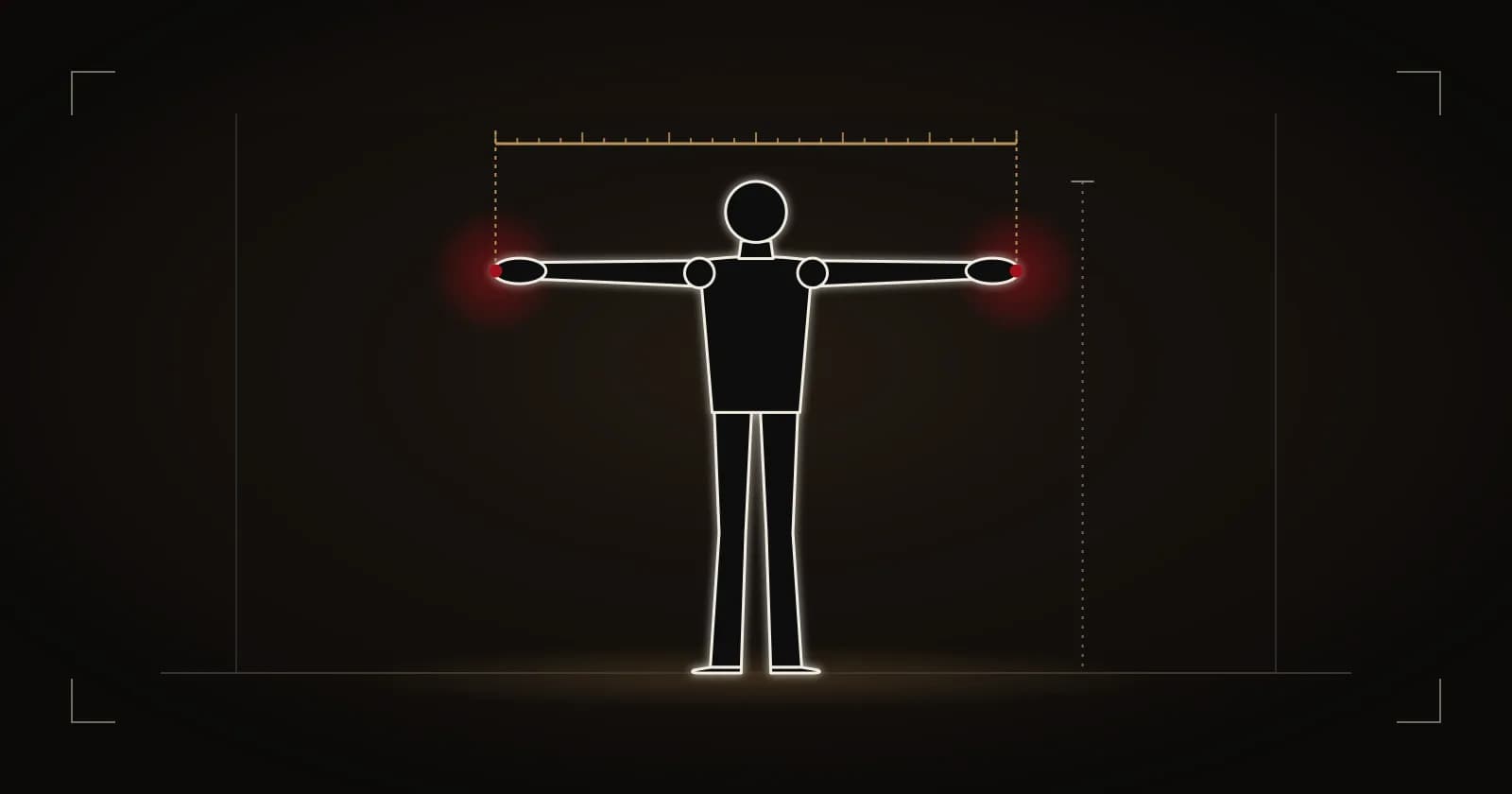
In the UFC, reach means arm span: the distance from the tip of one middle finger to the tip of the other with both arms stretched straight out to the sides. The UFC prints it in inches on every fighter's athlete page, next to height and leg reach, so Jon Jones reads 76 inches tall with an 84.5 inch reach.
You can take the same measurement at home in two minutes with a wall, a tape and a partner. Below you get the numbers the UFC publishes, the measuring method research labs use, a worked example, the ape index math, and what the biggest study of reach in MMA found about winning.
Read the UFC's tale of the tape
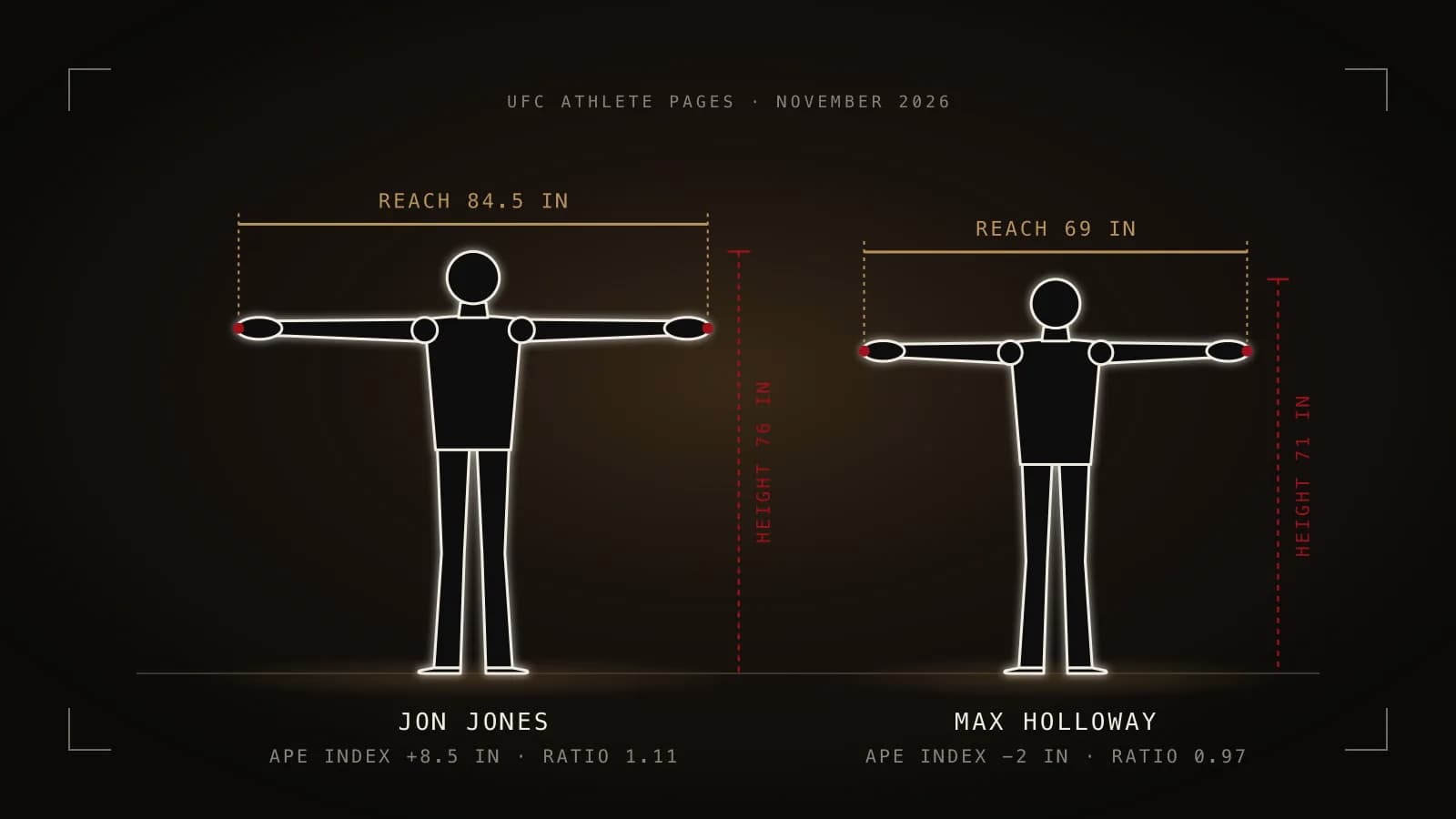
Open any UFC athlete page and you find three body numbers under the bio: height, reach and leg reach. The pages print bare numbers, and a heavyweight listed at 76 tall can only be measured in inches. Here are three current fighters, copied from their UFC athlete pages in November 2026:
| Fighter | Division on the page | Height | Reach | Leg reach | Reach minus height | Reach divided by height |
|---|---|---|---|---|---|---|
| Jon Jones | Heavyweight | 76 in | 84.5 in | 45 in | +8.5 in | 1.11 |
| Ilia Topuria | #1 Lightweight | 67 in | 69 in | 37 in | +2 in | 1.03 |
| Max Holloway | #4 Lightweight | 71 in | 69 in | 42 in | -2 in | 0.97 |
Topuria and Holloway post the same 69 inch reach, yet Holloway stands 4 inches taller. Same reach, different frames: that is why fighters compare reach with height instead of reading reach alone.
The pages give no note on how staff took the numbers, so treat them as the published record and measure yourself the way researchers do. Fight week also brings the weigh-in. If you cut water for yours, plan what you drink between the scale and the cage in the free post-weigh-in rehydration calculator.
Measure your reach at a wall in five steps
Labs that measure arm span for health research use a simple, repeatable method. A 2008 study in Annals of Thoracic Medicine describes it: the person stands with their back against a wall, arms spread in a straight line parallel to the floor, and the tape runs from the tip of the right middle finger to the tip of the left middle finger across the chest at the collarbones. The team read each measurement to the nearest 0.5 cm, took it three times and averaged the three.
Copy that method:
- Find a long, flat wall. Stand barefoot with your heels, hips and upper back against it.
- Raise both arms to shoulder height. Keep them straight and level with the floor, palms facing forward, fingers together and stretched long.
- Have a partner mark both middle fingertips. A pencil mark or a strip of tape on the wall works. Do not reach or lean toward one side.
- Measure between the marks. Read the tape to the nearest half inch or half centimeter.
- Repeat twice more and average. Step off the wall, shake your arms out and set up fresh each time.
Measure your height the same day, barefoot, with your heels against the wall and your head level. The same study measured height barefoot with the head in a level position, so your two numbers stay comparable.
Work through one example
You stand 70 inches tall. Your three reach readings come out at 72.5, 72 and 72.5 inches.
- Average reach: (72.5 + 72 + 72.5) ÷ 3 = 72.3 inches.
- Reach minus height: 72.3 minus 70 = +2.3 inches.
- Reach divided by height: 72.3 ÷ 70 = 1.03.
- In centimeters: 72.3 × 2.54 = 183.6 cm of reach on a 177.8 cm frame.
Enter your height and reach in the free reach calculator to get your ape index and to compare it with UFC fighters at your height.
Work out your ape index
Climbers and fighters call the ratio of arm span to height the ape index. A 2019 systematic review of climbing performance uses exactly that definition and found mixed results for whether a high ratio helps on the wall, with a tendency toward a benefit.
You can write your ape index two ways, and both describe the same body:
- As a difference: reach minus height, in inches or centimeters. Jones sits at +8.5 inches, Holloway at -2.
- As a ratio: reach divided by height. Jones sits at 1.11, Holloway at 0.97.
For most adults, arm span lands close to height. A study of 553 young adults by Reeves, Varakamin and Henry found correlations of 0.73 to 0.89 between the two, and it also found the relationship differs between ethnic groups and between men and women. A much larger data set of 13,947 people aged 5 to 99, analyzed by Quanjer and colleagues, showed the ratio changes with age, runs higher in males than in females, and differs between regions.
So a ratio near 1.00 is ordinary. In the MMA study by Christopher Kirk, the women's strawweights averaged a ratio of 1.003 among winners and 1.010 among losers. Jones' 1.11 sits far outside that range, which is why his reach became a talking point for most of his career.
Know what reach decides in a fight
Reach feels decisive when you watch a long fighter hold someone on the end of a jab. The data say it decides less than you think.
Kirk analyzed five years of professional MMA, 2,229 bouts in all, and checked age, height, arm span and the ratio of arm span to height for winners and losers. His results, published in Research Quarterly for Exercise and Sport:
| What Kirk checked | What he found |
|---|---|
| Age | Winners averaged 29.8 years and losers 30.7 years. Age separated winners from losers across the whole cohort. |
| Arm span | It made a difference at heavyweight only: winners averaged 198.4 cm and losers 196.1 cm. |
| Ratio of arm span to height | A higher ratio was a disadvantage in women's strawweight only. |
| How the bout ended | None of the measures changed how bouts were won. |
His conclusion: the effect of body shape on MMA results is greatly overstated and looks irrelevant in most divisions. A longer reach gives you an option. Your footwork, timing and defense decide whether you use it.
Fight long when your reach runs long
If your ratio sits above 1.0, make your opponent pay to enter your range. Keep your lead hand busy, step back or pivot off the line as they come in, and reset to your distance instead of trading in the pocket. Your boxing stance sets that range: a stance that lets you jab and step back in one motion turns extra inches into points.
Close the gap when your reach runs short
If your ratio sits below 1.0, plan your entries. Slip or parry the jab and step in behind it, take an angle instead of walking straight down the middle, and do your work once you are inside their arms. Your punching power comes from your legs and hips, and the guide on how to punch harder breaks down where that force comes from.
Fix the five measuring mistakes
Most wrong reach numbers start with the setup:
- Your arms drift up or down. A span taken with the arms angled reads shorter. Keep both arms level with the floor at shoulder height.
- You reach for the mark. Leaning toward one side stretches one arm and pulls the other. Keep your back flat on the wall.
- You make a fist. Research measures to the middle fingertips. Stretch your fingers long so your number compares with published spans.
- You trust one reading. Take three and average them, the way the 2008 study did.
- You mix units. The UFC pages use inches. Multiply inches by 2.54 for centimeters before you compare with a study in centimeters.
Train your range with video
Your reach is fixed, but the range you fight at changes every exchange, and you can only judge it on film.
Check your range on film in MMA AI: Cage Coach
Film one sparring round from the side and add the clip to MMA AI: Cage Coach. Coach Rico scores each technique from 0 to 100 with frame-by-frame feedback on your stance and strike accuracy, so you can step to the frame where your jab falls short and ask him how to manage distance with your reach in the next round.
If you compare apps before you film, our ranking of the best MMA apps lays out what each one reviews.
Get quick answers
How does the UFC measure reach?
The UFC lists reach as arm span in inches on each athlete page, beside height and leg reach. It does not publish the measuring method on those pages. Research labs measure arm span with the back against a wall, arms level at shoulder height, from one middle fingertip to the other.
Is reach the same as wingspan?
Yes. Reach, wingspan and arm span all name the same measurement: the distance between your middle fingertips with both arms stretched out to the sides.
What is leg reach in the UFC?
Leg reach is a second length the UFC prints on athlete pages, separate from arm reach. Jon Jones shows 45 inches and Ilia Topuria 37 inches. The pages do not say how either length was measured.
What is a good reach for my height?
A reach close to your height is normal, a ratio near 1.00. Arm span tracks height closely in most adults, though the ratio shifts with age, sex and ancestry. A ratio above 1.00 gives you more range for your size, and a ratio below 1.00 means you plan your entries.
Does a longer reach win more fights?
Not by much. In 2,229 professional MMA bouts, arm span separated winners from losers at heavyweight only, and age mattered more across the whole cohort.
Check the sources
- UFC athlete page: Jon Jones, checked November 2026.
- UFC athlete page: Ilia Topuria, checked November 2026.
- UFC athlete page: Max Holloway, checked November 2026.
- Kirk C. A 5-year analysis of age, stature and armspan in mixed martial arts. Research Quarterly for Exercise and Sport, 2024;95(2):450-457.
- Reeves SL, Varakamin C, Henry CJ. The relationship between arm-span measurement and height with special reference to gender and ethnicity. European Journal of Clinical Nutrition, 1996;50(6):398-400.
- Quanjer PH and colleagues. All-age relationship between arm span and height in different ethnic groups. European Respiratory Journal, 2014;44(4):905-912.
- Using arm span to derive height: impact of three estimates of height on interpretation of spirometry. Annals of Thoracic Medicine, 2008;3(3):94.
- Saul D, Steinmetz G, Lehmann W, Schilling AF. Determinants for success in climbing: a systematic review. Journal of Exercise Science and Fitness, 2019;17(3):91.
Try these free tools
Train MMA with AI
MMA AI: Cage Coach reviews your technique, helps plan training, and tracks nutrition. Download it free, then check the App Store for current paid access.