How to Improve Reaction Time: Drills and Training Backed by Research
Learn how to improve your reaction time with drills for fighters, the research behind why choice reactions lag behind simple ones, and a free test to track your progress.
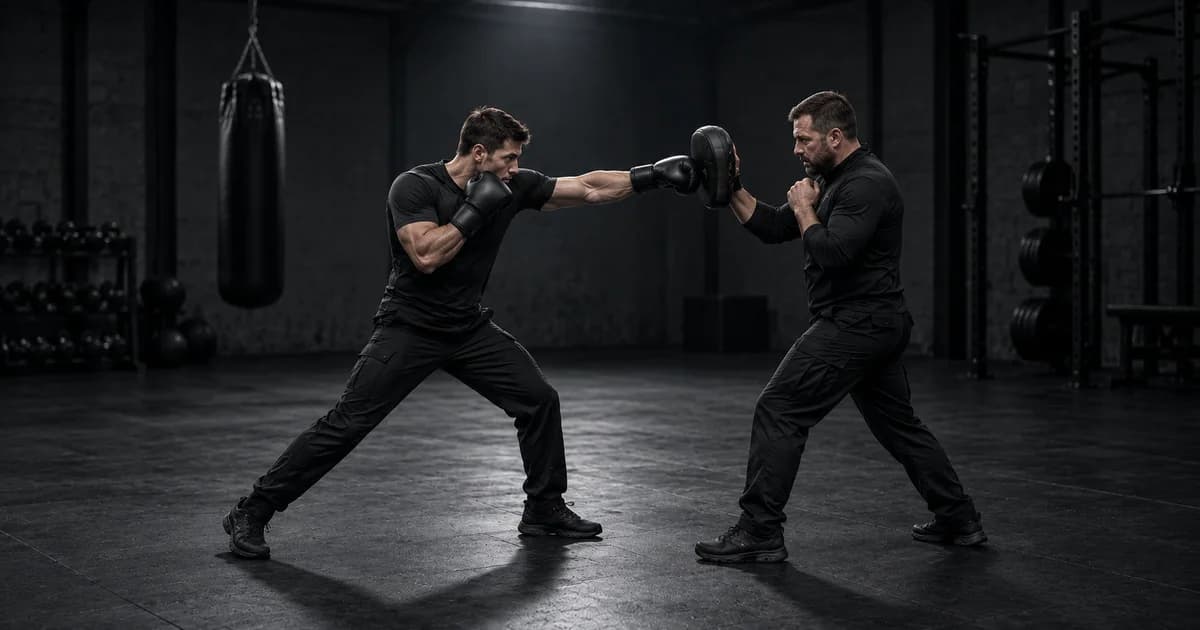
You improve your reaction time by training the specific type of reaction your sport demands. Generic speed work alone will not do it. Drill a single known cue until it gets faster (simple reaction), then drill picking the right response from two or more options (choice reaction), because fighting almost always gives you more than one possible cue. Add sleep, a proper warm-up and regular practice, and you address the three factors the research ties most consistently to a faster response.
Below you get the difference between simple and choice reaction time, six drills that target each one, the conditions that quietly slow your reaction time, and a free tool to measure where you stand today.
Measure your reaction time before you train it
You cannot see a 50 millisecond improvement by feel. Run our Fighter Reaction Time Test first: Simple mode gives you 5 trials against a single visual cue, and Choice mode gives you 10 trials where you have to read a jab or slip cue and answer with the matching side. Save your result, then retest every 2 to 3 weeks on the same device so your comparisons stay fair.
Know the difference between simple and choice reaction time
Reaction time research splits responses into types. A simple reaction has one known stimulus and one known response, like reacting to a single light. A choice reaction gives you two or more possible stimuli, each needing a different response, like reading whether your opponent is about to jab or shoot for a takedown (Kosinski, Clemson University). Choice reaction time is consistently the slowest of the two, because your brain has to identify the signal before it can act on it. An early comparison by Laming found simple reactions averaging 220 milliseconds against 384 milliseconds for a recognition task, nearly double the time, from added identification alone (Kosinski).
That gap matters for your training. A fighter who only drills reacting to one predictable signal, like a single pad coming up, gets fast at that narrow task and nothing else. Live exchanges are choice reactions: your opponent offers multiple possible attacks, and you have to identify which one is coming before you can answer it. Train both, but spend more of your working sets on choice drills if your goal is live performance.
Why experienced fighters read faster than beginners
A 2023 study measured the choice reaction time of 20 boxers responding to a jab-or-cross cue with the matching hand. Boxers with more than 5 years of experience answered the jab cue in a median of 570 milliseconds with their dominant hand, compared with 611 milliseconds for boxers with under 3 years of experience, a statistically significant gap (Yordanova et al., 2023, Journal of Physical Education and Sport). The same study found cross punches took longer to execute than jabs in both groups, and the dominant hand was consistently faster than the non-dominant hand.
None of that gap comes from faster nerves. It comes from pattern recognition built through repetition: an experienced fighter has seen the cue thousands of times and needs less processing to identify it. A separate line of research found that karate practitioners with more experience had shorter reaction times than less experienced practitioners doing the same task, while the opposite pattern showed up in volleyball players in that comparison, a reminder that reaction gains are sport-specific and come from repetitions inside your own sport (Fontani et al., cited in Kosinski).
Try 6 drills that train reaction time directly
Work these into the first 10 to 15 minutes of a session, while you are fresh. Fatigue slows reaction time, so save pure speed work for early in practice (Kosinski).
| Drill | Type | How to run it |
|---|---|---|
| Ruler or stick drop catch | Simple | A partner drops a stick between your open fingers without warning. Catch it as fast as you can. Swap which hand catches. |
| Single-mitt flash | Simple | Your coach holds one focus mitt still, then flashes it up once. React with one punch. No combinations yet. |
| Two-mitt choice | Choice | Your coach raises the left or right mitt at random. Throw the matching-side punch. This is the jab-or-slip pattern our Choice mode trains. |
| Color or number call-out | Choice | A partner calls a color or number while you shadowbox or dribble a ball. Respond with a pre-agreed action for each call without breaking your rhythm. |
| Live read sparring rounds | Choice | Short, controlled rounds where your only goal is identifying the first strike or shot your partner throws. Save the counter for later and isolate the read from the answer. |
| Reduced-light or eyes-closed warmup | Simple | Shadowbox with your eyes closed for 10 seconds, then open them and react to your coach's single cue. This removes visual anticipation and forces a genuine reaction. |
Run 3 to 5 sets of 8 to 10 reps per drill, 2 to 3 times a week. Reaction time to a visual stimulus has been shown to improve measurably after about 3 weeks of consistent practice, with the gains holding up for at least that long afterward (Ando et al., cited in Kosinski).
Train the conditions that quietly slow you down
Drills improve your ceiling. These factors decide whether you hit it on a given day.
- Sleep. Sleep deprivation lengthens reaction time in adults in their twenties, while the same study found little effect on much older adults, so do not assume you are the exception (Philip et al., cited in Kosinski). A separate study found that acute sleep deprivation and acute low blood sugar both lengthened reaction time on their own (Jauch-Chara et al., cited in Kosinski).
- Warm-up and arousal. Reaction time is fastest at a moderate level of arousal and gets worse when you are either flat or over-amped (Kosinski). A short isometric contraction of the muscles you are about to use, such as a 3 second push against an immovable object, has been shown to shorten the reaction time that follows it, which is a reasonable case for a brief activation exercise right before you drill (Etnyre and Kinugasa, cited in Kosinski).
- Fatigue. Reaction time gets slower as you fatigue, and the drop-off is bigger on complex, choice-style tasks than on simple ones (Welford and Singleton, cited in Kosinski). Put your highest-value reaction drills early in a session, well before your hardest conditioning.
- Distraction. Background noise and a second simultaneous task both lengthen reaction time (Kosinski). Add real-world noise and distraction only once the basic pattern is automatic.
Avoid these reaction-training mistakes
| Mistake | What happens | Your fix |
|---|---|---|
| Only drilling one predictable cue | You get fast at that one cue and nothing transfers to live rounds | Spend most sets on choice drills with 2 or more possible signals |
| Training reaction work when already fatigued | Your numbers get worse and you reinforce a slow pattern | Drill reaction work in the first 10 to 15 minutes of practice |
| Guessing instead of reacting | You start moving before the cue appears, which looks fast but counts as a false start | Use a tool that flags false starts and review your rate alongside your speed |
| Skipping sleep before a technical session | Your reaction times run slower regardless of how hard you trained reaction drills | Prioritize sleep the two nights before a session that depends on sharp reads |
| Never retesting | You cannot tell a real gain from day-to-day noise | Retest with the same method every 2 to 3 weeks and compare each session's median to the last |
Turn a faster read into a faster counter with MMA AI
A faster reaction only pays off in the cage if your technique catches up to your timing. Film a live-read sparring round or a two-mitt choice drill and open MMA AI: Cage Coach. Coach Rico reviews your striking, wrestling and cage-work footage and flags one specific habit to fix, so you are not guessing which part of your read-and-react sequence is costing you the exchange. Pick one correction, drill it for a week, then film the same round again.
Put your numbers to work
Reaction time and punch speed are related but separate measurements. Once you have a reaction time baseline, run our Punch Speed Test to see how quickly you close the gap once you decide to move. Pair both with a real training plan: our boxing footwork drills build the base that lets a fast read turn into a fast step, our 30-day shadow boxing program gives you daily reps without a partner, and our solo MMA training schedule slots reaction drills into a full week. If striking combinations are your priority, our beginner kickboxing combinations guide gives you the technique to react with once your read gets faster.
Your reaction time questions, answered
How long does it take to improve reaction time?
Research on visual reaction time found a measurable improvement after about 3 weeks of consistent practice, with the gain holding for at least 3 more weeks afterward (Ando et al., cited in Kosinski). Retest every 2 to 3 weeks with the same method so you can see the trend instead of a single day's noise.
Is reaction time mostly genetic, or can you train it?
Both play a role. Simple reaction time has a biological floor you cannot train past, but choice reaction time depends heavily on how quickly you recognize a pattern, and pattern recognition improves with specific practice, as the experience gap between boxers in the 2023 study shows (Yordanova et al., 2023).
Does caffeine or a pre-workout improve reaction time?
That question needs its own evidence review and sits outside what this guide covers. What is well established is that sleep deprivation and low blood sugar both work against you, so the more reliable lever is protecting your sleep before a session that depends on sharp reads (Jauch-Chara et al., cited in Kosinski).
Can a slower reaction time mean something is wrong?
A single slow session usually just means fatigue, poor sleep or distraction. This guide and its test are training tools. They do not screen for a concussion or any neurological condition. If your reaction time drops suddenly after a blow to the head, stop training and see a qualified clinician before you return to contact work.
Related Articles
MMA Transition Video Review Checklist 2026
Aug 25, 2026 · 5 min read
MMAMcGregor vs Holloway 2: What the 69-Second Ending Did and Did Not Reveal
Aug 11, 2026 · 6 min read
MMAJustin Gaethje vs Ilia Topuria: Complete UFC White House Fight Analysis, Training Lessons and AI Coaching Breakdown
Jun 16, 2026 · 21 min read
Train MMA with AI
MMA AI: Cage Coach reviews your technique, helps plan training, and tracks nutrition. Download it free, then check the App Store for current paid access.