How to Build a Complete MMA Training Schedule (Even If You Train Alone)
A real weekly MMA training schedule for solo athletes. Striking, grappling, conditioning, and recovery splits with equipment-free options and 12 weeks of progressive overload.
Titans Grip
MMA Coach, integrating striking, wrestling, and submission grappling
The Solo MMA Problem: Why Most Advice Fails
MMA is harder to train alone than almost any other combat sport. A boxer can shadow box and pound a bag for an hour and still get 80% of what a coach would have given them. A runner runs. But MMA stacks striking, wrestling, BJJ, and conditioning on top of each other, and most of those skills are partner-dependent at the level you actually fight. Worse, the mainstream advice for solo athletes — "hit a heavy bag, do burpees, you'll figure it out" — produces a fighter with cardio and zero ground game.
This guide is for people who don't have a gym down the street, or whose work schedule fights them every week. It's a structured six-day plan that develops striking, grappling movement, and three-system conditioning, with honest accounting of what you can and can't build alone. References at the end are real and the linked drills come from material taught at sanctioned MMA gyms — not "abs in 30 days" content.
Key Takeaways
- Solo training can build 60-70% of MMA skills, but live grappling and timing require a partner. One weekly partner session makes a disproportionate difference.
- A six-day split with one rest day is optimal for busy athletes. Each session is 60-90 minutes.
- Train all three disciplines from day one. A 40/30/30 split (striking/grappling/conditioning) prevents skill gaps.
- Progressive overload over 12 weeks is essential. Weeks 1-4 build form, 5-8 add volume, 9-12 increase intensity.
- Track your progress with tools like the Titans Grip MMA AI to catch overtraining before injury.
Why Three Disciplines Need Six Days
A competitive MMA fighter has to be functional in three buckets: striking (boxing/Muay Thai/kickboxing), grappling (wrestling and BJJ), and conditioning (strength, anaerobic capacity, aerobic base). The mistake almost every solo athlete makes is gravitating to whatever they enjoy. Strikers skip mat drills. Grapplers shadow box once a week and call it striking. Everyone skips mobility until something tears.
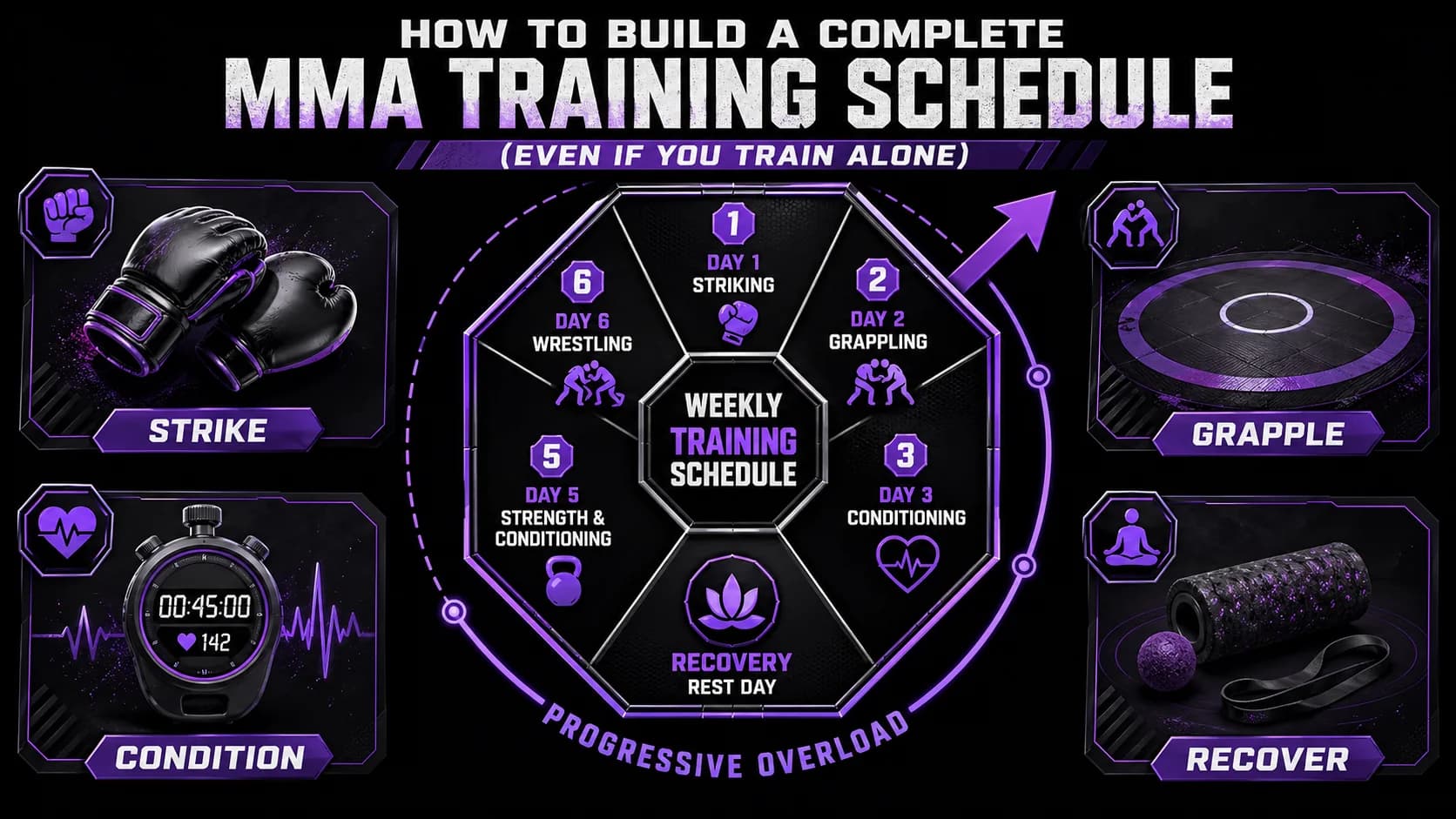
The schedule below is a six-day split with one true rest day. Each session has a primary focus and a secondary block, and total daily work sits between 60 and 90 minutes. That window is realistic for someone with a job — try to push past it and you'll cut sleep, which is where adaptation actually happens.
| Day | Primary Focus | Secondary Focus | Duration |
|---|---|---|---|
| Monday | Striking technique | Core | 75 min |
| Tuesday | Grappling movement | Grip strength | 60 min |
| Wednesday | Conditioning (HIIT) | Mobility | 75 min |
| Thursday | Striking power | Leg strength | 75 min |
| Friday | Grappling technique | Cardio | 60 min |
| Saturday | Full MMA simulation | Recovery | 90 min |
| Sunday | Rest | Active recovery | 30 min optional |
Train MMA with AI
Coach Rico analyzes your technique, scores your form 0-100, and builds your training plan.
Download MMA AIStep-by-Step: Monday – Striking Technique
Goal: Clean shapes through high-volume reps at moderate intensity. This is not a hard day. Hard days are Wednesday and Saturday.
Warm-up (10 min)
- 3 minutes jump rope (or high knees if you don't own one)
- 2 minutes shoulder circles
- 3 minutes light shadow boxing on the jab and cross only
- 2 minutes leg swings front-to-back and side-to-side
Block 1 – Boxing Fundamentals (15 min)
Five 3-minute rounds of shadow boxing with one minute rest between them.
- Round 1: Jab and cross only, full extension and clean return.
- Round 2: Add hooks and uppercuts.
- Round 3: Defense focus — slip after every combination.
- Round 4: Body-head with constant level changes.
- Round 5: Free flow.
Block 2 – Kicks (15 min)
If you have a heavy bag, run 5 × 2-min rounds of kick-focused bag work. If not, shadow kickboxing with a resistance band around your ankles (a power band threaded through a doorframe works).
- Round 1: Lead-leg roundhouse kicks (target 20 per round).
- Round 2: Rear roundhouse.
- Round 3: Teep to the body.
- Round 4: Switch kicks.
- Round 5: Free combinations ending in a kick.
Block 3 – MMA Integration (15 min)
Three 3-minute rounds combining hands, kicks, and cage-specific footwork.
- Practice dirty boxing — short hooks and uppercuts — against a wall to mimic the fence.
- Drop into level changes as if you're shooting a takedown, then return to striking.
- Drill the strike-to-takedown transition: jab-cross, then shoot a shadow double-leg.
Core (15 min)
- Hollow body holds 3 × 30 sec
- Russian twists 3 × 20
- Dead bugs 3 × 12 per side
- Plank rotations 3 × 10 per side
- Hanging leg raises 3 × 12 (lying leg raises if you don't have a bar)
Cool-down (5 min)
Hip flexors, hamstrings, shoulders, neck.
Step-by-Step: Tuesday – Grappling Movement
Goal: The movement library wrestlers and BJJ players use without thinking. Build the patterns first; the techniques layer on top.
Warm-up (10 min)
- Technical stand-ups 2 × 10 each side
- Hip escapes (shrimping) 2 × room length
- Forward and backward rolls 2 × 10 each direction
- Granby rolls 2 × 5 each direction
Block 1 – Wrestling Movement (15 min)
- Sprawl drills 5 × 10 reps (explosive hip drop, hands on the imaginary head, return to stance)
- Penetration steps 5 × 10 each leg
- Spin drills against a wall, simulating circling behind an opponent, 3 × 1 minute each direction
- Wrestling stand-ups from all fours, 3 × 10
Block 2 – BJJ Solo Drills (20 min)
- Guard retention movement on your back with feet toward a wall — hip escape and re-guard as if someone is passing, 3 × 2 minutes
- Bridges 3 × 10
- Bridge-and-roll (upa) 3 × 5 each side
- Mount-to-S-mount-to-technical-mount transitions on a pillow or rolled towel, 3 × 5 each side
- Armbar drill from guard — hip lift, leg swing, finish on air, 3 × 10 each side
- Triangle setup, cutting the angle and locking onto a pillow, 3 × 10 each side
Grip Strength (10 min)
- Dead hangs 3 × max hold
- Towel hangs (drape a towel over the bar) 2 × max hold
- No bar? Farmer's carries with two heavy bags or kettlebells, 3 × 1-minute walks
- Wrist curls with anything weighted, 2 × 15 each direction
Cool-down (5 min)
Pigeon, frog stretch, butterfly.
Step-by-Step: Wednesday – Conditioning (HIIT)
Goal: Train all three energy systems. MMA uses the phosphocreatine system for explosive bursts of 5–10 seconds, the glycolytic system for sustained 30–120 second efforts, and the aerobic system between exchanges. Long slow distance only trains one of them, which is why pure runners tend to gas out in round two of a fight even though they can run a 10K.
Warm-up (10 min)
- 5 minutes light jog or jump rope
- 5 minutes dynamic stretching
HIIT 1 – Fight Simulation (20 min)
Each exercise 30 sec on, 15 sec rest. Four full rounds with 1 minute rest between rounds.
- Burpees (scrambles)
- Shadow boxing at max speed (exchanges)
- Sprawls (takedown defense)
- Mountain climbers (ground fighting)
- Squat jumps (explosive entries)
HIIT 2 – Striking Cardio (15 min)
With a bag, 5 × 2-min rounds with 30-sec rest. Each round breaks into:
- 30 seconds max power
- 30 seconds technical combos
- 30 seconds clinch knees
- 30 seconds at pace Without a bag, shadow kickboxing at 90% — aim for 80+ strikes per round.
Tabata Finisher (4 min)
20 seconds on / 10 seconds off, 8 rounds, alternating explosive shadow boxing and sprawls.
Mobility (15 min)
- Foam roll IT band, quads, upper back (2 minutes each)
- 90/90 hip switches 2 × 10
- Thoracic rotations 2 × 10 each side
- Shoulder dislocates with a band or towel 2 × 15
- Deep squat hold 2 × 30 sec
Step-by-Step: Thursday – Striking Power
Goal: Knockout power and explosive output. This is your second hard day.
Warm-up (10 min)
- 3 minutes jump rope with double-unders
- 3 minutes med ball throws (or explosive push-ups)
- 4 minutes dynamic warm-up
Block 1 – Heavy Bag Power (or Power Shadow Boxing) (20 min)
- Round 1 (3 min): Single power shots only. One punch at a time, full force, reset stance. Jab, cross, rear hook.
- Round 2 (3 min): Power combinations. 1-2, 3-2, body-head hooks. Every combo at 90%+ power.
- Round 3 (3 min): Power kicks. Rear roundhouse to body, lead roundhouse to leg, rear head kick. 8–10 per minute with full follow-through.
- Round 4 (3 min): Ground and pound from the knees, throwing hooks and hammer fists at the bag (or into a pillow on the floor). Practice posturing up and striking down.
- Rounds 5–6 (3 min each): Full simulation. Mix punches, kicks, knees, level changes. End every 20-second burst with a defensive movement.
- 1 minute rest between rounds.
Block 2 – Explosive Movement (10 min)
- Clap push-ups 4 × 8
- Jump squats 4 × 10
- Rotational med ball slams (or rotational burpees) 4 × 6 each side
- Broad jumps 4 × 5
Block 3 – Clinch and Dirty Boxing (10 min)
Against a wall or heavy bag:
- Double collar tie knees 3 × 10 each
- Inside trip footwork 3 × 10 each side
- Pummel drill against a band looped around a post 3 × 30 sec
Leg Strength (15 min)
- Bulgarian split squats 3 × 10 each leg
- Single-leg RDLs 3 × 10 each side
- Calf raises 3 × 20
- Wall sits 2 × 45 sec
Cool-down (5 min)
Quads, hip flexors, hamstrings, calves.
Step-by-Step: Friday – Grappling Technique
Goal: Positional understanding and submission mechanics, drilled clean. Friday is light enough that Saturday's simulation works.
Warm-up (10 min)
- Hip escapes 3 × room length
- Forward rolls 2 × 10
- Technical stand-ups 2 × 10 each side
- Sit-outs 2 × 10 each side
Block 1 – Positional Flow (15 min)
Use a grappling dummy, a heavy bag flat on the floor, or a stack of pillows. Run five full cycles of: closed guard → hip escape to half guard → knee shield → technical stand-up → level change to a shadow double-leg → side control → mount → back. Each cycle takes 2–3 minutes. Smooth wins; speed comes later.
Block 2 – Submissions (10 min)
- Armbar from mount 3 × 10 each side
- Rear naked choke from back control on the dummy, focusing on hand position and hook depth, 3 × 10
- Guillotine — grip, hip thrust, guard pull, 3 × 10
- Triangle from guard with the angle cut, 3 × 10
Block 3 – Wrestling Chains (10 min)
- Single-leg to double-leg switch 5 × 5 each side
- Sprawl to front headlock to go-behind 3 × 10
- Takedown defense to clinch to trip in shadow form, 3 × 1-minute rounds
Cardio Finisher (10 min)
5 × 1-minute rounds. From your back: technical stand-up, three-punch combination, sprawl, ground-and-pound for 5 seconds, hip escape to guard, repeat. 1 minute rest between rounds.
Cool-down (5 min)
Hips, lower back, shoulders.
Step-by-Step: Saturday – Full MMA Simulation
Goal: Pressure-test everything you drilled all week. This is the most important session — also the most likely to break you if your sleep and nutrition aren't right. Skip it before you skip a recovery day.
Warm-up (15 min)
- 5 minutes light jog or rope
- 5 minutes shadow boxing (light)
- 5 minutes grappling movement
Block 1 – Three-Round Amateur Fight Simulation (15 min)
3 × 3-minute rounds, 1-minute rest. Each round: shadow box the first 90 seconds, "shoot a takedown" at 1:30, transition to ground work for 30 seconds (ground-and-pound or positional drilling on the bag/dummy), "stand back up," finish striking. Intensity 80–90%.
Block 2 – Position-Specific Rounds (18 min)
- Round 1: Against the cage. Back to a wall — frame, underhook, level-change out. Then face the wall and apply cage pressure with dirty boxing.
- Round 2: Takedowns. Continuous entries on the bag or in shadow. Doubles, singles, body locks, trips. Vary everything.
- Round 3: Ground. Start on your back. Guard retention, sweeps, stand-ups for the full round.
- Round 4: Clinch. Collar ties, underhooks, knees, elbows against a bag or wall.
- Round 5: Championship round. Maximum sustainable intensity. Don't stop moving.
- 1-minute rest between rounds.
Block 3 – Scenario Drilling (12 min)
Pick three scenarios, four minutes each.
- Down on points — you need a finish. Aggressive combinations and takedowns.
- You got rocked — survive one minute. Clinch, move, don't shell up stationary.
- Your opponent is hurt — close distance and finish. Ground-and-pound or standing barrage.
Recovery (15 min)
- Foam roll full body, two minutes per area
- Static stretches at 45 seconds minimum — hip flexors, hamstrings, shoulders, neck, lower back
- Two minutes of diaphragmatic breathing on your back: 4-second inhale through the nose, 8-second exhale through the mouth
Step-by-Step: Sunday – Rest
Walking, swimming, or light cycling for 20–30 minutes if you want it. Ten minutes of mobility flow. Watch fights and study tape — this counts. Sunday is also a good day to film one of last week's sessions and review it; the fatigue makes it easier to be honest about what you saw.
Common Mistakes and How to Avoid Them
| Mistake | Why It Happens | Fix |
|---|---|---|
| Skipping grappling | Striking is more fun to shadow box | Dedicate Tuesday and Friday to grappling only |
| Overtraining | Feeling like you need to do more | Watch resting heart rate; take a deload week every 4th week |
| Ignoring mobility | Feels unproductive | Add 15 min mobility to Wednesday; it prevents injury |
| No progressive overload | Same routine every week | Follow the 12-week progression below |
| Poor nutrition | Convenience over planning | Prep meals; hit 1g protein per lb bodyweight |
Decision Rules: When to Adjust Your Training
- If you're consistently sore for more than 48 hours: Reduce volume by 20% for a week.
- If your resting heart rate is 5+ beats above normal: Take an extra rest day.
- If you're bored: Swap a striking day for a kickboxing focus, or add a new submission to drill.
- If you have only 30 minutes: Cut to the core block. Striking days: 4 rounds shadow boxing (12 min) + 10 minutes of core. Grappling days: solo flow (15 min) + 10 minutes of grip. Conditioning days: a single 4-minute Tabata + 10 minutes of mobility.
- If you can find a partner: Even one session a week makes a disproportionate difference. Prioritize live grappling and sparring.
Equipment-Free Swaps
You don't need a gym. You do need to be honest about substitutions.
| Equipment | Swap |
|---|---|
| Heavy bag | Shadow boxing/kickboxing with a resistance band anchored to a doorframe. For kicks, a tree wrapped in old foam mats outdoors works, or stick to shadow with light ankle weights. |
| Pull-up bar | Dead hangs become towel-wringing — soak a towel and wring it out, three sets of 30 seconds. Pull-ups become inverted rows under a sturdy table. |
| Grappling dummy | A duffel stuffed with old clothes, towels, and blankets, 40–60 lb total. A heavy bag flat on the floor also works for ground-and-pound. |
| Medicine ball | A backpack loaded with books, 15–20 lb. Use it for slams, throws, rotations, and weighted carries. |
Twelve-Week Progression
The schedule above is your week-1 baseline.
Weeks 1–4 (Foundation)
The schedule as written. Form over intensity. Film one session per week and review it.
Weeks 5–8 (Volume)
- Add one round to every striking session.
- Add 5 minutes to every grappling session.
- Push HIIT to 5 rounds.
- Add light resistance — ankle weights for kicks, weighted vest for conditioning.
Weeks 9–12 (Intensity)
- All striking rounds at 3 minutes / 30 seconds rest.
- Conditioning at 85%+ heart rate.
- Saturday simulation extends to 5 × 3-minute rounds.
- If recovery allows, add a second conditioning session on Wednesday afternoon.
Track it with the Titans Grip MMA AI coaching tools — volume, technique scoring, conditioning trends. The goal isn't a prettier dashboard; it's catching the week your sleep slips before your knee does.
Nutrition (The Abridged Version)
- Daily calories: Bodyweight in pounds × 15–17 for maintenance at this volume. Add 200–300 to build, subtract 300–500 to cut.
- Macros (per pound of bodyweight): Protein 1 g, carbs 2–3 g, fats 0.3–0.4 g.
- Timing: Carb-rich meal 2–3 hours pre-training. 30–40 g protein within an hour post-session. Three to four liters of water daily, more if you're sweating heavily.
- Standard combat-athlete guidance — see the NSCA's "Strength and Conditioning Considerations for Mixed Martial Arts" by La Bounty et al. (2011) for the full protocol.
Comparison Table: Solo Training Approaches
| Approach | Pros | Cons | Best For |
|---|---|---|---|
| This 6-day schedule | Balanced, progressive, equipment-free options | Requires discipline; no live feedback | Athletes with 60-90 min/day |
| Gym-only training | Live sparring, coaching, community | Expensive, schedule-dependent | Those with access and budget |
| App-based coaching (e.g., Titans Grip MMA AI) | Structured, trackable, adaptive | Requires phone/tablet | Solo athletes who want data |
| Random YouTube workouts | Free, varied | No structure, no progression | Casual fitness, not competition |
Ranking Methodology for Solo Training Tools
When evaluating solo training tools, consider:
- Skill coverage (striking, grappling, conditioning)
- Progressive overload (does it scale?)
- Feedback mechanism (video review, heart rate, etc.)
- Cost vs. value
- Ease of integration into a busy schedule
The Titans Grip MMA AI ranks highly because it covers all three disciplines, offers progressive overload, and provides tracking. However, it requires a smartphone and cannot replace live sparring.
Honest Limitations of Each Option
- Solo training (no app): No feedback, easy to plateau, no live timing.
- Titans Grip MMA AI: Great for structure and tracking, but cannot correct your form in real-time.
- Gym training: Best for skill development, but expensive and time-consuming.
- YouTube workouts: Free, but often lack progression and can teach bad habits.
FAQ
Can you actually learn MMA without a partner?
You can build striking technique, conditioning, movement patterns, and positional understanding alone. What you cannot build is timing against a resisting opponent and live grappling sensitivity. Solo work gets you maybe 60–70% of the way; the rest needs mat time. Even one partner session a week makes a disproportionate difference, which is why open mats and seminars matter more than the volume of solo training you grind through.
How long until you're ready to compete?
For most athletes training six days a week, 12–18 months before a first amateur fight is realistic. The bottleneck for solo athletes is grappling — striking sharpens fast, but takedown defense and transitions need real bodies. Aim for at least three months of regular sparring before stepping into the cage.
Should I focus on one discipline first?
Train all three from day one. A pure striker gets taken down. A pure grappler gets cracked. The split here is roughly 40% striking, 30% grappling, 30% conditioning. Adjust to your weaknesses, but don't drop a discipline entirely.
What if I only have 30 minutes?
Cut to the core block. Striking days: 4 rounds shadow boxing (12 min) + 10 minutes of core. Grappling days: solo flow (15 min) + 10 minutes of grip. Conditioning days: a single 4-minute Tabata + 10 minutes of mobility. Thirty focused minutes outperforms 90 unfocused.
How do I avoid overtraining on six days?
Watch three things: resting heart rate (5+ beats above your normal in the morning means take an extra rest day), sleep quality (under seven hours consistently means cut volume), and joint pain (muscle soreness is fine, joint pain isn't). Take a deload week every fourth week — half the volume, same frequency.
What's the best app for solo MMA training?
The Titans Grip MMA AI is designed specifically for solo athletes, offering structured workouts, technique tracking, and progressive overload. It's not a replacement for a coach, but it's a solid tool for staying on track.
Can I build knockout power without a heavy bag?
Yes. Power shadow boxing with a resistance band, explosive push-ups, and rotational med ball slams (or backpack slams) all build explosive output. The key is intent — every rep at 90%+ effort.
How do I know if I'm improving?
Film yourself weekly. Compare your jab speed, kick height, and grappling flow. Track your conditioning times. Use the Titans Grip MMA AI to log sessions and spot trends. If you're not getting faster, stronger, or smoother over 4 weeks, adjust your training.
The Bottom Line
Training MMA alone is harder than training with a team, but it's not the impossible task most coaches make it sound like. Six honest days of work, a weekly recovery day you actually take, and a partner session whenever you can find one will move you further in 12 weeks than most gym-attending hobbyists move in a year. Roll the mat out. Track the work in the Titans Grip MMA AI so you stop arguing with yourself about whether last week was good or bad. Now go.
Other Doved Studio projects
Related tools from the same studio you might find useful:
- Glean: Turn scrolling time into a daily action plan. Capture, process, execute.
- Popout: Create your portfolio in minutes with a single shareable page.
- Doved Studio: Studio indie derrière cette app et une dizaine d'autres outils.
Coach Rico
MMA specialist. Expert in striking, wrestling, submissions.
Coach Rico is the AI coaching persona behind MMA AI, built to provide personalized mma guidance through video analysis, training plans, and technique breakdowns.
Related Articles
Justin Gaethje vs Ilia Topuria: Complete UFC White House Fight Analysis, Training Lessons and AI Coaching Breakdown
Jun 16, 2026 · 23 min read
MMAAlex Pereira vs Ciryl Gane: UFC White House Fight Analysis and Training Breakdown
Jun 15, 2026 · 26 min read
MMAUFC Freedom 250: The Science of Elite Fight Preparation — Training Methods, Biometrics, and AI Coaching
Jun 13, 2026 · 21 min read
Train MMA with AI
MMA AI gives you an AI coach that analyzes your technique, plans your training, and tracks your nutrition. Try it for free.