The 2026 Guide to Perfecting Your Sumo Deadlift
Master the sumo deadlift in 2026. Our guide breaks down stance, grip, and biomechanics. Use AI video analysis to score your form and unlock new PRs.
Titans Grip
Powerlifting Coach, squat, bench, deadlift programming and peaking
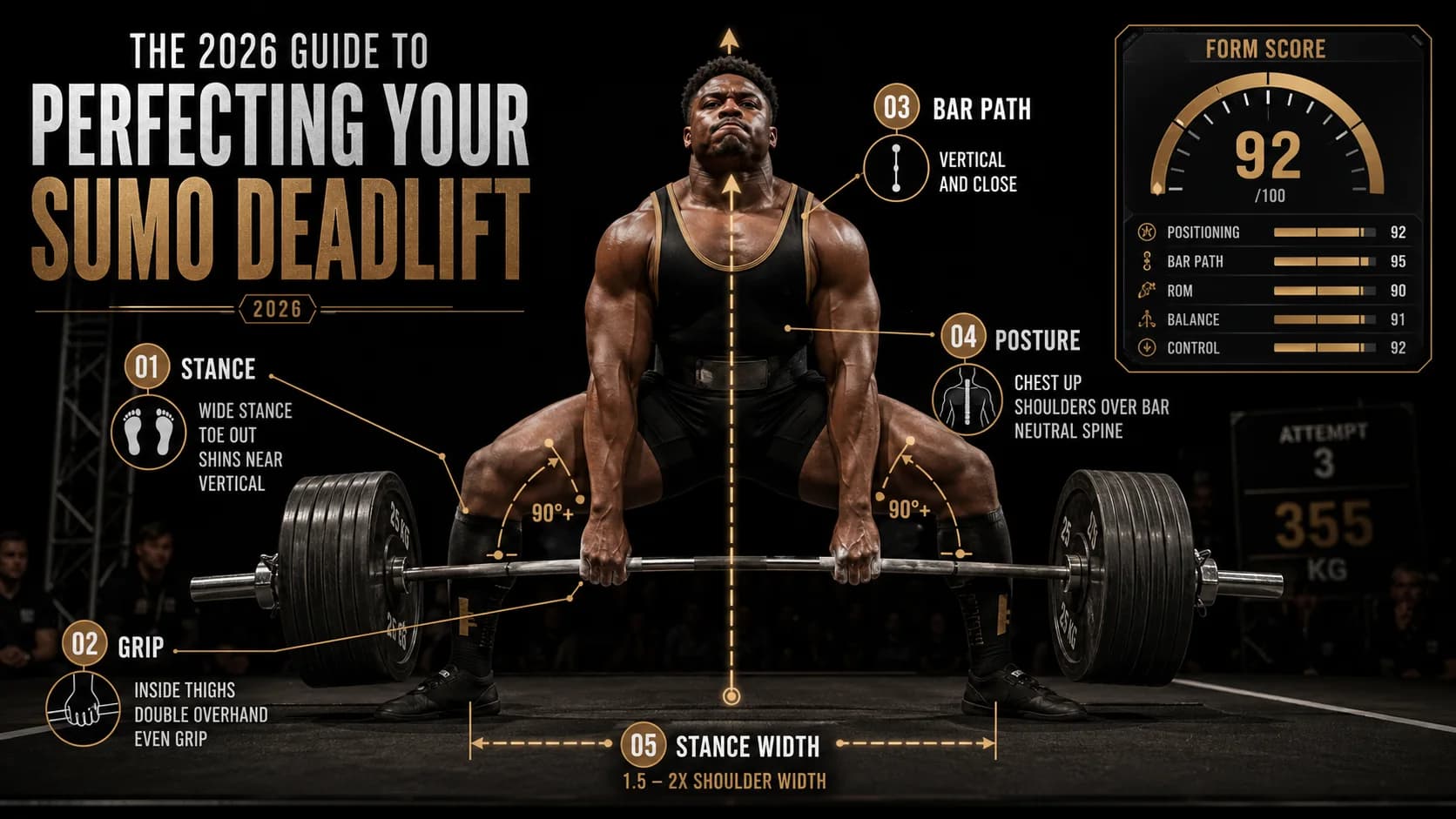
The sumo deadlift is a leverage trick. Sit a wide stance, point your knees out, get your hips closer to the bar, and the barbell travels less. Less travel means less work for the same kilograms. That single fact is why so many top lifters in the lighter and middle weight classes pull sumo, while the bigger guys often stay conventional. Look at the International Powerlifting Federation (IPF) results pages and the trend is hard to miss: sumo dominates the 59-83kg female classes and most of the men's classes under 100kg. Above 110kg, conventional starts winning back the room.
But the wider stance is not free. It punishes weak hips, lazy bracing, and anyone who tries to copy a stance from a YouTube clip without earning it. This guide explains the mechanics, walks through a 7-step setup you can drill on a Tuesday night, and shows you how AI video review can finally tell you whether your "good rep" is actually good.
What is a sumo deadlift?
A sumo deadlift is a barbell pull where you stand with your feet wider than your hands and your toes turned out, so you can sit your hips closer to the bar and lift with a more vertical torso. The classic three-dimensional analysis by Escamilla et al. (2000), published in Medicine & Science in Sports & Exercise, found that vertical bar travel, mechanical work, and predicted energy expenditure were roughly 25-40% greater for conventional pullers than sumo pullers in the same lifters. That is the whole pitch in one number. The cost is paid up front, in mobility, in quad work, and in patience.
| Feature | Sumo Deadlift | Conventional Deadlift |
|---|---|---|
| Stance Width | Wide, feet outside hands | Shoulder-width or slightly wider |
| Torso Angle | More vertical | More horizontal |
| Primary Movers | Quads, Glutes, Upper Back | Posterior Chain (Hamstrings, Glutes, Erectors) |
| Range of Motion | Shorter | Longer |
| Common For | Longer torso/shorter arms, hip mobility | Longer arms/shorter torso |
Who should use a sumo deadlift?
Sumo tends to favor lifters with longer torsos, shorter arms, and decent hip mobility. The wider stance lowers the start position and shortens the pull, which helps anyone whose arms do not naturally hang past mid-thigh. Greg Nuckols' analysis at Stronger By Science makes the case more carefully than most: anthropometry matters, but it is not destiny. Plenty of lifters with "conventional" builds still pull more sumo because they spent years getting strong in that position. If you are tall through the torso with shorter limbs, sumo is worth a real test cycle. So is it for any lifter coming back from a low-back issue, since the more upright torso reduces lumbar shear in the first inches of the pull.
What muscles does the sumo deadlift work?
The sumo deadlift hammers the quadriceps, glutes, adductors, upper back, and lats. Because the torso is more upright, less of the load passes through the spinal erectors and more passes through the leg extensors and the adductor magnus, which acts as a powerful hip extensor in a wide stance. Escamilla's 2002 EMG study showed greater vastus medialis, vastus lateralis, and tibialis anterior activity in sumo, and greater medial gastrocnemius activity in conventional. If your sumo pull stalls right off the floor, that is almost always a quad or adductor problem, not a back problem.
How does the sumo deadlift differ from conventional?
The core difference is leverage. Sumo shortens the moment arm between your hip and the bar, which keeps the torso closer to vertical and trims the bar's vertical travel. Conventional asks you to hinge harder, lean further, and lift with a longer lever through the lower back. Useful mental model: conventional is a hinge, sumo is a wedge. In sumo your job is to drive your knees out, push the floor away, and wedge your hips through to the bar. The bar barely moves until your legs do.
Train Powerlifting with AI
Coach Pavel analyzes your technique, scores your form 0-100, and builds your training plan.
Download Powerlifting AIWhy your sumo deadlift form matters
Good sumo deadlift form is the difference between a lifter who keeps adding weight for ten years and one who keeps refilling a physiotherapy account. Bad form does not just leave kilos on the platform. It quietly redirects load into joints that are not built to take it. The wider the stance, the less margin you have for sloppy bracing or a hip that opens before the bar moves.
Can bad sumo form cause injury?
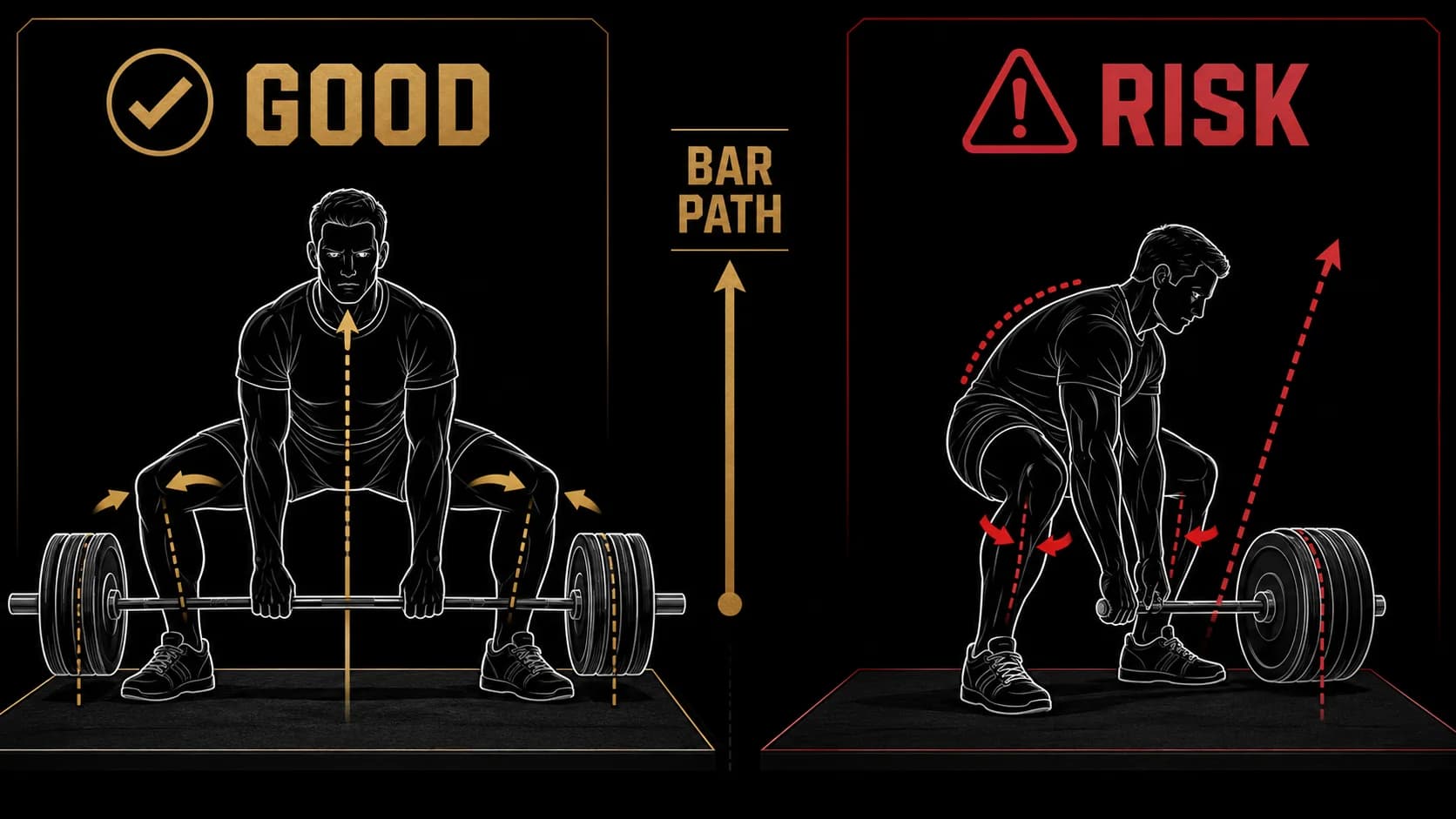
Yes. The most common injury patterns from poor sumo form involve the lower back, the hip joint, and the adductor group. A rounded lumbar spine under load is the obvious risk and the easiest to spot on video. The less obvious one is forcing a stance wider than your hips can actively control. When the knees collapse inward as the bar breaks the floor, the adductors have to fire while lengthening under heavy load, which is exactly the recipe for a strain. If your knees cave even at 60% of your max, your stance is too wide for now, not forever.
How much weight can proper form add?
A clean technical fix can add 5-15% almost overnight, and that is not a sales pitch, it is what you would expect from cleaning up bar path and bracing. Most lifters lose force in three places: a hip that opens before the bar moves, a chest that drops at the knees, and a finish that turns into a backward lean. Patch any one of these and the bar moves faster. Patch all three and a stalled max becomes a working set. The classic NSCA literature on motor learning supports this: form changes pay back fastest in the first few sessions, then taper off as the new pattern becomes default.
Why do my hips hurt when I sumo deadlift?
Hip pain in a sumo deadlift usually points to one of three things. Either you do not have the active external rotation to keep your knees over your toes, or your stance is wider than your real mobility, or you are starting with your hips too low and dragging the bar through your shins. A pinch in the front of the hip is often impingement caused by the femur driving into the socket at extreme angles. A deep ache in the groin is usually adductor overload. Neither one means "stop doing sumo." Both mean "regress the load, narrow the stance, fix the input." Our broader strength training resources cover the warm-up sequences that make this stick.
Is sumo deadlift easier than conventional?
No, and yes. Sumo is mechanically more efficient if your skeleton fits it, because the bar travels a shorter distance. It is technically harder to set up, and brutally unforgiving of weak quads or stiff hips. The "sumo is cheating" debate is internet noise. In a powerlifting meet you use the legal style that lifts the most weight. The real sumo vs conventional deadlift question is not which is easier. It is which one your body can express the most strength in over a long career.
How to sumo deadlift: a 7-step master checklist
Learning how to sumo deadlift is mostly about building a setup so consistent that every rep starts from the same wedge. Skip a step and the rep tells on you. Go through this in order, slowly, with a moderate weight, and treat the first month like skill practice rather than strength work.
Step 1: Stance and foot placement
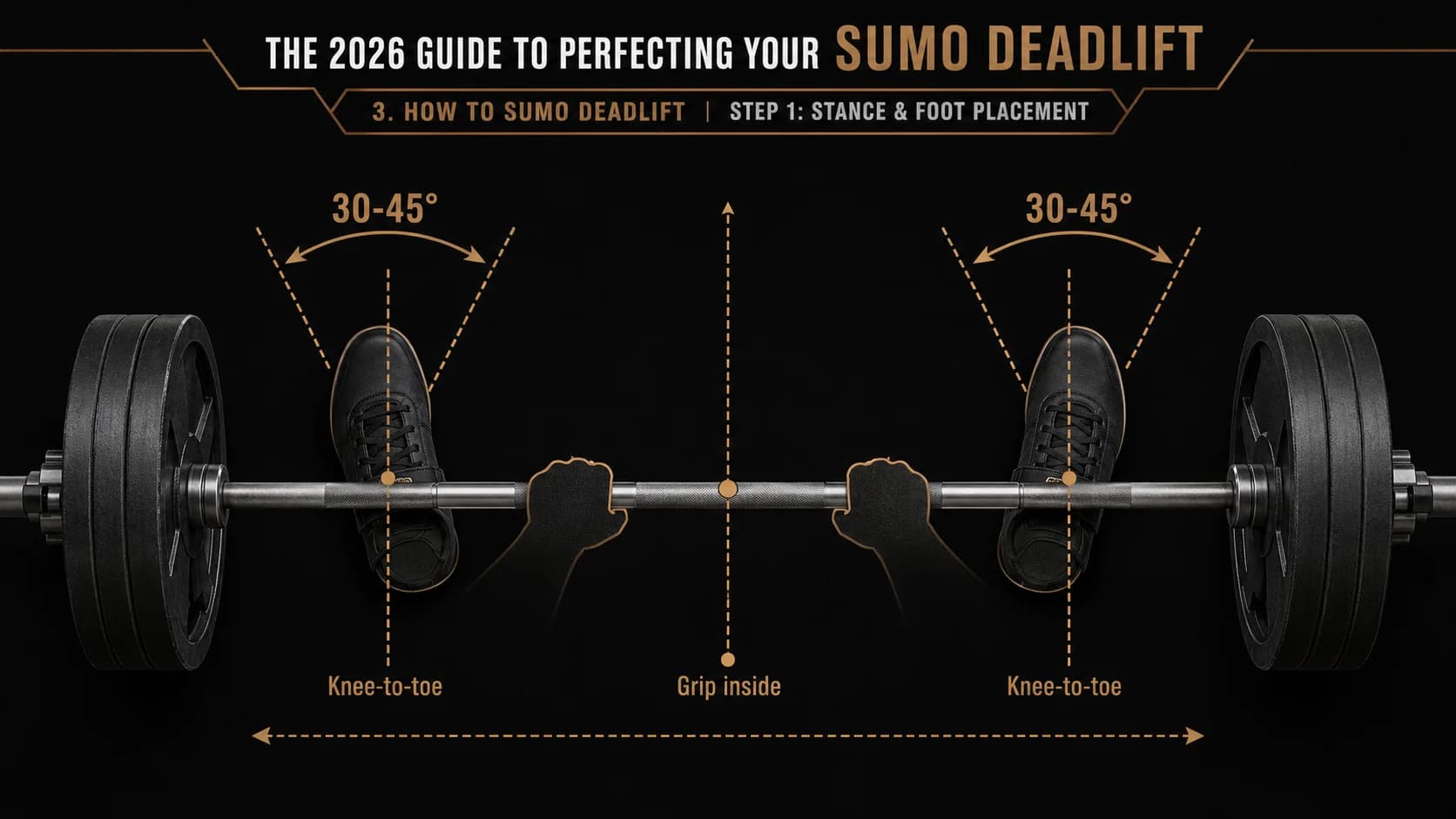
Set your feet wider than shoulder width with toes turned out 30 to 45 degrees. The shins should sit close to vertical when you look down. A simple sanity check: stand up, do a vertical jump, land naturally, then widen out from there. The inside of your foot will usually finish near the smooth ring on a standard 20kg barbell, but use that as a starting reference, not a rule. Your knees must travel in the same direction your toes point. If they cannot, narrow your stance until they can.
Step 2: Grip the bar
Grip the bar inside your legs with your hands roughly shoulder-width apart. Your arms should hang straight down from the shoulder so they act as ropes, not levers. Any bend in the elbow during the pull is wasted force and a torn bicep waiting to happen. Use a double overhand grip for warm-ups so you train your forearms. For top sets, switch to a hook grip or a mixed grip and use chalk. Most elite pullers compete with a mixed or hook grip simply because the bar will not hold under maximal load otherwise.
Step 3: Set your hips and back
Do not squat down to the bar. From your standing setup, push your knees out, drop your hips, and let your shins meet the bar. Your torso will be much more vertical than in a conventional pull. Pull air into your belly, brace as if you are about to be punched, then lift your chest until you feel a long flat line from tailbone to skull. Shoulder blades should sit roughly over the bar or a touch behind. If your butt is high in the air, your hamstrings are doing a job they are not supposed to do.
Step 4: The pull, break the floor
The first inches are a leg press, not a back pull. Push the floor away with your whole foot and shove your knees out as you go. Hips and shoulders should rise at the same speed. If your hips fly up first, the bar turns into a stiff-legged deadlift and the back takes everything. Cue yourself with "knees out, push down" rather than "pull up." That single change fixes more breakdowns off the floor than any program ever will.
Step 5: The lockout
As the bar passes your knees, drive your hips forward into the bar and squeeze your glutes hard. Do not lean back at the top. A leaned-back finish hyperextends the lumbar spine, looks ugly under judging, and can be reason for a red light in a meet. The legal finish is upright, knees locked, shoulders back, hips through. That is it.
Step 6: The descent
Reverse the motion under control. Push the hips back first, then bend the knees once the bar clears them. Dropping the bar is fine if your gym allows it, but you lose the eccentric strength work and the chance to feel the bar path on the way down. A controlled descent also keeps you out of trouble in shared gyms with thin platforms.
Step 7: The reset
Every rep starts from a dead stop on the floor. Touch-and-go reps train rebound, not starting strength. Let the bar settle, recenter your weight, breathe, brace, pull the slack out of the bar, then pull. This is also where most novice lifters lose tightness. Build the reset as carefully as the pull and you will own the lift. For a structured strength base around this lift, see our complete powerlifting program for beginners.
Proven strategies to fix your weak points
Past the first year, sumo deadlift training is mostly weak point work. Wherever the bar slows is where your body is asking for help. Programming for that exact stall is faster than adding random accessory volume.
How do I fix my sumo deadlift off the floor?
If the bar will not break the floor cleanly, you almost certainly need more quad and adductor strength. Two reliable tools: paused sumo deadlifts with a 1 to 2 second pause an inch off the floor, and wide-stance box squats. The pause kills the rebound and forces real concentric force. The wide box squat trains the exact hip angle you live in at the bottom of a sumo pull. Run them as a 4 to 6 week block and recheck.
What if I am weak at the knees?
A stall just past the knees usually means your glutes and upper back are not finishing what your quads started. Romanian deadlifts and sumo block pulls from a 5-10cm block fix this fast. Bands or chains on the bar add load through the lockout, which is the part you are weak in. Add one of these as your second deadlift session for a month and the lockout typically catches up.
How do I improve my sumo setup consistency?
Inconsistent setups quietly steal heavy attempts. Build a checklist and use it on every set: feet to bar, grip width, knees out, hips down, brace, pull slack. Film every top set from a side angle. AI coaching tools like Titans Grip will score each setup and flag deviations in hip height, bar position, and torso angle that you cannot feel yourself. Two weeks of side-on video review usually shows a clear pattern of what your "good rep" actually looks like. From there, repeat that pattern under load.
Should I train conventional if I pull sumo?
Yes, in moderation. Conventional deadlifts, deficit conventionals, and stiff-legs all build the posterior chain in ways that translate back to sumo lockouts and meet day resilience. Most elite sumo pullers, including 110kg standout Jamal Browner, use conventional variants in their off-season precisely for this reason. Treat conventional as accessory work, not as a second main lift, unless you are specifically running a long mechanical change.
Key takeaways
- Sumo cuts vertical bar travel by roughly 25-40% versus conventional in the same lifters, per Escamilla et al. 2000.
- Sumo loads the quads, glutes, adductors, and upper back more, with the lower back doing relatively less work than in conventional.
- The first inches of the pull should feel like a leg press with the knees pushed out, not a back lift.
- Stance preference correlates with weight class. Sumo dominates the lighter classes, conventional is more common above 110kg.
- Your sticking point tells you what to fix. Floor stalls are usually quad and adductor weakness. Knee stalls are usually glutes and lockout strength.
- Conventional pulls as accessory work build a more durable back and a stronger sumo lockout.
- Filmed setups and AI form scoring catch the small drift in hip height and bar position that your body cannot feel.
Got questions about the sumo deadlift? We have answers
What is the proper way to do a sumo deadlift?
Set a wide stance with toes turned out 30 to 45 degrees. Grip inside your legs with arms vertical. Push your knees out and drop your hips until your shins touch the bar with a near-vertical torso. Brace hard, pull the slack out of the bar, then push the floor away by driving your knees out and your whole foot down. Finish standing upright with hips through and shoulders back, no backward lean. Mastering how to sumo deadlift is mostly about repeating that exact sequence until it feels boring.
How much wider should my sumo stance be?
Wide enough that your shins sit close to vertical at setup, your knees track over your toes, and your hips can drop without your back rounding. For most lifters that ends up between 1.5 and 2 times shoulder width. The fastest way to find your stance is to start moderate, film a side and front view, and widen by 2-3cm at a time over a few weeks. A stance you cannot actively control is just a future hip strain.
Is sumo deadlift bad for your hips?
Sumo is not inherently bad for your hips. Forcing a sumo stance you do not have the mobility for absolutely is. With a stance that fits your hip range, with knees tracking over toes, and with progressive loading, the sumo deadlift is no harder on the hips than any other heavy lower-body lift. Pain is information, not a verdict on the lift itself.
Sumo vs conventional deadlift: which is better for me?
The sumo vs conventional deadlift answer is empirical, not philosophical. Film yourself pulling a moderate weight in both styles. Compare bar path, torso angle, and which feels more powerful at the second pull. Stronger By Science covers the anthropometric tendencies, but the real test is your body under load. Most lifters can name their stance after a single honest test session.
How often should I practice my sumo deadlift?
For intermediate and advanced lifters, one heavy sumo session every 5-10 days is enough to keep the pattern sharp without burning out the central nervous system. A common template is one heavy or low-rep day plus one lighter speed or technique day each week. Track your readiness and recovery so you can pull back when life gets noisy. AI training logs make this easy because they keep an honest record of what you actually did, not what you remembered doing.
Your sumo deadlift is a skill that rewards precise feedback. Stop guessing at form. Use tools that score your setup objectively, train against your real weak point, and build the pull your skeleton was actually designed for. Ready to get your technique scored and your questions answered any time you train?
Find Your Sport and see how AI-powered coaching can change how you pull.
Other Doved Studio projects
Related tools from the same studio you might find useful:
- Glean: Turn scrolling time into a daily action plan. Capture, process, execute.
- Popout: Create your portfolio in minutes with a single shareable page.
- Doved Studio: Studio indie derrière cette app et une dizaine d'autres outils.
Coach Pavel
Powerlifting specialist. Expert in squat technique, bench press, deadlift.
Coach Pavel is the AI coaching persona behind Powerlifting AI, built to provide personalized powerlifting guidance through video analysis, training plans, and technique breakdowns.
Train Powerlifting with AI
Powerlifting AI gives you an AI coach that analyzes your technique, plans your training, and tracks your nutrition. Try it for free.