Is Your Bench Press Form Actually Safe? (2026)
Pec tears keep climbing. Five technique checks, the data behind them, and how AI video review catches the flaws your spotter misses.
Titans Grip
Powerlifting Coach, squat, bench, deadlift programming and peaking
If you scroll the lifting side of TikTok for ten minutes, you will see a barbell get dropped onto someone's sternum. You will see arches that look more like cheerleading stunts than presses. You will see hands placed two finger-widths past the powerlifting rings, then nine-plate "wall benches" with the bar barely moving. The viral version of the lift is built for the algorithm. The pectoralis major is not.
The medical literature has been blunt about where this ends. A review of 365 pec tear cases going back to 1822 found that 76% happened in the last 20 years, and the rate has only climbed since (see PMC: pectoralis major rupture review). The single most common mechanism in modern reports: the eccentric phase of a heavy bench press. When the Journal of Special Operations Medicine profiled bench injuries in tactical athletes, the surgeons used the phrase "alarming frequency."
This article is not about chasing a one-rep max. It is about whether the rep you just put on Instagram is going to cost you a year of rehab. Five checks, the actual biomechanics behind each one, and a way to audit your own setup without trusting your felt sense, which is the part that fails first under load.
What does safe bench press form actually look like?
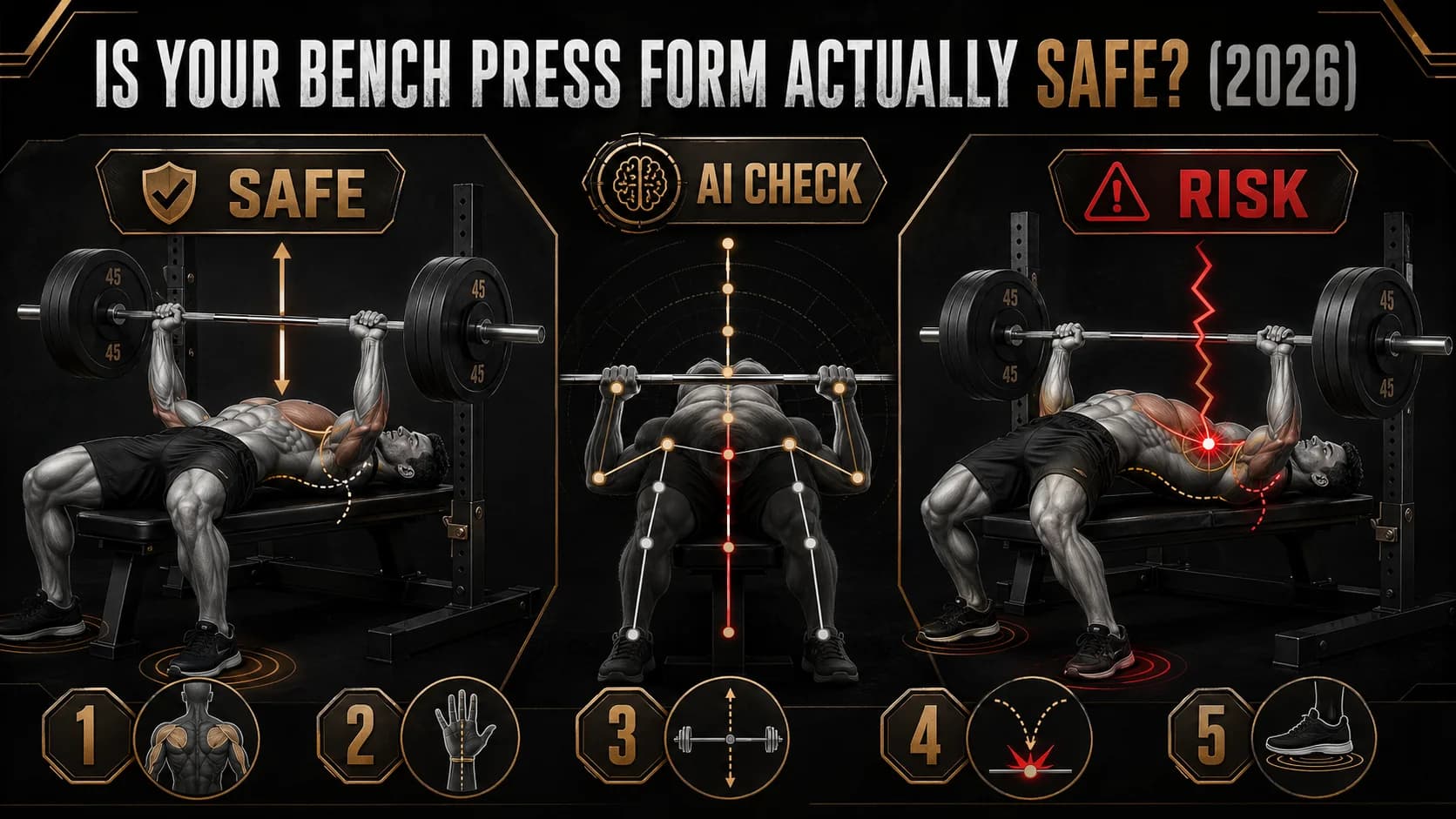
Safe bench press form is not a feeling. It is a set of repeatable joint positions and a controlled bar path that keep load on muscle and away from connective tissue. The NSCA summarizes it as scapular retraction and depression held throughout the lift, an arched but glute-down body position, and a slight diagonal bar path that finishes over the shoulder, not the face. Speed is not part of the definition. Arch depth is not part of the definition. Control is.
Use this as the contrast you want in your head whenever you film a working set:
| Variable | Safe technique | Algorithm-bait technique |
|---|---|---|
| Scapula | Retracted, depressed, locked into the bench like a shelf | Loose or shrugged up; humeral head exposed |
| Bar path | Slight diagonal from lockout to mid-sternum or just below the nipple line | Vertical, wobbly, or chasing the chest down with momentum |
| Eccentric | 2 to 3 seconds, lifter pulls the bar down with the lats | Dropped under gravity, depending on a chest-bounce |
| Arch | Thoracic extension; glutes and shoulders both stay on the pad | Lumbar hyperextension; pelvis lifts off the bench |
| Leg drive | Horizontal push into the floor that wedges the upper back into the bench | Hip thrust into a bridge, or no leg involvement at all |
Why the scapula is the whole game
If your shoulder blades drift, the rest does not matter. The shoulder joint is only stable when the glenoid is set against the bench by retracted, depressed scapulae. Lose that, and the humeral head migrates anteriorly with each rep. That is the position the surgical reviews keep flagging. The pec tendon attaches near the bicipital groove and gets shear-loaded, not stretch-loaded, when the shoulder rolls forward. The Wilderness and Environmental Medicine review of pec tears notes the same pattern: the rupture event almost always happens with the arm in an extended, abducted, and externally rotated position, which is the exact position a sloppy unrack puts you in.
When I work with new powerlifters I will spend an entire session on the setup without unracking once. The cue I use most: "shoelace your shoulder blades into the bench, then forget about them." If they release tension at the bottom of the press, we go back to the rack and start over. That is not perfectionism. It is the only thing that survives when the bar gets heavy.
Arch is thoracic, not lumbar
A safe arch is created by driving the upper back into the pad and the feet into the floor, which raises the chest by extending the thoracic spine. The glutes and the shoulder blades both stay in contact with the bench. According to IPF Technical Rules Book, lifters must keep the glutes on the bench from start to finish in competition.
The viral arch you have seen, where the pelvis tilts off the pad and the lifter is essentially in a back bridge, does two unhelpful things. It transfers shear into the lumbar spine, and it shortens the range of motion by tilting the chest, not by stacking the spine. If your goal is to actually press a weight rather than perform a yoga shape, the second one matters: a tilted chest changes the bar's vector and forces the shoulder into more abduction at the bottom, which is the angle the medical literature flags as the rupture position.
Touch-and-go vs paused: where the risk lives
Touch-and-go bench is not banned, and it is not automatically dangerous. What it does is hide weakness at the bottom of the lift, the spot where the pec is most stretched. Removing the pause means using a small bounce off the rib cage to reverse the bar. Done with light loads in a hypertrophy block, it is fine. Done at 90% with a nine-rep AMRAP, it is the exact loading pattern that the orthopedic reports keep describing.
I am not aware of a clean head-to-head injury study comparing paused and touch-and-go protocols, so anyone quoting a specific percentage is reaching. What we do know from the case reports is mechanical: the rupture event is overwhelmingly an eccentric overload at end-range with the shoulder externally rotated. A pause forces you to own the bottom of the rep instead of borrowing momentum. That is the variable that matters.
The point is not that you should never bounce. It is that bouncing is a load you have to earn.
Why bench safety matters more in 2026 than it did in 2016
Two things changed. First, more people are benching heavy. The Climbing Gym Market growth pattern is one part of a broader strength-sport boom that brought millions of new lifters into the room over the last decade. Second, the feedback loop those lifters get is now an algorithm. The viral clip is the dangerous one, because it has to be visually startling to earn the share. The biomechanically clean rep does not stand out, so it does not spread.
The result, as the Performance Sport Care clinical brief put it, is that pec tears that used to be a collegiate-football injury are now showing up in commercial gyms in the demographic that learned to bench from short-form video.
How preventable is most of this?
Almost all of it. Across the orthopedic case literature, the same handful of mechanical errors keep appearing: lost scapular position, an arm angle past about 75 degrees of abduction at the bottom, and an uncontrolled eccentric. None of those are bad luck. They are decisions that compound across hundreds of reps. The Calgary Barbell grip-width breakdown shows the geometry plainly: a wider grip moves the humerus into the at-risk angle, and most lifters who tear are gripping wide.
What does a pec tear actually cost?
According to StatPearls clinical entry on pectoralis major tear, surgical repair of a pectoralis major tendon avulsion is typically performed in the first two to three weeks post-injury, with a return-to-play timeline of roughly six months for non-overhead athletes and longer for athletes who load the chest aggressively. Out-of-pocket costs in the United States vary widely, but published estimates for tendon repair plus rehab routinely sit between five-figure ranges, and that is before you count lost training time. A twelve-month layoff usually means a regression of 10 to 20% on your bench in any case.
For context: a coaching session, a copy of the Starting Strength Bench Press article by Mark Barroso, or an AI form-analysis subscription is two orders of magnitude cheaper than the surgery you are buying insurance against.
Why your felt sense betrays you under load
Your nervous system's job, when you ask it to move heavy weight, is to move the weight. It is not auditing your shoulder mechanics. Under fatigue or near a one-rep max, motor recruitment shifts to whatever combination of muscles will get the bar locked, and joints will be put into compromised positions if that is what it takes. The flaws are small. A one-inch deviation in bar path, a five-degree shift in elbow angle, a half-second relaxation of the upper back at the touch point. They do not hurt today. They aggregate into the case report.
This is exactly the gap external feedback exists to close, and it is why every elite federation video reviews lifts after the fact. For a deeper take on the broader trend of objective feedback in strength training, our piece on the AI sports coaching revolution covers how it is changing the way coaches work.
How to perform a safe, powerful bench press, step by step
Five phases, in order: setup, unrack, descent, press, rack. Each one has a single decision that, if you skip it, propagates into the next.
Step 1: Setup, where 80% of the lift is decided
Lie down with your eyes directly under the bar. Drive your feet hard into the floor and pull your chest toward the bar, which retracts and depresses the shoulder blades into the pad. Take the same width grip every time, ideally with the ring finger on the powerlifting knurl ring, so the forearm is roughly vertical when the bar touches the chest. The Calgary Barbell grip-width analysis shows this width keeps humeral abduction in the 45 to 75 degree range, which is the safe band.
If your back is not already tight before you touch the bar, the rest of the lift is theater.
Step 2: Unrack, the first test of your setup
The unrack is one of the most common failure points and one of the most ignored. Do not press the bar straight up out of the hooks. Pull it horizontally toward your face by extending the lats, so the scapulae stay locked and the bar arrives over the shoulders rather than the neck. If you need a hand-off, agree on the cue with your spotter beforehand: lifter calls "lift," spotter releases the moment the bar clears the hooks. A grabby hand-off that travels with the bar past the shoulder pulls you out of position.
Step 3: Descent, where the injury actually happens
Once locked out, break at the elbows and pull the bar down. The cue I use is "imagine you are doing a row from the top." The lats control the eccentric, not gravity. The bar travels in a slight diagonal toward the base of the sternum or just below the nipple line, depending on your build. Two to three seconds at near-maximal loads. Faster than that and you are no longer eccentric-loading the muscle; you are loading the connective tissue that ties the muscle to bone.
Step 4: Press, the part most lifters think about
Touch the bar to the chest without a bounce. Drive your feet into the floor at the same instant you press, so leg drive transfers horizontally back through the bench and into the bar. The bar moves on the same diagonal back toward the shoulders. Glutes stay on the pad. Wrists stay stacked over the elbows. The lockout finishes over the shoulder joint, not the face.
Step 5: Rack, the part most lifters get bored of
Do not relax until the bar is in the hooks. Lock out, take a half-second to stabilize, then guide the bar back. Spotter and lifter share responsibility for finding the hooks. Most accidents on bench happen on the very first or very last rep of a set, and the rack is half of that.
Self-checking your form without a coach
Film every working set from a direct side angle, hip height, two meters away. On playback, pause at three points: (1) the start, before the unrack, to confirm the scapulae are set; (2) the bottom of the press, to check bar path and elbow angle; (3) the lockout, to confirm the upper back has not given up. Look for whether your butt rises, whether your head pops off the pad, whether the bar travels straight down rather than diagonally. Those are the tells.
For a more honest read, you want measurement, not eyeballing. AI video tools that timestamp each frame can quantify bar path deviation in centimeters, descent velocity in meters per second, and asymmetry between left and right elbow drop. That converts "my form felt off today" into "my right elbow flared 7 degrees more than my left and my eccentric on rep 4 was 0.3 m/s, which is 40% faster than rep 1." You can fix the second one. You cannot fix the first one.
The Titans Grip 5-point pre-lift checklist
A five-second mental loop before the unrack, every working set:
- Back. Are my shoulder blades pulled down and pinned into the bench?
- Feet. Are they planted with horizontal pressure into the floor?
- Grip. Are my wrists stacked, forearms vertical at the bottom?
- Breath. Did I take a big diaphragmatic breath and brace the trunk?
- Path. Am I going to pull the bar down and press it back, not let it fall?
Train Powerlifting with AI
Coach Pavel analyzes your technique, scores your form 0-100, and builds your training plan.
Download Powerlifting AIProgramming and accessory work that keeps you in the game
Strong is not enough. Durable is what keeps you benching at 50.
Variations that reinforce position rather than just adding tonnage
For every two competition-style flat sessions, run one position-reinforcing variation. The close-grip bench builds elbow control and tricep contribution at lockout. The 2 to 3 second paused bench removes any chest bounce and trains the bottom position directly. The floor press cuts the range so heavy top-half work can happen with reduced shoulder stress. The Spoto press, which pauses 2 to 5 cm above the chest, is the most underused of all of them: it keeps the pec under tension at the most stretched range without the bounce, and it is the variation I program most when a lifter feels a pec twinge.
You do not need exotic exercises. You need a training week where the most extreme position of the lift is not the only one you ever load.
Prehab that earns its place
The shoulder external rotators and lower trapezius are the muscles that get neglected in a press-heavy week and the ones the lifters who avoid injury keep training. Pick two of these and do them three times a week, 2 to 3 sets of 12 to 20 reps:
- Cable face pulls with external rotation at the end-range
- Band pull-aparts, shoulder-height, palms facing in
- Side-lying dumbbell external rotations, elbow tucked
- Prone Y raise on an incline bench with light dumbbells
This is not "rotator cuff fluff." The infraspinatus and teres minor have to fire to keep the humeral head centered while you press, and they fatigue before the pec does. If you only train pressing, they get progressively weaker relative to the prime movers, which is exactly the imbalance that lets the shoulder roll forward at the bottom of a max attempt.
When AI video analysis is actually worth it
You want video analysis on the lifts where the load is high enough that one bad rep matters. The break point in my coaching is roughly 80% of your training max, or any time you are doing a top single. At those loads the difference between safe and not safe is often a 2 to 3 cm shift in bar path or a half-second of upper back collapse, and your spotter is not catching that in real time. An AI tool that overlays your bar path on a previous rep tells you whether you are drifting before you tear. That is the version of "data-driven training" that pays off, as opposed to wearable noise about HRV trends.
The strongest lifters I know spend more time on durability work than on hitting numbers. The lifters who tore did the opposite.
Key takeaways
- Safe bench press form is a set of measurable joint positions, not a feeling, and it survives heavy load only if it is automatic.
- Pec tears are dramatically more common than they were 20 years ago, and the orthopedic literature consistently points at the same mechanical errors as the cause.
- The setup, not the press, decides whether a heavy bench is safe; if the scapulae are not pinned before the unrack, the rest of the lift is borrowed time.
- The rupture position is end-range eccentric with the shoulder abducted past 75 degrees and externally rotated; control of the descent and choice of grip width directly govern that.
- Position-reinforcing variations like the paused bench, Spoto press, and floor press belong in any serious training week.
- External feedback, whether from a coach or AI video analysis, exists because your nervous system will hide form breakdown from you under load.
FAQ
Is my bench press form actually safe?
It is probably not safe if you bounce the bar off your chest, if your shoulders roll forward in the bottom third of the press, or if your upper back releases tension before lockout. Film one heavy single from a direct side angle and compare it to the table at the top of this article. Safety is a measurable position, not a vibe.
How much does a serious bench press injury cost?
Surgical repair of a pectoralis major rupture in the United States typically runs into the five-figure range when you account for the procedure plus the rehab arc described in StatPearls. Add 6 to 12 months of regressed pressing strength on top of that. A coaching session is two orders of magnitude cheaper.
What is the single most common bench press mistake?
Failing to set and hold scapular retraction. Once that goes, every other tell, elbow flare, bar path drift, lifted hips, follows from it. If you fix one thing this month, fix that.
How often should I check my bench press technique on video?
Film every working set you do above 80% of training max. Do a longer review every four to six weeks or any time you increase your training max by more than 5%. The drift is gradual and the only way to catch it is to compare across weeks.
Can AI really analyze my bench press better than a coach?
For specific quantifiable metrics, yes: bar path deviation, descent velocity, joint angles, left-right asymmetry. AI does not get tired and does not miss the third rep of an eight-rep set. A great coach does the things AI cannot, which is programming, judgment, and the conversation that talks you down from a foolish attempt. Use both.
What is the safest way to bench press without a spotter?
Use a power rack with safety pins set just below your touch point. Skip the collars so you can dump the weight to the side if you fail. Do not train to absolute failure. Or use dumbbells, which can be dropped to the floor. The point is that nothing about a solo session should require luck.
Conclusion: build a bench that lasts
Your bench is going to either build you or break you, and the variable that decides which is the same one you can audit on tape this afternoon. The Titans Grip Powerlifting AI was built so that a working lifter can get the same frame-by-frame technical breakdown that used to require flying out to a national-level coach. It scores bench press form against the same criteria the orthopedic literature flags as risk factors and tells you, in numbers, where you are drifting. Find your sport and start lifting like you intend to be doing this in twenty years.
Other Doved Studio projects
Related tools from the same studio you might find useful:
- Glean: Turn scrolling time into a daily action plan. Capture, process, execute.
- Popout: Create your portfolio in minutes with a single shareable page.
- Doved Studio: Studio indie derrière cette app et une dizaine d'autres outils.
Coach Pavel
Powerlifting specialist. Expert in squat technique, bench press, deadlift.
Coach Pavel is the AI coaching persona behind Powerlifting AI, built to provide personalized powerlifting guidance through video analysis, training plans, and technique breakdowns.
Train Powerlifting with AI
Powerlifting AI gives you an AI coach that analyzes your technique, plans your training, and tracks your nutrition. Try it for free.