Why Your Squat 1RM is Wrong (2026)
Why squat 1RM calculators miss depth, fatigue and rep drift, plus a safer 3RM protocol, video checks and training-max links for powerlifters.
Titans Grip
Powerlifting Coach, squat, bench, deadlift programming and peaking
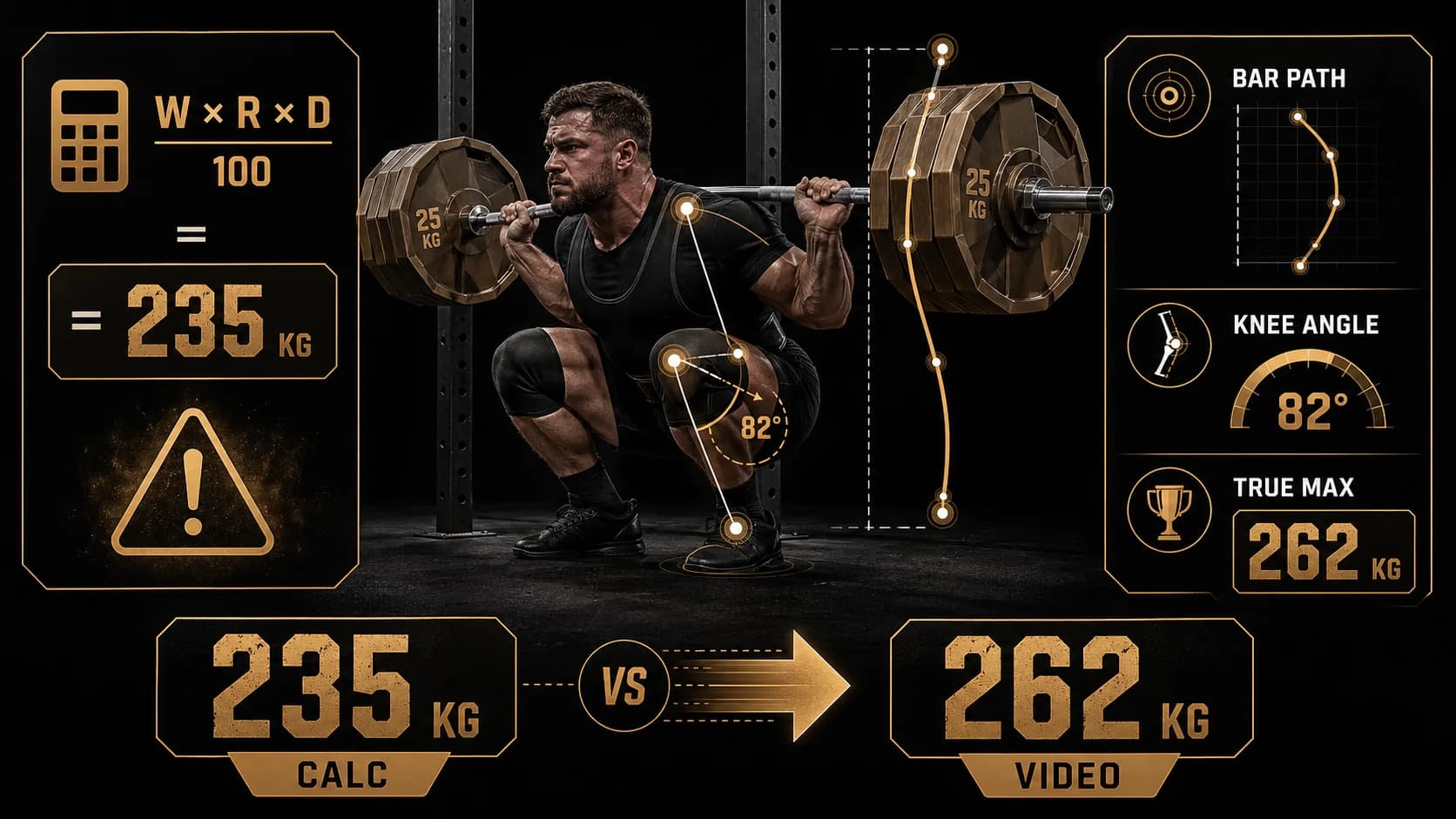
Your squat 1RM is usually wrong when a calculator treats a soft 5RM like a legal platform single. The error comes from depth, rep fatigue, bar-path drift and recovery state, not just math. A safer answer is a clean 3RM, side-on video, IPF-depth review, then a 90% training max. Use the 1RM calculator, plate calculator and strength standards only after the rep passes those checks.
You hit 405 for five last week. Felt clean. Walked out happy. Then you typed it into a 1 rep max calculator, the screen said 473, and your whole programming block reorganised around a number that was never there.
That number is probably wrong, and not in a charming way. I have coached lifters for fifteen years. I have watched the same scene play out a dozen times: confident off a 5RM, programming written off a calculator, missed third attempt at the meet. The lifter blames the day. The math was off long before the day arrived.
The IPF revised its technical rulebook for 2026, with the squat depth standard restated cleanly: the top surface of the legs at the hip joint must be lower than the top of the knees. Judges have been trained more strictly to enforce that line. Meets you might have squeaked past in 2023 are not the same meets in 2026. Programming off a soft 1RM costs you more now than it used to.
This piece walks through where the standard formulas go wrong on the squat, what to use instead, and what AI video analysis actually adds when you take it seriously. For more strength context, pair it with the powerlifting app guide, the bench press safety checklist, and the strength hub.
June 30 source check: what I trusted before changing the number
According to IPF, a squat only passes when the top surface of the legs at the hip joint drops below the top of the knees.
According to LeSuer JSCR, classic prediction equations can miss true strength across squat, bench and deadlift, which makes a single formula a weak programming anchor.
According to Cetin PeerJ, velocity-based prediction can improve estimates but still depends on clean execution.
According to Stronger By Science, rep-percentage tables drift across lifters enough that one calculator curve cannot describe everyone. According to Sports Medicine, acute sleep loss can reduce overall physical performance, so recovery belongs in the testing protocol. I used those sources to keep this refresh focused on measurable squat risk rather than calculator folklore.
| Check | Why it changes your 1RM | What I do before programming |
|---|---|---|
| Depth | A high squat can inflate the number by 5-10% | Side-on video against the IPF hip/knee line |
| Rep source | A 5RM or 10RM adds formula error | Prefer a clean 3RM and a 1.08 estimate |
| Bar path | Forward drift changes leverage under max load | Review the heaviest clean triple frame by frame |
| Recovery | Bad sleep and fatigue can bend the test day | Retest only after a deload and stable warm-ups |
Key Takeaways
- Classic 1RM formulas (Epley, Brzycki, Lombardi, Mayhew, Wathan) all overestimate squat 1RMs to varying degrees. The canonical reference is LeSuer et al., JSCR 1997.
- A 3RM test with a 1.08 multiplier is more accurate and lower-risk than a 1RM test pulled from a 5RM grind.
- The IPF 2026 technical rulebook restates the squat depth standard explicitly. Test under that standard or your gym number will not survive a meet.
- Computer-vision tools track depth and bar path more reliably than the human eye over many reps. Use them as a second pair of eyes.
- Use a 3-session average and program at ninety percent of the resulting true 1RM. Retest every 8-12 weeks.
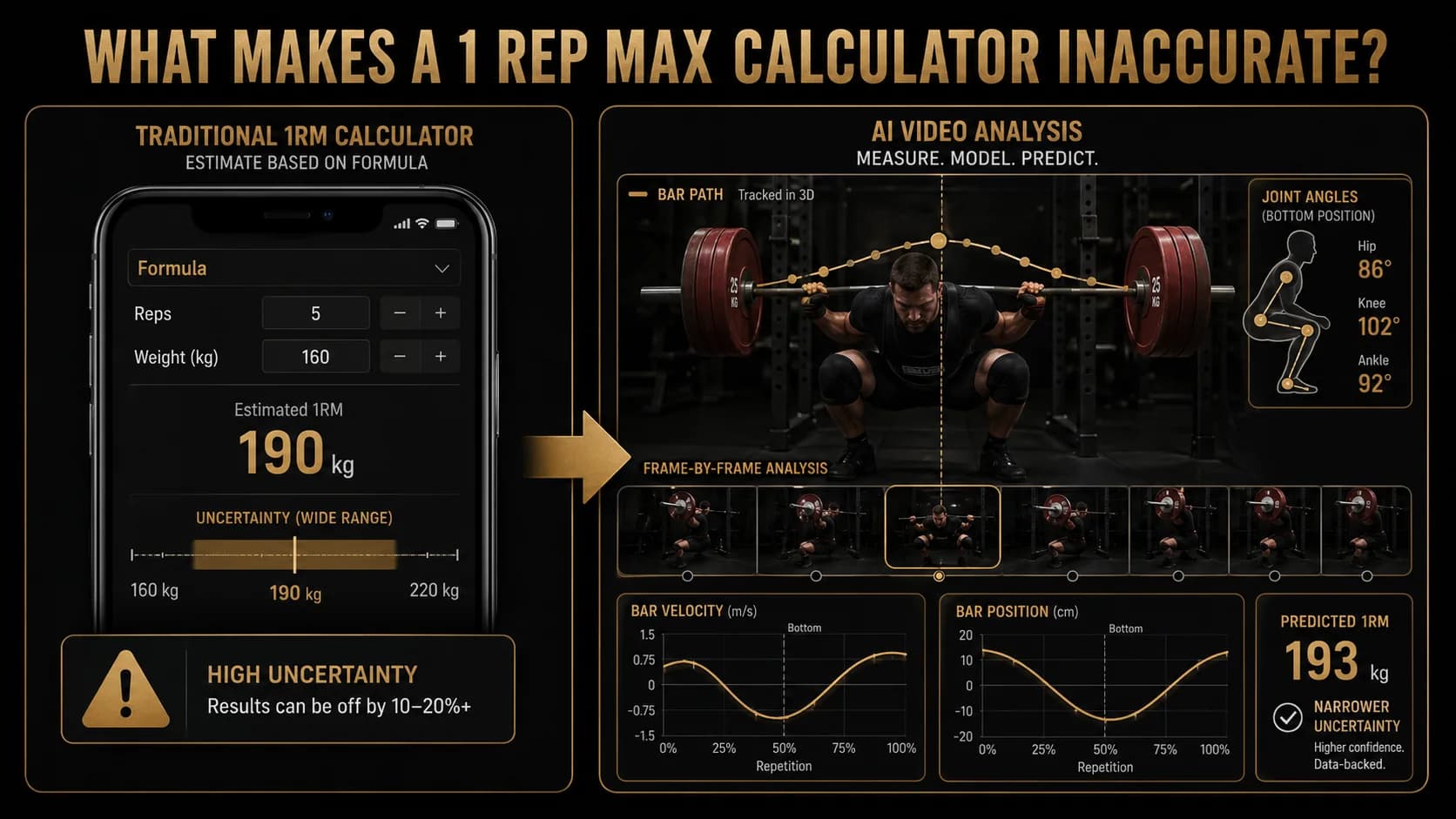
What makes a 1 rep max calculator inaccurate?
A 1 rep max calculator estimates a maximum from submaximal reps. Every formula on the menu makes assumptions about your body. Most of those assumptions are imported from somebody else's body.
The Classic Formulas: A Comparison
Here is a detailed breakdown of the five major formulas, including their limitations and how they perform on the squat.
| Formula | Year | Population Validated On | Equation | Squat Accuracy | Key Limitation |
|---|---|---|---|---|---|
| Epley | 1985 | Nebraska football lifters | 1RM = w × (1 + reps / 30) | Overestimates by 5-15% on squats | Linear assumption; fails for high-rep sets; validated on bench press primarily |
| Brzycki | 1993 | Extrapolated from Sale & MacDougall data | 1RM = w × (36 / (37 - reps)) | Overestimates by 8-12% on squats | Not validated on direct subjects; extrapolated from bench press data |
| Lombardi | 1989 | Mixed weight-training textbook population | 1RM = w × (reps^0.10) | Overestimates by 10-18% on squats | Weak validation; poor for high-rep ranges |
| Mayhew | 1992 | College men and women, bench press | 1RM = (w × 100) / (52.2 + 41.9 × e^(-0.055 × reps)) | Overestimates by 5-10% on squats | Validated only on bench press; exponential decay model may not fit squat |
| Wathan | 1994 | Mixed athletes | 1RM = (w × 100) / (48.8 + 53.8 × e^(-0.075 × reps)) | Overestimates by 6-12% on squats | General athlete population; not squat-specific |
The canonical paper on equation accuracy is LeSuer, McCormick, Mayhew and colleagues in JSCR (1997). It tested all five major equations on the bench press, squat, and deadlift, and found that all of them significantly mispredicted squat and deadlift maxes. Lifters with a true 405-lb squat saw estimates ranging from low-300s to high-400s depending on which formula and which rep target. That paper has been cited as the cautionary baseline for almost thirty years and the field has not closed the gap.
Why does the Epley formula for 1rm fail for squats?
The Epley formula reads 1RM = w × (1 + reps / 30). It is reasonable for the bench press in trained lifters. The squat is a different beast.
The formula assumes each rep adds roughly 3.3 percent to the load you can hit for one. Squats do not follow that line cleanly. There is more neural drive, more systemic fatigue, more technique dependence than in the upper-body lifts the formula was tested on. Greg Nuckols and the team at Stronger By Science have written carefully about how rep-percentage tables drift across populations. The picture they describe is not a single curve. It is a band, wide enough that any one estimate from any one formula can be off by ten percent in either direction without anybody having done anything wrong.
I see this play out the same way every quarter. A lifter pulls 405 for five reasonable reps, plugs it in, gets 473. Programming is built on 473. He misses 455 at the meet, blames himself, and never sees that the math was sloppy from rep one.
How much does technique affect estimated one rep max?
Estimated one rep max math assumes your form is constant across rep ranges. It is not. At a true single your bracing is tight, your depth is honest, your bar path stays in line. At a 10RM you grind. The knees drift in. Your hip rise gets early. Your back rounds enough to change leverage. A formula that does not see those changes cannot account for them.
The fix is small and unglamorous. Stop estimating from rep ranges higher than five. Drop the 8RMs and 10RMs out of your prediction inputs. The weight you can actually hit for one is closer to your three- or four-rep max corrected for a small multiplier than to your ten-rep max corrected for a large one.
What is the margin of error on a 1 rep max calculator squat?
Real numbers, from the literature:
- LeSuer et al. (1997): all five major formulas significantly overestimated squat 1RM. The squat error was larger than bench, smaller than deadlift.
- Cetin and colleagues, PeerJ 2022: tested two-point and multi-point velocity-based prediction methods. Direct prediction from velocity profiles was more accurate than rep-based formulas, but still imperfect, with errors ranging into the double digits for some subjects.
In practice, expect errors around ±5 percent on a 3RM-based estimate, ±8 percent on a 5RM-based estimate, and into the double digits if you are extrapolating from anything higher. Those are not trivial bands. They are the difference between a third attempt that flies and one that buries you.
A 1 rep max calculator is only as good as the technique it assumes you have.
Why your squat 1RM matters more in 2026
The strength world tightened up. The IPF's technical rulebook for 2026 keeps the squat depth definition explicit: the top surface of the leg at the hip joint must be below the top of the knee. Enforcement is stricter, video review is broadly available at major meets, and the courtesy parallels you might have hit in your basement gym are not the same as a passed lift on the platform.
How the 2026 IPF rulebook affects your squat 1RM
In practical terms: if your lifetime gym 1RM was achieved at parallel-ish, the platform version is probably five to ten percent lower. I have worked lifters who hit 500 in the gym at parallel and missed 475 at meets, and missed it for depth. The bar moved. The number on the bar said 475. The judge saw a high squat. Three reds and a story to tell.
You cannot fix this with belief. Test your max under competition standards, with side-on video, with depth verification, every time it matters.
Why most lifters overestimate their squat 1RM
A typical PR session goes like this. Fresh body. Music up. Friend in the gym. The lifter hits a heavy single, feels solid, calls it. They did not hit depth. They had a slight bounce. The training partner was on the bar before the rep slowed. None of those things are crimes; they are just not a competition lift.
EliteFTS has covered this kind of testing problem extensively. Their general guidance, from articles like strength training for young athletes and 1RM testing, is the same in spirit: gym maxes are useful for ego, not for programming. If you want a number you can use, you have to test under conditions that approximate the meet.
What happens when you program from a wrong 1RM
If your training max is too high, your prescribed weights are too heavy. You grind through reps that should move smoothly. Technique degrades, fatigue accumulates faster than you can absorb it, and the block ends in stalled progress at best, or a pulled lower back at worst.
If your training max is too low, you leave easy gains on the table. The block is too easy, the stimulus is below threshold, and you are essentially maintaining for ten weeks while telling yourself you are building. Both errors are common. Both are avoidable.
The Wendler 5/3/1 system, described by Jim Wendler, reframes the problem with a now-standard rule: program off ninety percent of your true 1RM, not the 1RM itself. The buffer is what makes the system work over many cycles. Most missed reps and missed cycles trace back to programming off a number that was a little too generous.
Your training max is the foundation of your program. A wrong foundation means a leaning building.
How to find your true squat 1RM: A Step-by-Step Guide
Forget the calculator. The protocol I use with my athletes is procedural, not algebraic. Six steps.
Step 1: Test your technique before testing your max
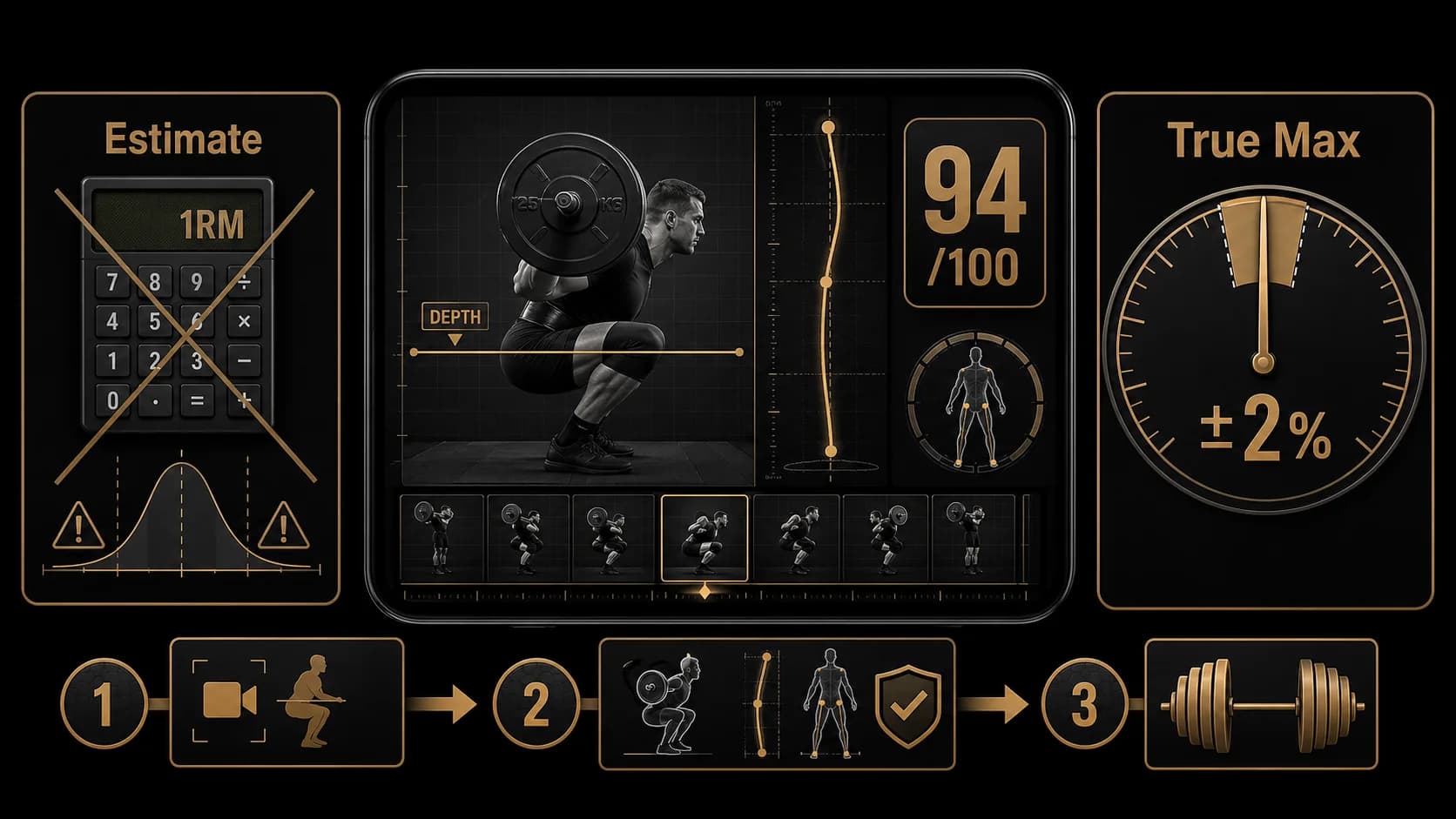
Record yourself squatting at seventy percent. Side-on. Use a tripod or a partner. Check three things from the footage: hip position relative to knee at the bottom (the IPF line), bar path through the rep, and brace integrity. If technique is suspect at seventy percent it will collapse at one hundred. Fix the technique first. The 1RM test will be there next month.
The Titans Grip Powerlifting AI app handles this with frame-by-frame video analysis and a 0-100 score on depth, bar path, and knee tracking. Use whatever tool you trust. The point is the audit, not the brand.
Step 2: Use a 3RM test, not a 1RM test
A 1RM is risky. Maximum neural output, perfect technique under pressure, a spotter who has to read your face in real time. A 3RM is safer and statistically tighter than higher-rep equivalents.
The protocol I use:
- Warm up to seventy percent of your estimated max for three reps.
- Add ten percent and do three reps.
- Add five percent and do three reps.
- If the third rep was smooth, add five percent and try three.
- Stop when the third rep slows obviously or technique slips.
Apply a 1.08 multiplier to the heaviest clean triple. The error band on this approach is roughly ±3 percent for trained lifters in line with the LeSuer JSCR work. It is not a perfect estimate. It is much closer to the bone than an Epley off a 5RM.
Step 3: Use AI video to verify depth and bar path
Computer vision earns its keep on the squat. The system measures hip and knee position frame by frame, tracks bar path, and flags knee valgus, butt wink, and asymmetric depth.
I worked with a lifter who was sure he was hitting depth. Side-on AI overlay said the top of his leg at the hip was sitting two centimetres above the top of his knee at the bottom. He was a passed-knee away from a legal lift. We retrained the cue, his honest 1RM dropped from 495 to 475, and that 475 has now passed twice in competition. Lower number, real number.
The 2025 review of AI in sport in the Journal of Sports Sciences gives a measured picture of where computer-vision tools are strong (joint angles on clean reps, bar-path tracking) and where they are still developing. Treat the score as a useful second opinion, not a verdict.
Step 4: Account for fatigue and life
The squat 1RM is not a fixed number. It moves with sleep, stress, and training history. The 2022 systematic review by Craven and colleagues in Sports Medicine on acute sleep loss is the cleanest summary in print. Mean acute sleep deprivation reduced overall physical performance by around 7.5 percent, with smaller and more variable effects specifically on maximum strength. Translation: a single rough night does not consistently knock 8 percent off your squat. Several rough nights stacked with stress and a hard week absolutely will.
Test after a deload. Test at the same time of day. Skip the test if your warm-ups feel heavier than they should. The data point you skip is cheaper than the data point that lies to you.
Step 5: Use a 3-session average
One test is one data point. Three tests are a number. The protocol:
- Test your 3RM and apply the 1.08 multiplier.
- Wait seven to ten days, retest.
- Wait another seven to ten days, retest a third time.
- Average the three estimates.
The average squeezes most of the day-to-day variance out. It takes three weeks. The number you get is the one I would actually program from.
Step 6: Program with a 90 percent training max
Once you have your true 1RM, do not program from it. Use ninety percent as the training max. This is the Wendler 5/3/1 principle, and it has held up across hundreds of cases I have run. Training near the true max accumulates fatigue faster than you can absorb it. Training at ninety percent leaves room for the volume that drives adaptation.
Step 7: Retest every 8 to 12 weeks
Strength is moving. If you do not retest, your training percentages drift away from your actual capacity. Eight to twelve weeks is the right window for trained lifters; novices can retest every four to six weeks because they progress faster. Use the same protocol each time.
Your true squat 1RM is a data point, not an identity. Test it, use it, move on.
Common Mistakes When Testing Your Squat 1RM
- Mistake 1: Testing after a hard training session. Your CNS is fried. The number will be low. Test after a deload.
- Mistake 2: Using a spotter who touches the bar. That rep does not count. Use a spotter who watches, not one who lifts.
- Mistake 3: Not warming up enough. A cold squat is a weak squat. Spend 15-20 minutes on warm-ups.
- Mistake 4: Testing at different times of day. Your 1RM at 6 AM is not your 1RM at 6 PM. Be consistent.
- Mistake 5: Ignoring technique drift. If your depth gets shallower as the weight goes up, the rep is not valid.
Decision Rules for Your Squat 1RM
- If your 3RM test feels easy, add 5% and try again. Do not stop early.
- If your 3RM test feels hard but technique is clean, use the 1.08 multiplier. Do not push for a 1RM.
- If your 3RM test shows technique breakdown, stop. The number is not valid.
- If your warm-ups feel heavy, skip the test. You are not recovered.
- If you are unsure about depth, use AI video analysis. Do not guess.
Strategies to actually improve your squat 1RM
Once the number is honest, the work begins.
How much can you add in 12 weeks?
Beginners can add 15-25 percent in twelve weeks. Intermediate lifters land closer to 5-10 percent. Advanced lifters work for 2-5 percent. These are wide bands because individual response varies, training history matters, and the bigger the lifter the slower the curve. The numbers you see online claiming a fixed average across populations are usually fabrications. The literature on dose-response in resistance training, including Robinson and colleagues' 2024 paper in Sports Medicine on proximity-to-failure, is the kind of source worth reading instead.
The variable that actually predicts gains is consistency. Show up, do the prescribed work, hit the warm-ups well, repeat. The lifters who miss fewer sessions add more weight. That is most of the story.
What rep range builds squat strength
Bulk of the work in the 3-6 range, at 75-85 percent of true 1RM. Heavier singles and doubles for peaking. Lighter accessory work in the 8-12 range for hypertrophy on weaknesses. This is roughly what every credible program in the past two decades has converged on.
What AI coaching adds to your squat
A coach watches the rep in front of them. AI watches every rep. Across a block, the system can show you that your bar path drifts forward in the third set, that your left knee caves more than your right, that your depth gets shallower as session length grows. None of this is exotic information. It is just hard for a human to track across hundreds of reps a week.
AI does not replace a coach. It hands the coach better notes than they could take by themselves.
Frequently Asked Questions
Why is my squat 1RM wrong according to most calculators?
Most calculators were validated on populations that are not you. Epley used Nebraska football lifters in 1985. Brzycki extrapolated from Sale and MacDougall's data in 1993. The squat involves more neural drive and more technique dependence than the bench press these formulas were largely tested on. Errors of five to fifteen percent show up routinely depending on which formula, which rep range, and which lifter.
How much does the Epley formula for 1rm overestimate squats?
Across the literature it tends to overestimate, with the size of the overestimate growing as the rep target grows. The original LeSuer et al. work (1997) is still the cleanest reference for this. Treat any Epley estimate from above five reps with suspicion.
What is the most accurate way to find my estimated one rep max?
A 3RM test with a 1.08 multiplier under competition technique. Better still: average three such tests over three weeks. For lifters who own a velocity device, Cetin and colleagues' 2022 PeerJ paper lays out the velocity-based alternative — usually a touch more accurate than rep-based formulas, but it requires a working device and clean execution.
How often should I retest my squat 1RM?
Every 8-12 weeks for trained lifters; every 4-6 weeks for novices. Use the same protocol each time, after a deload, at the same time of day. Skip the test if your warm-ups are heavy.
Can AI video analysis really help my powerlifting technique?
It helps most for the things humans miss across volume: bar-path drift, depth creep, asymmetric knee tracking. The 2025 narrative review of AI in sport gives a fair summary of strengths and current limits. It will not replace a good coach. It will catch the rep your coach missed because they were watching another lifter.
How much can I add to my squat 1RM in 12 weeks?
Wide range. Beginners often see fifteen percent. Intermediates closer to five. Advanced lifters less. Anyone publishing a single average across populations is usually selling something. Consistency, sleep, and protein at boring levels are the variables that actually move the line.
What is the difference between a gym 1RM and a competition 1RM?
A gym 1RM is often achieved with less strict depth, a bounce, or a spotter's help. A competition 1RM requires full depth, a pause at the bottom, and no assistance. The difference can be 5-10% or more.
Should I use a 1RM calculator for deadlifts?
The same principles apply. Deadlifts have even more technique dependence than squats. Use a 3RM test with a 1.08 multiplier instead.
Can I use a 1RM calculator for bench press?
Bench press is the most accurate lift for these formulas, especially Epley. But even then, technique matters. Use a 3RM test for the best results.
What if I don't have access to AI video analysis?
Use a phone camera and a tripod. Record every heavy set. Review the footage after the session. Look for depth, bar path, and knee tracking. It is not as fast as AI, but it is better than nothing.
Ready to find your true squat 1RM?
Stop programming off a number that came out of a 1980s textbook. The Titans Grip Powerlifting AI app analyses your squat frame by frame, measures depth and bar path, and gives you a verdict you can argue with. Use it next to your coach, not instead of them.
Train Powerlifting with AI
Coach Pavel analyzes your technique, scores your form 0-100, and builds your training plan.
Download Powerlifting AIFind your sport and start logging the right reps.
Conclusion: earn the max before you program from it
A squat 1RM should survive three questions: did the rep hit depth, did the estimate come from a low-rep clean set, and can the next training block absorb the number? If any answer is no, lower the training max and keep building. The honest number may bruise your ego for one session. It protects your next twelve weeks.
Other Doved Studio projects
Related tools from the same studio you might find useful:
- Glean: Turn scrolling time into a daily action plan. Capture, process, execute.
- Popout: Create your portfolio in minutes with a single shareable page.
- Doved Studio: Studio indie derrière cette app et une dizaine d'autres outils.
Coach Pavel
Powerlifting specialist. Expert in squat technique, bench press, deadlift.
Coach Pavel is the AI coaching persona behind Powerlifting AI, built to provide personalized powerlifting guidance through video analysis, training plans, and technique breakdowns.
Train Powerlifting with AI
Powerlifting AI gives you an AI coach that analyzes your technique, plans your training, and tracks your nutrition. Try it for free.