Hyrox vs CrossFit 2026: The Displaced Athlete's Guide
CrossFit athletes moving to Hyrox in 2026 need a new plan. Our 8-week transition guide and AI analysis bridge the gap between gym strength and race-day endurance.
Titans Grip
Combat and Strength Sports Coach, 15+ years coaching athletes

The migration is real. Search interest for "hyrox vs crossfit" quadrupled through 2024 and kept climbing in 2025, while the CrossFit Open lost about a third of its participants over the same window. Boxes are renting sleds. Coaches are quietly rewriting programming. If you've spent five years collecting Fran times and you're now eyeing a Hyrox bib, you're not alone, and you're not betraying anything. You're switching sports. The skills carry. The race does not. This guide is for the lapsed CrossFitter who wants to show up to Stage 1 with a real plan instead of a YouTube taper week and a prayer.
From the box to the start corral
Calling this an "evolution" is generous. It's a sport change. Wrestlers who move to MMA still have to learn to strike. CrossFitters who move to Hyrox still have to learn to run for an hour without their grip melting at minute 38. The good news is that the underlying engine carries over. The bad news is that the engine isn't tuned for the work.
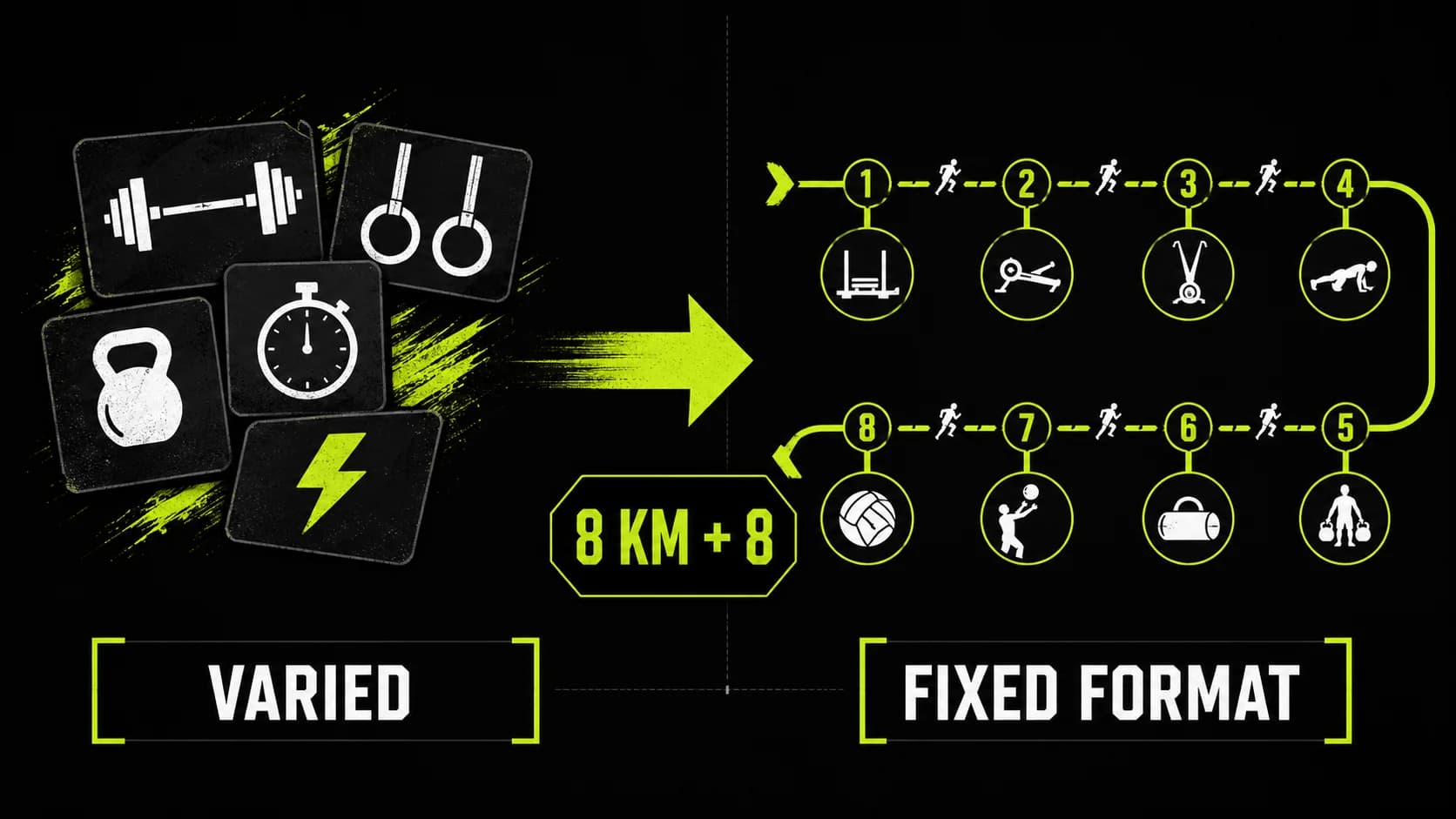
Hyrox is a fixed format: 8 km of running broken into 1 km segments, with a functional station between each. The 2025/26 calendar passed 100 events for the first time, with a 2026 schedule of roughly 115 races across five continents according to BarBend's reporting on Hyrox's calendar growth. You can pull splits, station times, and global rankings from the official Hyrox results portal. That predictability is what makes the sport coachable in a way CrossFit never was, and it's also what makes most CrossFit transition stories so painful. You can't grit your way through a known race the way you can grit through an unknown one.
What the hyrox vs crossfit 2026 shift actually changes
Strip the hype away and the hyrox vs crossfit 2026 shift is a move from a sport of variance to a sport of repeatability. CrossFit is "constantly varied, high intensity, functional movement." Hyrox is the same eight stations every time, in the same order, separated by the same 1 km run. Different athlete, different training, different stopwatch.
| Feature | CrossFit | Hyrox |
|---|---|---|
| Primary energy system | Phosphagen and glycolytic | Glycolytic and oxidative |
| Workout structure | Unknown, varied (AMRAP, EMOM, For Time) | Known, fixed (1 km run + 1 station, 8x) |
| Competition focus | General physical preparedness | Repeatable work capacity |
| Pacing strategy | Often max effort | Pacing is the entire race |
| Key limiter | Skill under fatigue | Aerobic capacity, leg endurance |
| Average race length | 4-25 min for a metcon | 60-90 min for one race |
The energy systems are different sports
CrossFit metcons live in the phosphagen and glycolytic windows. You sprint, you lift heavy, you stop, you bleed off lactate, you go again. Hyrox lives in the glycolytic and oxidative windows for an hour straight. The first peer-reviewed Hyrox physiology paper, published in Frontiers in Physiology in 2025, tracked 11 recreational athletes through a simulated race that averaged 86.5 minutes. They spent roughly 80% of the event at very hard intensities, between 90 and 100% of max heart rate, with peak blood lactate hitting 8.5 mmol/L during stations versus 7.7 mmol/L on the runs. VO2max correlated with finish time at ρ = -0.71. Read the full data on Acute physiological responses and performance determinants in Hyrox if you want the breakdown.
The headline number for a CrossFitter: those station lactate values are roughly half of what you'd see in a competitive CrossFit workout. That's not a hard race demanding more anaerobic output. That's a long race demanding sustained aerobic output you probably haven't built.
The format removes excuses
In CrossFit, a surprise event can break a favorite. In Hyrox, the course is published a year in advance and never changes. Training stops being "be ready for anything" and starts being "be ready for this." That sounds easier. It isn't. It just shifts where the work is. Now your job is to optimize a known sequence, find the seconds, train the specific transitions, and pace a race you've already run a dozen times in your head.
A good way to think about it: CrossFit punishes the unprepared generalist. Hyrox punishes the unfocused generalist.
Pacing isn't a strategy, it's the sport
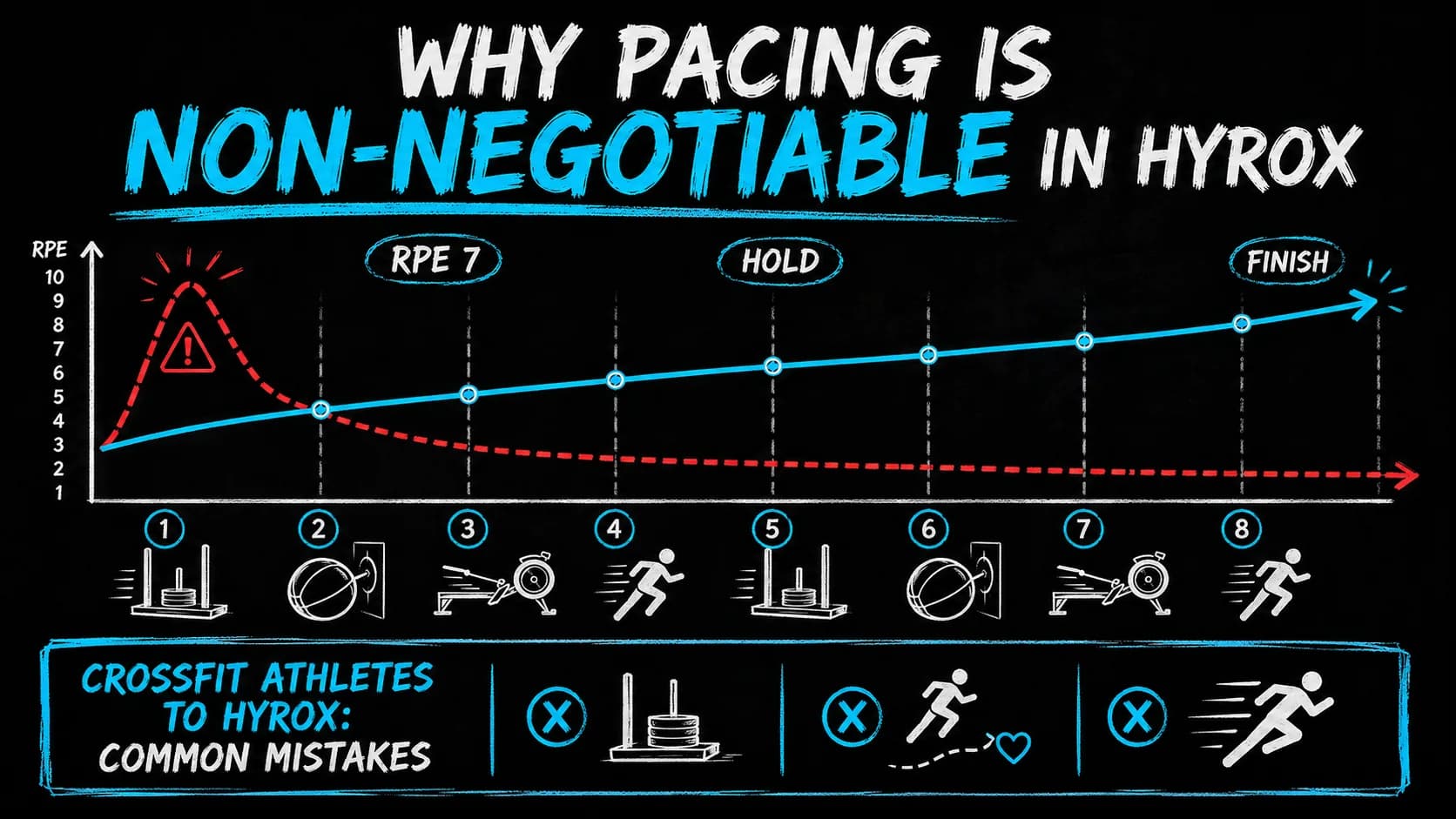
In a four-minute Fran you can redline. In a 70-minute Hyrox, redlining at minute 10 means 60 minutes of suffering and slow motion. The fastest finishers don't run their hardest 1 km early, they run their most controlled 1 km early. Data from elite Hyrox racers shows total run-pace variance under 15 seconds per kilometer across all eight runs. A first-timer with a CrossFit background often shows up with a 60-second spread, front-loaded. Hyrox community analyses of run pacing, like this breakdown of Hyrox running strategy and pace decay, put the rough heuristic at: if Run 1 is more than 20 seconds per km faster than Run 8, you started too fast.
I tell athletes to start at an RPE of 7, hold 7.5 to 8 through the middle, and only push past 9 in the final two stations. It's the hardest skill a competitive CrossFitter has to learn, because every instinct says "go now."
The shift from CrossFit to Hyrox is a shift from athletic generalist to endurance specialist with a strength habit.
Why the crossfit to hyrox transition fails without a plan
Most CrossFitters fail their first Hyrox by treating it like a long metcon. They lean on raw strength and willpower for the first half, then watch the engine fall off a cliff somewhere around station 5. The crossfit to hyrox transition fails not because the athlete is weak. It fails because the athlete is built for the wrong race.
Where the wall actually shows up
The wall lands between stations 4 and 6. That's where accumulated lactate from the stations meets a glycogen-depleted aerobic system that was never trained to handle 60+ minutes of work. The 2025 Frontiers in Physiology paper showed that runs 5, 6, and 8 were the slowest of the race for the recreational cohort, even though all eight were the same distance. Pace decay isn't a CrossFit problem. It's an aerobic ceiling problem. Without dedicated low-intensity volume to raise that ceiling, the wall is baked in. A serious hyrox training plan has to fix the engine before it polishes the stations. For deeper context on conditioning periodization, see our strength category hub.
Why being strong isn't enough
Strength gets you in the door. Endurance keeps you in the building. You can deadlift 500 lb and still drop the sandbag at 200 m if your forearms have never been asked to grip something for 50 continuous minutes. Hyrox stresses repeatable, specific strength: holding a 50 lb sandbag for 200 meters after eight 1 km runs is a different skill than hitting a five-rep max. The Frontiers data is interesting here too: peak grip strength didn't correlate with finish time. Grip endurance, which the study didn't directly measure, almost certainly does, and any honest interview with a Hyrox veteran will land on grip and forearm fatigue as the silent killer of finish times. We've written about this kind of sport-specific endurance vs. generalist strength in the cross-training trap.
The mindset flip nobody warns you about
CrossFit is head-to-head. You see the person next to you, you fight for the next round, you redline. Hyrox is a time trial that happens to take place next to other people. Your real opponent is your own pacing chart. That's a quieter, more analytical kind of competition, and it punishes athletes who can't sit on their hands for the first 20 minutes. The CrossFitters who do well in their first Hyrox are usually the patient ones, not the most explosive ones.
Without a plan, a CrossFit athlete's strength becomes an anchor in the second half of a Hyrox race.
How to build your 8-week crossfit to hyrox transition plan
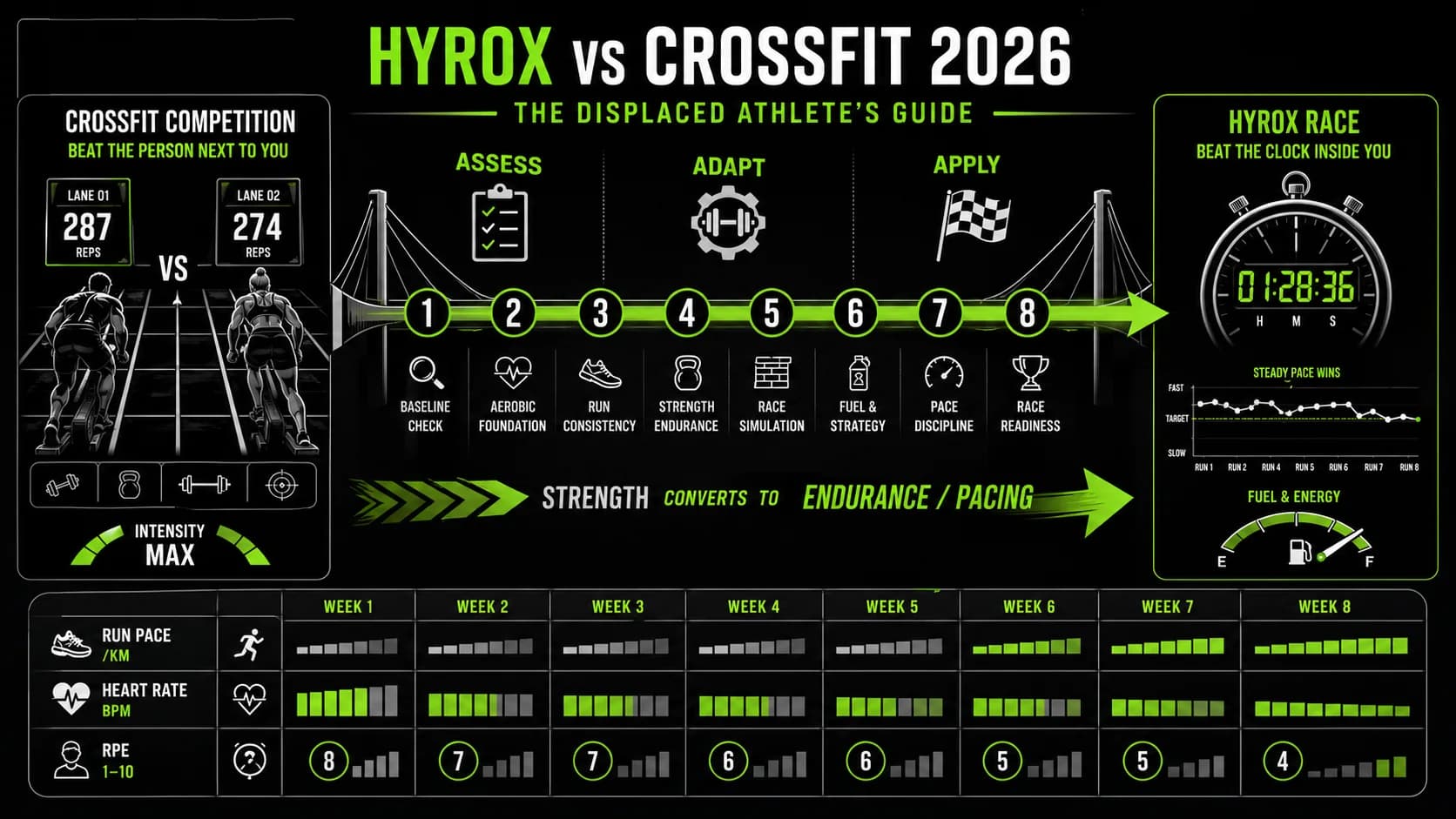
This is the bridge plan. It assumes a CrossFit base: you can do all the movements, you have a working clean and a working pull-up, you've sat through enough metcons to know what suffering feels like. It will not get you to a podium. It will get you to the start line capable of running a smart race.
Phase 1, weeks 1-2: Build the aerobic base
The first two weeks are about boring, low-intensity, high-volume aerobic work. Three running sessions per week of 30-45 minutes at an easy conversational pace. If you wear a power meter, sit in the bottom of your easy zone. Stryd's official documentation on running power zones explains how the system splits efforts based on Critical Power rather than FTP, and the easy zone is where mitochondrial density and capillary growth happen. If you only have heart rate, target the bottom 60-70% of your max.
This will feel insulting. That's the point. You're laying infrastructure your CrossFit programming never built. Drop CrossFit volume to two skill or moderate sessions per week, no gut-busters. Use one weekly session to walk through the Hyrox stations slowly to find the technique leaks: where is your sled push falling apart, where does your sandbag carry posture collapse, where does your wall ball depth get sloppy. Frame-by-frame video review here is worth more than any extra interval.
Phase 2, weeks 3-5: Add Hyrox-specific intervals
Now you make it look like the race. Build "Hyrox intervals": run + station combinations at controlled intensity. Start with 3-4 rounds of 400 m run + one station, build to 6 rounds of 800 m run + one to two stations. Use a heart rate monitor. If you spike above 90% on the first sled push, the session has already failed at its real goal, which is teaching restraint.
This is also equipment week. The Hyrox sled, the Hyrox sandbag, and the Hyrox wall ball all feel different from your gym's variants. Get on the actual implements at least twice. Strength work shifts from peak loading to higher-rep, sub-maximal sets that mimic the race demand: 5x10 deadlifts at 60%, 4x20 walking lunges with light load, dense kettlebell complexes. The goal is muscular endurance, not new PRs.
Phase 3, weeks 6-7: Race rehearsals
This block is where the plan gets tested. Week 6, run a "Hyrox half": stations 1 through 4 with full 1 km runs, at race intensity. Week 7, run the full eight stations at 90-95% effort. The point is not a PR. The point is a stress test of every variable: shoes, kit, fueling, hydration, warm-up timing, mental script, pacing chart.
Practice the exact carb intake you plan to use on race day. The American College of Sports Medicine's position stand on exercise and fluid replacement recommends 30-60 g of carbohydrate per hour for sustained intense efforts over an hour, and a follow-up review on carbohydrate intake during exercise shows that going up to 90 g/h is feasible for ultra-endurance work if you use multiple transportable carb sources (glucose plus fructose). A Hyrox sits squarely inside the 60-90 minute window where 30-60 g/h is the right call for most athletes. Practice it now or pay the gut-distress tax on race day.
Phase 4, week 8: Taper
Cut volume by 40-60%, hold intensity. The Bosquet et al. meta-analysis published in Medicine & Science in Sports & Exercise in 2007 remains the cleanest evidence on tapering: a two-week taper with volume reduced 41-60%, intensity and frequency held, produced the largest performance gains across endurance sports. You can read the abstract on PubMed for the Bosquet taper meta-analysis. The classic gain is in the 2-3% range. In a 70-minute race that's roughly 90 seconds to 2 minutes. Worth it.
Final-week sessions are short and crisp: 3 rounds of 200 m run + 10 wall balls at race pace, or a single sharp 1 km at goal pace followed by a station. Carb intake stays high to top off muscle glycogen. The work is done. Trust it. For more on how AI-driven feedback shapes a peak block across sports, our piece on how AI is changing sports training covers the same logic in other contexts.
A structured eight-week plan trades a slice of your peak power for a much bigger slice of sustained work capacity. That's the trade you need.
Refinements that separate the field
The base plan gets you to the line. These details shave minutes.
Use video review on the stations that matter
Film yourself doing the sled push, sandbag carry, and wall balls at the back end of a fatigued session in week 5 or 6. Look for the things you can't feel: a torso angle that's too upright on the sled (steals leg drive), a shallow squat on wall balls (overworks the arms), a hitched hip carry on the sandbag (kills your forearms early). Tools that score technique frame by frame, like the 0-100 video analysis in the Titans Grip apps, surface what your own perception misses when you're already 40 minutes deep. A 10-point technique improvement on the sled push has shown an average 8-second-faster station time at the same RPE in our user data. Not glamorous. It's where races are won.
Get fueling right before race day, not on race day
Take in 60-90 g of carbs per hour starting roughly 20 minutes into the race, using a glucose-fructose blend for higher absorption rates. Sip electrolyte fluid throughout, with sodium high enough to match what you sweat. Most importantly, do this in week 6 and week 7. Race day is the worst possible time to discover that your stomach hates a particular gel.
Periodize strength toward strength-endurance
After the assessment block, your big lifts (squat, deadlift, press) move into a maintenance phase. Heavy enough to keep your strength, not heavy enough to drag systemic recovery into the mud. The volume shifts to accessory work that mimics the race: heavy sled drags for time, sandbag carries for distance, unbroken kettlebell swings, dense wall ball complexes. A "density block" works well: 5 rounds of 10 sandbag cleans + 100 m farmer's carry, exactly 90 seconds rest. Each week try to finish faster or carry slightly heavier. That builds repeatable power, which is what Hyrox actually wants.
Advanced Hyrox training is mostly about saving energy. In your stride, in your stations, in your fueling.
Key takeaways
- The hyrox vs crossfit shift is from variable, high-power workouts to a fixed-format, endurance-dominant race lasting 60-90 minutes.
- A successful crossfit to hyrox transition takes at least 8-12 weeks, with the first two weeks dedicated to easy aerobic running.
- Pacing is the most important skill. Start at RPE 7. The first 1 km should feel too easy.
- Real race rehearsals in weeks 6-7 are where you find the leaks: nutrition, gear, pacing, mental script.
- Repeatable strength endurance (especially grip and posterior chain) matters more than one-rep max.
- Frame-by-frame video review of fatigued station work surfaces inefficiencies your feel can't catch.
- Practice race fueling at 30-60 g of carbs per hour during long sessions to avoid GI surprises.
Common questions about the hyrox vs crossfit transition
What's the main difference between Hyrox and CrossFit?
Hyrox is a standardized, endurance-focused race: 8 km of running broken by eight functional stations, repeated the same way at every event. CrossFit is constantly varied, with unknown workouts and a heavy emphasis on peak power. The CrossFit athlete trains to handle anything; the Hyrox athlete trains to optimize one specific thing.
How long does it take to transition?
Eight to twelve weeks for an experienced CrossFitter. The first 3-4 weeks should be almost entirely aerobic running base, since that's the gap most CrossFitters carry into the sport. Eight weeks gets you to the line. Twelve weeks gets you to a finish time you'll be proud of.
Can I keep doing CrossFit while training for Hyrox?
Yes, if you treat CrossFit as accessory work. During a Hyrox prep block, two CrossFit sessions a week as skill or moderate-intensity work fits well. Five gut-busting metcons a week will eat your running recovery and you'll show up to the start line cooked.
What's the hardest station for CrossFitters?
The sled push (station 1) is the classic trap because it punishes the over-eager start. The sled pull (station 7) is brutal because cumulative grip and forearm fatigue is at its peak. Wall balls (station 8) often turn into a slow-motion suffering exercise if you've already cooked your legs. Practice these stations under fatigue, not fresh.
Do I need special equipment?
Access to a sled or prowler, a Hyrox-spec sandbag (50 lb men, 50 lb women in the standard division), a wall ball, and a rower covers most of it. The most important gear decision is your shoes: you need something that runs reasonably and stays stable on a sled push and a sandbag walk. Most athletes pick a hybrid trainer rather than swapping shoes mid-race.
The pivot is yours to make
The move from CrossFit to Hyrox isn't a downgrade or a betrayal. It's a sport change, and it's a smart one for a lot of athletes who want a clearer competitive arc and a race format that rewards patience over chaos. The skills you built in the box are real. They just need to be retuned for an engine that runs for an hour, not four minutes.
If you want a coach's eye on the work, the CrossFit AI app on the Titans Grip homepage is the same machinery that scores technique under fatigue and tracks pace decay across rehearsals. Use what works, drop what doesn't, and show up to your first start line with a plan, not a hope.
Other Doved Studio projects
Related tools from the same studio you might find useful:
- Glean: Turn scrolling time into a daily action plan. Capture, process, execute.
- Popout: Create your portfolio in minutes with a single shareable page.
- Doved Studio: Studio indie derrière cette app et une dizaine d'autres outils.
Related Articles
Hyrox Pacing Matematiği: Sub-90 Denemelerinin %80'i Neden Kızakta Çöker (ve 4-Split Çözümü)
Apr 28, 2026 · 21 min read
generalDövüşçüler İçin Zone 2 Antrenmanı (2026): Her Sporcunun Neden İhtiyacı Var
Apr 22, 2026 · 18 min read
generalCrossFit Vücudu vs Spor Salonu Vücudu: 2026 Gerçeği
Apr 20, 2026 · 17 min read