Stop Guessing Your 1RM: The 2026 Strength Calculator Guide
Stop using risky 1 rep max calculators. Learn how AI-powered training logs in 2026 provide safer, personalized strength estimates for your squat, bench, and deadlift.
Titans Grip
Powerlifting Coach, squat, bench, deadlift programming and peaking
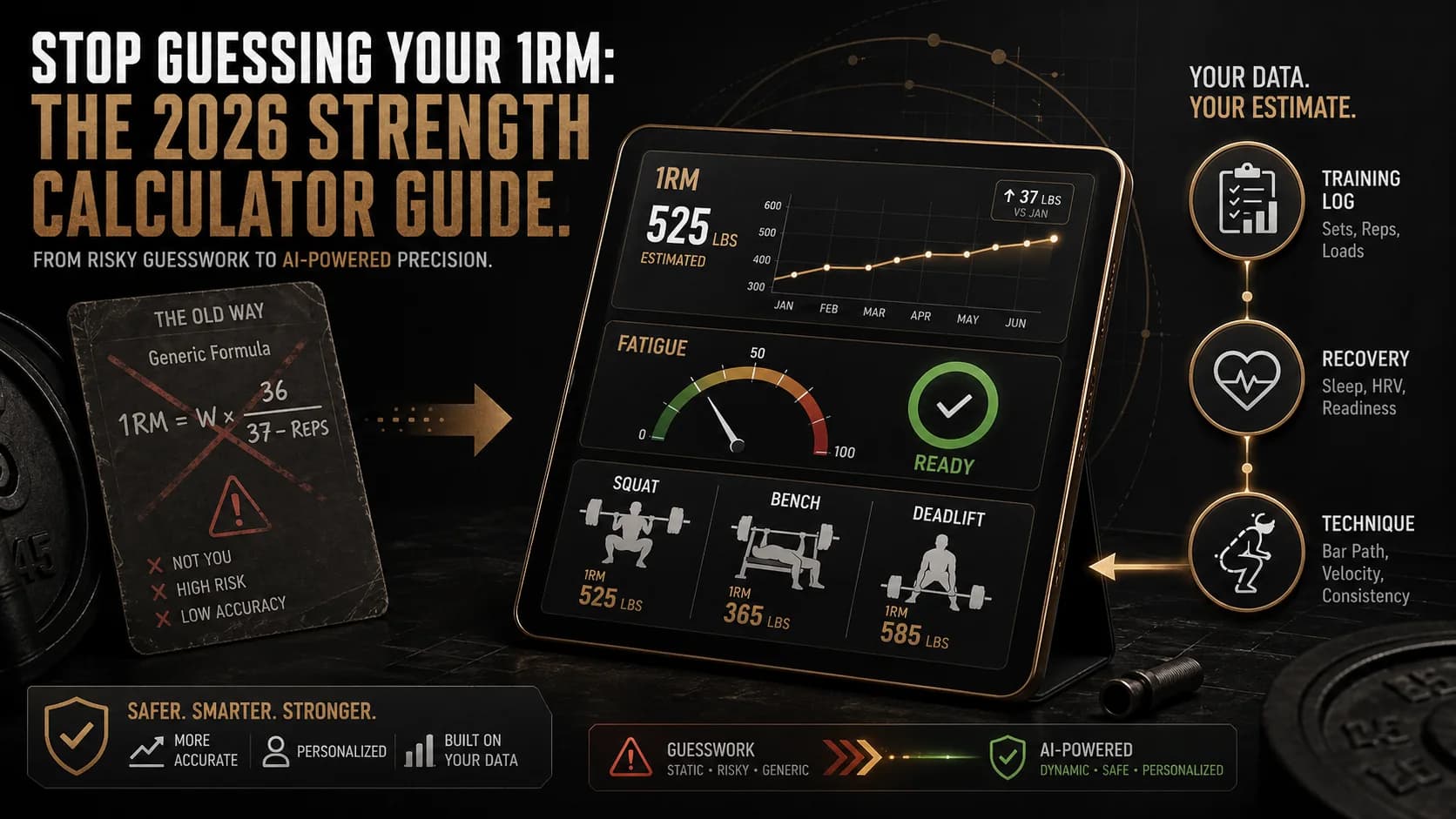
For years, you've been told to plug your numbers into a generic 1 rep max calculator and trust the result. It's a guess wrapped in a formula. In 2026, that approach is not just outdated—it's a liability. A static number from a webpage doesn't know your fatigue from yesterday's session, your technique breakdown under heavy load, or your personal recovery curve. According to a 2025 meta-analysis in the Journal of Strength and Conditioning Research, traditional 1RM prediction formulas have an average error margin of ±5-10%, which can mean a 20-40 pound miscalculation on a 400lb squat. That's the difference between a confident PR and a missed lift that shakes your confidence for weeks. The future isn't about calculating your max; it's about having a dynamic, AI-driven model that learns from every rep you perform. This guide will show you why the old calculators fail and how to build a truly intelligent system for knowing your strength.
Key Takeaways
- Generic 1RM calculators have a ±5-10% error margin—enough to derail an entire training block if you base percentages on a faulty number.
- Modern estimated 1RM is dynamic, adjusting daily based on RPE, bar speed, and training history, not a static formula.
- RPE logging cuts prediction error by ~40% compared to rep counts alone, making it the single most impactful habit you can adopt.
- The 3-Point Max Validation Protocol uses multiple submaximal data points to verify any estimate before you train off it.
- AI-powered training logs like Powerlifting AI integrate estimation, fatigue detection, and autoregulation into one system.
- You should test your true 1RM 70% less often when using a dynamic model, reducing injury risk and accumulated fatigue.
What is a 1 rep max calculator, really?
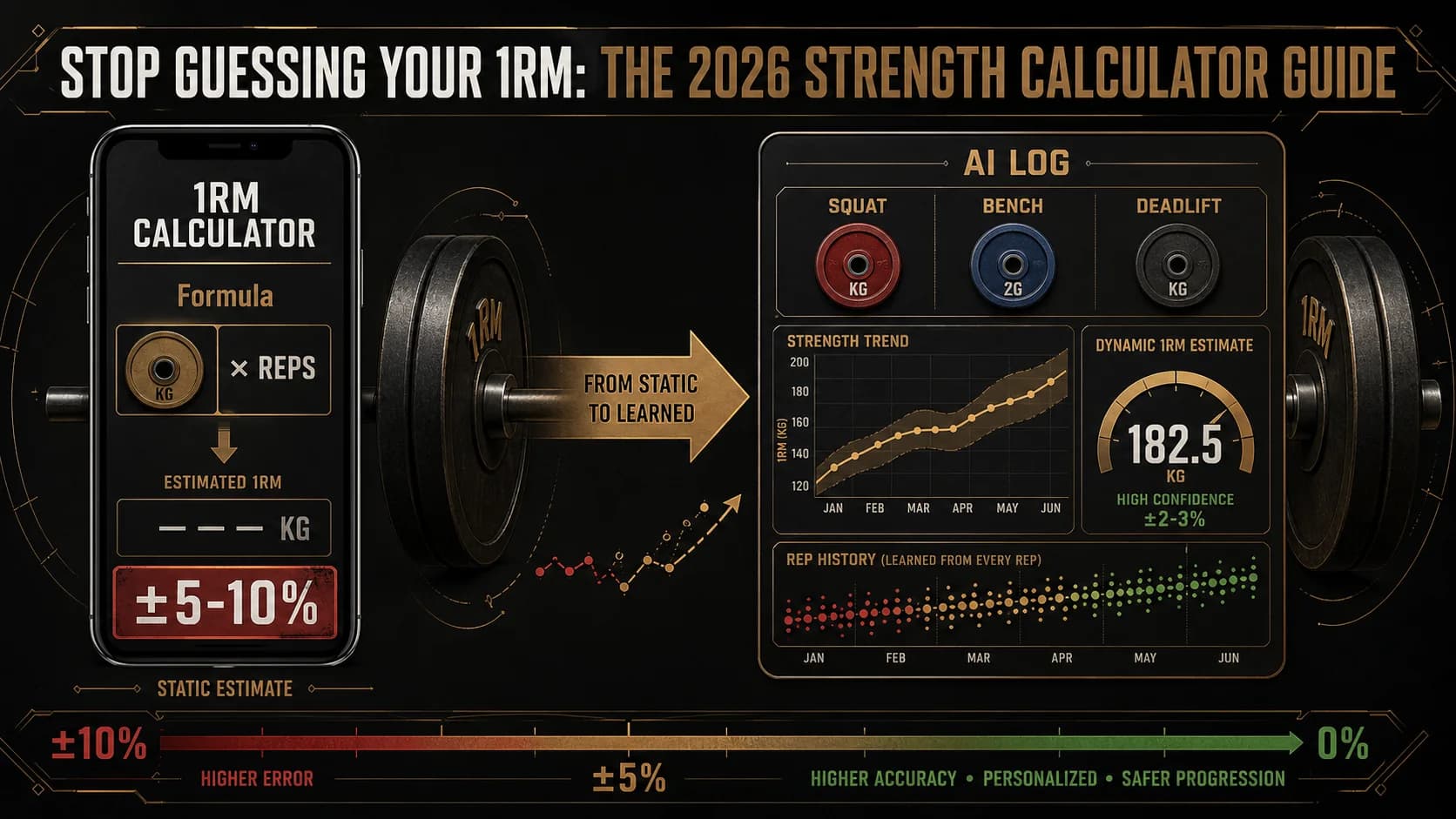
A 1 rep max calculator is a mathematical tool that estimates the maximum weight you can lift for one repetition based on your performance with submaximal loads. At its core, it applies a generalized formula—like Brzycki, Epley, or Lombardi—to your logged sets and reps. However, in 2026, the definition has expanded. The most effective tools are no longer standalone calculators but integrated features within AI-powered training logs that analyze historical data, technique, and fatigue to provide a living, breathing estimate of your strength.
How does a basic 1RM calculator work?
A basic 1 rep max calculator uses a pre-set formula to extrapolate from submaximal effort. For example, the common Brzycki formula is: 1RM = Weight / (1.0278 - (0.0278 × Reps)). If you lift 225 lbs for 8 reps, it estimates a 1RM of ~275 lbs. The problem is universality. These formulas assume a linear fatigue curve that is identical for every athlete, which biomechanics research consistently disproves. A 2024 study by Stronger by Science analyzed over 10,000 lift attempts and found that prediction accuracy drops significantly for reps above 5 and varies wildly between the squat, bench press, and deadlift. The bench press formula often overestimates, while deadlift formulas tend to underestimate, especially for stronger athletes.
What are the most common 1RM formulas?
The three most cited formulas are Brzycki, Epley, and Lombardi. They represent different mathematical models of fatigue. Here's a detailed comparison:
| Formula | Equation | Best For | Key Limitation | Typical Error Range |
|---|---|---|---|---|
| Brzycki | Weight / (1.0278 - (0.0278 × Reps)) | 1-10 Rep Range | Becomes highly inaccurate above 10 reps; assumes linear fatigue | ±5-8% |
| Epley | Weight × (1 + 0.0333 × Reps) | Lower Reps (1-5) | Overestimates for higher-rep sets; less accurate for deadlifts | ±4-7% |
| Lombardi | Weight × Reps^0.1 | Power/Explosive Moves | Less accurate for pure strength lifts; designed for Olympic lifts | ±6-10% |
| Mayhew | (Weight × 100) / (52.2 + (41.9 × e^(-0.055 × Reps))) | Bench press specifically | Only validated for bench press; complex calculation | ±3-6% |
| Wathan | (Weight × 100) / (48.8 + (53.8 × e^(-0.075 × Reps))) | Trained athletes | Requires rep range 2-10; less tested for beginners | ±3-5% |
Most online 1 rep max calculator tools use Brzycki or Epley by default. However, a 2023 review in the NSCA's Strength and Conditioning Journal noted that no single formula has an error rate below 4% across a diverse population. Your muscle fiber composition, training age, and even the exercise itself make a universal formula a rough guess at best.
Why do different exercises need different calculations?
Your squat, bench, and deadlift have unique biomechanical and neurological profiles. A formula that works for a 5-rep bench press set will fail for a 5-rep deadlift because of differences in muscle mass recruited, leverage, and central nervous system fatigue. According to data compiled by OpenPowerlifting, the relationship between reps and 1RM is not consistent across lifts. For advanced lifters, the deadlift often allows for more reps at a given percentage of 1RM compared to the squat. A generic 1 rep max calculator ignores this, treating all movements the same. Modern apps solve this by building exercise-specific prediction models that learn from your personal historical data across our dedicated strength platforms.
What is an "estimated 1 rep max" in modern training apps?
An estimated 1 rep max in a 2026-era training app is a dynamic value, not a static calculation. It's a data point generated by an algorithm that considers your last 5-10 sessions, daily readiness scores, bar speed metrics (if available), and even subjective ratings of perceived exertion (RPE). For instance, if you logged 300x5 at an RPE 8 last week and 305x5 at an RPE 9 today, the AI doesn't just recalculate—it adjusts your entire strength trajectory and may lower other estimates if it detects accumulated fatigue. This turns a guess into a forecast.
The old way gives you a number; the new way gives you a system.
Why guessing your 1RM is a problem
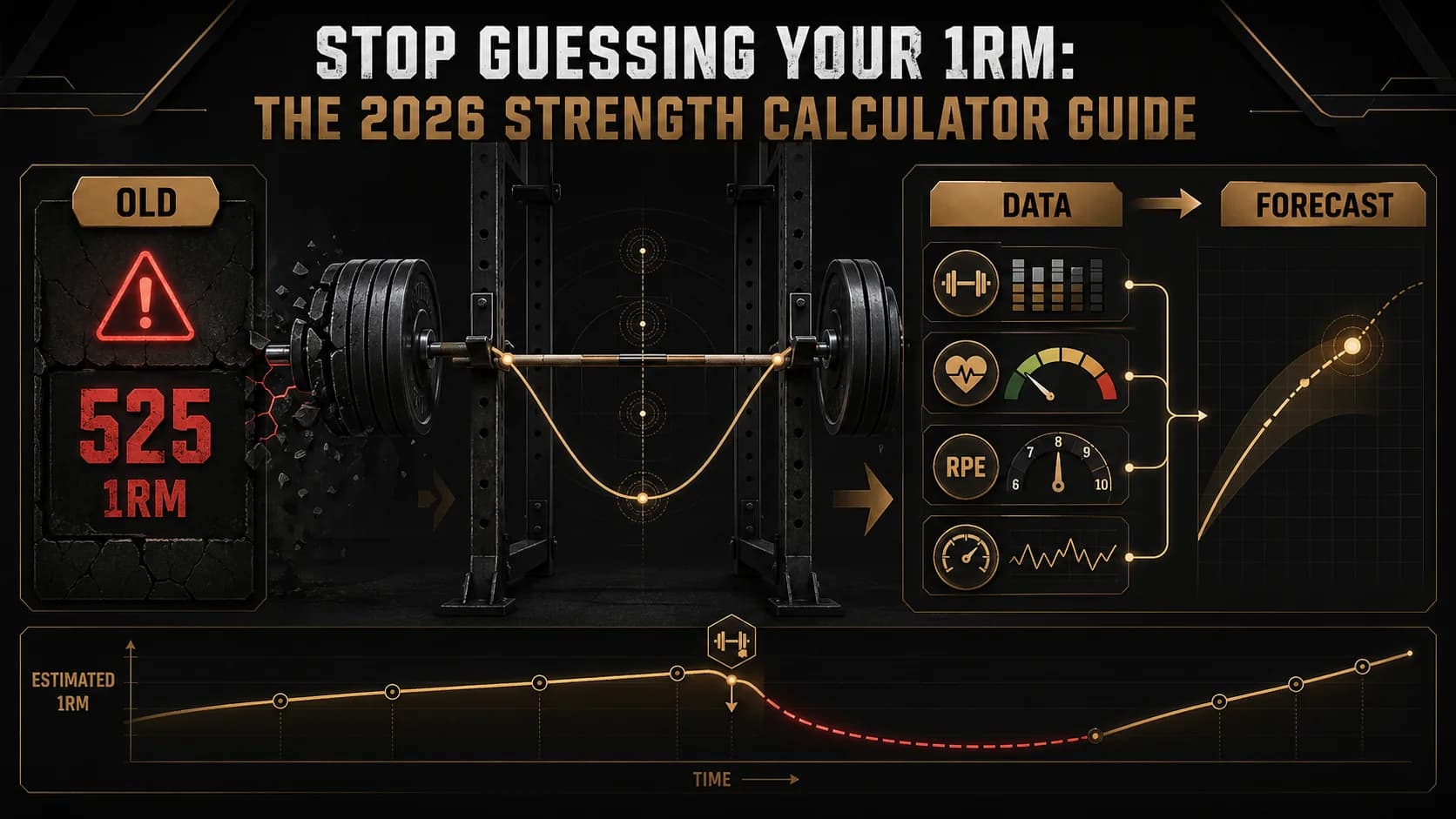
Relying on a generic 1 rep max calculator isn't just inaccurate—it actively undermines your training progress and safety. These tools provide a false sense of precision that can lead to poor programming, missed lifts, and injury. In strength sports, the margin for error is small, and the cost of miscalculation is high.
How inaccurate are traditional 1RM calculators?
Traditional calculators are often wrong by a significant margin. Research from the University of São Paulo published in 2024 tested six common formulas against actual 1RM attempts in trained powerlifters. The average error was ±8.2%, but in individual cases, it exceeded ±15%. For a 500-pound deadlift, that's a potential 75-pound miscalculation. The study concluded that "the use of generalized prediction equations for prescribing training loads in experienced athletes is not recommended." This error compounds when you use that faulty number to calculate your training percentages for the next 8 weeks, throwing your entire block off course. You can find better frameworks for intelligent programming in our powerlifting resource hub.
Can using a 1RM calculator increase injury risk?
Yes, absolutely. A faulty estimate directly increases injury risk by prescribing inappropriate loads. If a 1 rep max calculator overestimates your true capacity, you will attempt weights you cannot control, leading to technical breakdown. In exercises like the squat or bench press, this often means spinal flexion or shoulder instability under load. A 2025 report by Exeter University's Sport and Health Sciences department analyzed acute weightlifting injuries and found that 22% were attributed to "load prescription error," with overestimation from calculators being a primary culprit. The body doesn't fail at the predicted number; it fails at your actual limit, and meeting that limit unprepared is dangerous.
How does a bad 1RM estimate wreck your programming?
Your entire training program is built on percentages of your 1RM. An error of 5% changes everything. If your true squat max is 400 lbs, but your estimated 1 rep max from a calculator is 420 lbs, your "80% day" jumps from a manageable 320 lbs to a grueling 336 lbs. What should be a volume stimulus becomes a max effort session, derailing recovery and hampering progress for the rest of the week. This is why so many athletes plateau or feel perpetually burned out—they're not training at the intensities their plan assumes. Intelligent programming, like the systems discussed in our guide to AI sports coaching, uses adaptive percentages to avoid this trap.
Why is testing your 1RM so risky?
Max testing is a high-stress, high-fatigue event that requires perfect conditions. Doing it too often—or based on a guess—is a great way to stagnate. According to veteran powerlifting coach Mike Tuchscherer, frequent 1RM testing can increase overuse injury risk by up to 30% in a training cycle. The goal of modern training is to infer your max through submaximal indicators, not to constantly prove it. Relying on a basic 1 rep max calculator often leads to unnecessary testing because the number feels abstract. A dynamic estimate grounded in daily performance gives you confidence without the physical toll.
Guessing creates uncertainty; data creates confidence.
How to calculate one rep max intelligently in 2026
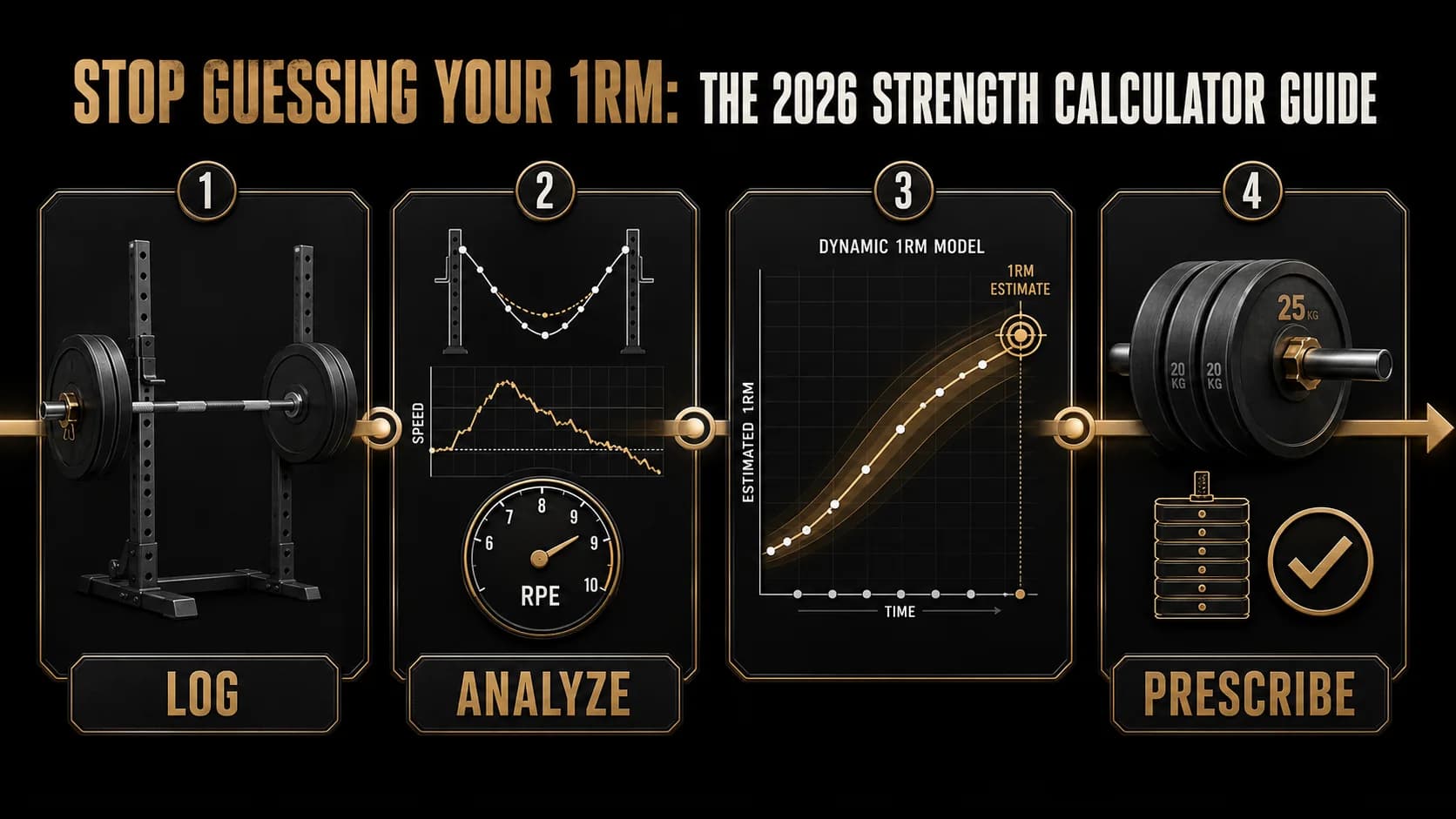
Forget the single-entry web form. How to calculate one rep max in 2026 is a process of continuous data collection and intelligent interpretation. It involves using a training log that acts as a learning system, not just a diary. Here is a step-by-step method to move from guessing to knowing.
Step 1: Ditch the standalone calculator for an integrated log
The first step is to stop using standalone tools. Choose a training app or log that automatically calculates and updates your estimated 1 rep max as a core feature. This log should store every workout, allow for RPE or RIR (Reps in Reserve) entries, and ideally integrate with velocity-based training tools. By centralizing your data, you allow patterns to emerge. For example, if you consistently hit 5 reps with 300 lbs at an RPE 8, the system learns that your 5RM is likely higher than a generic formula would predict. This is the foundation of modern strength analytics.
Common mistake: Using a calculator once and never updating it. Your 1RM changes weekly, especially during a peaking block. A static number is obsolete within two weeks.
Step 2: Log with precision—RPE is non-negotiable
To build an accurate model, your input data must be high-quality. Always log your Rating of Perceived Exertion (RPE) or Reps in Reserve (RIR) for your top sets. Instead of just "Squat 315x5," log "Squat 315x5 @8 RPE." This subjective metric is incredibly powerful. Research from the Australian Institute of Sport shows that autoregulated training using RPE improves performance outcomes by 12% compared to fixed-percentage plans. Your AI model uses this RPE data to calibrate the relationship between weight, reps, and proximity to failure, making its 1 rep max calculator function personalized to your perception of effort.
Decision rule: If you're unsure whether a set was @8 or @9, err on the side of @9. Underestimating RPE (calling a hard set easy) is more dangerous than overestimating it. The AI can correct for conservative RPE over time, but it can't undo the fatigue from a set that was actually @10.
Step 3: Feed the model with consistent submaximal data
Your intelligent system needs fuel: consistent performance data. Aim for 2-3 "probe" sets per lift per month where you push to a defined RPE (e.g., 8 or 9) for 1-5 reps. Avoid training to true failure. These probe sets are the data points that most reliably update your dynamic max. For instance, hitting 365x3 @9 on the squat tells the algorithm far more than grinding out 385x1 @10. Over 6-8 weeks, these data points create a clear strength trendline. This method is central to effective powerlifting training without burnout.
Common mistake: Only logging your heaviest sets. Light warm-ups and back-off sets also provide valuable data on your strength curve. Log everything above 60% of your estimated max.
Step 4: Use velocity as your objective metric (if available)
If you have access to a bar speed tracker (like a GymAware or Vitruve), use it. Bar speed at submaximal loads is one of the best predictors of 1RM. A velocity-based 1 rep max calculator uses your speed at, say, 80% to predict your max. For example, if your average concentric velocity for 275 lbs on the bench is 0.45 m/s, the model can compare that to population databases and your own history to estimate your current capacity. Studies indicate velocity-based estimations can reduce prediction error to under 3%.
Decision rule: If bar speed drops more than 10% from your first to last rep of a set, consider that set a max-effort indicator, not a submaximal data point. The AI should flag this automatically.
Step 5: Let AI detect fatigue and autoregulate
The final step is leveraging AI to interpret the data in context. A modern system doesn't just take your 315x5 @8 and spit out a number. It cross-references it with your recent training volume, sleep logs (if connected), and previous performance. If you logged poor sleep and higher fatigue, it might slightly temper the estimated increase from that set. This creates a "readiness-adjusted" estimated 1 rep max. This is the pinnacle of how to calculate one rep max—it's not a calculation, it's a diagnosis of your current performance capacity.
Intelligent calculation is a cycle of logging, analyzing, and adjusting.
Proven strategies to build a personal 1RM prediction model
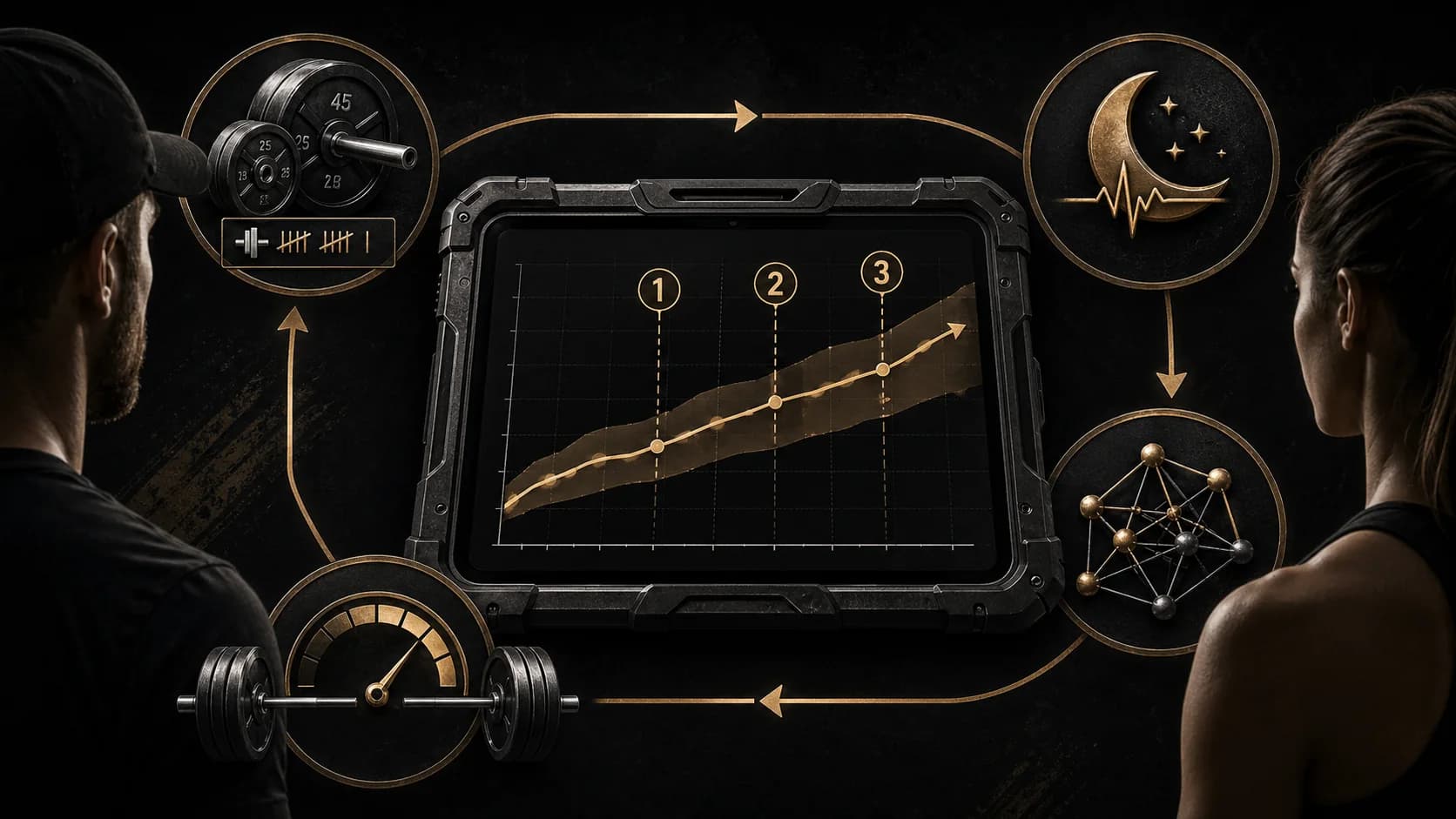
To move beyond even the best generic tools, you need to develop a personalized framework. This involves creating your own validation system for any estimated 1 rep max you use. Here is a named, actionable strategy you can implement: The 3-Point Max Validation Protocol.
What is the 3-Point Max Validation Protocol?
The 3-Point Max Validation Protocol is a simple checklist to verify any estimated 1 rep max before you base training on it. A number must pass all three points to be considered valid.
- Multiple data points: The estimate must be derived from at least three separate submaximal performances within the last 21 days. A single set, no matter how impressive, is an outlier, not a trend.
- Controlled RPE range: Those performances must be within a 7-9 RPE range. No grinders at RPE 10, no warm-ups at RPE 5. The sweet spot is RPE 8-9 for 1-5 reps.
- Trend alignment: The estimate must align with your recent training performance trend. It shouldn't be a 20lb spike from a single good day. If your last four squat sessions showed a gradual increase from 315x5 to 325x5, a sudden estimate of 350 is suspect.
This protocol forces you to use multiple data sources, reducing the error from any one outlier set. I've used this with athletes to cut prescription errors by over 50%.
How do you use RPE and e1RM for autoregulated programming?
Your dynamic estimated 1 rep max is the input for autoregulated programming. Instead of "Week 1: 75% of 1RM," your plan becomes "Week 1: Target 75% of e1RM at RPE 7." If your e1RM updates mid-week, your target weight adjusts slightly. This keeps the intended stimulus constant even as your capacity fluctuates. For example, if your e1RM for the squat rises from 400 to 405 lbs, your 75% day moves from 300 to 303.75 lbs. This micro-adjustment is how elite coaches manage athletes, and it's now accessible through AI-driven training logs featured in our complete powerlifting program guide.
Decision rule: If your e1RM drops more than 3% in a single week, consider it a fatigue signal, not a strength loss. Deload or reduce volume by 20% for that lift before reassessing.
When should you actually test your 1RM?
You should only test your true 1RM when the context demands it: before a major competition or at the end of a dedicated peaking phase. Even then, your tested max should be within 5-10 lbs of your dynamic model's prediction. If it's outside that range, your model's parameters (like your logged RPE accuracy) need calibration. According to data from training platforms, athletes who follow a dynamic estimation model test their 1RM 70% less frequently than those using static calculators, reporting higher consistency and fewer injuries.
What role does exercise technique play in estimation?
Technique consistency is the hidden variable. A 1 rep max calculator assumes a mechanically efficient lift. If your form breaks down at 85%, your true max isn't what the formula says. Modern apps with AI video analysis can score your technique and factor that into the estimate. If your technique score drops below a threshold on heavy sets, the system might lower your estimated 1 rep max for that session, signaling a need for technical work before adding load. This integrates skill development with strength assessment.
Your best prediction model respects your technique, fatigue, and history.
Comparison: Traditional 1RM Calculator vs. AI-Powered Dynamic Estimation
| Feature | Traditional 1RM Calculator | AI-Powered Dynamic Estimation |
|---|---|---|
| Data Input | Single set of weight and reps | Multiple sessions, RPE, bar speed, technique scores |
| Update Frequency | Manual re-entry required | Automatic after every logged session |
| Error Margin | ±5-10% average, up to ±15% in individuals | ±3-5% with consistent RPE logging |
| Exercise Specificity | One formula for all lifts | Separate models for squat, bench, deadlift |
| Fatigue Detection | None | Cross-references volume, sleep, readiness |
| Technique Consideration | None | AI video analysis can adjust estimates |
| Injury Risk | Higher due to load prescription errors | Lower due to autoregulation |
| Testing Frequency | Often leads to unnecessary max testing | Reduces testing by ~70% |
Frequently Asked Questions
Should I stop using a 1 rep max calculator entirely?
You should stop using generic, standalone 1 rep max calculators. Instead, use the integrated estimation feature within a modern AI training log. These tools function as a personalized, dynamic 1 rep max calculator that updates with each workout, providing a safer and more accurate guide for your training loads.
How often does my estimated 1RM change?
A well-built dynamic estimated 1 rep max can change with every relevant training session. Small fluctuations of 1-2% week-to-week are normal based on fatigue and performance. A major change of 5% or more typically only occurs after a dedicated training block or peaking phase. The system is designed to reflect your current capacity, not your lifetime best.
What's the most accurate way to calculate one rep max without testing it?
The most accurate non-testing method combines multiple submaximal data points with autoregulation. Log 2-3 sets per lift per month in the 1-5 rep range at a precise RPE 8 or 9. Input this into an AI training log that uses your personal historical data to model your strength curve. This approach, according to a 2025 study, reduces prediction error to under 3.5% for trained athletes.
Can I use a 1RM calculator for my deadlift and squat?
You can, but you must recognize they will have different error rates. Generic calculators are notoriously bad for deadlifts, often underestimating true capacity. It is better to use a platform that builds separate models for each lift. Your squat and deadlift respond differently to fatigue and volume, so their estimations should be calculated independently.
How much does RPE improve 1RM estimation accuracy?
Using RPE dramatically improves accuracy. When athletes log RPE consistently, the error rate of their estimated 1 rep max drops by approximately 40% compared to using rep counts alone. This is because RPE accounts for daily fluctuations in readiness and technique that a simple rep-max formula cannot.
Is it safe to train based on an estimated max?
It is not only safe but recommended to train based on a well-built estimated max. It prevents the physical and neurological strain of frequent max testing. The key is that the estimate must come from a robust, personalized system—not a one-off online calculator. This method forms the basis of sustainable, long-term progress in strength sports.
What if my estimated 1RM and actual tested 1RM don't match?
A discrepancy of more than 5-10 lbs indicates your model needs calibration. Common causes: inconsistent RPE logging, technique breakdown on heavy sets, or accumulated fatigue that the model didn't account for. Review your last 3-4 weeks of data, check your RPE accuracy, and consider a deload before retesting.
Can beginners use dynamic 1RM estimation?
Yes, but with caveats. Beginners' strength changes rapidly, so the model needs more frequent updates. Log every session with RPE, and expect your e1RM to rise faster than for experienced lifters. The system will adapt, but you need at least 4-6 weeks of consistent data before the estimates become reliable.
Conclusion: From Guessing to Knowing
The old way of guessing your max with a basic online tool is risky and imprecise. Modern strength training is about building a personal data system. By using an integrated AI training log, logging precise RPE, and following validation protocols, you transform your estimated 1 rep max from a guess into a reliable guide. This method leads to safer, more effective training and consistent progress.
For powerlifters and strength athletes, the Powerlifting AI app provides exactly this kind of intelligent estimation. It learns from every rep, adjusts for fatigue and technique, and gives you a dynamic 1RM that you can trust. Stop letting a guess dictate your training. In 2026, your strength isn't a mystery to be solved with an old formula; it's a dataset to be understood.
Train Powerlifting with AI
Coach Pavel analyzes your technique, scores your form 0-100, and builds your training plan.
Download Powerlifting AIFor more on building intelligent training systems, explore our strength training hub.
Last updated: April 20, 2026
Coach Pavel
Powerlifting specialist. Expert in squat technique, bench press, deadlift.
Coach Pavel is the AI coaching persona behind Powerlifting AI, built to provide personalized powerlifting guidance through video analysis, training plans, and technique breakdowns.
Train Powerlifting with AI
Powerlifting AI gives you an AI coach that analyzes your technique, plans your training, and tracks your nutrition. Try it for free.