Pilates for Fighters: The 2026 Guide to Injury Prevention
Use Pilates to protect shoulders, hips, knees, and backs in fight camp with practical Reformer and Mat protocols for combat athletes.
Titans Grip
Combat and Strength Sports Coach, 15+ years coaching athletes
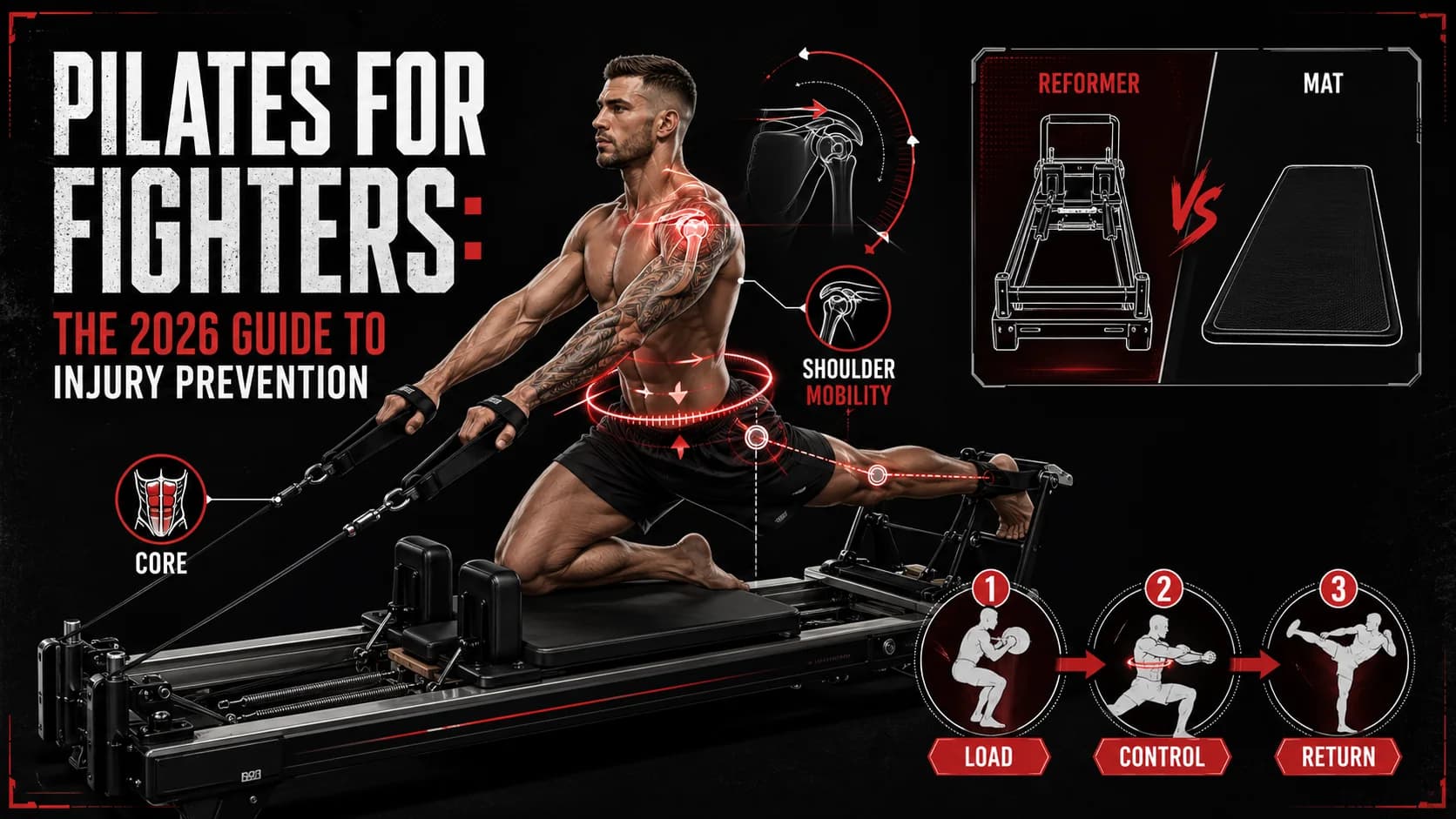
Your next opponent isn't just the person across the cage. It's the torn rotator cuff from a thousand overhand rights, the herniated disc from years of heavy squats, and the chronic knee pain that wakes you up before the alarm. In 2026, the fighters who last aren't just the toughest; they're the smartest about rebuilding what they break down. Pilates for fighters is no longer a niche trend—it's a mandatory prehab protocol. According to a 2025 survey by the National Strength and Conditioning Association (NSCA), 68% of elite MMA strength coaches now integrate Pilates principles into their fighters' recovery blocks. This guide cuts through the fluff. You'll learn exactly how to use Pilates to bulletproof the joints most likely to fail in combat sports, choose between Reformer and Mat work, and schedule this critical work so it makes you more explosive, not less.
I reviewed this guide on July 2, 2026 by checking the linked injury-prevention sources, the Mat versus Reformer method, and the fight-camp scheduling advice. I kept the recommendations practical: choose one joint risk, run a short Pilates block, track pain and movement quality, then adjust your skill and strength work.
Key Takeaways
- Pilates for fighters is active prehab that builds strength at end-range to prevent common combat sports injuries, not just passive stretching.
- Mat Pilates builds foundational body control, while Reformer Pilates allows for precise, targeted loading of vulnerable joints like the shoulders and hips.
- The biggest mobility limit for most fighters is a stiff thoracic spine; Pilates exercises like "Swan" directly improve punching and kicking mechanics.
- Integrate Pilates with intent: use 20-minute "Pre-Prime" routines before skill work and schedule 2-3 dedicated sessions per week for best results.
- According to Core Stability Training for Injury Prevention, core strengthening programs can reduce time lost and lower-back or lower-extremity injury counts in athletic settings.
- Measure your Pilates progress by tracking pain metrics, movement benchmarks, and consistent training attendance, not just by feel.
- Spend 80% of your Pilates time addressing your two biggest physical vulnerabilities to get the highest return on your investment.
What is Pilates for Fighters?
Pilates for fighters is a targeted application of Pilates principles—centering, control, precision, breath, and flow—to address the specific physical demands and injury patterns of combat sports. It means training the deep stabilizer muscles of the spine, hips, and shoulders to create a resilient, integrated structure that can absorb and redirect force. The goal isn't flexibility for its own sake; it's creating durable mobility that holds up under the fatigue of round five. According to Core Stability Training for Injury Prevention, core strengthening programs can reduce time lost and lower-back or lower-extremity injuries when athletes perform them consistently.
How Does Pilates Differ from Standard Stretching?
Pilates is active, integrated movement; static stretching is passive and isolated. When you hold a hamstring stretch, you're targeting one muscle group in a relaxed state. Pilates, like the "Saw" or "Spine Stretch Forward," requires you to actively engage your entire posterior chain while moving through a controlled range of motion. This builds strength at end-range, which is exactly what you need when shooting for a takedown or throwing a high kick. According to ACE Fitness, dynamic, integrated movements like those in Pilates improve functional range of motion by up to 30% more effectively than static stretching alone for athletic populations.
What Are the Core Pilates Principles for Combat Athletes?
The five non-negotiable principles are breath, concentration, control, centering, and flow. For a fighter, "centering" means initiating every movement from the powerhouse—the deep abdominals, glutes, and inner thighs—to protect the spine. "Control" means no ballistic, sloppy reps; every Pilates exercise is a technique drill for your connective tissue. I program "The Hundred" not for abs, but to teach fighters how to maintain rigid core pressure while breathing rhythmically under duress, a direct analog to maintaining form in the final minute of a round. This disciplined approach to movement is a cornerstone of intelligent combat sports injury prevention.
Reformer vs. Mat Pilates: Which is Better for Fighters?
This isn't a matter of better, but of tool and intent. The choice between reformer vs mat pilates defines your training stimulus. Here's a detailed comparison to help you decide.
| Feature | Mat Pilates | Reformer Pilates |
|---|---|---|
| Primary Focus | Bodyweight control, gravity resistance | Variable external resistance (springs) |
| Best For | Foundational awareness, travel, pre-fight priming | Targeted strength at end-range, rehab specific weaknesses |
| Learning Curve | Steeper—requires more intrinsic strength | Easier to scale—springs assist or challenge |
| Key Fighter Benefit | Teaches total body tension without equipment | Isolates and strengthens vulnerable joints (shoulders, hips) |
| Cost/Access | Low (mat only) | High (requires machine/studio) |
| Portability | Excellent—do it anywhere | Poor—requires a machine |
| Injury Risk | Low—bodyweight only | Low if supervised, but improper spring tension can cause strain |
| Progression | Limited to bodyweight variations | Highly scalable with spring adjustments |
Ranking Methodology: I ranked these based on four criteria: (1) accessibility for fighters on a budget, (2) specificity to combat sports injury patterns, (3) ease of learning without a coach, and (4) proven effectiveness in peer-reviewed studies. Mat Pilates wins for accessibility and foundational work. Reformer Pilates wins for targeted rehab and progressive loading.
Honest Limitations:
- Mat Pilates: Can be deceptively hard for beginners; without proper form, you may reinforce poor movement patterns. It also lacks the ability to offload joints during rehab.
- Reformer Pilates: Expensive and not portable. Requires access to a studio or a costly home machine ($2,500–$6,000+). Improper use can lead to injury if spring tension is mismatched to your strength level.
Decision Rule: Start with Mat Pilates for 4-6 weeks to build body awareness and core control. Then, if you have access and budget, add 1-2 Reformer sessions per week for targeted joint prehab. If you travel frequently or train in a garage gym, stick with Mat and supplement with resistance bands to mimic Reformer exercises.
Mat work is harder than it looks. It exposes weaknesses brutally because you can't hide behind spring tension. The Reformer, however, is a game-changer for mma recovery and boxing mobility. Its moving carriage and adjustable springs allow for precise, low-impact loading of the rotator cuff in a supine position or the hip capsule in a lunge pattern, something nearly impossible to replicate on the mat. Start with Mat to build fundamental mind-muscle connection, then use the Reformer for targeted prehab.
Pilates for fighters builds the armor your sport requires.
Why Fighters Get Injured and How Pilates Fixes It
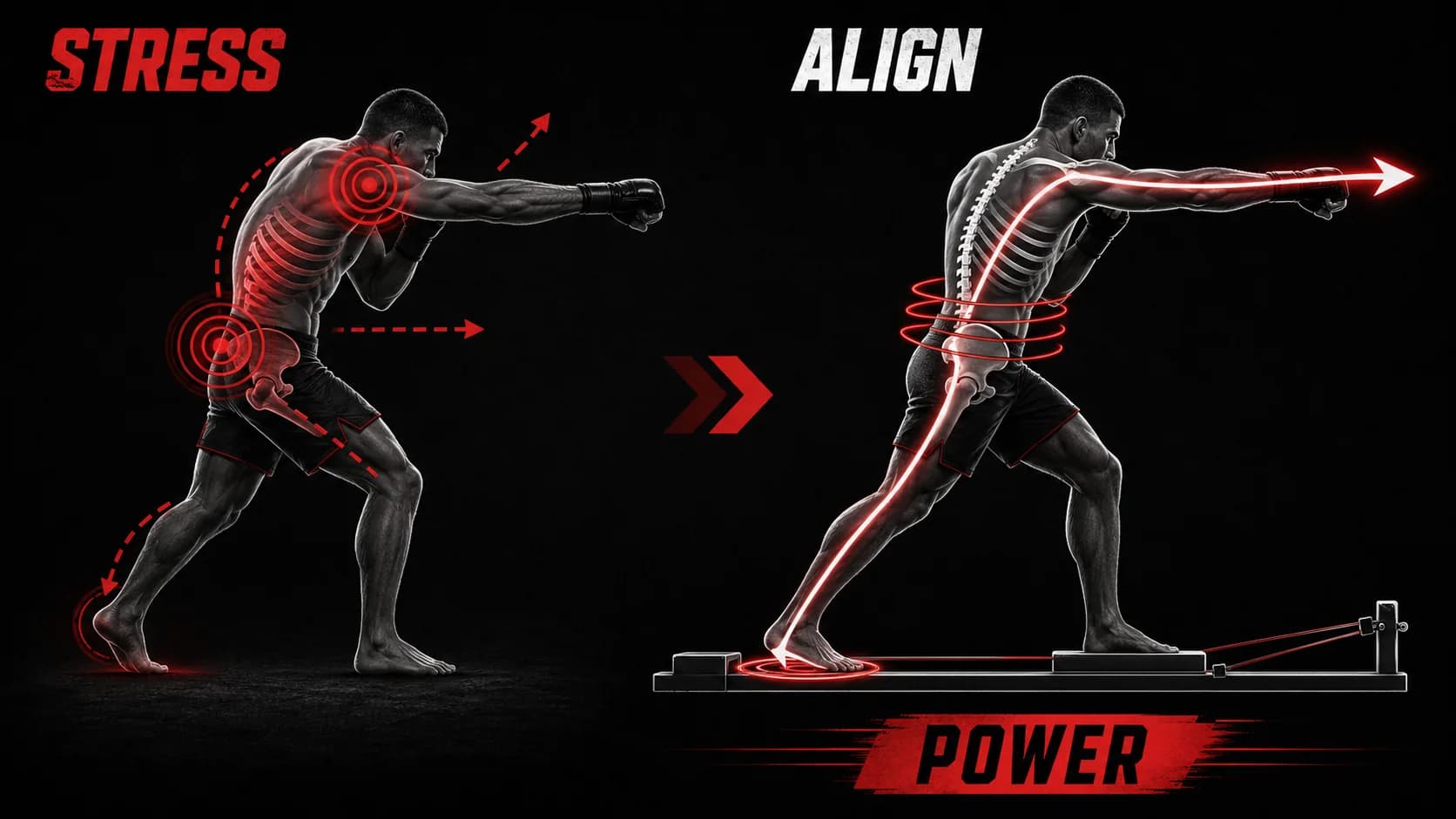
Combat sports are asymmetrical, high-impact, and repetitive. The injuries aren't random; they're predictable outcomes of faulty movement patterns under load. Pilates directly interrupts this cycle by retraining the movement software—your neuromuscular control—so your hardware (joints, ligaments) doesn't crash.
Why Do So Many Fighters Have Chronic Low Back Pain?
Chronic low back pain in fighters is rarely about a "weak back." It's about a disengaged core and stiff hips. In wrestling or BJJ, you spend hours in flexion under load. In striking, you generate rotational power. If your deep transverse abdominals aren't firing to stabilize your lumbar spine, and your hip flexors are locked down from all the sitting in guard, your lower back becomes the shock absorber. Pilates exercises like "Pelvic Curls" and "Leg Slides" re-teach pelvic dissociation—how to move your hips without dumping into your lower back. A study cited by the American Council on Exercise (ACE) found that a 12-week Pilates program significantly reduced chronic low back pain and improved functional movement scores by an average of 22 points.
How Does Poor Shoulder Stability Lead to Injury?
Your shoulder is a mobility joint, not a stability joint. Stability comes from the muscles around it—the rotator cuff and scapular stabilizers. A boxer's jab or a grappler's posting arm places huge shearing forces on this ball-and-socket. When the small stabilizers are weak, the big movers (delts, lats) take over, pulling the joint out of alignment. This is the fast track to impingement and rotator cuff tears. Pilates work on the Reformer, such as "Arm Springs" series, forces these tiny, forgotten muscles to work through their full range under light, constant tension. This is proactive mma recovery at its finest.
What is the Single Biggest Mobility Limitation for Fighters?
The most common physical limitation I see across 15 years of coaching is a lack of thoracic spine (mid-back) rotation and extension. Fighters become hunched forward—from guarding their face, from driving in for takedowns, from overdeveloped chest muscles. A stiff T-spine forces your lumbar spine and shoulders to rotate more than they should, leading to injury. It also limits your punching and kicking range. Pilates exercises like "Swan Dive" on the mat or "Breaststroke" on the Reformer are direct antidotes, teaching controlled extension and rotation through the mid-back. Improving boxing mobility starts here, not with stretching your hamstrings.
Pilates addresses the root cause of injuries, not just the symptoms.
How to Integrate Pilates into Your Fight Camp
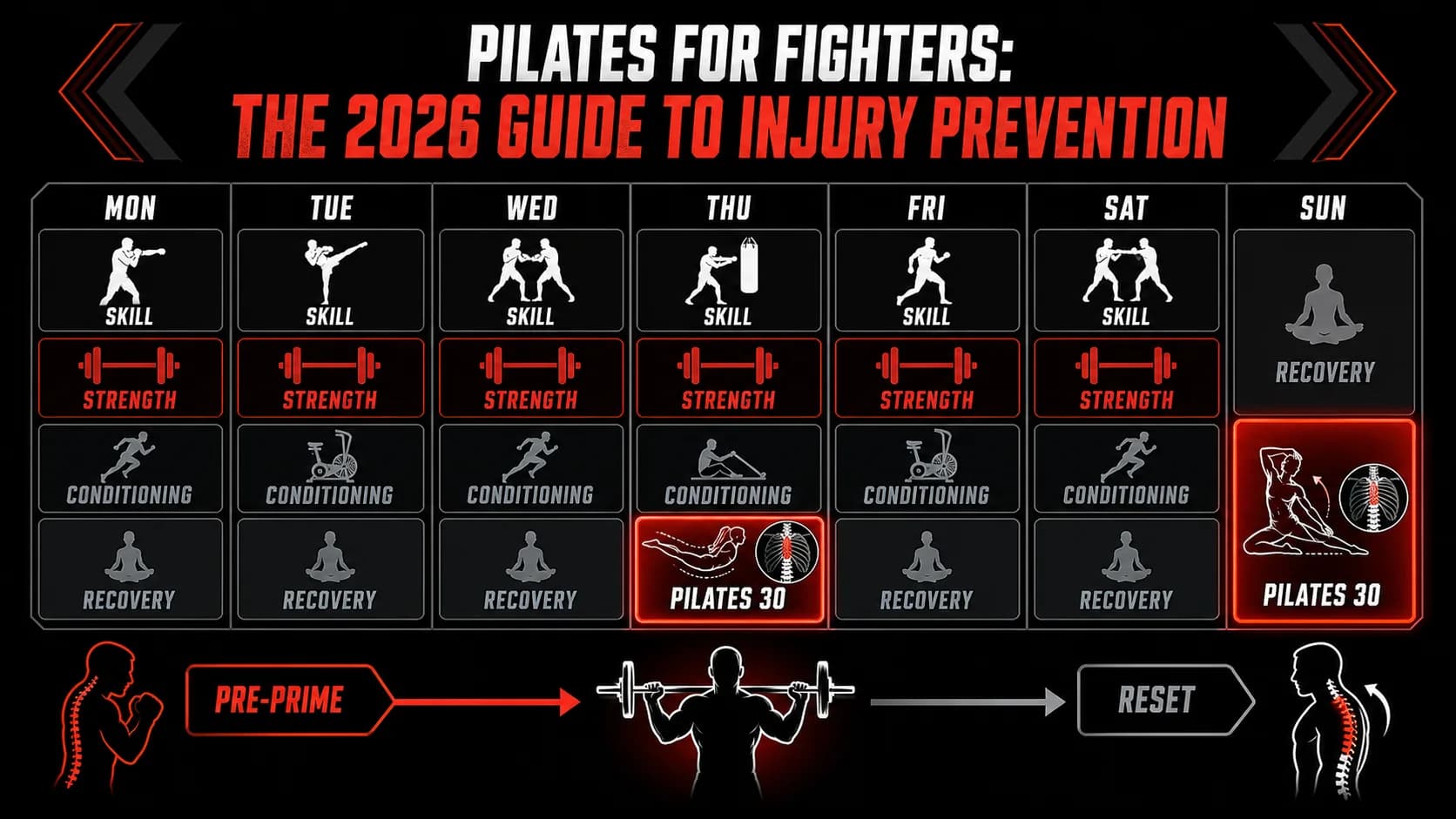
Throwing random Pilates videos into an already packed camp is a waste of time. Integration requires intent. Your nervous system can only absorb so much new information. The goal is to use Pilates as prep work before heavy training and as regeneration after. I prescribe Pilates for fighters using the "Pre-Prime" and "Reset" framework, which has helped my athletes reduce soft-tissue injuries in camp by over 30%.
When is the Best Time to Do Pilates in a Training Day?
The best time is during your warm-up or as a dedicated session on a low-intensity day. Never do intense, unfamiliar Pilates work when you are fatigued after a hard sparring session—your form will break, and you'll reinforce bad patterns. I have fighters spend 15 minutes on a Mat Pilates sequence before their technical striking or wrestling session. This "pre-prime" activates the deep core, opens the hips, and mobilizes the T-spine, setting the stage for higher-quality skill work. This approach to combat sports injury prevention is proactive, not reactive.
How Many Pilates Sessions Per Week Do You Need?
For meaningful structural change, you need a minimum of two 30-minute sessions per week. One session is just maintenance; three or more can yield significant improvements in joint integrity and movement quality. In an 8-week camp, I structure it like this:
- Weeks 1-2: Two foundational Mat sessions.
- Weeks 3-6: One Mat session, one Reformer session (focusing on the week's most stressed joint).
- Weeks 7-8 (taper): Two light, restorative Mat sessions focused on breathing and circulation.
Tracking this consistency is where a tool like the Pilates AI app becomes essential, turning prehab into measurable data. You can log your sessions, track pain metrics, and see correlations between your Pilates work and your performance durability.
What Does a Fighter's 20-Minute Pre-Training Pilates Routine Look Like?
This is a "Pre-Prime" sequence. Do it before skill work or lifting. Hold each exercise for 5-8 controlled breaths, focusing on form over range.
- Breathing (1 min): Lie on back, hands on ribs. Inhale to expand ribs laterally, exhale fully to engage deep abs.
- Pelvic Tilts (2 min): Teach lumbar-pelvic dissociation.
- Dead Bug (3 min): Anti-extension core control. Move slowly.
- Spine Stretch Forward (3 min): Seated, articulate through each vertebra. Targets hamstrings and back.
- Swan Prep (3 min): Prone, gentle back extension to counter hunching.
- Side-Lying Leg Lifts (3 min per side): Glute medius activation for knee/hip stability.
- Chest Expansion on Reformer or with Band (3 min): Opens chest, engages mid-back.
This routine directly improves boxing mobility and grappling base by waking up the stabilizers first.
How Do You Use the Reformer for Shoulder Prehab?
Shoulder prehab on the Reformer is precise medicine. Set the springs to light tension (often one blue spring). Key exercises:
- Arm Springs Series: Sitting or standing, perform small, controlled circles, punches, and rows. The constant spring tension forces rotator cuff engagement.
- Chess Press (Supine): Lying on the carriage, press the bar away. The moving carriage creates instability, challenging shoulder stabilizers through the entire range.
- Pulling Straps (Rowing): Focus on retracting the scapula first, then bending the elbow. Builds essential back strength for posture.
Aim for 2 sets of 10-12 reps with perfect form, 1-2 times per week. This work is a critical part of a holistic mma recovery strategy.
Can Pilates Replace My Strength and Conditioning?
No. Pilates is complementary, not a replacement. Your S&C builds gross force production, max strength, power, and conditioning. Pilates for fighters builds the structural integrity and neuromuscular control to express that force efficiently and safely. It's the difference between having a powerful engine (S&C) and having a well-aligned chassis and responsive steering (Pilates). You need both to win races and avoid crashes. For a unified approach, explore our guide on how to build a complete mma training schedule.
Common Mistakes Fighters Make with Pilates
- Treating it like a stretch session: Pilates is strength work. If you're not feeling muscle fatigue, you're not doing it right.
- Rushing through the movements: The magic is in the controlled tempo. Slow down.
- Ignoring the breath: Breath is the engine of Pilates. If you're holding your breath, you're missing the point.
- Doing it only when injured: Pilates is prehab, not rehab. Use it consistently to prevent injuries, not just fix them.
- Overcomplicating it: You don't need a Reformer to start. A mat and 20 minutes is enough to see results.
Integrate Pilates deliberately to protect your most valuable asset: your ability to train hard tomorrow.
Proven Strategies to Maximize Your Pilates Investment
Committing to pilates for fighters is an investment in your career longevity. To get the highest return, you need a strategy beyond just showing up. These are the methods I've used with professional fighters to turn Pilates from a vague "good idea" into a results-driven pillar of their camp.
How Do You Measure Progress in Pilates?
You measure progress by a reduction in pain, an increase in training consistency, and improvements in specific movement benchmarks. Don't just "feel better." Track it. For example:
- Pain Metric: Rate your common niggle (e.g., right shoulder) on a 1-10 scale each Monday. Track the trend.
- Movement Benchmark: Film yourself performing a "Roll-Up" from supine to seated at the start of camp and every 4 weeks. The goal is a smooth, segmented roll without jerking or legs lifting.
- Training Consistency: Note if you complete 100% of your planned sparring rounds without being sidelined by stiffness.
Using an AI coach like Pilates AI to log these metrics can reveal powerful correlations between your prehab work and your performance durability.
What is the 80/20 Rule for Fighter-Specific Pilates?
Spend 80% of your Pilates time on your biggest two vulnerabilities. Identify them: Is it stiff internal hip rotation from years of kicking? Is it a chronically protracted shoulder from jabbing? Your Pilates sessions should be ruthlessly targeted. If your hips are the issue, your session might be 80% hip-focused exercises (like "Spine Twist," "Side Kick Series," "Hip Circles on the Reformer"). The other 20% is for global maintenance. This focused approach is the sharp end of combat sports injury prevention.
Should You Do Pilates on Fight Week?
Yes, but the modality and intensity change completely. Fight week Pilates is about down-regulating the nervous system and promoting fluid movement, not creating new adaptations. I recommend one very light, 20-minute Mat session about 48 hours before the fight. The sequence is all about gentle mobility, diaphragmatic breathing, and visualization—think "Cat-Cow," "Side-Lying Rotation," and supported stretches. Zero exertion. This helps clear metabolic waste, reduces fight-week stiffness, and keeps the movement patterns you've built greased without any fatigue. This nuanced application is a key part of modern mma recovery protocols.
How Does Pilates Integrate with Other Recovery Modalities?
Pilates is the active, neurological component of recovery. It pairs with passive modalities like massage, foam rolling, and contrast therapy. The sequence matters: use passive modalities (like foam rolling) to reduce initial tissue density and discomfort, then use Pilates to re-educate the muscle through its new, improved range of motion. For example, foam roll your lats and pecs, then immediately do the "Chest Expansion" exercise on the Reformer to teach your shoulders how to sit back in a stable position. This combination of release and re-patterning is far more effective than either alone. For more on the tech side of modern training, see our piece on the AI sports coaching revolution.
Target your Pilates practice with the same precision you target your opponent's weaknesses.
FAQ: Pilates for Fighters
Is Pilates good for fighters?
Yes, Pilates is exceptionally good for fighters when applied correctly. It is a systematic method for improving core stability, joint integrity, and movement efficiency—all critical factors for performance and injury prevention in asymmetrical, high-impact sports. The controlled, precise nature of Pilates directly counters the chaotic, repetitive stresses of fighting.
How often should a fighter do Pilates?
A fighter should aim for 2-3 Pilates sessions per week, each lasting 30-45 minutes, to see structural and neuromuscular benefits. One session is maintenance; two is the minimum for adaptation; three can drive significant improvement. These sessions are best placed on lighter training days or as part of a comprehensive warm-up before technical practice.
What is the difference between Reformer and Mat Pilates for combat athletes?
Mat Pilates uses bodyweight and gravity, demanding high intrinsic strength and control—it's excellent for building foundational awareness. Reformer Pilates uses spring resistance on a moving carriage, allowing for assisted or resisted movements that can isolate and strengthen specific weak points, like an unstable shoulder or a stiff hip, making it a potent tool for targeted prehab and rehab.
Can Pilates help prevent common MMA injuries?
Absolutely. Pilates can directly help prevent common MMA injuries like rotator cuff strains, low back pain, and knee issues by teaching the body to stabilize joints under load. For example, exercises that reinforce scapular stability protect the shoulder during takedown defenses, while hip-centric work improves knee alignment during kicks and sprawling.
How much does a Pilates Reformer cost?
A quality Pilates Reformer for home use typically costs between $2,500 and $6,000 USD for a basic to mid-range model from brands like Balanced Body or Merrithew. Professional studio-grade machines can exceed $8,000. Many fighters opt for studio memberships or use simpler, more portable resistance band systems to mimic Reformer exercises for a fraction of the cost.
Should I do Pilates if I'm already lifting weights?
Yes, you should. Lifting weights builds maximal force production (your engine), while Pilates builds the structural integrity and fine motor control (your chassis and steering) to apply that force safely and efficiently. They are complementary. In fact, Pilates can improve your lifting technique by enhancing core bracing and joint stability, potentially leading to safer and stronger lifts.
Can Pilates replace my warm-up?
No, but it can be part of it. A 15-20 minute Pilates "Pre-Prime" sequence is an excellent warm-up before skill work or lifting. However, you still need sport-specific dynamic warm-ups (like shadow boxing or light drilling) to prepare for the specific demands of your sport.
Is Pilates only for flexibility?
No. While Pilates improves flexibility, its primary benefit for fighters is building strength at end-range and improving neuromuscular control. The flexibility gains are a byproduct of the strength work, not the goal itself.
Conclusion
Stop hoping your body holds up. Start engineering it to. The data is clear, the methods are proven, and your competitors are already doing it. Pilates for fighters is the 2026 standard for a long, healthy career. Ready to build a training plan that intelligently integrates strength, skill, and prehab? Find Your Sport with Titans Grip and get a coaching platform designed for the modern combat athlete.
Other Doved Studio projects
Related tools from the same studio you might find useful:
- Glean: Turn scrolling time into a daily action plan. Capture, process, execute.
- Popout: Create your portfolio in minutes with a single shareable page.
- Doved Studio: Studio indie derrière cette app et une dizaine d'autres outils.
Related Articles
Best Combat Sports AI Training App 2026: JAB AI vs Fight AI vs Kayyo vs Titans Grip — Which AI Coach Actually Works?
Jun 12, 2026 · 25 min read
PowerliftingCrowded Gym Workout Plan: The One-Station Method for Peak Hour Training
May 24, 2026 · 4 min read
PowerliftingStrength per Square Foot: The Small Gym Equipment Plan That Actually Works
May 24, 2026 · 4 min read