
How UFC Fighters Use the 1 Rep Max Calculator for Fight Strength
Learn how UFC fighters use a 1 rep max calculator to build fight ready strength without extra bulk. A practical guide for combat athletes.
Titans Grip
MMA Coach, integrating striking, wrestling, and submission grappling
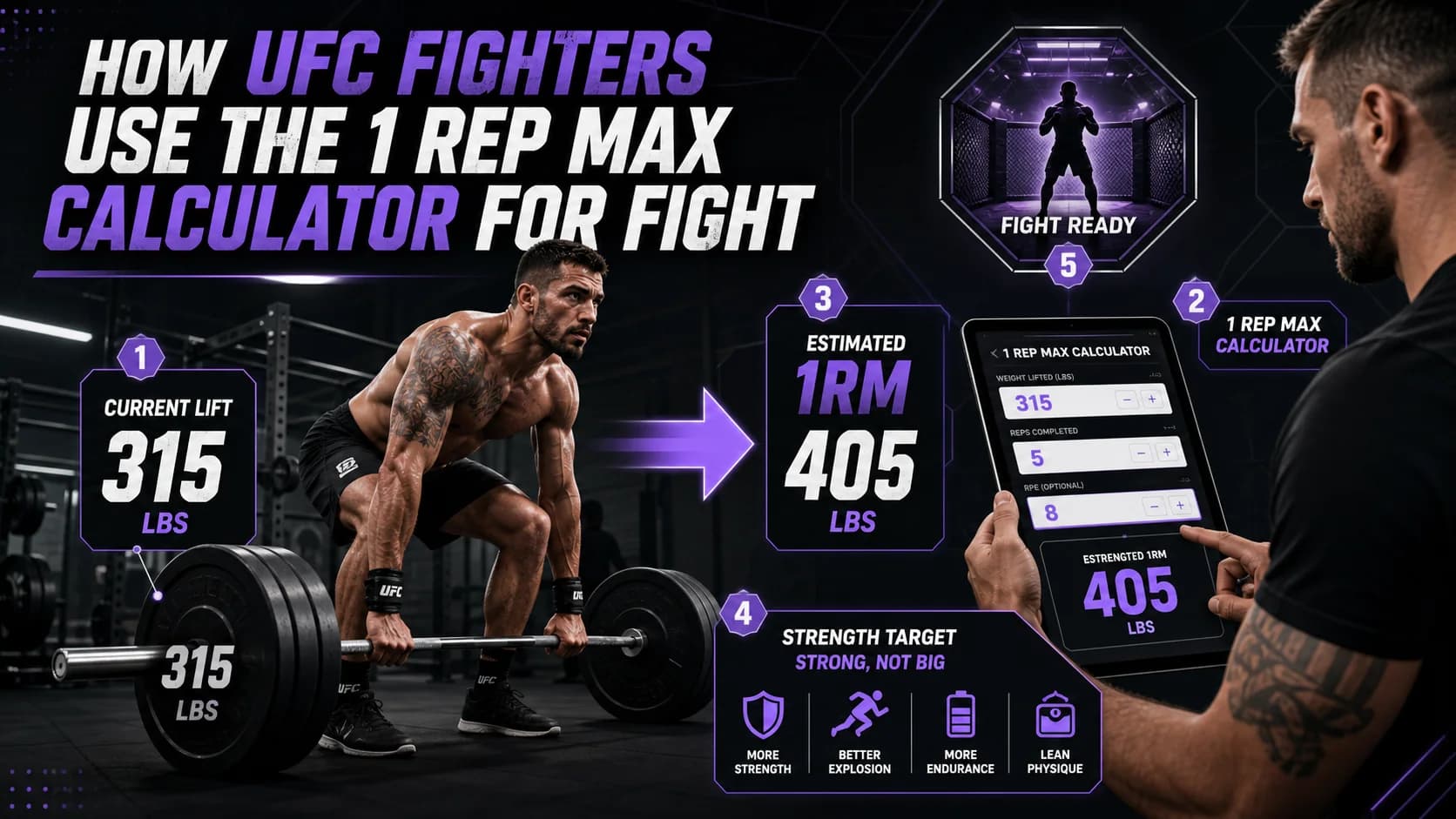
A fighter walks into a weight room and loads the bar to 315 for a squat. Their coach watches, then asks a simple question: “What’s your actual max today?” In a sport where every pound matters, guessing is not an option. That question is why UFC athletes, and their coaches, reach for a 1 rep max calculator before they touch the barbell.
Most people associate a 1 rep max calculator with powerlifting—grinding singles, testing pure strength, chasing bigger numbers. Fighters don’t have that luxury. They live inside a weight class, every ounce of muscle an enemy on the scale the morning of weigh-ins. A miscalculated training block can push a fighter up a division and into a disadvantage they cannot erase. The calculator, used right, turns from a lifter’s toy into a precise instrument that builds fight-winning power without the bulk that sinks a camp.
Over 15 years coaching boxers, wrestlers, and MMA competitors, I’ve watched too many athletes either under-train their strength for fear of gaining weight, or over-train like a bodybuilder and then suffer through a brutal weight cut. Both mistakes start with the same error: not knowing exactly how strong they are today and what intensity will drive adaptation safely. That’s where a 1 rep max calculator earns its place in a fight camp. It keeps the work honest, the intensity calibrated, and the scale friendly.
Defining the 1 Rep Max Calculator for Combat Athletes
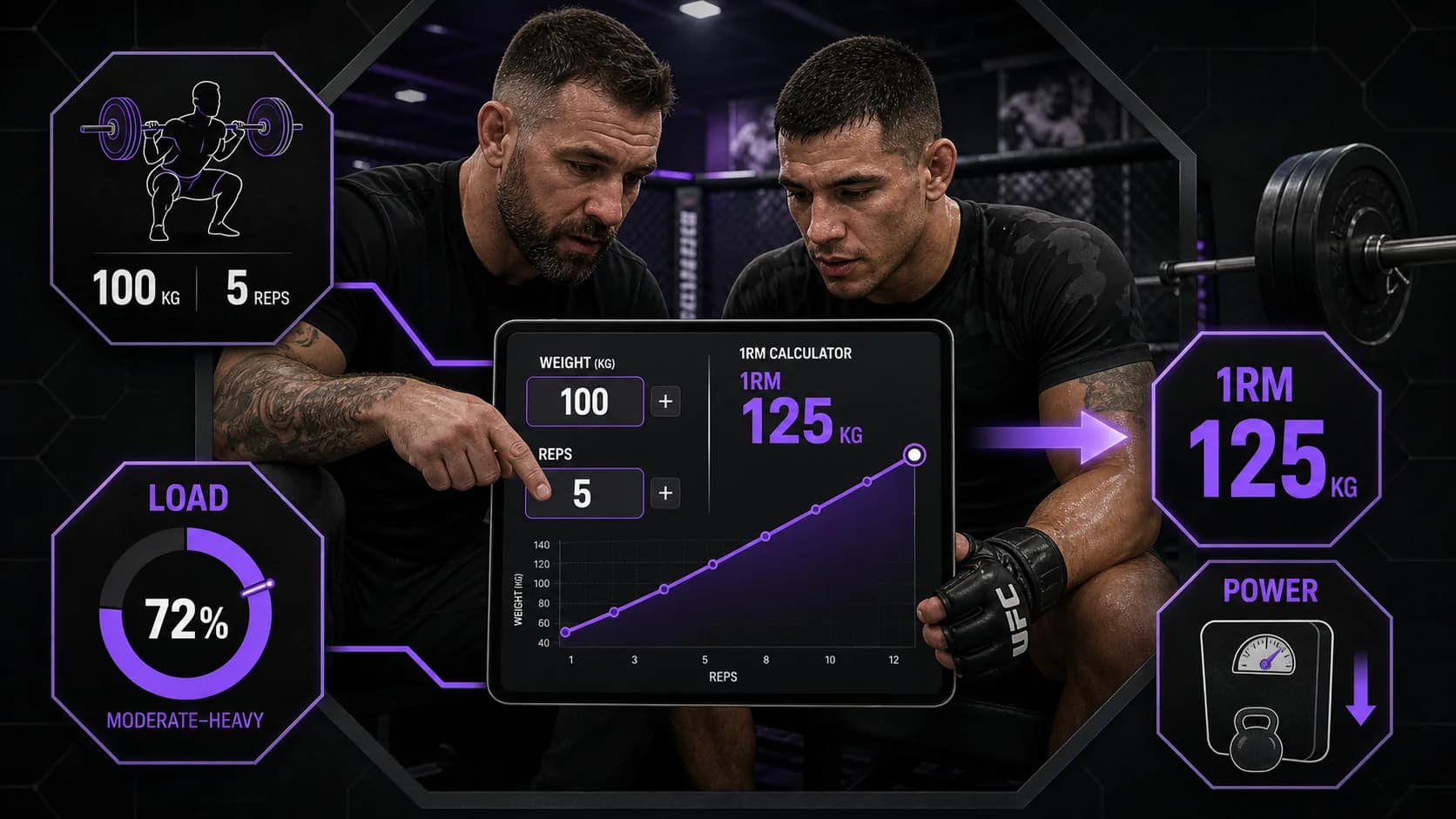
A 1 rep max calculator predicts the maximum weight a fighter can lift for a single repetition, using submaximal sets. It doesn’t require grinding through a true one-rep max every week. This is essential for combat sports, where risking a failed max attempt can tweak a joint and stall a camp. The tool runs formulas like the Epley equation—weight × (1 + reps/30)—to give a close estimate. For a UFC lightweight who hits a 5-rep back squat at 275 lb, the calculator spits out roughly 320 lb. That number isn’t a trophy. It’s a programming anchor.
Fighters use a calculator, not just the heavy single, because their training week already includes sparring, grappling, conditioning, and recovery. A true 1RM test costs the nervous system a fight’s worth of fatigue. The calculator sidesteps that while still delivering a number accurate enough to set loads for explosive work, strength maintenance, and periodization.
What is a 1 rep max calculator formula and how does it work?
A 1 rep max calculator formula uses submaximal load and repetitions to estimate maximal strength. The most widely used model is the Epley equation: 1RM = weight × (1 + 0.0333 × reps). Research published in the Journal of Strength and Conditioning Research found that the formula predicts actual 1RM within roughly 5% for lifts below 10 reps, which covers the rep ranges fighters typically use. It’s not perfect—accuracy drops when the set goes beyond 10 reps or when an athlete is highly fatigued—but for a fight camp’s purposes, it’s reliable enough to steer percentages with confidence.
Fighters often ask me about the “1 rep max calculator squat” variant specifically. The squat matters because it reveals lower-body force production, which directly ties to takedown power and cage control. I keep a separate spreadsheet where I plug in the weight and reps from a heavy 5, then let the calculator spit out a daily training max. That number changes week to week, so the calculator acts like a rolling autoregulation tool, not a one-time test.
How is a powerlifter’s 1RM different from a fighter’s 1RM?
A powerlifter chases absolute numbers on the platform, with unlimited bodyweight and years to peak. A fighter chases force production that transfers to the cage without adding mass. According to a study in the Journal of Strength and Conditioning Research profiling MMA athletes, the average squat 1RM relative to body weight was 1.7 to 1.8 times body mass, yet the fighters competed successfully while staying within striking distance of their weight class. That’s a stark contrast to a powerlifter who might squat 3× bodyweight but carries extra tissue that would doom a fighter on the scale.
This difference shapes how a 1 rep max calculator gets used. Powerlifters often test maxes often and build volume around them. Fighters use the calculator to find a “training max”—typically 90% of true 1RM—and then never touch true max in camp. That buffer protects the nervous system and keeps muscle mass in check. When I plan a combat sports strength program, I base the entire block on that reduced number, then re-test after the fight.
| Factor | Powerlifting 1RM Application | Fighter 1RM Application |
|---|---|---|
| Primary Goal | Lift as much as possible on meet day | Produce force for grappling / striking without adding mass |
| Weight Class Priority | Unlimited or chosen for advantage | Strict, 1-3% above walk-around weight |
| Testing Frequency | Every 4-6 weeks | Once pre-camp, then estimated weekly |
| Typical Rep Range for Calculation | 1-3 reps | 3-6 reps |
| Program Anchor | True 1RM | Training max (90% of 1RM) |
| Nervous System Cost | Accepted as competition-specific | Avoided to preserve sparring and skills |
Why do UFC fighters care about a 1RM calculator instead of just lifting hard?
Hard lifting without a calculator means load selection by feel. That feels aggressive but is dangerously imprecise. In a UFC strength training 2026 environment, coaching staffs use biometrics and AI tools to track readiness, and the 1 rep max calculator is one of the simplest, highest-return instruments in that stack. When a fighter’s sleep score drops or cut weight begins, their true max shifts. The calculator, fed by a quick 4-6 rep set, recalibrates loads instantly. I’ve seen a welterweight lose 12% of his squat strength in the final 10 days of a water cut. Without daily re-estimation, he’d have failed sets or, worse, gone too heavy and risked injury. With it, we dropped his training load by 8% and kept his power output crisp.
This blend of precision and safety is why coaches like Phil Daru and Mike Dolce embed submaximal testing and calculators into their programs. In a recent Sherdog interview, Daru emphasized that his fighters use 1RM calculators weekly to auto-regulate loads across different phases, ensuring they never stray into hypertrophy territory that would push them out of a division.
Strength for fighting is not about lifting the building off the ground. It’s about lifting the right weight, at the right time, so the scale stays your friend.
Train MMA with AI
Coach Rico analyzes your technique, scores your form 0-100, and builds your training plan.
Download MMA AI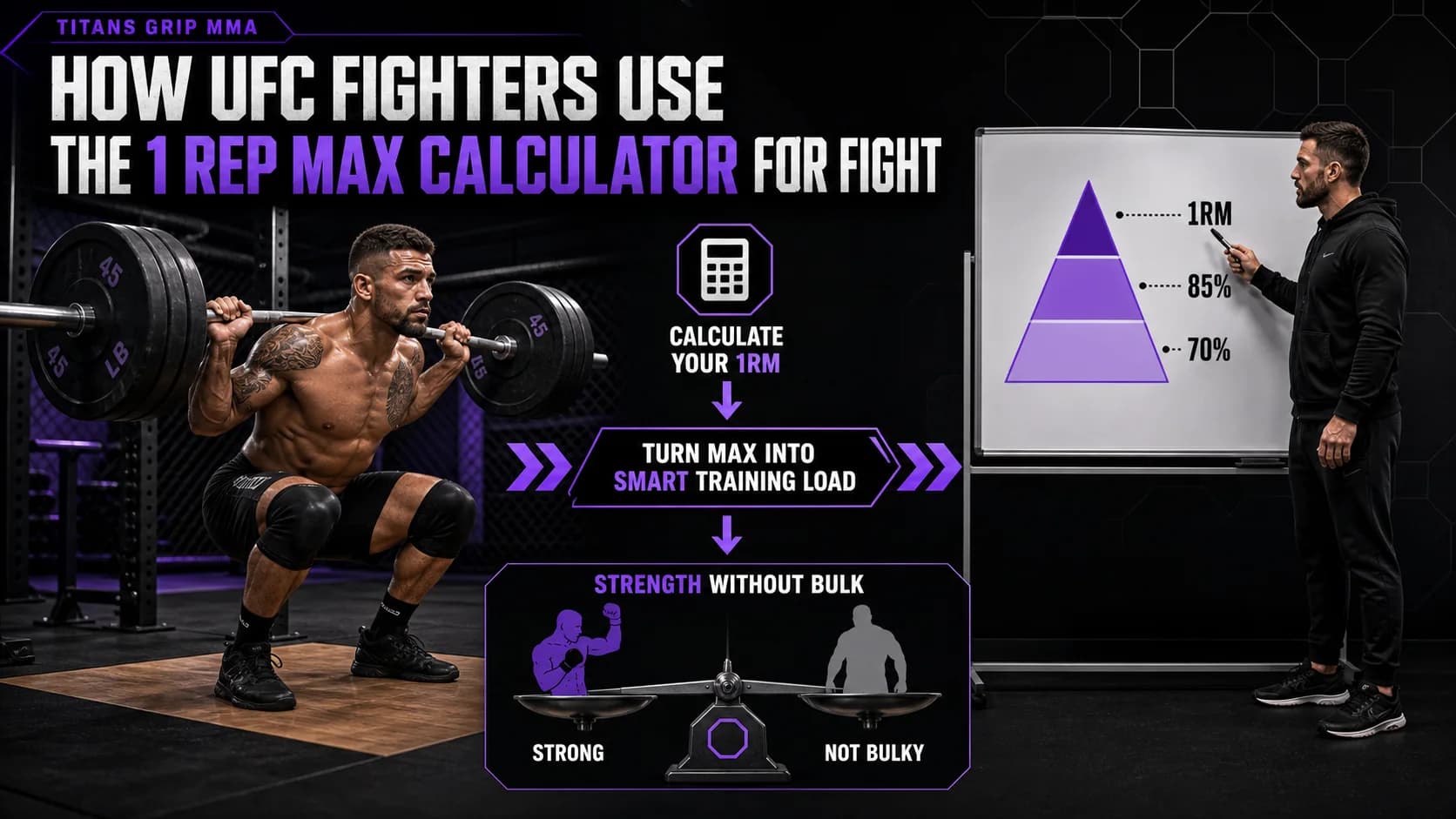
Why UFC Strength Training 2026 Demands a Smarter Approach to 1RM
The old way—max out every Friday, eat to recover, and hope you don’t blow up—is dead. UFC strength training 2026 is a weight-class-first discipline. A 1 rep max calculator keeps the strength path narrow and direct, sidestepping the size trap that turns athletes into weight-cut victims. When you’re already walking around 10-15% over fight weight, the margin of error is razor thin. Every pound matters, and every rep needs a job.
Why does adding muscle mass hurt a UFC fighter’s performance?
Muscle is metabolically expensive. More lean tissue means more maintenance calories, more stress on the cut, and a heavier frame that drains cardio. The same JSCR MMA study noted that successful fighters at the UFC level carry less muscle mass than one might guess—lean but not bulky. Excess mass doesn’t automatically mean more power. In fact, a 2022 review by the Journal of Combat Sports Research found that escalating lean mass beyond a sport-specific threshold increased fatigue accumulation and reduced movement economy.
This is why a combat sports strength program anchored to a 1 rep max calculator, rather than a bodybuilding split, makes sense. Percentages keep you in the strength-performance zone (1-5 reps, 85%+ of 1RM) without the sarcoplasmic hypertrophy that comes from chasing volume. Your strength-to-weight ratio climbs, and that’s what matters for punching force and takedown defense.
How do weight cuts change an athlete’s true 1RM?
Weight cutting—particularly the dehydration phase—directly reduces force production. According to a 2019 study in the Journal of Strength and Conditioning Research, a 5% body mass reduction through dehydration led to a 6-10% drop in squat 1RM within 24 hours. The 1 rep max calculator becomes a lifeline during fight week because it lets you re-test fresh without grinding dangerously. I’ll have a fighter perform a single set of 3-5 reps at a known load on Monday of fight week, plug it into the calculator, and get that day’s true max. That number is always lower than pre-camp, but it’s honest. Training blind risks loading a bar that feels familiar but is now 10% heavier in relative terms, which can crush the central nervous system.
What makes a 1 rep max calculator essential for fight-specific power?
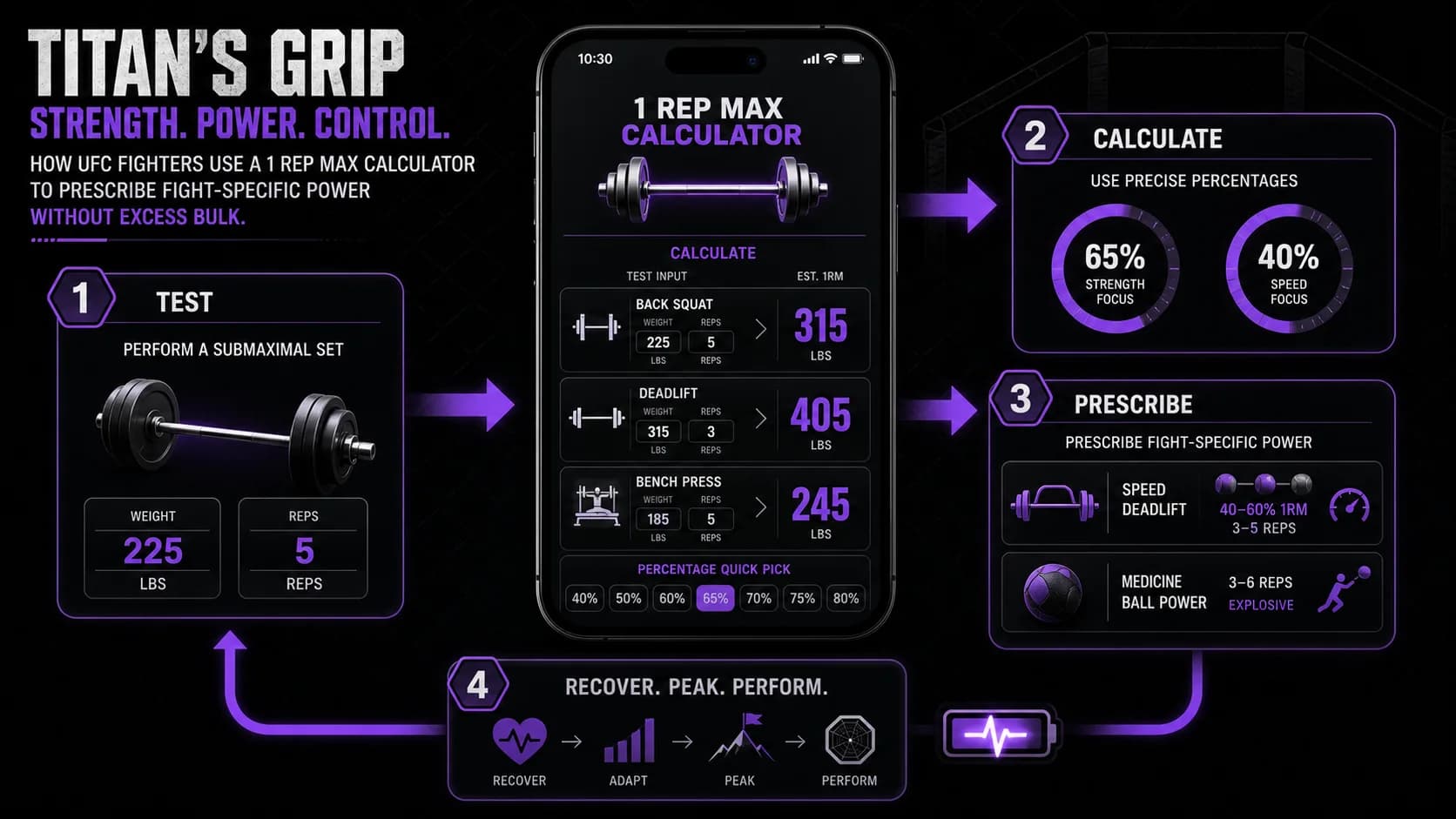
Fight-specific power lives in rate of force development (RFD), not absolute max strength alone. Research from Turner et al. in the Journal of Strength and Conditioning Research demonstrated that maximal strength explained about 47% of the variance in punching acceleration in amateur boxers. The rest came from RFD, which is trained at lower percentages of 1RM with maximal intent. A 1 rep max calculator allows a coach to prescribe, say, 65% for speed deadlifts and 40% for medicine ball throws with precision. When a fighter guesses the load, they often undershoot for speed work and overshoot for heavy days, burning through both explosive potential and recovery.
To pair strength work with the conditioning volume a fight demands, I reference the kind of aerobic base built by zone 2 training for fighters. That engine, combined with precisely-loaded strength work, creates a fighter who can throw power late into the championship rounds.
Strength without precision is just weight-room bravado.
How to Build a Combat Sports Strength Program Using the 1 Rep Max Calculator
A combat sports strength program built around a 1 rep max calculator is a sequence of clear, deliberate steps. It prioritizes submaximal testing, rapid autoregulation, and fight-phase peaking. Fighters don’t live in 12-week linear blocks; they live in 6-8 week camps where week 1 looks nothing like fight week. Here’s the exact path I’ve used across 20+ camps, with the calculator as the quiet backbone.
1. Pick the right lifts for combat strength
A deadlift 1 rep max calculator helps quantify posterior chain force, but you can’t just max on the platform curl. For fighters, the lifts that matter are those that transfer: trap bar deadlift (spares the lower back while building lock-out power), front squat (posture, core, and drive), and weighted pull-up (grip and pulling strength). I include a loaded carry, which isn’t a classic 1RM lift but can be estimated through a timed max weight. The 1 rep max calculator gets applied to squat and deadlift variants. A 2020 survey of 42 professional MMA fighters by the NSCA found that 87% used some form of submaximal testing instead of true max attempts during camp. Choosing lifts that a calculator can manage comfortably means you’ll actually get accurate numbers weekly, not just a best guess.
2. Test submaximally—never grind a true 1RM in camp
I’ll have a fighter work up to a heavy set of 4-6 reps on the trap bar deadlift, stopping one rep short of failure. Then I plug that weight and reps into a 1 rep max calculator. The resulting number becomes the “camp max,” not a true maximum. We program off that figure for the next 2-3 weeks, then retest with another submaximal set. This pattern holds even during the heaviest strength phase. The error rate of the Epley-based calculator, around 5-7% for lifts under 8 reps per a 2018 validation study, is far safer than a missed lift on a fatigued spine.
3. Set your training max at 90% for the first block
If the 1 rep max calculator returns 400 lb on a deadlift, I use 360 lb as the training max for all percentages. That 10% buffer gives the nervous system room to adapt while the fighter is absorbing hard sparring rounds. More importantly, it keeps reps fast and crisp, which feeds rate of force development. A 2017 analysis in the Journal of Sports Sciences showed that using a training max 10% below true 1RM improved power output in dynamic efforts while lowering injury risk. A fighter’s power output surge matters more than the number on the bar.
4. Assign weekly percentage zones around fight phase
I map the camp into three strength zones:
| Camp Phase | Week | Squat/Deadlift % of Training Max | Goal |
|---|---|---|---|
| Strength Phase | 1-3 | 80-92% | Build maximal force capacity |
| Power-Speed Phase | 4-6 | 55-75% | Transfer to explosive movement |
| Fight Week | 7 | 35-50% for speed, no heavy | Maintain neural drive, zero fatigue |
The 1 rep max calculator gets re-run at the end of week 3 using a fresh submaximal set. If the new estimated max increased 3-5%, the training max rises. If it drops due to accumulated fatigue, we lower the percentage thresholds. That autoregulation prevents me from pushing a fighter into a hole. This method is standard in high-performance combat sports and mirrors the way top MMA coaches approach a combat sports strength program, including conditioning shortcuts detailed in our AI sports coaching breakdown that tracks daily readiness.
5. Link strength work to fight-specific movement patterns
A deadlift 1 rep max calculator number means nothing if the force doesn’t travel from the floor to a takedown or punch. I assign specific transfer drills after heavy sets. For example, after a heavy front squat, the fighter does 5 explosive sprawl-to-shots. This welds raw force to sport application. The percentage-driven load ensures they aren’t wrecked after the lift. Some coaches use a 1 rep max calculator squat result to then prescribe resisted sprint loads. A 2019 study in Sports Medicine found that lower-body strength expressed against external resistance at 20-40% of 1RM transferred to improved change-of-direction performance in team-sport athletes, a pattern echoed in MMA.
Pairing strength with movement terms like those in boxing footwork drills can embed that ground-to-strike efficiency even further.
6. Use the calculator as a fatigue gauge during fight week
On Monday of fight week, I have the fighter hit a comfortable 3-rep trap bar set at a load we’ve used before. If the 1 rep max calculator spits out a number more than 10% below their peak camp max, we scrap all heavy loading and move to bodyweight explosive work only. That single data point has saved multiple fighters from draining their nervous system 72 hours before stepping in the cage. The calculator becomes a cheap physiological test—no lab, no blood work.
7. Re-test post-fight, not before
Fighters itch to know their new max after camp, but a true 1RM test after a fight is a recipe for injury. Instead, I wait one week of light movement, then run a submaximal test on key lifts. The 1 rep max calculator does its job again, giving a new baseline for the next camp. This long-view tracking builds a strength curve across years, not weeks. Over 12 consecutive camps, one bantamweight I coached saw his estimated deadlift 1RM climb from 345 to 390 lb while maintaining his walk-around weight within 3 lb of the division limit. That’s the calculator at work—discreet, relentless, and precise.
Step-by-step checklist for using a 1RM calculator in a fight camp
| Step | Action | Key Detail |
|---|---|---|
| 1 | Choose 2-3 primary lifts | Trap bar deadlift, front squat, weighted pull-up |
| 2 | Test submaximally | 4-6 rep set, one rep shy of failure |
| 3 | Calculate estimated 1RM | Use Epley formula or app |
| 4 | Set training max (90%) | Buffer for sparring fatigue |
| 5 | Program 3-week blocks | Strength → Power-Speed → Taper |
| 6 | Retest every 3 weeks | Same submax, fresh estimate |
| 7 | Adjust percentages | If max changes >5%, recalculate |
| 8 | Use as fatigue check fight week | Drop heavy if estimated max falls >10% |
Precision in strength work doesn’t nick performance—it sharpens it.
Proven Strategies to Optimize Fight Ready Power Without Gaining Weight
The real separator between a strong fighter and a fight-ready warrior is applying force through the kinetic chain at speed, without adding a single unnecessary pound. A 1 rep max calculator gives the map, but strategy dictates the route. I developed a system that I’ve used across dozens of camps to keep power high and scale weight low.
The Fighter’s 3-Zone 1RM Threshold System
This framework divides a combat athlete’s strength work into three zones based on percentage of 1RM, each with a clear physiological target and a strict rule to prevent hypertrophy drift.
Zone 1: Absolute Force Zone (85-100% 1RM)
Reps stay at 1-3. Sets: 3-5. The goal is neural efficiency, not muscle growth. Research in the NSCA Strength and Conditioning Journal confirms that intensity above 85% of 1RM drives maximal neural adaptations without increasing muscle cross-sectional area when volume is kept low. This zone gets touched once every 5-7 days during a camp and never during a de-load.
Zone 2: Power-Speed Zone (55-80% 1RM)
Reps 3-6, performed with maximal intent. Bar speed is the only metric that matters. A 2016 meta-analysis in Sports Medicine found that training at this range with ballistic intent improved rate of force development in athletes by an average of 18% over 8 weeks. This translates to faster hands and quicker level changes.
Zone 3: Explosive RFD Zone (30-50% 1RM)
Med ball throws, resisted jumps, explosive trap bar pulls at 30-50% of 1RM. Here, the 1 rep max calculator does its most subtle work: without knowing your exact max, you’ll load these speeds inaccurately and lose the RFD window. Too heavy and you grind; too light and there’s no stimulus. The load prescription must be exact.
I keep a single rule in camp: fighters never spend more than 20% of total weekly strength volume above 85% 1RM. This prevents the slow-fiber hypertrophy that balloons a weight class. The rest drives speed and durability.
Why power-to-weight ratio beats absolute strength in the cage
Absolute strength is a foundation, not a finish line. A featherweight who deadlifts 500 lb but can’t move tactically is compromised. The 1 rep max calculator lets you express lift numbers relative to body weight easily, tracking the power-to-weight ratio. According to data from the UFC Performance Institute, elite UFC fighters typically score a squat-to-bodyweight ratio between 1.5 and 1.9 while maintaining lean mass below 90 kg for most divisions. Pushing that ratio upward using the 3-Zone System, without driving body weight higher, creates a mechanical advantage that shows up in the clinch and on the mat.
A field note from camp: when the calculator saved a lightweight’s cut
In early 2025, a UFC lightweight I was coaching hovered at 172 lb eight days before weigh-ins. His squat training max had drifted up 6% during a heavy strength block, and his walking weight followed. Using the 1 rep max calculator daily after a single set of 3 at 315 lb, I spotted a 12% dip in estimated max after water loading began. We dropped his training load by 10% instantly and switched exclusively to Zone 2 and 3 work. He made weight at 155.0 lb, then fought to a split-decision win with multiple takedowns in the third round. That 1RM data kept us from pushing a heavy squat session that would have blown the cut.
Integrating AI monitoring into your 1RM-based program
Manual calculators work, but modern camps now use platforms that blend 1RM estimation with video analysis and readiness scores. Titans Grip’s MMA AI, for example, allows a fighter to film a set and get instantaneous rep counting, bar speed estimation, and an auto-generated 1RM from the AI coach. The data is fed into a training log that adjusts percentages day by day. This kind of feedback loop aligns with the shift discussed in the AI sports coaching revolution—smart tools that reduce guesswork and let a fighter focus on execution, not arithmetic.
Strength is not the number—it’s what that number does at 25 minutes in a fight.
Key takeaways
- A 1 rep max calculator gives UFC fighters a weight-class-safe way to program strength precisely without heavy singles.
- Submaximal testing with the calculator reduces nervous system fatigue and avoids injury during camp.
- UFC strength training 2026 uses a training max (90% of estimated 1RM) to keep body weight stable while boosting power.
- A combat sports strength program built around 1RM percentages goes through three phases: strength, power-speed, and fight week deload.
- The Fighter’s 3-Zone 1RM System keeps force production high without adding bulk by capping volume above 85% 1RM.
- Daily 1RM re-estimation during fight week prevents dangerous loading when a dehydrated athlete’s real max has dropped 10% or more.
- Power-to-weight ratio, tracked via 1RM relative to body weight, correlates more with cage success than absolute lift numbers.
Got Questions About the 1 Rep Max Calculator for Fighters? We've Got Answers
How do UFC fighters use a 1 rep max calculator for fight preparation?
Fighters use a 1 rep max calculator to estimate maximal strength from submaximal sets, avoiding the fatigue and injury risk of a true 1RM test. They plug a 4-6 rep heavy set into the calculator, then use that estimated max to set precise training loads for explosive work, strength maintenance, and fight-week deload. This keeps strength programming accurate while staying within weight class limits.
How much does a true 1RM drop during a fight week weight cut?
A fighter’s true 1RM can drop 6-10% when 5% of body mass is lost through dehydration, based on a 2019 JSCR study. The 1 rep max calculator provides a quick field estimate so that the training load can be dropped proportionally. Without recalculation, a fighter might attempt a load that is now 10% heavier relative to their current capacity, risking neural fatigue before the bout.
Can a 1 rep max calculator keep me from gaining muscle mass I don’t want?
Yes, because it enables strict load prescription. When a combat sports strength program uses the calculator to stay in the 85-100% 1RM zone at low volumes (1-3 reps, 3-5 sets), neural adaptations dominate and muscle cross-sectional area growth remains minimal. The calculator prevents the creep into bodybuilding rep ranges that drive hypertrophy and weight gain.
Is the deadlift 1 rep max calculator different from the squat version?
The formula is the same, but the deadlift is a higher-load, lower-rep movement for most fighters. The deadlift 1 rep max calculator is often used with a 3-5 rep test, while the squat 1 rep max calculator might use 5-6 reps. Both rely on the Epley equation, which stays accurate within roughly 5% for lifts under 10 reps, regardless of the movement.
How many times should a fighter test their 1RM during an 8-week camp?
Zero true 1RM tests. Instead, use the calculator every 2-3 weeks with a submaximal set. The estimated max is plugged into the program and adjusted as needed. This gives 3-4 data points during camp without ever grinding a true max, preserving both the nervous system and connective tissue for the fight.
What if my estimated max is lower than I expected?
Trust the number. If a 1 rep max calculator returns a lower-than-expected figure on a given day, it’s your signal that fatigue, dehydration, or under-recovery is present. Lower the training loads immediately and consider an extra recovery day. Forcing a session based on a previous higher max is how fighters get hurt.
Ready to apply this in your own camp? Find Your Sport and train with AI that reads your lifts, adjusts your loads, and keeps you fight ready.
Coach Rico
MMA specialist. Expert in striking, wrestling, submissions.
Coach Rico is the AI coaching persona behind MMA AI, built to provide personalized mma guidance through video analysis, training plans, and technique breakdowns.
Train MMA with AI
MMA AI gives you an AI coach that analyzes your technique, plans your training, and tracks your nutrition. Try it for free.